Published: 27 August 2026. The English Chronicle Desk. The English Chronicle Online
Professors at Belgium’s Ghent University had raised serious concerns about Nathan Cofnas’s suitability for an academic research position months before he became embroiled in allegations of plagiarism against Cambridge sociology professor Jason Arday, according to documents seen by the Guardian.
The academics questioned whether Cofnas had sufficient expertise for a postdoctoral role examining the future of liberalism and warned university leaders that his appointment could have a negative impact on the institution.
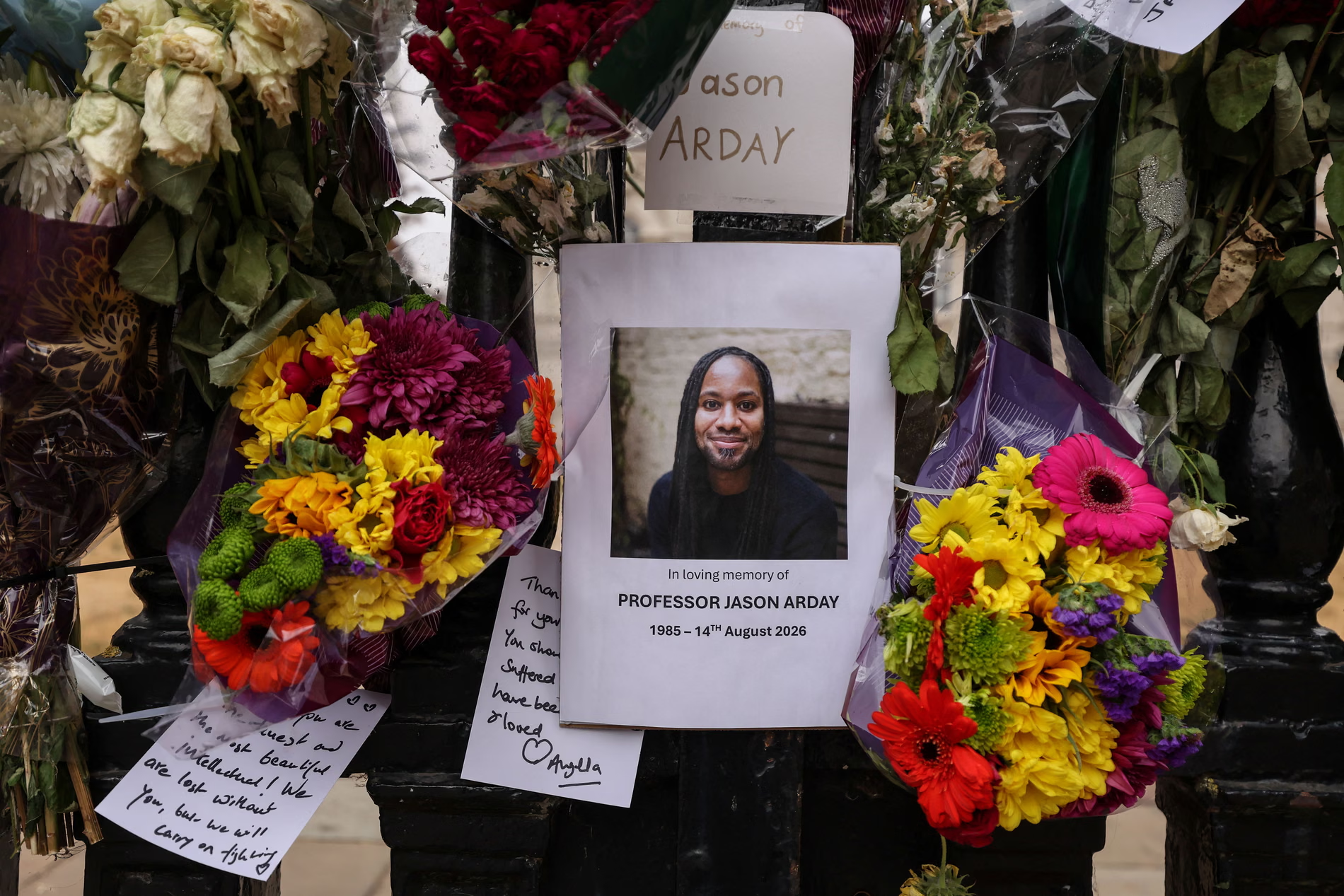
The concerns have gained renewed attention following Arday’s death on 14 August, after weeks of intense public scrutiny surrounding allegations made against him by Cofnas. The plagiarism allegations against Arday have not been formally proven.
Cofnas, who secured the Ghent postdoctoral position in March, had previously attracted controversy because of his writings and online activity concerning race, intelligence and political ideology. Academics at Ghent subsequently questioned both his academic qualifications for the specific project and the nature of some of the views he had promoted publicly.

In a 19-page statement submitted to university officials in May, Ghent’s department of philosophy and moral sciences argued that it was “improbable” Cofnas had been the strongest candidate among the 14 applicants for the position.
The department said it had identified what it described as “very limited expertise” in areas central to the research project, including political philosophy, liberalism and demography.
It also questioned whether the requirement for a “strong research interest in liberalism”, included in the job advertisement, was supported by Cofnas’s academic publication record or wider CV.
The statement was approved by the department’s council as its official position before being submitted to Ghent’s rector and faculty dean.
Academics also raised concerns about transparency surrounding the appointment. They said a large majority of those involved suspected the decision could have been an ideological choice and that the successful candidate may effectively have been selected in advance.
The criticism was not limited to senior academics.
An email sent to university leaders and governors in March reportedly carried the signatures of 48 department staff, 73 students and 367 academics from Ghent and other universities. Those signatories expressed what they described as “astonishment and indignation” over Cofnas’s appointment.
The university has declined to discuss the specific details of the case.
A spokesperson said Ghent University did not comment on the particular disciplinary matter or the arguments underlying it.
The controversy surrounding Cofnas has become particularly sensitive because of his public writings about race and intelligence.
According to the material cited by the Guardian, his online activity has included claims about alleged differences between racial and ethnic groups. In a 2023 post on X, he wrote about supposed personality differences between Jews and non-Jews and made a claim about average intelligence.
Critics have described some of his arguments as pseudoscientific and accused him of promoting ideas associated with racial hierarchy.
Ghent academics specifically challenged whether such views were grounded in his own scientific research.
In their May statement, they said Cofnas had never conducted research on intelligence and that such research was not part of the project for which he had been employed.
They further argued that views expressed in his blog posts were not based on his own scientific research and did not rest on sound research.
The debate raises difficult questions about the boundary between academic freedom and professional responsibility.
Universities generally protect the freedom of researchers to investigate controversial subjects and express unpopular arguments. At the same time, academic institutions are expected to maintain standards concerning research quality, professional conduct and the treatment of colleagues.
Ghent University itself referred to this balance when it announced last week that Cofnas had been suspended pending a preliminary investigation.
The university’s rector, Petra De Sutter, and vice-rector, Herwig Reynaert, said academic freedom and open debate were important principles but stressed that such freedom was not unlimited.
They said freedom of expression carried responsibilities and could be restricted when necessary to protect the rights of others.
The university described Cofnas’s recent public statements as a serious matter and said it had taken appropriate action within its powers and the applicable framework.
It has not publicly established what specific allegations led to his suspension, nor has it said whether the disciplinary action relates directly to concerns about his appointment.
The developments have unfolded alongside the controversy involving Arday, whose academic career and reputation came under intense scrutiny following Cofnas’s allegations.
Arday, a sociology professor at the University of Cambridge, was found dead earlier this month. His death came after weeks in which questions about his professional record, including claims of plagiarism, had generated extensive media and online attention.
Arday acknowledged that there had been mistakes in his academic work but rejected what he described as unacceptable cruelty directed towards him.
His supporters have strongly criticised the manner in which the allegations were pursued publicly, describing the episode as a racially charged campaign.
The circumstances have prompted renewed discussion about the responsibilities of academics who make serious allegations against colleagues and the standards that should govern public accusations of research misconduct.
Cofnas’s own history of commentary has also become part of that debate.
In an April 2023 Substack article titled “How to take back academia”, he discussed ways to remove academics whom he characterised as “wokesters”, arguing that their qualifications or professional standards could be challenged.
Critics have pointed to that writing as evidence that his academic and political activities extend beyond conventional scholarly disagreement.
Cofnas, however, has rejected the criticism surrounding his appointment.
Responding to questions about his qualifications, he said his academic credentials were publicly available.
He also rejected the accusation that he was uninterested in academic debate, arguing that those opposing him were attempting to have him dismissed or even prosecuted because of his views.
The disagreement illustrates the highly polarised environment in which debates about race, intelligence, ideology and academic freedom are increasingly taking place.
For universities, the issue is particularly complicated because controversial ideas cannot automatically be treated as grounds for exclusion. Academic freedom depends in part on institutions allowing researchers to explore disputed questions and challenge prevailing assumptions.
But critics of Cofnas argue that freedom of inquiry does not remove the need for relevant expertise, methodological rigour or professional conduct.
That distinction was central to the Ghent philosophy department’s objections. Its concerns were not presented simply as opposition to controversial opinions but also as questions about whether Cofnas’s research background matched the stated purpose of the postdoctoral project.
The timing of those concerns is also significant.
The department raised them shortly after Cofnas secured the position, well before his later public dispute with Arday became a major controversy. This means the concerns about his appointment were not apparently prompted by the subsequent plagiarism allegations.
Instead, academics had already questioned his qualifications, research interests and potential influence within the university.
The episode has now placed additional scrutiny on how academic appointments are made and how universities respond when substantial objections are raised internally.
For Ghent University, the immediate issue is its preliminary investigation and the questions surrounding Cofnas’s conduct. For the wider academic community, the controversy is likely to fuel continuing arguments over academic freedom, ideological disagreement and the standards applied when researchers make claims about race, intelligence and professional misconduct.
The case also demonstrates how disputes within academia can quickly move beyond university campuses. Once allegations and academic arguments enter social media, they can reach enormous audiences and expose researchers to intense public criticism.

The death of Arday has made those consequences particularly stark.
His supporters have raised more than £224,000 through a fund established by cultural historian Sir Patrick Vernon to support his grieving family. His family has said it was deeply moved by the response and by the number of people who had been touched by Arday’s life and work.
As Ghent University continues its investigation, many of the questions surrounding Cofnas remain unresolved. His academic qualifications, the circumstances of his appointment and the precise reasons for his suspension will remain matters for institutional review.
What is already clear is that concerns about his appointment had been formally raised within Ghent months before the dispute with Arday intensified.
The documents therefore add another dimension to a controversy that has brought academic standards, freedom of expression, race and professional accountability into sharp focus.
Related News:
 Canadian astronaut French words ease language row
 UK Fighter Jet Purchase Could Breach Nuclear Treaty, Warns CND
 Russia repeatedly targets UK military satellites, warns Space Command chief
 UK Universities Warn Students Ahead of 7 October Pro-Palestine Protests
 Moldova River Crisis Exposes War’s Hidden Cost
 NHS Safety Fears as Nurses Cover Doctor Gaps
 Black Forest Tragedy Remembered 90 Years On
 Chornobyl Still at Risk 40 Years After Disaster
 Reform UK funding: mystery billionaire revealed
 RAF Typhoons scrambled amid Russian drone threat near Nato
 Father’s diaries reveal doubts over Hawking
 Farage and Reform UK Reshape British Politics
 Starmer Leadership Under Pressure After Setbacks
 Is America Ready for an AOC Presidential Run?
 Cambridge Professor Jason Arday Found Dead at Home
 Five Years of Taliban Rule Leave Afghanistan in Crisis
 UK Must Act with Courage and Clarity on Israel-Palestine Conflict, Says Foreign Affairs Committee Report
 Michele Dougherty Makes History as the UK’s First Female Astronomer Royal
 MPs Call on UK Government to Delay Biometric Visa Checks for Gaza Students Amid Humanitarian Crisis
 Radioactive Leak at UK’s Nuclear Warhead Base Sparks Outcry Over Safety and Secrecy
 Mutual Inconvenience: Why Alaska Was Chosen for the Trump-Putin Summit on Ukraine
 From ‘Skibidi’ to ‘Mouse Jiggler’: Cambridge Dictionary Expands with Modern Slang and Social Terms
 Is the UK Ready to Put Boots on the Ground in Ukraine? Assessing Military Capacity and Challenges
 Protests Expected as Israeli Arms Firms Join Global Defence Trade Fair in London
 University of Edinburgh Lecturers Launch Five-Day Strike Amid £140m Budget Cuts
 Thousands Gather in London to Protest Donald Trump’s Second UK State Visit
 Trump Urges UK to “Call Out the Military” to Secure Borders Amid State Visit
 British AI Startup Outshines Human Forecasters in Global Prediction Contest
 It Changed My View’: Campaign Encourages Pupils in Deprived Areas to Consider University
 A Third of EU Citizens in UK Report Discrimination by Public Bodies Post-Brexit
 Jailed Georgian Opposition Leaders Warn UK of Iranian Links to Ruling Party
 Public Trust in SNP Hits Historic Low Amid NHS Concerns
 Cooper Unveils £4m Cyber Plan Against Russian Hackers
 Yvette Cooper Backs Digital ID Plan for UK Teens
 Johnson Suggests Mandelson Linked to China Spy Controversy
 Witness statements reveal the CPS China spy row collapse in the UK
 Rachel Reeves signals welfare reform ahead of key budget
 Oxford Union president-elect ousted following Charlie Kirk scandal
 Reform UK candidate fined £19,000 after using AI-generated cases to challenge election
 The debate over England’s compulsory reading test for 13-year-olds
 Kosovo agrees to host Britain’s refused asylum seekers
 Experts Warn Russia’s Burevestnik Missile Could Destabilise Arms Control
 British Woman in Iran ‘Losing Hope’ Amid Ongoing Detention
 Johnson Approved China’s London ‘Super-Embassy’ in 2018
 BBC Journalist Held and Interrogated in Vietnam
 UK University Suspends Human Rights Research Following Pressure from China
 UK University Faces Counter-Terror Probe Over China Pressure
 Top Christmas Books Reads: Classics to Cozy Romcoms
 Britain deploys RAF specialists to assist Belgium with drone threats
 Government urges schools to ban phones to curb classroom disruption
 England’s Special Needs Support Faces Breaking Point
 Barron Trump police call heard in London assault trial
 Trump Pulls Canada from His Controversial ‘Board of Peace’ Plan
 Starmer Condemns ‘Depraved’ Russian Strikes on Ukraine
 Trump Tariffs Threat Spark UK and EU Alarm
 Student Loan Crisis Sparks Outrage Among Graduates in England
 Gordon Brown urges court for crimes against children
 UK Minister Denies Iran Missile Threat to Britain
 Teen Admits Filming Westfield Chair Prank
 Army Probes Apache Flyover at Kid Rock’s Nashville Estate
 Relationship with Trump may be beyond repair, Starmer warned
 Kezia Dugdale Warns of Possible Reversal of Equal Rights Gains
 City & Guilds Sale Sparks Fees and Pay Uproar
 UK Stands Firm on Falklands Amid US Rift
 Older Than Dinosaurs: Secrets of Mayfly Dance Revealed
 John Terry Faces Backlash Over Political Posts
 Germany to Return Rare Irritator Dinosaur Skull to Brazil
 US ‘Narco Boat’ Strikes Draw Global Outcry
 Barrister Criticises Trial After Suicide Case Verdict
 Immigration Judges Fear Pressure in Trump Era
 Tech Trends and the Battle Against Exam Hall Cheating
 UK Ministers Lobby Trump Over Under-16s Social Media Ban
 British Teens in EU Face Soaring UK University Fees
 New South Wales Premier Chris Minns Signals Tough Road Ahead for Labor
 Le Pen’s Popularity Holds Despite Conviction
 UK Schools Struggle as Classrooms Top 40C
 Westminster Council Threatens Charing Cross Soup Kitchen
 BBC Warned About Missing Clothes of Murder Victim
 Burnham unveils £65m drought aid for farmers
 Former Diplomats Urge UK and France to Act on Palestine