Published: 07 October 2026. The English Chronicle Desk. The English Chronicle Online
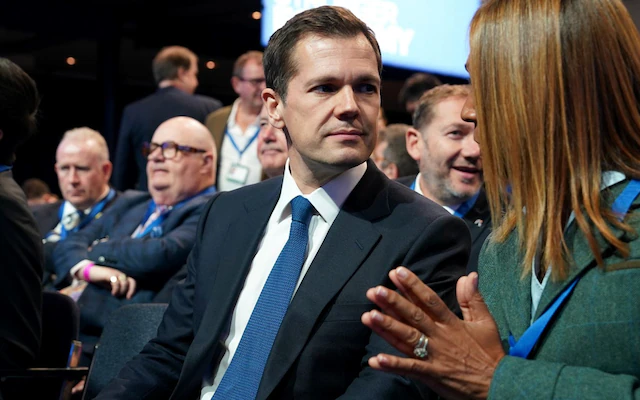
Robert Jenrick may no longer have a seat among Conservative MPs, but his departure from the party continues to cast a long shadow over the Conservatives’ annual conference in Birmingham. The former Tory leadership contender, who later defected to Reform UK, has become the subject of jokes, criticism and open political schadenfreude among Conservative members and senior figures gathered for the event.
Jenrick, who unsuccessfully challenged Kemi Badenoch for the Conservative leadership, left the party several months after losing the contest. His move to Reform UK transformed him from a prominent Conservative figure into one of the most frequently cited examples of internal division and political defection within the party.
At this year’s Conservative conference, the lingering resentment towards him has been turned into something considerably more theatrical. A huge satirical tapestry displayed at the heart of the conference venue in Birmingham portrays the political events of the past two years from a distinctly Conservative perspective. Among its many caricatures is a deliberately unflattering depiction of Jenrick, presenting him as a defeated and ultimately banished figure.

The 27-metre-long woven artwork has attracted crowds of Conservative members keen to see how the party has chosen to portray its recent political history. Badenoch is depicted as a triumphant warrior, while Jenrick appears in several scenes designed to ridicule his leadership defeat and subsequent departure.
In one section, the former leadership candidate is shown as a tiny, distressed figure watching supporters celebrate Badenoch’s victory. Another scene carries the dramatic caption “Expelleth the Turncoat”, showing an enlarged Badenoch apparently banishing her former colleague. Nearby is a photocopier, referencing the reported discovery of Jenrick’s resignation letter.
For Conservative members, the artwork has provided an opportunity to turn a difficult episode in the party’s recent history into political comedy. One attendee described Jenrick as having become little more than a “figure of fun”, suggesting that his departure had diminished his standing among Conservatives who once viewed him as an important future leader.
The bitterness is particularly striking because Jenrick was once regarded as one of the party’s rising stars. He served in government and became a prominent voice on immigration and other contentious political issues. His leadership campaign positioned him as a serious alternative to Badenoch, and his defeat did not initially suggest that he would soon leave the party altogether.
However, relations deteriorated rapidly. Badenoch ultimately removed him from the Conservative parliamentary ranks after learning that he was preparing to defect to Reform UK. The move was followed by a highly public political break, with Jenrick subsequently taking on a prominent role as Reform’s economy spokesperson.
Since joining Reform, Jenrick has remained highly visible. He has frequently used social media to promote his political arguments and to draw attention to issues including crime, fare evasion and shoplifting. His energetic online presence has made him one of Reform’s more recognisable figures, but among Conservative colleagues it is often viewed with irritation rather than admiration.
Some Conservatives who previously supported Jenrick have expressed particular disappointment over his conduct after the leadership contest. One former supporter said he had felt betrayed by what he regarded as efforts to undermine the party leadership after Jenrick failed to secure the top position.
The criticism has extended well beyond ordinary party members. Conservative figures attending conference events have spoken openly about Jenrick, sometimes with strikingly personal language. One senior Tory reportedly compared missing him to missing a painful dental problem, illustrating the depth of hostility that appears to have developed towards the former colleague.
Other Conservatives have suggested that Jenrick’s departure has actually helped the party become more cohesive. His decision to defect, along with the departures of several other Conservative MPs, has allowed Badenoch and her supporters to present the remaining parliamentary party as more disciplined and united.
The language used by senior Conservatives reflects how decisively the relationship has broken down. Members of Badenoch’s team have previously described the defectors in highly derogatory terms, while the Conservative leader has made clear that those who left for Reform should not expect an invitation to return.
Badenoch has even credited Reform leader Nigel Farage with effectively carrying out what she described as the “spring cleaning” of the Conservative Party. The remark underlines the extent to which the Conservatives now regard the defections as a process that removed internal opponents and left behind a more unified political organisation.
The rejection of Jenrick was reinforced at a fringe conference event involving Conservative shadow cabinet figures. When deputy leader Alex Burghart was asked whether the party would consider welcoming Jenrick or any of the other former Conservative MPs who defected back into its ranks, his response was emphatic. He rejected the prospect of bringing any of them back.
That stance reflects a broader strategic calculation. The Conservatives are attempting to rebuild their political identity while competing directly with Reform UK for voters on the right of British politics. Former Conservative MPs who have crossed the floor therefore carry an unusual significance. Their decisions are not simply personal career choices; they are also symbols of the struggle over the future direction of the British right.
Jenrick’s new position makes the issue particularly sensitive. As a Reform spokesperson on the economy, he is now helping a rival party challenge the Conservatives on one of the central issues facing British voters. His criticism of his former party has also continued, including accusations that Conservatives are adopting policies previously associated with Reform.
That has ensured that the political separation remains visible even though Jenrick is no longer physically present among Conservative MPs.
The Birmingham tapestry therefore serves two purposes. On the surface, it is a piece of conference entertainment, offering members a humorous retelling of recent political events. Beneath the jokes, however, it reflects genuine tensions within a party that has experienced leadership changes, defections and an increasingly direct electoral challenge from Reform.
The mockery also demonstrates how quickly political fortunes can change. Jenrick once stood as a candidate for the Conservative leadership and was considered by supporters to have a significant future within the party. Today, his former colleagues are laughing at his caricature and publicly insisting that they have moved on.
Aphra Brandreth, the shadow undersecretary for environment, food and rural affairs, offered perhaps the most carefully restrained assessment. She said she did not spend time thinking about Jenrick and that he had gone and the party had moved forward.

Yet the prominence given to Jenrick at the conference suggests that the issue has not disappeared entirely. His image woven into a giant political tapestry, the repeated references from Conservative figures and the enthusiasm with which members discuss his departure all indicate that the former colleague remains useful as a symbol of a political rupture the Conservatives have yet to forget.
For Jenrick, meanwhile, the conference presents an opportunity to observe his former party from across the political divide. Reform UK is seeking to strengthen its position as a major force in British politics, while the Conservatives are attempting to recover ground and re-establish themselves as the principal party of the political right.
The hostility on display in Birmingham is therefore more than a personal feud. It represents a wider battle over political loyalty, leadership and the future direction of British conservatism. For now, Conservative members appear happy to turn their former colleague into the villain of their own political story, while Jenrick continues his career on the other side of the political divide.
Related News:
 Green Party Surges Past Labour in Latest UK Poll
 Trump’s UK Ambassador Urges North Sea Drilling to Strengthen US Ties
 French Taxi Driver Cleared in David Lammy Theft Case After Fare Dispute
 Millionaires group urge Reeves to introduce wealth tax to ‘lift kids out of poverty’
 Starmer Faces Growing Dissent as Labour MPs Weigh Leadership Challenge
 Reeves rejects £1bn plea for NHS redundancy payouts
 PM Condemns Leaks, Vows Loyalty to Ministers and Stability
 Major Rent Reform Ends No-Fault Evictions in England
 Peers Flood Assisted Dying Bill with 942 Amendments
 Most Tories Expect to Support a Farage-Led Government
 Starmer Says Labour’s Economic Plan Needs Years to Deliver
 Culture secretary to review Telegraph takeover by Daily Mail owner
 Labour Blocks Burnham as Party Rift Deepens Ahead of Polls
 Huge mistake: Labour blocks Burnham from byelection bid
 Artificial intelligence will cost jobs, admits Liz Kendall
 Labour targets Greens on drugs in Gorton Denton byelection
 Greens nominate Hannah Spencer for Gorton and Denton byelection
 Mandelson Faces Police Inquiry Over Epstein Leak
 Labour Thinktank Row Deepens Over Journalist Probe Claims
 Morgan McSweeney downfall shocks Labour leadership
 Cabinet Secretary Shake-Up Triggers Due Diligence Warning
 Starmer Faces Inquiry Calls Over Thinktank Probe
 Royal Mail Delivery Crisis Deepens Amid Weather Chaos
 UK shelves £110m border project amid trade strain
 Farage Unveils Reform UK Frontbench Team
 California Democrats Vow Trump Reckoning
 Trump Tariffs Threat Spark UK and EU Alarm
 Wales Approves Assisted Dying Bill Consent
 UK EU Trade Reset Gains Public Backing
 Green Party Stuns Labour in Gorton and Denton Byelection
 Corbyn Leads Your Party in Coordinated Left-Flank Strategy
 Labour Together scandal sparks clean break vow
 Asylum Seekers to Work After Year-Long Wait
 Starmer Row as Greens Demand Apology
 Proposed Law Leaves Gap for Children of Convicted Paedophiles
 Gordon Brown urges court for crimes against children
 Starmer Praised for Stance on Trump and Iran Conflict
 Inquiry into HMRC child benefit errors launched by NAO
 NHS Plans to Cut Overseas Workers Labeled Overambitious
 Farage Faces Backlash Over Crypto Cameo Endorsements
 Army Probes Apache Flyover at Kid Rock’s Nashville Estate
 Relationship with Trump may be beyond repair, Starmer warned
 Unions Raise Concerns Over Doctors’ Pay Dispute
 UK Government Poised to Revive Stalled Hillsborough Law
 UK Stands Firm on Falklands Amid US Rift
 Welsh Labour Faces Potential Historic Election Defeat
 Starmer Survives Mandelson Rebellion
 Silent Tracks: Rail Line Without Passengers
 Major test for Labour as polls open in Great Britain
 Reform UK Faces Crisis as Newly Elected Councillors Resign
 Keir Starmer Struggles to Secure His Grip on Downing Street
 Farage Faces Standards Probe Over Cash Property Purchase
 Secret Role of UK Security Services in Troubles Amnesty Law
 Farage and Reform UK Reshape British Politics
 Minister Criticises Police Guidance Amid Southampton Protests
 Makerfield Voters Demand Real Change as Election Looms
 The Hidden Crisis Eroding Trust in British Communities
 Deepfake Abuse on X Sparks Safety Concerns for Dissidents
 Labour MP Revives Blocked Assisted Dying Bill in Commons
 Starmer Set to Announce Exit Plan as Burnham Eyes No 10
 Farage Warns Sky News Following Financial Inquiry
 Burnham Pledges New Era of Open Debate for Labour MPs
 Ann Widdecombe, Formidable Political Figure, Dies at 78
 Security Row Erupts Following Tragic Death
 Burnham unveils £65m drought aid for farmers
 Unions Warn Labour Over Zero-Hours Contract Reforms
 Former Diplomats Urge UK and France to Act on Palestine
 Bayeux Tapestry Revives Franco-British Ties
 Tom Watson Takes Senior Role at Palantir
 Mahmood Warns Far Right Over Asylum Protests
 MPs Defend UK Economic Watchdog Against Critics
 The Tests Awaiting Andy Burnham After Labour Conference
 Free Speech Emerges as Key UK Election Issue
 Burnham Opens Door to Possible UK Return to EU
 Badenoch Raises Prospect of 2027 UK Election
 Half of UK Voters Back Possible EU Return
 US bombers leave RAF Fairford after terror threat
 Tories Plan Major Overhaul of UK Environmental Rules
 Gosport Protesters Clash With Police Over Migrant Rescue
 Palace Rejects Funding Andrew’s Police Legal Challenge