Published: 07 October 2026. The English Chronicle Desk. The English Chronicle Online
France has temporarily suspended the use of stun grenades by police at high-school demonstrations after a 15-year-old protester suffered a devastating hand injury during a demonstration in the northern city of Lens, intensifying an already heated national debate over police tactics and the treatment of young protesters.
Interior Minister Laurent Nuñez announced the decision on Wednesday, saying the use of the grenades in the context of the current high-school protest movement would be halted until authorities establish exactly what happened.
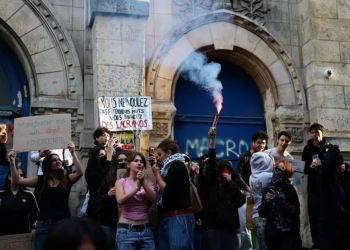
The decision follows two weeks of demonstrations that have spread across France and brought tens of thousands of pupils, parents, teachers and trade unionists onto the streets. The protests began over long-standing problems within the education system, including teacher shortages, overcrowded classrooms, deteriorating school buildings and demanding school schedules.

The scale of the unrest has increased pressure on President Emmanuel Macron’s government, which is already dealing with serious financial difficulties and growing political tensions ahead of crucial presidential elections.
The injury in Lens has become a particularly sensitive issue because of the age of the student involved. Authorities have not yet established precisely how the injury occurred. Officials are investigating whether the teenager picked up a grenade or whether he was struck by one during the confrontation.
Police said that as many as 200 protesters had been throwing objects at officers when riot police intervened. The circumstances surrounding the injury remain under investigation, however, and the interior minister said the suspension would remain in place until there was a clearer understanding of the incident.
The teenager’s mother said on Wednesday that her son’s hand had been amputated following the injury. She strongly rejected the suggestion that her son had attempted to pick up a grenade and criticised the treatment of young people during the protests.
Her comments have added to growing demands for accountability over police conduct.
The Lens incident is not the only case that has raised concerns. According to the interior minister, 18 internal police investigations have been opened into allegations of excessive or disproportionate force during the demonstrations.
Among the incidents under examination are cases in which a young protester reportedly lost several teeth and another student suffered an injury resulting in the loss of use of an eye.
The government has defended the police response, arguing that officers have been deployed to protect students and maintain public order during increasingly volatile demonstrations. Nuñez said investigations are routinely opened when allegations of disproportionate policing are made.
Human rights organisations and trade unions, however, have repeatedly accused police of using excessive force.
Amnesty International’s French organisation has also expressed concern over footage and testimony emerging from the demonstrations. Its president, Anne Savinel-Barras, said the reports raised serious questions about the use of tear gas, batons and other policing techniques.
The controversy over police tactics comes as the education protests have reached their largest scale.
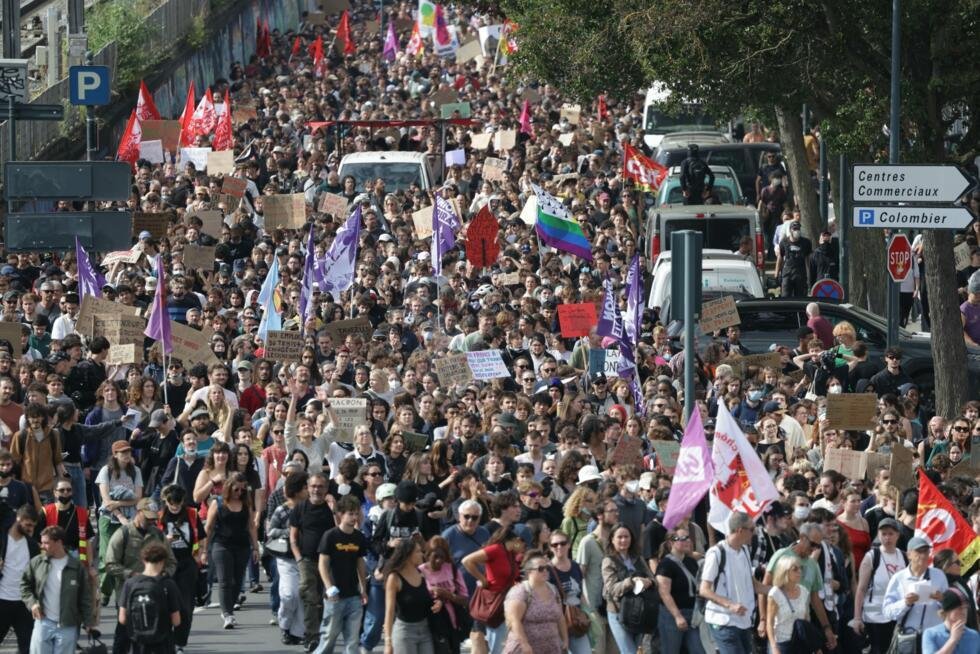
On Tuesday, at least 250,000 pupils, parents, teachers and union members were estimated to have taken part in demonstrations across France. The day represented the biggest mobilisation of the campaign so far and prompted Macron to convene an emergency cabinet meeting.
Many demonstrations remained peaceful, but several descended into clashes between protesters and police. In Paris, some marches were followed by vandalism and running confrontations with riot police. Officers used tear gas and baton charges to disperse groups during some incidents.
The protests have also involved disruption at schools. Demonstrators have blocked entrances, while some groups have burned rubbish bins, damaged public infrastructure and thrown projectiles at police.
Authorities have reported serious consequences from the unrest. Twenty-four schools have reportedly been burned or ransacked, while more than 6,500 people have been arrested since the protests began. Most of those arrested are minors.
More than 1,800 people are facing prosecution, with nearly 1,500 of those under the age of 18, according to justice ministry figures.
The education system itself has also experienced widespread disruption. On Wednesday, classes were wholly or partially suspended at 528 of France’s approximately 3,700 high schools. Although the number was significantly lower than on Tuesday, the disruption demonstrated the continuing reach of the movement.
At the heart of the protests are longstanding complaints about the condition of French schools.
Teachers and students have highlighted shortages of teaching staff, overcrowded classrooms and buildings in poor condition. Concerns have also been raised about the length and intensity of school days and the broader inequalities affecting educational opportunities across the country.
For many protesters, the demonstrations are therefore not simply about one policy decision. They reflect accumulated frustration over the state of public education and concerns that the government has failed to provide adequate resources.
The government is facing additional constraints because of France’s difficult financial position.
The country has a large budget deficit, high public debt and weak economic growth, limiting the government’s ability to respond quickly to demands for greater spending on education.
Prime Minister Sébastien Lecornu was expected to address the protests and France’s financial situation in a speech on Wednesday. He has condemned violence associated with the demonstrations while rejecting claims that the government has deliberately ordered a campaign of police repression.
The political dimension of the protests has also become increasingly prominent.
The government has accused the radical-left La France Insoumise party of encouraging or even helping to organise the demonstrations. Several members of the party have attended school blockades, leading ministers and government supporters to accuse the opposition movement of exploiting the unrest.
La France Insoumise has rejected such characterisations. Its veteran leader and presidential candidate, Jean-Luc Mélenchon, has strongly backed the students while also calling for the protests to remain non-violent.
The dispute comes only months before France is due to hold a presidential election to determine Macron’s successor. The political stakes are therefore unusually high, with education, public spending, policing and economic management all becoming part of a broader national debate.
For Macron’s government, the protests represent a difficult balancing act. Authorities must maintain public order and protect schools and police officers while also responding to legitimate concerns raised by students, parents and teachers.
The decision to suspend stun grenades reflects the growing sensitivity surrounding the police response. By temporarily withdrawing their use, the government has acknowledged the need for greater clarity about how such weapons are being deployed and the circumstances under which protesters have been injured.
At the same time, the suspension does not resolve the wider dispute over policing. Riot police continue to face confrontations during some demonstrations, and officers themselves have suffered significant injuries during the unrest.
More than 750 police officers have reportedly been injured since the protests began, highlighting the increasingly dangerous environment in which both demonstrators and law enforcement are operating.
The competing accounts have made independent investigations particularly important. Authorities must establish how individual injuries occurred while protesters and rights organisations are demanding transparency over police tactics.
The Lens teenager’s injury has become a powerful symbol of the wider confrontation because it involves a young person whose protest was linked to concerns about the education system. His mother’s description of the consequences has added an intensely personal dimension to a political dispute that has increasingly involved violence and public disorder.
The coming days are likely to determine whether the protests lose momentum or develop into a broader political movement. Much will depend on the government’s ability to address concerns over education while managing France’s financial limitations.
For students and teachers, the underlying problems remain unresolved. For police, maintaining control of demonstrations without provoking further accusations of excessive force will remain a major challenge.

The suspension of stun grenades may therefore represent only the beginning of a wider examination of policing methods during the protests.
As France confronts the continuing demonstrations, the government faces pressure from several directions at once: young people demanding better schools, police seeking protection during increasingly tense confrontations, rights groups calling for accountability and opposition parties attempting to shape the political consequences.
The immediate focus remains on the injured teenager in Lens and the investigation into how he lost his hand. But the incident has also become part of a much larger national debate about education, policing, public finances and the government’s responsibility to protect both the right to protest and the safety of those taking part.
Related News:
 French Student Protests Escalate Into Violent Clashes
 French School Protests Escalate as 400 Schools Close
 China-critical UK academics face ‘extremely heavy’ pressure from Beijing
 Hungary election: Orbán faces biggest test amid scandal
 Former ICC prosecutor condemns US sanctions
 Irish Gangland Figure Fails in Dublin Election Bid
 Exeter Approves Saudi Military Training Partnership
 Lithuania Offers to Fund Permanent US Military Base
 France Braces for Major Student Protest Mobilisation
 France Schools Protests Draw 250,000 as Police Clash
 UK University Suspends Human Rights Research Following Pressure from China
UK University Faces Counter-Terror Probe Over China Pressure
UK University Suspends Human Rights Research Following Pressure from China
UK University Faces Counter-Terror Probe Over China Pressure
 US Justice Department Files Lawsuit Against California Over Partisan Voting Maps
 Trump Deploys DHS to Charlotte in Major Arrest Operation
 Congress Approves Release of Epstein Files, Trump Expected to Sign
 Texas Governor Faces Lawsuit From CAIR
 Chinese & Japanese Boats Clash Near Disputed Islands
 Putin Meets US Envoy Amid Key Ukraine Peace Talks
 EU weighs response amid Greenland tariff crisis with Trump
 EU Says US Ties Have Suffered ‘Big Blow’ After Greenland Crisis
 UK and EU Signal Fresh Push for Defence Cooperation Talks
 Thousands Protest ICE Operations in Nationwide US Day of Action
 Sydney Protest Clash Triggers Police Probe
 Queensland Protest Laws Spark Free Speech Backlash
 Italian Town Buys Mussolini Villa to Keep Away Fascist Fans
 Report Says Pezzullo Acted ‘Recklessly’ in Dealings
 Suspected Plot Targets Pipeline Before Hungary Vote
 Canadian astronaut French words ease language row
 US Court Ruling Reshapes Voting Rights Landscape
 Cartel crackdown raises fears of fresh violence
 US states redraw maps after voting rights ruling
 Judge halts deportation of Yemeni refugees in US
 Asylum deal sparks fears over Syria deportations
 Trump warns Iran as Middle East tensions surge again
 Ceasefire Standoff Deepens in Ukraine War
 France Faces Record Presidential Crowded Race Amid Far-Right Surge
 Norway Doubles Down on Oil and Gas for Europe Energy Security
 Zelenskyy warns over Oreshnik threat as Kyiv hit
 Gunman Killed After White House Security Shootout
 Deadly Russian Air Raids Strike Across Ukraine
 Le Pen to Run for President Despite Embezzlement Conviction
 Le Pen’s Popularity Holds Despite Conviction
 Mystery Grows Over Mitch McConnell’s Health
 Pradhan Resigns Amid Protests
 Russian Missiles Intensify Pressure on Kyiv
 Ukraine Villagers Demand Answers After Deadly Arms Depot Strike
 Bayeux Tapestry Revives Franco-British Ties
 UN expert urges UK to rethink Israel policy
 AfD election surge leaves Magdeburg residents deeply uneasy
 UK plans tougher Israel stance with settlement trade ban
 Europe’s democracies face a growing far-right threat
 Miliband Rejects Chief Rabbi’s West Bank Warning
 Sweden Election Hangs on Far-Right Breakthrough
 Germany’s Far Right Surge Puts Merz Under Pressure
 Israel Accused of Undermining Palestinian Life
 Saudi Pact Raises Risk of Pakistan Entering War
 Macron and Carney deepen France-Canada ties
 US Networks Suspend Trump White House Pool Coverage
 Japan PM Backs International Criminal Court
 King Refers Jamaica Slavery Petition to Privy Council
 Irish PM Backs Coach in Israel Football Dispute
 UK Pauses Chagos Deal Amid US Opposition
 Elif Eralp Emerges as Berlin’s Next Political Force
 Russia Targets Ukraine’s Digital Economy With Strikes
 National Rally makes historic gains in French Senate
 Republican Senator Questions Trump Ad Spending
 Madrid Tent Camp Grows as Spain Housing Crisis Deepens
 Trump Ads Trigger Fight Over Taxpayer Money
 Burnham Opens Door to Possible UK Return to EU
 Drumcree Talks Falter as Legal Challenge Deepens
 UK-France Returns Deal Faces Expiry as Talks Stall
 Trump Immigration Policy Faces New Legal Tests
 Bosnia’s Young People Look Beyond Election Hope
 Germany Pledges €1bn Military Aid to Ukraine
 Latin America women fear rollback of rights
 Spain Sets Snap Election as Housing Crisis Deepens
 Ukraine claims strikes have crippled Russia’s oil refining
 Former German Intelligence Chief Arrested Over Espionage
 EU-China Talks Target Surge in Hybrid Car Imports
 Tanker Ablaze After Drone Strike Near Sochi