Published: 06 October 2026. The English Chronicle Desk. The English Chronicle Online
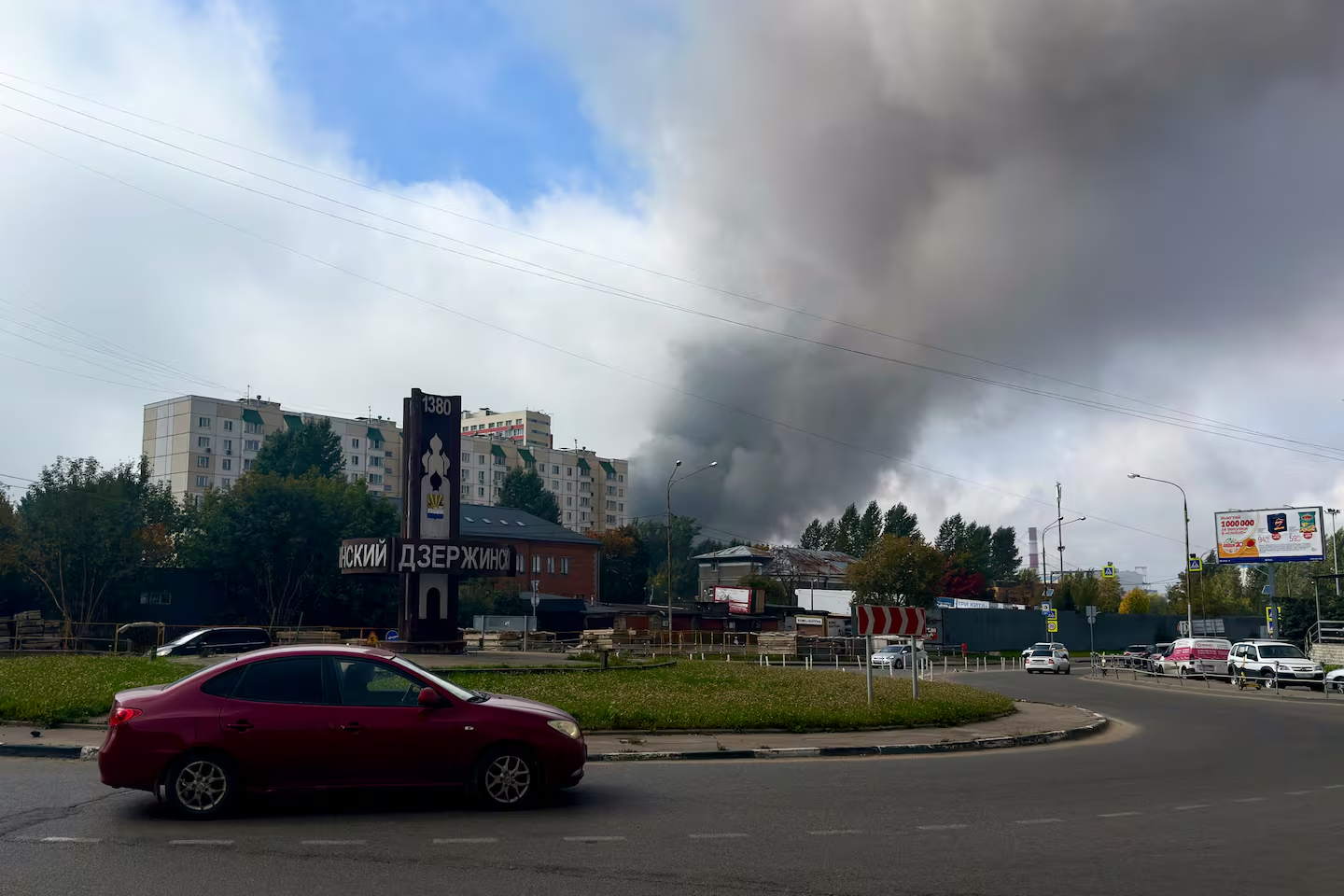
Ukraine has claimed that its long-range strikes have damaged or disabled more than half of Russia’s oil refining capacity, describing the attacks as one of the most significant blows to Moscow’s wartime economy since the full-scale invasion began. Kyiv says the sustained campaign against Russian energy infrastructure is not only disrupting fuel supplies but also increasing pressure on the Kremlin’s ability to finance and sustain its military operations.
The Ukrainian defence ministry said that 51% of Russia’s refining capacity affected by Ukrainian strikes had been taken out. The claim represents a major escalation in the economic dimension of the war, as Ukraine increasingly relies on long-range weapons and drones to target facilities far beyond the immediate front lines.
Ukrainian Defence Minister Yevhenii Khmara said the damage represented a serious challenge for Russia’s economy and its ability to supply military forces. He argued that the attacks demonstrated Kyiv’s growing capacity to bring the consequences of the war directly into Russian territory.

The Ukrainian campaign has repeatedly targeted oil refineries and other energy facilities across Russia, including locations hundreds and, in some cases, thousands of kilometres from the Ukrainian border. The attacks have contributed to disruptions in Russia’s domestic fuel market and previously prompted authorities to introduce restrictions on petrol sales in several parts of the country.
Russia has not publicly released a comprehensive assessment of the damage caused to its refining infrastructure. However, President Vladimir Putin has acknowledged that Ukrainian attacks have had a measurable economic effect. In remarks to an international foreign policy forum last week, Putin said the attacks had cost Russia approximately 1% of gross domestic product.
Putin characterised the attacks as an attempt by Ukraine to damage the Russian economy and acknowledged that the strategy had achieved at least part of its intended objective. His comments were notable because Moscow has generally sought to project resilience in the face of Ukrainian strikes and has avoided publicly providing detailed assessments of the economic consequences.
The impact on Russia’s energy sector has also become an issue in the wider international debate over fuel prices. US President Donald Trump has recently pointed to attacks on Russian refineries as a factor behind rising petrol prices, arguing that disruptions to refining capacity have become more important than earlier concerns surrounding crude oil supplies and shipping through the Strait of Hormuz.
Trump’s remarks underline the increasingly interconnected nature of the war. Although the fighting remains centred on Ukrainian territory, attacks on energy infrastructure have consequences that can extend into international markets, affecting fuel availability, transportation costs and consumer prices.
For Ukraine, the strikes are part of a broader effort to weaken Russia’s military-industrial and economic capabilities without relying solely on conventional fighting along the front. Russian refineries are strategically important because they convert crude oil into petrol, diesel and other products needed by both civilian and military users. Sustained disruption can therefore place pressure on logistics and increase the cost of maintaining military operations.
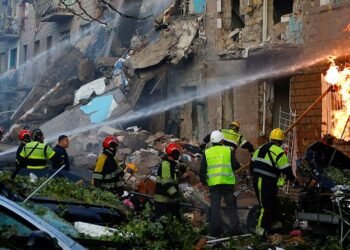
The latest developments came as Russian forces continued their attacks on Ukrainian cities. Six people were killed and almost 60 others were injured after Russian bombs struck a residential area in Kharkiv, Ukrainian officials said. Rescue teams worked through damaged buildings and piles of debris as residents were brought out of affected areas.
Kharkiv, Ukraine’s second-largest city, has remained one of the most exposed major Ukrainian urban centres because of its proximity to the Russian border. The city has experienced repeated missile, drone and artillery attacks throughout the war, with residential districts and civilian infrastructure frequently affected.
French President Emmanuel Macron condemned the latest escalation, accusing Moscow of making an irresponsible decision to intensify attacks against civilian infrastructure and other targets. The continuing strikes have reinforced concerns among European governments that Russia is preparing to maintain or increase pressure on Ukrainian cities as the war enters another difficult phase.
The conflict has also expanded the dangers facing civilian shipping in the Black Sea. Ukrainian President Volodymyr Zelenskyy said Russian drones struck a civilian grain vessel in neutral waters on Monday. Romania separately reported that a ship caught fire and sank near its coast, leaving two crew members dead and 11 others rescued.
Zelenskyy said the vessel was Turkish-owned and was carrying corn, with Azerbaijani and Indian nationals among those on board. The incident added to growing fears over the safety of commercial shipping in the Black Sea, where military activity, drones and unexploded weapons have created an increasingly dangerous environment.
Maritime security specialists have warned that war-related objects found in the Black Sea have increased significantly in recent months. These objects include drones, unmanned vehicles and unexploded ordnance, some of which may still contain live explosives. The accumulation of such hazards presents a growing challenge to commercial vessels attempting to operate in waters that remain essential to the movement of Ukrainian agricultural exports.
Another potentially serious incident was reported at the Russian-controlled Zaporizhzhia nuclear power plant in south-eastern Ukraine. Russian state nuclear corporation Rosatom said Ukrainian drones attacked two facilities at the site overnight. According to Rosatom chief Alexei Likhachev, a driver delivering food to plant employees was killed.
Likhachev said a laboratory building and a radioactive waste processing facility were targeted. Ukrainian authorities had not publicly commented on the Russian allegations at the time of reporting. Russian officials said there was no immediate threat to nuclear safety, although any military activity around the plant remains a matter of international concern because of the potential consequences of damage to nuclear infrastructure.
Meanwhile, Ukraine is also adapting its air-defence strategy to confront a new generation of Russian drones. Kyiv has begun deploying artificial intelligence-assisted robotic gun systems designed to detect and destroy fast-moving, jet-powered unmanned aircraft.
Ukrainian officials said 12 automated turrets had already been installed in Kyiv, with additional systems expected to be deployed. The technology is intended to help address the growing challenge posed by Russian drones that move faster than earlier versions and can be more difficult to intercept using conventional weapons.
Ukrainian Air Force representatives said the automated systems had successfully destroyed jet-powered Russian drones, including the Geran-5. The systems use machine vision to identify targets, while artificial intelligence helps determine how to engage them.
The development illustrates how the war is increasingly becoming a contest of technology as well as manpower and ammunition. Both sides are seeking cheaper and faster methods of identifying and destroying drones, particularly as large-scale drone attacks can place significant pressure on conventional air-defence systems.
Beyond Ukraine and Russia, European governments are also becoming increasingly concerned about the wider security consequences of the conflict. Germany’s foreign intelligence chief, Martin Jaeger, warned lawmakers that Russia’s expanding campaign of hybrid attacks could draw Germany and other European countries into a more direct confrontation with Moscow.
Jaeger described Russia’s undeclared campaign against Germany and its allies as a growing threat that had entered a more dangerous phase. European officials have increasingly linked cyberattacks, sabotage, disinformation campaigns and other forms of covert activity to Russia’s broader strategy against Western countries supporting Ukraine.
European Union foreign policy chief Kaja Kallas has similarly warned that Russian hybrid operations are putting lives at risk across Europe. Germany has responded by increasing investment in its armed forces and strengthening its ability to deter potential Russian aggression, while remaining one of Ukraine’s most important European supporters.
The latest developments therefore highlight several interconnected dimensions of the war. Ukraine’s long-range attacks are increasingly targeting Russia’s economic infrastructure, particularly the energy sector, while Russia continues to strike Ukrainian cities and civilian infrastructure. At the same time, the conflict is spreading into maritime security, nuclear safety, artificial intelligence and European security policy.

Kyiv’s claim that more than half of Russia’s affected refining capacity has been taken out remains a Ukrainian assessment and has not been independently confirmed in full. Nevertheless, Putin’s acknowledgment that refinery attacks have cost Russia around 1% of GDP provides an indication that the economic consequences are significant.
As the war continues, the ability of both countries to absorb economic and military pressure is likely to remain a crucial factor. For Ukraine, long-range strikes offer a way to impose costs on Russia beyond the battlefield. For Moscow, maintaining fuel supplies, military logistics and economic stability while sustaining operations in Ukraine will remain a major challenge.
The conflict is consequently entering another phase in which infrastructure, technology and economic resilience are becoming just as important as territorial control. With attacks reaching deeper into both countries and European governments increasingly concerned about hybrid threats, the consequences of the war continue to extend far beyond the front lines.
Related News:
 Ceasefire Standoff Deepens in Ukraine War
 Putin Declares Russia Victory at Scaled Victory Day Parade
 Russian Missiles Intensify Pressure on Kyiv
 Russia Targets Ukraine’s Digital Economy With Strikes
 Ukraine’s New FP-7 Missile Makes Combat Debut
 Germany Pledges €1bn Military Aid to Ukraine
 EU weighs response amid Greenland tariff crisis with Trump
 EU Says US Ties Have Suffered ‘Big Blow’ After Greenland Crisis
 UK Prepares Aircraft Carrier for Middle East Crisis
 Italian Town Buys Mussolini Villa to Keep Away Fascist Fans
 Hungary election: Orbán faces biggest test amid scandal
 Activists allege abuse after Gaza flotilla seizure
 Global order shifts amid Trump-era turmoil
 Middle East Crisis Escalates as Oil Routes Shake Markets
 Trump Announces 3-Day Russia–Ukraine Ceasefire Deal
 France Faces Record Presidential Crowded Race Amid Far-Right Surge
 Norway Doubles Down on Oil and Gas for Europe Energy Security
 Zelenskyy warns over Oreshnik threat as Kyiv hit
 Former ICC prosecutor condemns US sanctions
 Irish Gangland Figure Fails in Dublin Election Bid
 Deadly Russian Air Raids Strike Across Ukraine
 Millions Gather for Khamenei’s Six-Day State Funeral
 Le Pen to Run for President Despite Embezzlement Conviction
 Houthis Strike Saudi Arabia as Middle East Tensions Rise
 Taliban global ties grow as rights fears mount
 Israeli Strike in Southern Lebanon Kills Seven
 Trump dismisses concerns over 250-day carrier deployment
 Trump Calls Strait of Hormuz ‘American Territory’
 Trump Faces Iran War Crisis Before Midterm Vote
 Ukraine Villagers Demand Answers After Deadly Arms Depot Strike
 Bayeux Tapestry Revives Franco-British Ties
 UN expert urges UK to rethink Israel policy
 AfD election surge leaves Magdeburg residents deeply uneasy
 Europe’s democracies face a growing far-right threat
 North Korea Expands Uranium Facility at Yongbyon
 Sweden Election Hangs on Far-Right Breakthrough
 Germany’s Far Right Surge Puts Merz Under Pressure
 Saudi Pact Raises Risk of Pakistan Entering War
 Macron and Carney deepen France-Canada ties
 Netanyahu faces protests and pressure at UN
 Elif Eralp Emerges as Berlin’s Next Political Force
 Iran Awaits Trump Response on Seven-Day Hormuz Plan
 National Rally makes historic gains in French Senate
 Trump Asked Xi About Buying US Weapons
 Madrid Tent Camp Grows as Spain Housing Crisis Deepens
 Putin Orders Russian Army Expansion as War Intensifies
 South Korea-Ukraine Row Erupts Over North Korean POWs
 French Student Protests Escalate Into Violent Clashes
 Russia Escalates Ukraine Energy Attacks as Winter Nears
 New Maps Reveal Gaza’s Vast Destruction
 French School Protests Escalate as 400 Schools Close
 Russian Strikes Disrupt Kyiv Bridge Traffic
 Bosnia’s Young People Look Beyond Election Hope
 Spain Sets Snap Election as Housing Crisis Deepens
 BBC to Apologise Over Edited Trump Speech Amid Backlash
 Britain deploys RAF specialists to assist Belgium with drone threats
 Greene Pushes Epstein Files Amid Trump Fallout
 December Run-Off in Chile as Election Produces No Winner
 Shadow Fleet at Sea: Europe’s Battle Against Illicit Oil Shipping
 Georgians Defy Government Crackdown After Year of Protests
 Pentagon Signals Reduced Role in Deterring North Korea
 UK and US Drop in Global Corruption Index Rankings
 Canberra Poster Seizure Sparks Free Speech Row
 Evo Morales Returns After Mysterious Absence
 Jacinda Ardern Moves To Australia Following Her US Fellowships
 Jacinda Ardern Move Sparks Kiwi Reflection
 Nick Greiner Warns Over Election Review Fallout
 Injured Mojtaba Khamenei Elevated as Iran Leader
 Gordon Brown urges court for crimes against children
 Pakistan Targets Militant Hideouts in Afghanistan
 Air Canada CEO Faces Outcry Over Recent Language Misstep
 Relationship with Trump may be beyond repair, Starmer warned
 Trump Brokers Landmark Lebanon Ceasefire Amid Regional Hopes
 UK Stands Firm on Falklands Amid US Rift
 Meta Under Fire: The Battle Over Addictive Social Media Design
 England and Norway Fans Turn Miami Into World Cup Carnival
 Republican Senator Questions Trump Ad Spending
 US Sends Third Carrier to Middle East
 Lula Warns of Bolsonaro Family Return as Brazil Votes
 Yemen government launches offensive against Houthis