Published: 07 October 2026. The English Chronicle Desk. The English Chronicle Online.
A Liberian-flagged oil tanker has been struck by a naval drone in the Black Sea off the Russian resort city of Sochi, triggering a major fire and sending a thick cloud of black smoke over parts of the coastal area, according to Russian officials.
The incident has added to growing concerns over the safety of commercial shipping in the Black Sea, where civilian vessels have increasingly found themselves operating amid the wider conflict between Russia and Ukraine. The attack occurred near one of Russia’s best-known resort destinations, turning an area normally associated with tourism and seaside activity into the scene of a major maritime emergency.
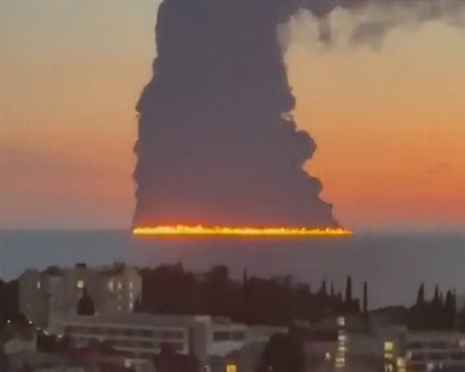
Russia’s transport ministry said the tanker was attacked while offshore and that crude oil had caught fire directly on the surface of the Black Sea. Officials said the blaze was intense enough to prevent firefighting vessels from immediately approaching the stricken ship.

Emergency crews were waiting for conditions to become safer before beginning direct firefighting operations. Authorities said rescue vessels could only move towards the tanker once the intensity of the flames had decreased sufficiently to allow them to operate safely.
All 23 members of the tanker crew were rescued, according to the Russian transport ministry. The crew members were reported to be Indian nationals, meaning that the incident also carries an international dimension involving the safety of seafarers working on commercial vessels in a conflict-affected maritime region.
There were no immediate reports indicating that crew members had been killed or seriously injured. The successful evacuation of everyone aboard the vessel was a significant development as emergency services assessed the fire and the potential environmental consequences of burning crude oil in the sea.
Images and videos circulating online showed a dramatic scene offshore, with bright flames visible across the water and a large column of dark smoke rising above the Black Sea. The smoke was visible from areas around Sochi, a major Russian resort city with a population approaching half a million people.
Local authorities responded by restricting access to sections of the coastline and beaches. The measures were intended to protect residents and visitors while emergency services dealt with the fire and assessed the risks posed by the burning tanker.
The incident is the latest in a series of attacks and security incidents affecting commercial shipping in and around the Black Sea since Russia’s full-scale invasion of Ukraine began. Both Russia and Ukraine have used drones and other weapons against maritime targets, raising concerns about the increasing risks faced by civilian shipping operating through the region.
Kyiv had not immediately issued a statement claiming responsibility for the strike on the tanker. The absence of an immediate Ukrainian response left the circumstances surrounding the attack unclear, including the precise type of drone used and whether the vessel was deliberately selected as a target.
The attack also came amid heightened tensions surrounding commercial vessels operating elsewhere in the Black Sea. Ukrainian officials have previously accused Russia of targeting ships involved in the movement of Ukrainian goods, while Moscow has repeatedly portrayed Ukrainian maritime drone activity as part of a broader campaign against Russian interests.
The latest incident therefore comes at a particularly sensitive time for maritime security. Commercial ships carrying oil, grain and other goods continue to use Black Sea routes despite the risks created by military operations, making attacks or accidents involving civilian vessels a potentially serious international concern.
The situation was further complicated by reports from Bulgaria on Tuesday that two commercial vessels had been struck by drones in the country’s exclusive economic zone in the Black Sea. Bulgarian authorities said they were investigating the origin of the drones, while Ukrainian President Volodymyr Zelenskyy blamed Russia for the attacks.
Bulgarian Prime Minister Rumen Radev strongly condemned those incidents following an emergency government meeting. He described an attack inside Bulgaria’s exclusive economic zone as unacceptable and said it represented a serious violation of international and maritime law.
According to Radev, the vessels were attacked by sea and aerial drones approximately 128 kilometres from Bulgaria’s coast. The reported incidents marked an important development because Bulgaria is a member of Nato, meaning that attacks or military activity close to its maritime territory carry broader security implications for the alliance and neighbouring countries.
The sequence of maritime incidents has intensified scrutiny of the Black Sea, where the boundary between military operations and civilian commercial activity has become increasingly difficult to maintain. The region is vital for energy shipments, food exports and international trade, while several countries bordering the sea have major economic interests connected to maritime transport.
The tanker fire near Sochi also highlights the potential environmental consequences of attacks involving oil-carrying vessels. Burning crude oil on the surface of the sea can create additional hazards beyond the immediate threat to crew members, particularly if a damaged vessel begins leaking large quantities of petroleum.
Russian authorities had not immediately provided a detailed assessment of any potential oil spill or the condition of the tanker itself. The priority initially remained rescuing the crew and controlling the fire once emergency vessels could approach safely.
The incident near Sochi occurred as the wider Russia-Ukraine conflict was entering another period of heightened military activity. Ukraine’s capital Kyiv came under Russian attack in the early hours of Wednesday after Zelenskyy warned that a major Russian strike could be imminent.
Russian attacks damaged buildings and warehouses in Kyiv, according to the city’s mayor, Vitali Klitschko. Reports also indicated that multiple explosions were heard across the Ukrainian capital, while separate reporting said two people were killed in the Russian strikes.
Another Russian attack on the south-eastern Ukrainian city of Dnipro damaged an industrial facility, according to local officials. Details about the scale of the damage were not immediately available.
Kyiv has faced increasingly intense Russian attacks as winter approaches, with energy infrastructure remaining a major focus of Russian military operations. Railways, roads and other transport infrastructure have also been targeted, raising concerns about Ukraine’s ability to maintain essential services and supply networks during the colder months.
The attacks have placed enormous pressure on civilians in the Ukrainian capital and other cities. Air raid warnings have become a regular feature of daily life, with residents repeatedly urged to move into shelters, basements or underground railway stations when missile and drone threats emerge.
Against this broader backdrop, the tanker incident demonstrates how the consequences of the war continue to extend beyond the immediate battlefield. Commercial shipping routes, ports, energy supplies and coastal communities have all become exposed to risks created by the expanding use of drones and long-range weapons.
For the shipping industry, the latest events are likely to reinforce concerns about operating in the Black Sea. Even when commercial vessels are not directly involved in military activity, they can face serious dangers if attacks occur nearby or if drones and other weapons are misidentified.

The rescue of all 23 crew members provides a measure of relief in an otherwise alarming incident. Their evacuation prevented the fire from becoming an even greater human tragedy, while authorities now face the difficult task of containing the blaze and determining whether the damaged tanker poses an environmental threat.
The circumstances of the strike, including who launched the drone and whether the tanker was deliberately targeted, are expected to remain subjects of investigation. With maritime tensions already rising across the Black Sea, the incident near Sochi is likely to add further pressure on Russia, Ukraine and neighbouring states to address the growing dangers faced by civilian shipping.
As emergency teams work to bring the fire under control, the episode serves as another stark reminder that the war’s impact is no longer confined to military positions on land. The Black Sea has become an increasingly contested and dangerous environment where commercial vessels, international crews and coastal communities can suddenly find themselves caught in the consequences of a conflict far beyond their immediate control.
Related News:
 Ceasefire Standoff Deepens in Ukraine War
 Putin Declares Russia Victory at Scaled Victory Day Parade
 Russian Missiles Intensify Pressure on Kyiv
 Russia Targets Ukraine’s Digital Economy With Strikes
 Ukraine’s New FP-7 Missile Makes Combat Debut
 Germany Pledges €1bn Military Aid to Ukraine
 Ukraine claims strikes have crippled Russia’s oil refining
 EU weighs response amid Greenland tariff crisis with Trump
 EU Says US Ties Have Suffered ‘Big Blow’ After Greenland Crisis
 UK Prepares Aircraft Carrier for Middle East Crisis
 Italian Town Buys Mussolini Villa to Keep Away Fascist Fans
 Hungary election: Orbán faces biggest test amid scandal
 Activists allege abuse after Gaza flotilla seizure
 Global order shifts amid Trump-era turmoil
 Middle East Crisis Escalates as Oil Routes Shake Markets
 Trump Announces 3-Day Russia–Ukraine Ceasefire Deal
 France Faces Record Presidential Crowded Race Amid Far-Right Surge
 Norway Doubles Down on Oil and Gas for Europe Energy Security
 Zelenskyy warns over Oreshnik threat as Kyiv hit
 Former ICC prosecutor condemns US sanctions
 Irish Gangland Figure Fails in Dublin Election Bid
 Deadly Russian Air Raids Strike Across Ukraine
 Millions Gather for Khamenei’s Six-Day State Funeral
 Le Pen to Run for President Despite Embezzlement Conviction
 Houthis Strike Saudi Arabia as Middle East Tensions Rise
 Taliban global ties grow as rights fears mount
 Israeli Strike in Southern Lebanon Kills Seven
 Trump dismisses concerns over 250-day carrier deployment
 Trump Calls Strait of Hormuz ‘American Territory’
 Trump Faces Iran War Crisis Before Midterm Vote
 Ukraine Villagers Demand Answers After Deadly Arms Depot Strike
 Bayeux Tapestry Revives Franco-British Ties
 UN expert urges UK to rethink Israel policy
 AfD election surge leaves Magdeburg residents deeply uneasy
 Europe’s democracies face a growing far-right threat
 North Korea Expands Uranium Facility at Yongbyon
 Sweden Election Hangs on Far-Right Breakthrough
 Germany’s Far Right Surge Puts Merz Under Pressure
 Saudi Pact Raises Risk of Pakistan Entering War
 Macron and Carney deepen France-Canada ties
 Netanyahu faces protests and pressure at UN
 Elif Eralp Emerges as Berlin’s Next Political Force
 Iran Awaits Trump Response on Seven-Day Hormuz Plan
 National Rally makes historic gains in French Senate
 Trump Asked Xi About Buying US Weapons
 Madrid Tent Camp Grows as Spain Housing Crisis Deepens
 Putin Orders Russian Army Expansion as War Intensifies
 South Korea-Ukraine Row Erupts Over North Korean POWs
 French Student Protests Escalate Into Violent Clashes
 Russia Escalates Ukraine Energy Attacks as Winter Nears
 New Maps Reveal Gaza’s Vast Destruction
 French School Protests Escalate as 400 Schools Close
 Russian Strikes Disrupt Kyiv Bridge Traffic
 Bosnia’s Young People Look Beyond Election Hope
 Spain Sets Snap Election as Housing Crisis Deepens
 Lithuania Offers to Fund Permanent US Military Base
 Canadian Veterans Condemn Trump Allies’ Military Remarks
 Former German Intelligence Chief Arrested Over Espionage
 France Schools Protests Draw 250,000 as Police Clash
 Israeli Settlers Assault Palestinian Photographer
 EU-China Talks Target Surge in Hybrid Car Imports
 BBC to Apologise Over Edited Trump Speech Amid Backlash
 Greene Pushes Epstein Files Amid Trump Fallout
 December Run-Off in Chile as Election Produces No Winner
 Shadow Fleet at Sea: Europe’s Battle Against Illicit Oil Shipping
 Georgians Defy Government Crackdown After Year of Protests
 Pentagon Signals Reduced Role in Deterring North Korea
 UK and US Drop in Global Corruption Index Rankings
 Canberra Poster Seizure Sparks Free Speech Row
 Evo Morales Returns After Mysterious Absence
 Jacinda Ardern Moves To Australia Following Her US Fellowships
 Jacinda Ardern Move Sparks Kiwi Reflection
 Nick Greiner Warns Over Election Review Fallout
 Injured Mojtaba Khamenei Elevated as Iran Leader
 Air Canada CEO Faces Outcry Over Recent Language Misstep
 Relationship with Trump may be beyond repair, Starmer warned
 Meta Under Fire: The Battle Over Addictive Social Media Design
 England and Norway Fans Turn Miami Into World Cup Carnival
 Republican Senator Questions Trump Ad Spending
 Yemen government launches offensive against Houthis