Published: 09 September 2026.The English Chronicle Desk. The English Chronicle Online.
Foreign Secretary Ed Miliband has rejected a warning from the UK’s Chief Rabbi, Sir Ephraim Mirvis, that the government’s sanctions against Israeli settlements in the occupied West Bank could make British Jews less safe.
Miliband, who has described himself as a “proud British Jew”, said it was possible for the UK government to challenge policies pursued by Benjamin Netanyahu’s Israeli government while simultaneously taking a strong stand against antisemitism and protecting Jewish communities in Britain.
The disagreement followed the government’s announcement of wide-ranging measures targeting trade and services connected with Israeli settlements in the West Bank. Ministers have argued that Israel’s continued occupation and expansion of settlements threaten the prospects of a future Palestinian state and undermine efforts to preserve a two-state solution.
The sanctions were coordinated with France, Canada and several other countries, reflecting growing international concern over the expansion of Israeli settlements and the deteriorating situation in the occupied Palestinian territory.

In a joint statement, leaders including Andy Burnham, French President Emmanuel Macron and Mark Carney said further action was necessary to protect the possibility of a two-state solution, defend national interests and uphold international values.
The decision immediately triggered criticism from Sir Ephraim Mirvis, who described the government’s action as a “dark day for British Jews”. He warned that the measures could embolden individuals who use hostility towards Israel as a pretext for hatred against Jewish people.
Miliband was asked directly during an interview on BBC Radio 4’s Today programme whether he believed the Chief Rabbi was wrong to suggest the sanctions could make British Jews feel less secure.
“Yes, I am saying I don’t agree with the chief rabbi,” Miliband said, while making clear that he continued to hold Mirvis in high regard.
The foreign secretary stressed that criticism of the Israeli government should not be directed towards Jewish people in Britain or elsewhere. He argued that holding British Jews collectively responsible for decisions taken by the Israeli government would itself constitute antisemitism.
Miliband said Britain had to remain capable of defending principles such as freedom, dignity and opposition to oppression and injustice while ensuring that Jewish people and members of all faiths could live safely.
He also rejected the suggestion that Mirvis’s concerns carried less weight because Miliband does not attend synagogue. The foreign secretary said antisemitism was an “evil” and a serious threat to society, insisting that his position on the Israeli government’s policies should not be confused with hostility towards Jewish people.
The dispute comes at a particularly sensitive moment for relations between Britain and Israel. The UK government’s sanctions announcement prompted an immediate response from the Israeli authorities, who ordered the closure of the British consulate in Jerusalem and imposed entry restrictions on 12 British MPs and activists.
The Israeli reaction has raised concerns about the practical consequences of the British measures and the future of diplomatic engagement between the two countries.
The United States has also expressed opposition to Britain’s approach. Washington’s ambassador to Israel, Mike Huckabee, warned that the US could consider retaliatory trade measures. US Secretary of State Marco Rubio, meanwhile, said Washington would not follow the British government’s decision, although he also indicated that the United States did not want the situation in the West Bank to become more unstable.
Miliband declined to speak on behalf of the American administration but acknowledged the frustration felt by parts of the international community over actions taken by the Israeli government.
He said he regretted Israel’s decision to close the British consulate but maintained that ministers had considered the possible consequences before proceeding with the sanctions.
According to the government’s plans, Britain will impose restrictions on imports from Israeli settlements in occupied territories. New restrictions will also apply to arms licences and other exports that are judged to materially contribute to the occupation.
The measures extend beyond goods. The government intends to introduce a comprehensive sanctions framework covering services associated with settlement activity, including construction and financing. Advertising Israeli settlements in Britain will also be prohibited under the planned measures.
Personal sanctions are additionally expected to target individuals accused of promoting settler violence, adding another layer to Britain’s response to developments in the West Bank.
The government has presented the sanctions as a response to policies and actions rather than a measure directed against Israeli citizens as a whole. Prime Minister Andy Burnham has defended the decision, arguing that the measures are aimed at settlement activity and not at the Israeli people.
The issue is expected to remain at the centre of parliamentary debate, with Burnham due to face MPs during Prime Minister’s Questions.
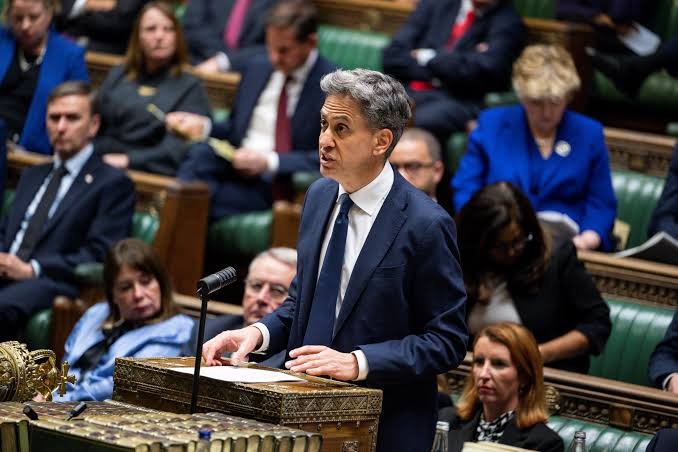
Miliband used his statement in the House of Commons on Tuesday to explain the moral and humanitarian reasoning behind the government’s decision. He referred to accounts he had heard from Palestinians living in the West Bank, including people whose homes had been destroyed, as well as medical workers in Gaza who had witnessed children dying while awaiting treatment.
His comments reflected the increasingly difficult political balance facing the British government. Ministers are under pressure to respond to the humanitarian situation affecting Palestinians while maintaining diplomatic relationships and addressing concerns about antisemitism within Britain.
For Jewish communities, the debate has become particularly sensitive because disagreements over Israel can quickly intersect with concerns about antisemitism and communal security. Mirvis’s warning reflects fears that heightened political hostility towards Israel could spill over into attacks or intimidation against British Jews.
Miliband, however, has drawn a distinction between opposing government policy and targeting a religious or ethnic community. His argument is that Britain must be able to criticise actions by a foreign government without allowing Jewish people in Britain to be treated as responsible for those actions.
That distinction is likely to remain central to the political debate as the sanctions begin to take effect.
The confrontation also highlights the increasingly complicated diplomatic position Britain faces over the Israeli-Palestinian conflict. The government is seeking to exert pressure over settlement expansion while continuing to insist that antisemitism has no place in British society.
The sanctions could therefore have consequences extending beyond trade and diplomatic relations. They are likely to influence Britain’s relationship with Israel, its coordination with European and other international partners, and the domestic political debate surrounding the Middle East.
For Miliband, the central argument is that these positions are not mutually exclusive. The government can oppose Israeli settlement policies, he says, while standing firmly against antisemitism and defending the safety and dignity of British Jews.

For Mirvis and those who share his concerns, however, the timing and nature of the sanctions raise a different question: whether increased political pressure on Israel could unintentionally deepen insecurity for Jewish communities in Britain.
That disagreement places the government and the Chief Rabbi on opposite sides of a highly sensitive political argument, even as both acknowledge the importance of combating antisemitism.
As Britain prepares to implement the new measures, ministers will face continued scrutiny over their impact on diplomatic relations, trade, security and the wider Middle East peace process. The government will also be expected to demonstrate that its opposition to Israeli settlement activity does not translate into hostility towards Jewish people.
The debate is therefore likely to continue well beyond the immediate diplomatic fallout. At its heart is a difficult question about how Britain can respond to developments in the West Bank while protecting domestic communities from hatred and maintaining its commitment to a negotiated political settlement.
Related News:
 UN expert urges UK to rethink Israel policy
 Emails Show Epstein Funded Mandelson’s Husband After Jail
 Former ICC prosecutor condemns US sanctions
 Charlie Kirk Killing Used to Mobilise UK’s Largest Far-Right Rally in Decades
 Jailed Georgian Opposition Leaders Warn UK of Iranian Links to Ruling Party
 It’s time to come clean on the China spy case
 Pregnant UK Teen to Be Freed from Georgian Jail
 French Taxi Driver Cleared in David Lammy Theft Case After Fare Dispute
 Just Stop Oil Protesters Convicted Amid Climate Defence Row
 Met Police Culture Makes Racial Harm ‘Inevitable’
 British Grandmother to Return Home After Death Sentence in Bali
 Remaining rebel Labour MPs have whip restored
 Second world war veterans honoured as King leads Remembrance Sunday
 UK and EU Signal Fresh Push for Defence Cooperation Talks
 Files Link Andrew to Epstein Dinner After Prison Release
 Labour Attacks Reform Candidate Over Tommy Robinson Backing
 UK Prepares Aircraft Carrier for Middle East Crisis
 Mass Arrests at London Palestine Protest Spark Debate
 Cartel crackdown raises fears of fresh violence
 Judge halts deportation of Yemeni refugees in US
 Asylum deal sparks fears over Syria deportations
 UK may ban protests amid rising antisemitism fears
 Israeli Strikes in Lebanon Kill 10 Amid Ceasefire Strain
 US judge dismisses Kilmar Abrego Garcia indictment
 China mine blast death toll rises to 90
 Ebola outbreak in DRC overwhelms health system as cases surge
 Victim says non-custodial rape sentence ‘rock in my face’
 Gunman Killed After White House Security Shootout
 Irish Gangland Figure Fails in Dublin Election Bid
 Murder Probe Continues After Arrest Release
 New Footage Revives Peter Falconio Mystery
 Ukraine Creates Long-Range Strike Command
 Dreyfus Statue Finally Gets Permanent Paris Home
 Israeli Strike in Southern Lebanon Kills Seven
 Former Diplomats Urge UK and France to Act on Palestine
 US immigration arrests hit record high in July
 Exeter Approves Saudi Military Training Partnership
 Ukraine Villagers Demand Answers After Deadly Arms Depot Strike
 Daughter Finds Bones in Parents’ Burned-Out Car
 Argentina Orders Return of Nazi-Looted Painting
 Masked Protesters Bring Dover Port Traffic to Standstill
 Ministers Condemn Far-Right Unrest in Portsmouth
 UK plans tougher Israel stance with settlement trade ban
 Johnson Approved China’s London ‘Super-Embassy’ in 2018
 Major Rent Reform Ends No-Fault Evictions in England
 Peers Flood Assisted Dying Bill with 942 Amendments
 US Justice Department Files Lawsuit Against California Over Partisan Voting Maps
 Greene Pushes Epstein Files Amid Trump Fallout
 Trump Deploys DHS to Charlotte in Major Arrest Operation
 Serial Rapist and Former Cop Found Guilty Again
 Venezuela Threatens Nobel Winner Machado with Fugitive Status
 Most Tories Expect to Support a Farage-Led Government
 Thousands Protest ICE Operations in Nationwide US Day of Action
 Starmer Condemns ‘Depraved’ Russian Strikes on Ukraine
 Trump Tariffs Threat Spark UK and EU Alarm
 Proposed Law Leaves Gap for Children of Convicted Paedophiles
 Iran Defiance Grows Amid US-Israel War Pressure
 Injured Mojtaba Khamenei Elevated as Iran Leader
 Gordon Brown urges court for crimes against children
 Army Probes Apache Flyover at Kid Rock’s Nashville Estate
 Relationship with Trump may be beyond repair, Starmer warned
 Report Says Pezzullo Acted ‘Recklessly’ in Dealings
 Hungary election: Orbán faces biggest test amid scandal
 Suspected Plot Targets Pipeline Before Hungary Vote
 Ben Roberts-Smith Denies War Crime Allegations in First Statement
 Learner Driver Charged After Expo Tragedy
 UK Stands Firm on Falklands Amid US Rift
 Crackdown Backfires on UK Climate Protesters
 US ‘Narco Boat’ Strikes Draw Global Outcry
 Trump Announces 3-Day Russia–Ukraine Ceasefire Deal
 Barrister Criticises Trial After Suicide Case Verdict
 US green card applicants must apply from abroad, DHS says
 Farage and Reform UK Reshape British Politics
 Starmer Leadership Under Pressure After Setbacks
 Houthis Strike Saudi Arabia as Middle East Tensions Rise
 Westminster Council Threatens Charing Cross Soup Kitchen
 Unions Warn Labour Over Zero-Hours Contract Reforms
 Bayeux Tapestry Revives Franco-British Ties
 Trump Calls Iran War ‘Small Potatoes’ Despite US Deaths
 Abusive ex used Tesla to control and harass former partner