Published: 05 September 2026. The English Chronicle Desk. The English Chronicle Online.
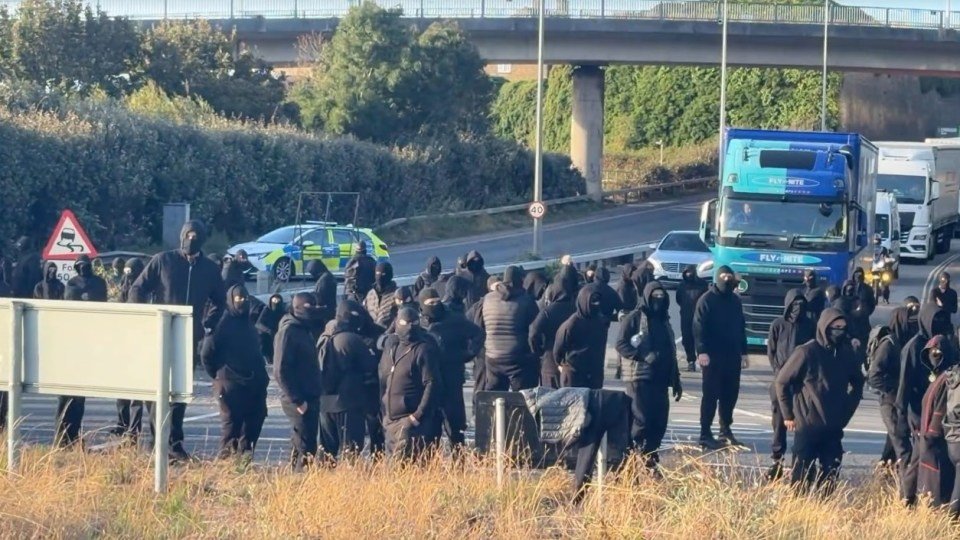
Traffic around the Port of Dover in Kent was brought to a standstill on Saturday morning after a large group of people dressed in black and wearing balaclavas blocked roads leading into and out of one of the UK’s busiest ferry terminals.
The disruption began early in the morning, with police attending what authorities described as a public order incident. Kent Police said officers were at the scene and engaging with the group, while the Port of Dover confirmed that the protest was affecting routes around the port and the wider town.
National Highways reported that traffic on the A20, a major route serving the port, had been stopped in both directions. The disruption resulted in delays of up to 30 minutes and congestion extending for around four miles as lorries and other vehicles were unable to move normally through the area.
Images and videos circulating online showed a large group of masked individuals dressed predominantly in black standing across the road. Police vehicles were visible nearby as heavy goods vehicles waited in queues, highlighting the immediate impact on freight and passenger traffic.

The precise size of the gathering had not been confirmed by police. Some witnesses estimated that around 300 people were involved, although that figure remained unverified.
One local resident, Nathan Ditchburn, said he encountered the group while travelling to work at around 6.45am. He described seeing hundreds of men and said the protesters appeared unwilling to speak directly with members of the public.
According to Ditchburn, the group had blocked entrances and exits around the Dover port area, as well as Jubilee Way. He warned that the disruption could cause substantial delays for ferry passengers and freight operators throughout the day.
The Port of Dover said the incident was having an impact not only on access to the port but also on the surrounding community.
In a statement, the port confirmed that the public order incident was ongoing around Dover and that it was affecting all routes into and out of the port, as well as roads around the town. The port said it was working with police and hoped the situation would be resolved quickly.
The disruption also affected local community activities. The Dover Waterfront Parkrun event was cancelled because organisers considered the course unsafe or inaccessible amid the protest and associated disruption.
The cancellation illustrated how a demonstration centred on a politically sensitive issue had quickly affected activities well beyond the port itself. Residents, commuters, businesses and visitors were all caught up in the consequences of the road blockade.
The protest appeared to be connected to opposition to small-boat crossings across the English Channel, although the organisers’ precise demands and identity were not immediately clear from the information available.
Far-right activist Tommy Robinson, whose real name is Stephen Yaxley-Lennon, reposted footage of the blockade and highlighted a livestream of the demonstration. His involvement in amplifying the images added to the political attention surrounding the incident.
Dover and Deal Labour MP Mike Tapp strongly criticised the protesters and condemned what he described as deliberate disruption in the town.
Tapp pointed to the cancellation of the local Parkrun and the disruption to port access, arguing that the demonstration was imposing costs on residents and businesses. He also referred to a reduction in small-boat crossings and said work was continuing to address the issue of irregular migration.
A local Reform councillor, Paul King, also advised residents to avoid the port area while the disruption continued. He said he had been informed that the gathering was intended as a “stop the boats” protest.
King also raised concerns about the atmosphere created by the large gathering. He said some local women he had spoken to felt frightened by the sight of a large group of men walking through the area.
At the same time, King said he did not support protests that caused public disturbance. He argued, however, that the demonstration reflected wider concerns within parts of the local community about people arriving in the UK by small boats.
The events underline the highly sensitive nature of the migration debate in Dover, a town that has become closely associated with Channel crossings because of its geographical position and its importance as a major transport connection between Britain and continental Europe.
The Port of Dover is a critical part of the UK’s transport infrastructure, handling large volumes of passenger and freight traffic every day. Any prolonged interruption can therefore have consequences beyond the immediate area, particularly when queues of lorries begin to build.
Ferry operators were monitoring the situation and attempting to minimise disruption to passengers.
DFDS said it was aware of the traffic problems affecting access to the port and reassured passengers that those unable to reach their scheduled departure would be accommodated on a subsequent sailing.
P&O Ferries similarly said its sailings were continuing as scheduled. The company told affected passengers that anyone who missed a departure because of the disruption would be offered the next available crossing.
The response from ferry operators offered some reassurance to travellers, but the continuing road blockade created uncertainty for passengers planning to reach Dover at a particularly busy time of the weekend.
For freight operators, the situation was potentially more complicated. Heavy goods vehicles rely on predictable access to the port, and delays can have knock-on effects for delivery schedules and supply chains on both sides of the Channel.
Police involvement remained focused on managing the public order situation and engaging with those taking part. Authorities did not immediately confirm how many arrests, if any, had been made or provide a detailed explanation of the protesters’ next steps.
The presence of masked demonstrators also raised questions about public safety and the management of politically charged protests. Balaclavas and face coverings can make it more difficult for police and members of the public to identify individuals, particularly when large groups gather in busy transport areas.
The incident also demonstrated how quickly local disruption can become a national political story when it occurs at a strategically important location such as Dover.
For residents, the immediate concern was the effect on daily life. Roads were blocked, a community sporting event was cancelled and people travelling to work faced delays. For travellers, the focus was on whether they could reach ferries on time and continue their journeys across the Channel.

The political debate surrounding small-boat migration is likely to continue, but Saturday’s events have highlighted the tensions that can arise when demonstrations take place at critical transport infrastructure.
Authorities now face the task of restoring normal traffic while balancing public safety, the rights of protesters and the interests of residents, businesses and travellers. The Port of Dover’s call for a swift resolution reflects the importance of returning access to normal as quickly as possible.
As police continued to engage with the group, the immediate priority remained clearing the roads and preventing further disruption. With thousands of passengers and freight vehicles relying on Dover’s transport links, the duration of the blockade will determine the extent of its wider impact.
The incident has once again placed Dover at the centre of Britain’s contentious debate over irregular migration, while also demonstrating the practical consequences that political protests can have when they disrupt a major gateway between the United Kingdom and Europe.
Related News:
 Second world war veterans honoured as King leads Remembrance Sunday
 NHS Safety Fears as Nurses Cover Doctor Gaps
 Farage and Reform UK Reshape British Politics
 Starmer Leadership Under Pressure After Setbacks
 Dreyfus Statue Finally Gets Permanent Paris Home
 Green Leader Targets Starmer’s Former Seat
 Jailed Georgian Opposition Leaders Warn UK of Iranian Links to Ruling Party
 Kosovo agrees to host Britain’s refused asylum seekers
 British Woman in Iran ‘Losing Hope’ Amid Ongoing Detention
 BBC Journalist Held and Interrogated in Vietnam
 FBI Director Kash Patel Defends Girlfriend Amid Government Jet Claims
 Trump Speaks on Prince Andrew’s Royal Scandal Fallout
 French Taxi Driver Cleared in David Lammy Theft Case After Fare Dispute
 UK University Faces Counter-Terror Probe Over China Pressure
 Just Stop Oil Protesters Convicted Amid Climate Defence Row
 Met Police Culture Makes Racial Harm ‘Inevitable’
 British Grandmother to Return Home After Death Sentence in Bali
 Boris Johnson accused of undermining BBC leadership
 Remaining rebel Labour MPs have whip restored
 ‘Reckless’ cuts to victims’ services will cost more than they save
 BBC Faces Backlash as Reform UK Withdraws from Film
 Ukraine-Russia war latest: Putin’s troops exploit bad weather to force Kyiv withdrawal from multiple towns
 New review urges UK to repatriate Shamima Begum, others from Syria
 Greene Pushes Epstein Files Amid Trump Fallout
 UK Candidate Moved to Safe House After Election Threats
 Rama Rebukes Mahmood for Targeting Albanian Families
 Russian Vessel Used Lasers on RAF Pilots, UK Claims
 WhatsApp Messages Expose Nathan Gill’s Bribery
 Venezuela Threatens Nobel Winner Machado with Fugitive Status
 Most Tories Expect to Support a Farage-Led Government
 Trump Envoy to Discuss Ukraine Peace at Kremlin
 Video shows Israeli troops kill Palestinians after surrender
 ‘It’s a Complete Scandal’: Aristocrat’s Fight for Prison Children
 Police response times face strict new national limits
 UK and EU Signal Fresh Push for Defence Cooperation Talks
 Starmer Condemns ‘Depraved’ Russian Strikes on Ukraine
 Trump and Chagos Deal Rift Over Iran Strikes
 Andrew Mountbatten-Windsor Arrest After FBI Radar
 Farage Chagos Islands Row Sparks Fury
 Trump Tariffs Threat Spark UK and EU Alarm
 Gordon Brown urges court for crimes against children
 Yvette Cooper: UK Must Follow Principles, Not US Pressure
 UK Minister Denies Iran Missile Threat to Britain
 Teen Admits Filming Westfield Chair Prank
 Army Probes Apache Flyover at Kid Rock’s Nashville Estate
 Relationship with Trump may be beyond repair, Starmer warned
 Melania Trump Epstein remarks spark survivor backlash
 Kezia Dugdale Warns of Possible Reversal of Equal Rights Gains
 Charles Faces Trump Test in High-Stakes US Visit
 UK Stands Firm on Falklands Amid US Rift
 Two Children Die in Wolverhampton House Fire Tragedy
 Reform UK funding: mystery billionaire revealed
 Two Dead in Adelaide Airport Plane Crash Fire
 John Terry Faces Backlash Over Political Posts
 Cartel crackdown raises fears of fresh violence
 China Fireworks Factory Blast Kills 21 in Hunan
 US ‘Narco Boat’ Strikes Draw Global Outcry
 France Faces Record Presidential Crowded Race Amid Far-Right Surge
 Barrister Criticises Trial After Suicide Case Verdict
 Labour Members Turn Against Starmer Leadership
 UK Pushes for New EU Goods Trade Deal
 Gunman Killed After White House Security Shootout
 Deadly Russian Air Raids Strike Across Ukraine
 UK Nations Brace for Potential Breakup Amid Reform Surge
 New South Wales Premier Chris Minns Signals Tough Road Ahead for Labor
 Ukraine Creates Long-Range Strike Command
 Le Pen’s Popularity Holds Despite Conviction
 Labour MPs Urge Burnham to Revive UK Aid Target
 UK’s Largest Muslim Convention Scales Up Security Amid Rising Bigotry
 Three-Quarters of England’s Riverbanks Still Off Limits
 Westminster Council Threatens Charing Cross Soup Kitchen
 BBC Warned About Missing Clothes of Murder Victim
 Israeli Strike in Southern Lebanon Kills Seven
 Is America Ready for an AOC Presidential Run?
 Burnham unveils £65m drought aid for farmers
 Former Diplomats Urge UK and France to Act on Palestine
 Ghent Professors Questioned Cofnas Appointment
 RAF Barnham Protests Fuel Tensions in Norfolk Town
 Ukraine Villagers Demand Answers After Deadly Arms Depot Strike
 Bayeux Tapestry Revives Franco-British Ties