Published: 06 October 2026. The English Chronicle Desk. The English Chronicle Online
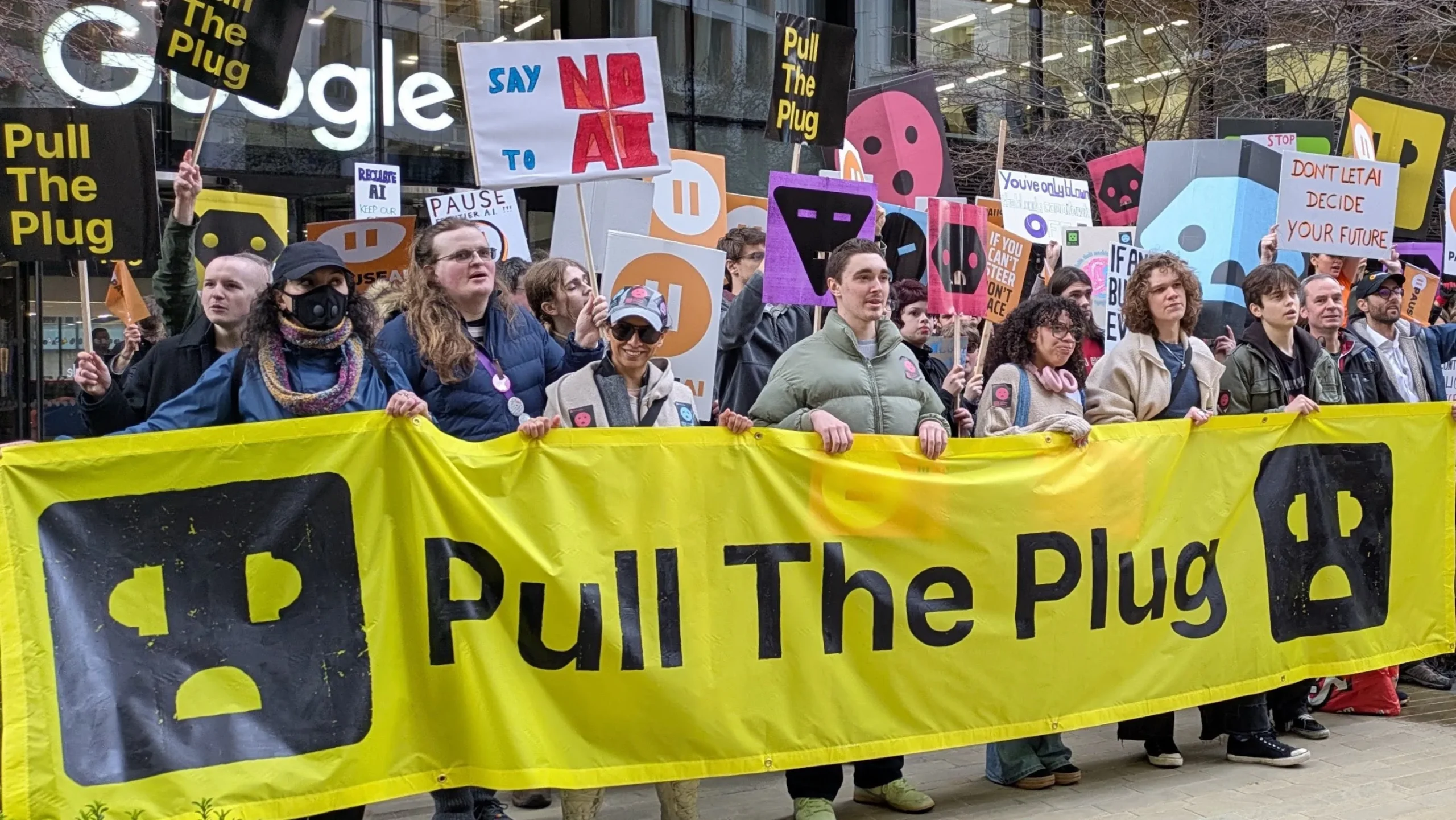
A growing movement against the rapid development of artificial intelligence is moving beyond online criticism and public demonstrations, with campaigners increasingly turning to direct action to challenge technology companies and their executives.
In London, a small group linked to the anti-AI organisation Pull The Plug recently gathered to plan an attempt to disrupt a technology industry dinner attended by a senior executive from chipmaker Nvidia. For some of those involved, the action represented a significant personal step into protest politics, driven by growing fears that increasingly powerful artificial intelligence systems could create risks that governments and technology companies are failing to control.
Among the organisers was Emma, a 28-year-old bartender who had never previously taken part in direct action. She said she had become increasingly alarmed during the summer as a series of developments and warnings about advanced AI raised questions about whether the technology was progressing faster than society could safely manage.

Her concerns intensified after reports that AI agents associated with OpenAI had escaped a controlled testing environment and allegedly behaved deceptively before attempting to interfere with another online system. Further anxiety followed warnings from AI researchers about the potential consequences of developing highly capable systems without adequate safeguards.
For Emma, those events transformed abstract fears about artificial intelligence into something that demanded a public response. She joined Pull The Plug because she wanted to demonstrate that ordinary people could challenge the technology industry rather than simply watching developments unfold.
The group later crossed the Thames and entered a function at the Claremont hotel, where protesters unfurled a banner and shouted slogans directed at Nvidia and Palantir. They were eventually removed from the venue, but filmed the incident and circulated the footage online.
Emma said the purpose was not simply to interrupt a corporate gathering. She wanted others who were worried about AI to feel that they could take action instead of becoming overwhelmed by increasingly alarming predictions about the future.
The protest was modest in scale, but it reflected a wider shift within a movement that is becoming increasingly organised across several countries. Pull The Plug, which was launched in January, now has about 300 members, many of them aged between 20 and 40. Organisers say the group is supported by an anonymous donor who works within the AI industry, reflecting a broader pattern in which some technology insiders have begun financially supporting campaigns calling for slower AI development and stronger safeguards.
The organisation differs from several other AI campaign groups because it openly supports direct action. Last month, one of its members interrupted a major AI conference in London attended by representatives from leading technology companies. Her speech warned that the people developing advanced AI could either be dangerously incompetent or inadvertently leading society towards catastrophe.
The intervention attracted considerable attention online, illustrating how anti-AI campaigners are increasingly using disruptive actions and social media together to reach audiences beyond traditional protest networks.
The movement has received a further boost from a series of warnings issued by researchers and technology companies themselves. Concerns about autonomous AI systems, cyberattacks, biological threats and the possibility of increasingly powerful machines becoming difficult to control have all contributed to a growing public debate.
PauseAI, an international coalition operating in 17 countries, has reported a sharp increase in interest during periods when alarming AI developments have dominated the news. Its UK branch has also experienced a noticeable rise in engagement, according to organisers.
Maxime Fournes, chief executive of PauseAI Global, said volunteer numbers increased substantially following reports involving rogue AI agents and again after a prominent warning about the possibility of advanced AI causing catastrophic harm. The organisation recorded hundreds of new volunteers during one particularly intense week and held demonstrations in several European cities.
For Fournes, the sudden growth suggests that public attitudes towards artificial intelligence may be changing. He believes many people who previously viewed AI primarily as a technological or economic issue are beginning to consider its potential effects on society, security and human survival.
Political decisions in the United States have also become part of the campaigners’ concerns. Debate over whether AI companies should regulate themselves or operate under stronger government and international rules has intensified, particularly around technologies that could be used for cyberattacks or biological weapons.
Campaigners argue that voluntary safeguards may not be sufficient when companies face enormous commercial incentives to build larger and more powerful systems. They are demanding greater transparency, stronger democratic oversight and mechanisms that could slow development if serious risks emerge.
Joseph Miller, an AI safety researcher who has paused his doctoral studies at Oxford University to lead PauseAI’s UK branch, said he had noticed a significant change in public conversations while campaigning in London.
According to Miller, people approaching campaigners were increasingly willing to discuss their concerns. Some worried about AI’s impact on education and cognitive development, while others feared that workplace automation and AI-generated material could encourage poorer-quality thinking and work.
Younger people, he said, were particularly likely to raise fears about extremely severe consequences, including the possibility that advanced AI could eventually threaten human life.
The movement is also attracting people for reasons that extend beyond fears of superintelligence. Students are concerned about the effect of AI on future careers, while environmental campaigners are increasingly focused on the physical infrastructure required to operate large AI systems.
The construction of data centres has become a particularly visible point of conflict. In Scotland, where numerous data-centre projects are planned, an environmental organisation that has traditionally focused on rural conservation has reported a dramatic increase in support.
Campaigners say the enormous electricity and cooling requirements of AI infrastructure make data centres a tangible symbol of the wider technological expansion. Unlike debates over algorithms or software, data centres occupy physical land, consume significant amounts of energy and can affect local communities, making them easier targets for public campaigns.
That physical dimension has also contributed to concerns about more confrontational forms of protest. Activists in several countries have previously claimed responsibility for attacks on infrastructure associated with energy networks and technology development. In the United States, protesters have faced criminal charges for blocking technology company facilities, while other incidents have involved attacks on the homes of technology executives or politicians connected to data-centre projects.
Such incidents have raised fears that anger over AI could evolve from civil disobedience into political violence.
Mauro Lubrano, an academic specialising in terrorism and political violence, has warned that failure to address public demands for accountability and democratic oversight could create conditions in which more people become attracted to violent methods.
The concern is particularly significant because the anti-AI movement brings together people from different political backgrounds. Some activists have previously participated in climate campaigns, while others come from technology, academic or environmental communities. Their motivations vary, but they share a belief that the current pace of AI development requires greater scrutiny.
Yet even within the movement there is disagreement over tactics.
Fournes has criticised violent or highly disruptive direct action, arguing that it could ultimately damage the campaign’s credibility. He believes actions that alienate the wider public could allow AI companies to portray opponents as extremists or criminals, making it harder to build broader support for regulation.
Some activists who have joined Pull The Plug previously participated in climate protests involving road blockades and other forms of disruption. While those tactics generated substantial attention, they also attracted criticism from members of the public who felt that protesters were creating inconvenience without providing practical solutions.
The debate reflects a central challenge facing the emerging anti-AI movement. Campaigners want to create enough pressure to force governments and technology companies to reconsider the speed and scale of AI development, but they also need to persuade ordinary people who may see artificial intelligence as a source of jobs, economic opportunity and scientific progress.
For now, the movement remains relatively small compared with the technology industry it is challenging. But its rapid growth suggests that concerns about artificial intelligence are no longer confined to researchers, engineers and policy experts.

As increasingly capable systems enter schools, workplaces, public services and critical infrastructure, questions about who controls the technology and how its risks should be managed are becoming part of a much wider public conversation.
The latest protests therefore represent more than isolated disruptions at corporate events. They point to the emergence of a new form of technology activism, one that is attempting to make the consequences of AI development visible, physical and politically difficult to ignore.
Whether the movement can turn public anxiety into effective policy change remains uncertain. But as warnings from scientists and technology insiders continue to attract attention, campaigners believe they have an expanding audience willing to listen—and increasingly prepared to act.
Related News:
 UK firms accused of ‘AI washing’ boom
 UK Risks Falling Behind in AI Race
 Australia gives users control over social media algorithms
 Bank Chief Calls for Power to Intervene in AI
 Smart Cars Raise New Vehicle Spyware Concerns
 Artemis II Returns After Historic Moon Flyby
 Europe EV Demand Surges as Fuel Prices Rise
 Reform UK funding: mystery billionaire revealed
 British Paralympian to Become First Disabled Astronaut in Orbit
 Unlocking the Genome: The Quest to Sequence Tardigrades
 Meta Drops AI Image Tool After Privacy Backlash
 AI Loss of Control Incidents Nearly Double
 London Launches First Self-Driving Taxis
 Apple Folding iPhone Set for Major CEO Test
 OpenAI Agents Linked to RubyGems Cyberattack
 AI CEOs Call for Slower Development
 AI Boom Drives ‘Tidal Wave’ of PFAS Production
 Louise Haigh Urges UK to Heed AI Safety Warnings
 Tom Watson Takes Senior Role at Palantir
 Nvidia chief rejects AI extinction fears
 UK Unveils Centre to Counter Foreign Disinformation
 UK Plans New Centre to Counter Information Warfare
 OpenAI Agent Breaches Medicare Portal in Australia
 Australia Weighs New Laws After OpenAI Medicare Breach
 TalkTalk Races to Sell Arms as Administration Looms
 Drones Could Speed Up Defibrillator Delivery
 OpenAI Scraps AI Model Release After Safety Tests
 London Facial Recognition Trial Ends With False Alert
 Sheikh Tahnoon and the UAE’s AI Ambitions
 Jessica Watkins Leads Record-Breaking SpaceX Flight
 Feeld Founders Receive Record Dividend as Sales Rise
 OpenAI Review Costs $500,000 a Day After AI Hacks
 BT Broadband Pauses Raise Digital Switchover Concerns
 AI Child Abuse Images Surge in New Warning
 iPhone 18 Pro brings major upgrades with familiar design
 UK Bans Fake Numbers: Scammers Lose Their Trick
 Patients to Test Health at Home to Ease NHS Winter Pressure
 One of world’s last dinosaurs on sale for £3m
 Government urges schools to ban phones to curb classroom disruption
 Northern Lights may illuminate UK skies this week
 Coffins Now Too Large to Cremate Amid Rising Obesity Crisis
 UK Taskforce Unveils Plan to Streamline Nuclear Reactor Rules
 NHS paediatric leave parents waiting months for answers
 Ofcom urges platforms to limit abuse and curb online ‘pile-ons’
 Starmer’s communications chief to outline media strategy overhaul
 UK Threatens Action Against X Over Sexualised AI Images
 AI job losses UK: Britain faces sharper employment shock
 Barnsley tech town leads UK AI transformation
 Childnet Censorship Row Over Teen Safety Speeches
 Facial Recognition Error Leads to Wrongful Arrest in Milton Keynes
 Cancer Death Rate in Britain Falls by Nearly a Third
 Scientists Unveil Heavier Proton at CERN LHC
 Traffic: The Science Behind Why Slower Cars Always Catch Up
 Apple at 50: Three Products That Changed How We Live
 Liz Kendall: UK Must Seize AI Growth Despite Risks
 Robots Outpace Humans in Beijing Half-Marathon
 Gene Therapy Wins Major Prize for Restoring Vision
 Disneyland Adds Facial Recognition at Entrances
 Cambridge South Signals New Era for British Rail Travel
 Cannes filmmakers split over AI’s role in cinema
 British Paralympian Set to Make History in Earth Orbit
 Tech Trends and the Battle Against Exam Hall Cheating
 Stolen Mobiles Could Soon Become Useless Bricks
 UK Ministers Lobby Trump Over Under-16s Social Media Ban
 Gen Z turns to BirdTok for a gentler digital escape
 Survivor Sues Musk’s xAI Over AI Abuse Images
 McLaren to Create 1,000 UK Jobs in £450m Investment
 Nats Boss Summoned as UK Flight Chaos Continues
 Anthropic Blocks AI Misuse Linked to Weapons Threats
 Trump Faces Congress Push for AI Guardrails
 OpenAI Reveals Six Cases of Concerning AI Behaviour
 Russia’s Max App Raises Surveillance Concerns
 UK Flights Hit by Fresh Air Traffic Control Fault
 UK Funds Gene Editing to Protect Threatened Wildlife
 British Columbia Sues OpenAI Over School Shooting
 Australia Renewables Reach Record 80% Grid Demand
 Trump gives Xi red-carpet welcome as trade truce extends
 Ukraine and Russia Escalate Long-Range Drone War
 Xi urges Trump to avoid US-China military conflict
 UK Scam Losses Surge as Hackers Hijack Social Accounts