Published: 02 October 2026. The English Chronicle Desk. The English Chronicle Online
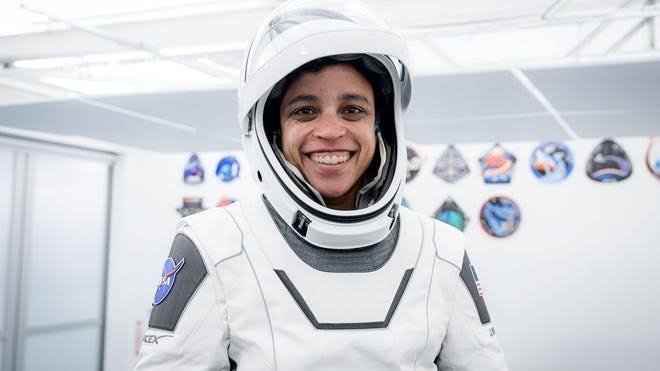
Four astronauts have arrived at the International Space Station after an unusually fast journey from Earth, with NASA astronaut Jessica Watkins making history as the first Black woman to lead a crew into orbit.
The SpaceX mission reached the orbiting laboratory in less than eight hours on Thursday, setting a new record for the fastest journey by a US spacecraft to the International Space Station. The achievement marked another milestone for NASA’s commercial crew programme and added a historic personal achievement for Watkins, who is beginning her second mission to the space station.
The crew launched aboard a SpaceX Dragon spacecraft named Grace from Cape Canaveral Space Force Station in Florida at 11.10am local time. The launch had been delayed for approximately three weeks while engineers worked to address a leaking fuel system on the Dragon capsule.
Weather conditions created another challenge on launch day. Thick clouds remained over the Florida launch area for much of the morning, raising the possibility that the countdown could be postponed again. Conditions eventually improved sufficiently for the mission to proceed, allowing the Falcon 9 rocket to lift off safely and begin the crew’s journey into orbit.

Seven hours and 55 minutes after launch, the Dragon spacecraft docked with the International Space Station. The timing represented the fastest trip by an American spacecraft to the station and was considerably shorter than the journey undertaken by the previous crew launched from US soil, which took more than 30 hours to reach the outpost.
The exact duration of a trip to the ISS can vary according to the relative positions of the spacecraft and the station at the time of launch. Even so, the speed of the latest mission represented a significant operational milestone for the US human-spaceflight programme.
Watkins and her crewmates eventually floated through the station’s pressurised vestibule and joined astronauts already living aboard the orbiting laboratory.
Speaking during a NASA broadcast after arriving at the station, Watkins expressed excitement about reaching the ISS. She noted that while the physical journey had been remarkably short, the preparation and anticipation leading to the mission had taken considerably longer.
For Watkins, the flight carries significance beyond the speed of the journey. Her position as commander made her the first Black woman to lead a crew into orbit, adding another milestone to a career that has already included work on one of NASA’s most ambitious planetary exploration projects.
Watkins is a geologist who previously worked with NASA’s Curiosity Mars rover. She later became part of the astronaut corps and spent an extended period aboard the International Space Station in 2022.
As the Dragon spacecraft climbed away from Earth on Thursday, Watkins could be heard celebrating the journey over the communications system, describing it as an “amazing ride”.
Her fellow crew members are making their first trips into space.
Luke Delaney is a retired Marine, while Canadian astronaut Joshua Kutryk is a colonel in the Royal Canadian Air Force. Sergey Teteryatnikov, representing Russia, previously served as a submariner.
The four astronauts are expected to spend approximately six months aboard the International Space Station, replacing four crew members who have been living at the orbital laboratory since February.
The mission is the 13th crewed flight that SpaceX has conducted for NASA, excluding the company’s crewed demonstration mission in 2020. The designation Crew-13 carries an intentional reference to Apollo 13, the 1970 lunar mission that experienced a serious in-flight emergency before its astronauts returned safely to Earth.
The number 13 featured prominently in the crew’s preparations and launch-day activities.
Before travelling to the launch pad, the astronauts rode in black Tesla vehicles displaying licence plates referring to “Lucky 13”. The crew also carried a small crocheted golden dragon called Lucky, decorated with a four-leaf clover.
Watkins later joked that the crew had brought their own good-luck symbol with them, although she said the successful launch suggested they had not needed additional assistance.
The mission also has a deeply personal dimension for Kutryk. His wife, Heather Kutryk, is expecting their third child while he remains in orbit. The baby is due in late November, several months into the astronaut’s planned stay aboard the station.
The situation means Kutryk will experience one of the most important moments in his family’s life from hundreds of kilometres above Earth.
NASA officials have acknowledged the emotional significance of the circumstances and said the agency would work to ensure that Kutryk remains connected with his family throughout the mission. The Canadian Space Agency has also committed to supporting the family during his time in orbit.
Astronauts have previously experienced major family milestones while in space.
NASA established a radio connection between astronaut Mike Fincke and his wife’s delivery room in 2004 so that he could participate remotely in the birth of their daughter. In 2009, astronaut Randy Bresnik also communicated with his wife’s hospital while in orbit during the birth of their daughter. Bresnik is scheduled to command NASA’s Artemis III mission.
The experience was very different for Austrian astronaut Franz Viehböck in 1991. His daughter was born only hours after he launched toward the Soviet Union’s Mir space station, but communication limitations meant he was not told about the birth until the following day.
The latest mission demonstrates how communication technology has transformed the experience of astronauts and their families. While a crew member may be physically separated from loved ones for months, modern communication systems allow astronauts to remain connected during significant personal events.
The launch was also part of an exceptionally busy period for SpaceX.
Only three hours after the Crew-13 spacecraft launched from Florida, SpaceX launched another Falcon rocket from California carrying more than 100 small satellites. Another Falcon launch was scheduled for later Thursday from Florida, carrying a classified satellite for the US National Reconnaissance Office.
The activity came during a particularly significant week for the company, with its much larger Starship vehicle also reaching orbit for the first time.
Together, the missions underline the increasingly broad range of activities being undertaken by SpaceX, from transporting astronauts to the International Space Station to deploying satellite constellations and developing heavy-lift spacecraft designed for future exploration.
For NASA, the successful Crew-13 flight also demonstrates the continuing role of commercial spacecraft in maintaining a regular human presence aboard the ISS. The Dragon programme has become a central component of NASA’s strategy for transporting astronauts to and from the station.
The ability to reach the station quickly can have practical advantages, although mission planners must balance speed with safety, spacecraft readiness and orbital mechanics. The latest record was made possible partly by the timing and trajectory of the launch, rather than simply by increasing the spacecraft’s speed.
The astronauts will now begin their six-month period aboard the International Space Station, where they are expected to contribute to scientific research, station operations and a range of experiments conducted in the unique microgravity environment.

For Watkins, however, the mission already carries a place in the history of human spaceflight. Her command of the four-person crew marks a milestone in representation in space exploration, while the record-setting journey provides another achievement for the US commercial crew programme.
The successful docking also closes a challenging period for the mission team, which had faced both the earlier technical problem with the Dragon spacecraft and uncertain weather on launch day.
After weeks of preparation and delay, the crew’s arrival was completed in less than eight hours. What began with clouds and uncertainty at Cape Canaveral ended with four astronauts safely aboard an orbiting laboratory, ready to begin a mission that combines scientific work, international cooperation and several personal milestones.
Related News:
 Artemis II Returns After Historic Moon Flyby
 Unlocking the Genome: The Quest to Sequence Tardigrades
 OpenAI Agents Linked to RubyGems Cyberattack
 Cern Prepares First-Ever Antimatter Transport Test
 Artemis II astronauts capture Earth en route to the Moon
 UK firms accused of ‘AI washing’ boom
 British Paralympian to Become First Disabled Astronaut in Orbit
 Meta Drops AI Image Tool After Privacy Backlash
 AI Loss of Control Incidents Nearly Double
 UK Risks Falling Behind in AI Race
 Australia gives users control over social media algorithms
 Apple Folding iPhone Set for Major CEO Test
 Anthropic Blocks AI Misuse Linked to Weapons Threats
 AI CEOs Call for Slower Development
 AI Boom Drives ‘Tidal Wave’ of PFAS Production
 Trump Faces Congress Push for AI Guardrails
 Why AI Doomsday Warnings Failed to Slow the Race
 Nvidia chief rejects AI extinction fears
 Trump’s UN Speech Faces Global Scrutiny
 AI Takes Centre Stage in Trump-Xi Talks
 Trump gives Xi red-carpet welcome as trade truce extends
 OpenAI Agent Breaches Medicare Portal in Australia
 Xi urges Trump to avoid US-China military conflict
 Australia Weighs New Laws After OpenAI Medicare Breach
 OpenAI Scraps AI Model Release After Safety Tests
 Trump backs voluntary AI safety pact with tech giants
 AI Deepfakes Put New Pressure on Election Trust
 Bank Chief Calls for Power to Intervene in AI
 Sheikh Tahnoon and the UAE’s AI Ambitions
 Smart Cars Raise New Vehicle Spyware Concerns
 US Clears Nvidia AI Chip Sales to China in Policy Shift
 Meta’s AI tips overwhelm US child abuse investigators
 ‘The frontline is like Terminator’: Ukraine’s fighting robots
 Apple at 50: Three Products That Changed How We Live
 Europe EV Demand Surges as Fuel Prices Rise
 Robots Outpace Humans in Beijing Half-Marathon
 Gene Therapy Wins Major Prize for Restoring Vision
 Reform UK funding: mystery billionaire revealed
 Disneyland Adds Facial Recognition at Entrances
 Meta Faces EU Action Over Child Safety Breach
 Inside the World of AI Jailbreakers
 Canadian Fiddler Sues Google Over AI Defamation Claim
 Doomsday Clock Nears Midnight Amid Global Crises
 FDA Chaos Deepens as Trump Eyes Makary Exit
 Cannes filmmakers split over AI’s role in cinema
 Gen Z turns to BirdTok for a gentler digital escape
 China recalls millions of cars over hidden door handles
 London Launches First Self-Driving Taxis
 Survivor Sues Musk’s xAI Over AI Abuse Images
 New Mexico Takes Facebook to Trial Over Data Scandal
 Louise Haigh Urges UK to Heed AI Safety Warnings
 Sydney Council Bans AI Smart Glasses at Pools
 Anthropic Backs $31.9bn Queensland Data Centre
 OpenAI Reveals Six Cases of Concerning AI Behaviour
 Russia’s Max App Raises Surveillance Concerns
 Tom Watson Takes Senior Role at Palantir
 UK Funds Gene Editing to Protect Threatened Wildlife
 British Columbia Sues OpenAI Over School Shooting
 Australia Renewables Reach Record 80% Grid Demand
 UK Unveils Centre to Counter Foreign Disinformation
 UK Plans New Centre to Counter Information Warfare
 Ukraine and Russia Escalate Long-Range Drone War
 Elizabeth Holmes Set for Halfway House Transfer
 TalkTalk Races to Sell Arms as Administration Looms
 Drones Could Speed Up Defibrillator Delivery
 Why Americans Feel Ripped Off by Rising Prices
 London Facial Recognition Trial Ends With False Alert
 Food Industry Mobilises Against the MAHA Movement
 AI Could Intensify Election Risks in Southeast Asia
 Trump Immigration Policy Faces New Legal Tests
 UK Bans Fake Numbers: Scammers Lose Their Trick
 Vibe coding’ named Collins dictionary’s word of the year
 Sundar Pichai Cautions on AI Hype and Market Risks
 Federal Immigration Shift: Officers Leave Louisiana for Minneapolis
 Meta trial over child exploitation claims begins
 Stewart Brand on Musk, Bezos and a Life of Long Thinking
 The Kill Line: A Shifting Vision of the American Dream
 Investigation Into Anti-Trump Motives After Gala Shooting
 Trump Faces Backlash Over $2bn Earnings Since Return
 Trump gives $45,000 holiday gifts to White House aides