Published: 03 June 2026. The English Chronicle Desk. The English Chronicle Online.
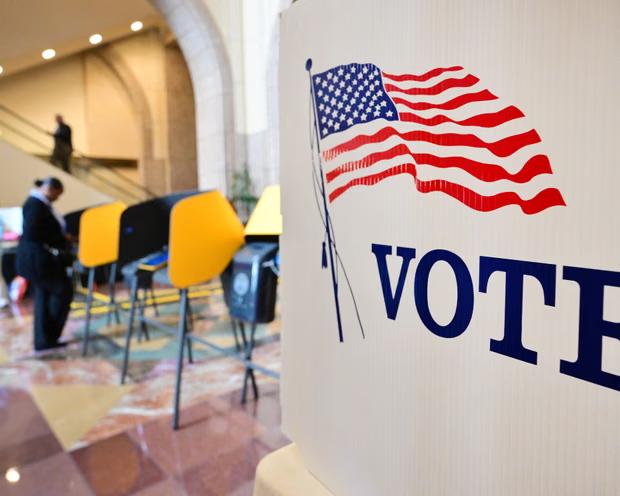
The essential battle for the California governorship remains locked in a tense, unresolved stalemate. Vote counting continues across the United States on Wednesday morning following pivotal midterm primary contests. These elections will determine which candidates compete for vital seats in the autumn vote. The upcoming November midterms are widely projected to benefit the out-of-power Democratic party.
Early results from California show a remarkably close race to lead the massive state. The frontrunners emerged as Republican Steve Hilton and Democratic former health secretary Xavier Becerra. Hilton is a former British political operative who became a popular Fox News host. Becerra previously served as a senior official in the administration of Joe Biden. The unique California jungle primary system sends the top two candidates to the final. This structural rule applies regardless of political party, creating an unpredictable general election matchup.
The billionaire progressive candidate Tom Steyer currently trails far behind the two leading contenders. Simultaneously, a dramatic mayoral battle is unfolding in the major metropolis of Los Angeles. The current Democratic incumbent Karen Bass has already secured her place on the ballot. Meanwhile, former reality television star Spencer Pratt is locked in a very tight race. He faces progressive city council member Nithya Raman for the second general election spot.
Primary results from the West Coast to New Jersey highlighted several prominent national dynamics. Voters are reflecting the intense political forces that will shape the final November outcomes. Democrats are demonstrating a clear desire for change following their devastating losses in twenty-twenty-four. President Donald Trump still maintains a powerful and enduring grip on conservative primary voters. His significant influence persists across the country despite his generally low public approval ratings. Additionally, everyday citizens continue to express a deeply pessimistic view of the American economy.
The most intensely watched local contests stretched across several highly competitive states on Tuesday. In New Jersey, Democrats hope to displace a vulnerable Republican incumbent in the House. The current representative has been notably absent due to a mysterious undisclosed medical issue. In America’s heartland, Iowa features multiple ambitious Democrats hoping to flip a traditionally conservative state. Crucial congressional races in California tested recently redrawn boundaries designed to favor the Democratic party.
Democratic strategic targets are beginning to take clear shape as the autumn field stabilises. The recent primary victories did not represent a single ideological triumph for either faction. Instead, the wins offered a calculated blend of both moderate and highly progressive candidates. This intentional ideological mixture aims to appeal to vastly different blocks of American voters. The party hopes to overperform in red states after a string of special elections. Massive financial spending is now expected across several districts currently rated as complete toss-ups.
In a key New Jersey suburban swing district, the opposition chose Rebecca Bennett. She is a prominent former healthcare executive and a veteran of the national navy. Bennett will face Republican congressman Tom Kean Junior, who easily ran completely unopposed. Trump narrowly won this specific congressional district during the last major presidential election cycle. The suburban race took on sudden national prominence due to Kean’s lengthy recent absence. The representative has missed three full months of congressional work without providing clear explanations.
The agricultural state of Iowa will witness several high-stakes rematches from two years ago. Those prior congressional contests produced some of the absolute closest results in the nation. Democrats are increasingly confident they can capture an open seat in the federal Senate. The long-serving Republican incumbent Joni Ernst recently decided not to seek another term. State representative Josh Turek won a competitive primary by projecting a moderate populist message. The successful politician defeated his anti-establishment rival, state senator Zach Wahls, on Tuesday night.
Turek will face current Republican congresswoman and former broadcaster Ashley Hinson this coming autumn. Analysts quickly moved the competitive race from likely Republican to a leaning conservative rating. The candidate’s compelling life story is expected to resonate strongly with independent local voters. Turek was born with spina bifida and achieved national fame as a Paralympic champion. Following his primary victory, he released a statement welcoming all voters to his coalition. He promised to fight tirelessly for middle-class families and workers throughout the entire state.
In Iowa’s House contests, Republicans re-nominated vulnerable representatives Mariannette Miller-Meeks and Zach Nunn. Both incumbents will face aggressive challenges from a newly unified and energised Democratic base. Former state representative Christina Bohannan easily secured her nomination to challenge Miller-Meeks once again. Bohannan previously came within eight hundred votes of winning the seat two years ago. Nunn and his Democratic opponent, Sarah Trone Garriott, both ran completely unopposed on Tuesday.
Gubernatorial elections across the nation have also solidified critical opportunities for both major parties. These state-level executive races carry profound importance during eras of persistent congressional gridlock. In Iowa, Democrats view state auditor Rob Sand as a highly viable statewide candidate. Sand will run for governor following the planned retirement of Republican Kim Reynolds. In South Dakota, the Republican contest for governor is officially headed to a runoff. Businessman Toby Doeden advanced, while current governor Larry Rhoden fights for the second spot. Rhoden previously assumed office when Kristi Noem joined the cabinet of the Trump administration.
In New Mexico, former interior secretary Deb Haaland secured the Democratic nomination for governor. Haaland is heavily favored to win the general election in the blue-leaning western state. If successful, she will become the first female Native American governor in history. The primary results also tested the impact of highly contentious redistricting maps nationwide. States have rushed to reconfigure boundaries to maximize partisan advantages before the midterms. Trump previously pushed several conservative states to adjust maps to protect a slim majority. A recent Supreme Court ruling significantly weakened existing federal voting rights legislation as well.
That judicial decision allowed multiple conservative states to aggressively alter their local congressional boundaries. California voters intentionally retaliated by drawing lines designed to net five extra Democratic seats. The internal ideological debates animating the modern Democratic party also featured heavily in several races. Factions clashed over economic policy, Israel, and the best strategy to defeat Donald Trump. State senator Scott Wiener won the primary to succeed retiring former House Speaker Nancy Pelosi. It remains unclear whether Wiener will face progressive Connie Chan or tech executive Saikat Chakrabarti. Pelosi has endorsed Chan, while Chakrabarti previously served as chief of staff to Alexandria Ocasio-Cortez.
Despite the optimistic Democratic outlook, several strong Republican candidates could complicate the national picture. In New Mexico, conservative Greg Cunningham faced no formal opposition in his primary race. He will challenge Democratic congressman Gabe Vasquez in a highly unusual congressional district. This area voted for Trump in twenty-twenty-four but simultaneously elected a Democratic representative. The Democratic Congressional Campaign Committee quickly labeled Cunningham a rubber stamp for an extreme agenda. Meanwhile, local party leaders praised Vasquez as a trusted and reliable independent voice.
In Montana, Republicans rallied around talk radio host Aaron Flint for an open seat. Flint is Trump’s handpicked choice to succeed outgoing representative Ryan Zinke in Congress. The political commentator previously worked directly as a staffer in Zinke’s official congressional office. Flint secured endorsements from the governor, Senator Tim Sheehy, and the former president himself. The Democratic primary field features former candidate Ryan Busse and organizer Sam Forstag. Political forecasters currently rate the Montana congressional race as a likely win for Republicans.
Concurrently, Kurt Alme rose to the top of Montana’s competitive Republican Senate primary. Alme will face a formidable challenge from independent candidate Seth Bodnar in November. Strategic outside spending by conservative groups attempted to boost a more left-wing primary candidate. Republicans hoped to split the independent vote to ensure an easier path to victory. It remains uncertain if Democratic primary winner Alani Bankhead will withdraw from the race. National strategists want to clear the path for a direct two-way contest against Alme. A similar tactical dynamic is currently playing out in the neighboring state of Nebraska.
In South Dakota, current state attorney general Marty Jackley won his competitive primary contest. Jackley is running to replace Dusty Johnson, who is currently campaigning for state governor. Buoyed by an endorsement from Trump, Jackley easily defeated his conservative opponent James Bialota. This victory leaves Jackley extremely well-positioned to win the state’s sole congressional seat. The reliably conservative state has consistently voted for Republican representatives for several consecutive decades.
The primary results carry profound implications for the future direction of both American parties. The outcomes clearly illustrate the complex issues that voters have faced since twenty-twenty-four. In New Jersey’s twelfth district, plastic surgeon Adam Hamawy rose rapidly from total obscurity. The army veteran gained prominence after traveling on a medical mission to Gaza last year. Hamawy secured the nomination to succeed the retiring veteran congresswoman Bonnie Watson Coleman. He is vocal about his progressive views and his direct criticisms of Israeli military policy. His primary victory in the safely Democratic seat ensures a general election win in November. Hamawy will become the first Muslim lawmaker to represent New Jersey in Washington.
Related News:
 Putin Intensifies Territorial Demands Before US Talks
 Trump to Recheck Green Cards from 19 Nations After DC Attack
 Trump Escalates Minnesota Immigration Surge Amid Rising Tensions
 Greenland Faces Pivotal Summit Over Arctic Power Struggle
 Trump Threatens Strong Action If Iran Executes Protesters
 Trump Receives Machado’s Nobel Medal in White House Meeting
 EU Says US Ties Have Suffered ‘Big Blow’ After Greenland Crisis
 Thousands Protest ICE Operations in Nationwide US Day of Action
 Epstein Files Reveal Trump Officials’ Emails with Financier
 Thousands Protest ICE in New York Against Trump Deportation Campaign
 Trump Praises ‘Terrific’ Petro After White House Talks
 Clinton Testimony Erupts in Fiery Exchange
 Trump Faces Questions Over Iran Conflict Plan
 UK Prepares Aircraft Carrier for Middle East Crisis
 Pete Hegseth Iran War Remarks Spark Alarm
 Trump’s Harsh Rhetoric on Iran Sparks Global Alarm
 Trump Faces Crisis as Iran Reopens Hormuz Tensions
 Charles Faces Trump Test in High-Stakes US Visit
 UK Stands Firm on Falklands Amid US Rift
 US Court Ruling Reshapes Voting Rights Landscape
 US states redraw maps after voting rights ruling
 Trump orders US troop pullout from Germany
 Judge halts deportation of Yemeni refugees in US
 Trump likens US Navy actions to ‘pirates’
 Trump approval plunges amid Iran war fears
 Giuliani hospitalised in critical condition
 Ohio’s Battle for Trust: Democrats Vying to Flip the Buckeye State
 Trump Threatens UN Budget Cuts as US Pushes ‘Trade Over Aid’ Agenda
 Trump warns Iran as Middle East tensions surge again
 US ‘Narco Boat’ Strikes Draw Global Outcry
 Indiana Republicans Defy Trump in Key Vote Test
 US Court Restores Abortion Pill Access Temporarily
 Ohio Primaries Set Stage for Crucial Midterms
 Afghan Families Left in Limbo Face Risk of Deportation
 Tensions Emerge in Netanyahu-Trump Alliance
 US Awaits Iran Reply on New Ceasefire Proposal
 Hormuz Talks Near Critical Stage
 Trump’s Revenge Drive Deepens GOP Divide
 Former ICC prosecutor condemns US sanctions
 Gunman Killed After White House Security Shootout
 Trump Claims Iran Peace Deal Near Completion
 House Curbs Trump’s War Powers in Rare Rebellion
 Mystery Grows Over Mitch McConnell’s Health
 Senate Halts Defense Bill Over Iran Clashes
 Trump Jokes, Jabs and Press Tensions at WHCA Dinner
 Houthis Strike Saudi Arabia as Middle East Tensions Rise
 Is America Ready for an AOC Presidential Run?
 Trump dismisses concerns over 250-day carrier deployment
 BBC to Apologise Over Edited Trump Speech Amid Backlash
 Britain deploys RAF specialists to assist Belgium with drone threats
 Greene Pushes Epstein Files Amid Trump Fallout
 December Run-Off in Chile as Election Produces No Winner
 Shadow Fleet at Sea: Europe’s Battle Against Illicit Oil Shipping
 Georgians Defy Government Crackdown After Year of Protests
 American Mother Extradited From UK to U.S. on Murder Charges
 Trump press secretary attacks reporter over ICE question
 Greenland Crisis Forces Europe to Draw a Line With Trump
 Trump Fed bid heads to Supreme Court
 Pentagon Signals Reduced Role in Deterring North Korea
 Partial US Government Shutdown Hits Homeland Security Funding
 UK and US Drop in Global Corruption Index Rankings
 Canberra Poster Seizure Sparks Free Speech Row
 Evo Morales Returns After Mysterious Absence
 Jacinda Ardern Moves To Australia Following Her US Fellowships
 Jacinda Ardern Move Sparks Kiwi Reflection
 Nick Greiner Warns Over Election Review Fallout
 Injured Mojtaba Khamenei Elevated as Iran Leader
 Gordon Brown urges court for crimes against children
 Pakistan Targets Militant Hideouts in Afghanistan
 Air Canada CEO Faces Outcry Over Recent Language Misstep
 Relationship with Trump may be beyond repair, Starmer warned
 Trump Signals Hope for New Iran Talks as Ceasefire Fades
 Trump Brokers Landmark Lebanon Ceasefire Amid Regional Hopes
 Investigation Into Anti-Trump Motives After Gala Shooting
 Trump Announces 3-Day Russia–Ukraine Ceasefire Deal
 Fear and Betrayal: The Chilling Case of Kouri Richins
 Trump Sends 5,000 More US Troops to Poland
 Farage and Reform UK Reshape British Politics
 US Courts Back Trump on Park Signage Removals
 Trump’s Mount Rushmore Speech: A Divisive Anniversary