Published: 15 July 2026 | The English Chronicle Desk | The English Chronicle Online
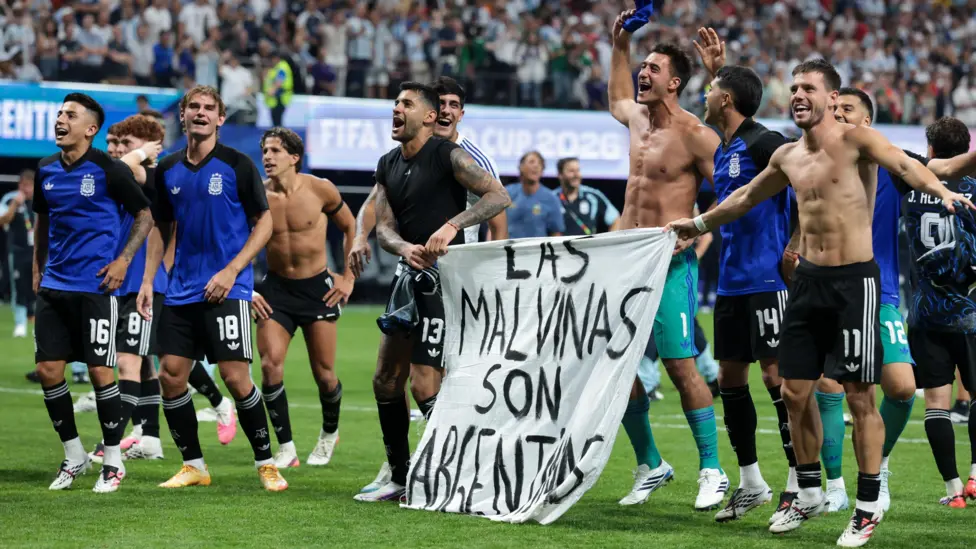
Argentina could face disciplinary action from FIFA after members of the national team displayed a banner referring to the Falkland Islands during post-match celebrations following their World Cup semi-final victory.
The incident has sparked fresh controversy surrounding one of the world’s longest-running territorial disputes, with football authorities now assessing whether the display breached regulations governing political messages at international sporting events.
While Argentina celebrated its place in the FIFA World Cup final, attention quickly shifted away from the result as images of players holding or posing with a banner linked to the Falklands dispute circulated widely across social media and international news outlets.
FIFA has yet to announce whether formal sanctions will be imposed, but officials are understood to be reviewing reports from match delegates and disciplinary officers.
Argentina secured a memorable victory to reach the World Cup final, with players and supporters celebrating long after the final whistle.

However, the celebrations took an unexpected turn when a banner referencing the Falkland Islands was displayed during the post-match festivities.
The banner reflected Argentina’s long-standing claim over the islands, known in Argentina as the Islas Malvinas.
Images of the display quickly attracted international attention, prompting debate over whether political messages should appear during FIFA tournaments.
Officials are now examining the circumstances surrounding the incident, including whether the banner was introduced by players, team staff or supporters.
FIFA maintains strict regulations prohibiting political, religious or ideological messages during official competitions.
The governing body has repeatedly emphasised that football should remain politically neutral, particularly during major international tournaments watched by millions around the world.
Players, coaches and national associations are expected to comply with competition rules governing celebrations, clothing and public displays inside stadiums.
If investigators determine that tournament regulations were breached, FIFA’s disciplinary committee could issue sanctions ranging from warnings and financial penalties to other disciplinary measures.
No decision has yet been announced.
The Falkland Islands have remained a source of diplomatic disagreement between Argentina and the United Kingdom for generations.
Britain has administered the South Atlantic islands since the 19th century, while Argentina continues to claim sovereignty over the territory.
The dispute escalated dramatically in 1982 when Argentina invaded the islands, leading to a ten-week conflict with the United Kingdom.
British forces ultimately regained control, but the issue has remained central to Argentine foreign policy.
Successive Argentine governments have continued to advocate for negotiations over sovereignty, while the British government maintains that the islanders have the right to determine their own political future.
International sporting competitions have frequently found themselves at the centre of political debates.
Football’s global popularity means symbolic gestures made by players or supporters often receive worldwide attention beyond the sporting arena.
In recent years, FIFA has taken action in several cases involving political statements, unauthorised slogans and symbolic displays during international competitions.
The organisation argues that maintaining neutrality protects the integrity of tournaments and prevents sporting events from becoming platforms for geopolitical disputes.
Critics, however, argue that distinguishing political expression from cultural or national identity can sometimes prove difficult.
The banner has generated contrasting reactions in both Argentina and the United Kingdom.
Many Argentine supporters viewed the display as an expression of national identity and historical sentiment surrounding the islands.
Others questioned whether the World Cup was an appropriate stage for raising politically sensitive issues.
In Britain, the incident prompted criticism from commentators who argued that international football should remain separate from diplomatic disputes.
The debate has continued across social media, with supporters from both countries expressing differing perspectives on the controversy.
Officials representing the Argentine Football Association have not provided detailed public comments regarding the possibility of disciplinary action.
Team representatives are expected to cooperate with any inquiries conducted by FIFA if requested.
The coaching staff has largely focused on preparations for the upcoming World Cup final rather than the controversy surrounding the celebrations.
Players have also avoided discussing the incident publicly while attention turns toward the tournament’s decisive match.
Sports law experts note that any disciplinary response will depend on FIFA’s assessment of the available evidence.
Investigators are likely to examine official reports, broadcast footage, photographs and witness accounts before determining whether competition rules were violated.
Potential outcomes could include formal warnings, financial fines or other administrative sanctions against individuals or the national football association.
Experts caution that disciplinary proceedings often consider intent, context and previous conduct before determining appropriate penalties.
Despite the controversy, Argentina remains focused on preparing for the World Cup final.
The team has impressed throughout the tournament with disciplined defending, effective teamwork and consistent performances against elite opposition.
Coaches will be hoping external attention does not distract players from the opportunity to compete for football’s biggest prize.

Meanwhile, FIFA’s disciplinary process is expected to continue independently of preparations for the final.
The incident highlights the challenges international sporting organisations face when political disputes intersect with global competitions.
Football tournaments often bring together nations with complex historical relationships, making it difficult to separate sport entirely from wider geopolitical issues.
FIFA has consistently maintained that its competitions should promote unity, respect and fair play while avoiding political controversy.
Whether disciplinary action ultimately follows, the banner has already become one of the tournament’s most talked-about off-field moments.
As Argentina prepares for the World Cup final, the outcome of FIFA’s review will be closely watched by football associations, players and supporters around the world, potentially influencing how political symbolism is handled at future international sporting events.
Related News:
 Trump Helps Clear Balogun for Belgium World Cup Clash
 Trump’s Red-Card Intervention Hurts the US World Cup
 Rising World Cup Ticket Prices Spark Concern
 Fans Angry Over US Visa Rules Before World Cup
 Iran Team Arrives in Mexico Amid US Visa Dispute
 Scotland Branded “Unprofessional” in World Cup Fallout as England Build Momentum
 Chinese Football Fans Embrace Referee as Unexpected World Cup Figure
 Referee Controversy Raises Questions Over FIFA’s Control of the World Cup
 Nike Charges Fans Most for World Cup Replica Shirts
 Saka Playing Through Pain As England World Cup Campaign Looms
 England Cruise Past Costa Rica as World Cup Warm-Up Sharpens Tuchel’s Vision
 ‘We all love him’: Henderson backs Bellingham for England success
 Can France Escape the Ghosts of their 2002 World Cup Nightmare?
 Deschamps Shields Mbappé From Fierce Political Storm
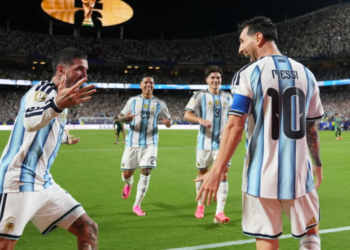 Messi Equals World Cup Record In Masterclass Victory
 Erling Haaland Double Fires Norway To Victory On Debut
 Iran Files Official Fifa Complaint Over World Cup Travel
 Historic Victory for Canada as They Defeat Nine-Man Qatar
 Heartbreak for Canada as Koné Suffers Horrific Injury
 Declan Rice Facing Burnout as Tuchel Confronts Midfield Crisis
 Rodrygo Reflects On World Cup Pressure And Social Media
 How ‘Little Scotland’ Is Embracing the World Cup Spirit
 Cape Verde Hold Uruguay in Dramatic World Cup Clash
 World Cup 2026: Reclaiming the American Dream
 The Forgotten Hosts Making World Cup History Behind the Scenes
 Great Stories, Little Jeopardy – Does the New World Cup Format Really Work?
 Martinelli Strikes Late as Brazil Edge Past Brave Japan
 Paraguay Shock Germany in Historic Penalty Shootout
 Morocco Beat Dutch in Wild World Cup Penalty Drama
 England Fans Praised for ‘Excellent’ Behaviour During World Cup Campaign
 France Dominate Sweden as Deschamps’ New Era Takes Shape
 Haaland Heroics Send Norway Into Historic Last 16 Knockout
 Kane Saves Tuchel as England Survive Dramatic Exit
 Ramos Sends Portugal into the Last 16
 Swiss Star Manzambi Shines in World Cup Victory
 Norway’s Stunning World Cup Victory Over Brazil
 England Triumph in Azteca World Cup Thriller
 Trump Intervenes in Fifa World Cup Balogun Ban
 Haaland Makes History as England Prepare for Biggest Test
 Trump Helps Clear Balogun for Belgium World Cup Clash
 England’s 10 Men Hold Firm in World Cup Thriller
 USA World Cup Heartbreak: Belgium Ends Their Dream
 Spanish Late Winner Sends Ronaldo Into Final Sunset
 Belgium Thrashes USA After Red Card Controversy
 Balogun Drama Overshadows USA’s World Cup Exit
 Messi’s Tears and Triumph in Epic World Cup Escape
 Switzerland Advance in Penalty Thriller
 Egyptian Fury After Argentina World Cup Heartbreak
 World Cup 2026 Power Rankings: England on the Rise
 Mbappé Brilliance Leads France Into Semi-Finals
 Belgium Draws Global Support Before Spain Showdown
 Golden Boot Battle Reaches World Cup Boiling Point
 Rollercoaster Semi-Final Leaves Fans Breathless
 Haaland and Bellingham: A Dortmund Bond Tested
 Rice Poised for England Semi-Final Clash Against Argentina
 Teamwork Over Talent: How Spain Outclassed France to Reach the World Cup Final
 Tuchel: England Ready for Historic Argentina Clash
 Tuchel Backs England Stars to Overcome Messi’s Argentina
 Argentina End England’s World Cup Dream With Semi-Final Victory
 Iran, the US, and a World Cup That Starts in Three Months
 Iranian Footballers Escape Team Hotel to Seek Asylum
 Can Congress Stop US Sports Teams From Moving Cities?
 ‘Safe Haven’: Iranian Footballers Rebuild Lives in Australia Following Asylum Bid
 Breaking the “Glass Turnstile”: Bradford City Leads Charge for Greater Gender Diversity
 Southgate Calls for Different Approach to Boys
 Fans Bring Flags and Fire to World Cup Scenes
 11 EFL Stars Ready to Shine at World Cup
 Fans Invited to Share Scotland World Cup Stories
 “My Drinking Days Are Over” — How to Enjoy an Alcohol-Free World Cup
 Kane Enters Ballon d’Or Debate After Bayern Form, but World Cup Seen as Decisive Factor
 Football Regulator Contacts West Ham Over “Serious Allegations” Linked to Sullivan
 Tuchel’s England Mission Goes Beyond Football Success
 US Advance Past Bosnia in World Cup Thriller
 Police Raise Concerns Over Government’s Late Decision to Extend Pub Opening Hours for England Match
 Paul Seixas: French Cycling’s Teenage Hope at the Tour
 Ronaldo Says Farewell to the World Cup Stage
 Kane vs Haaland: Which Striker Would You Choose?
 De la Fuente’s Spain Eye History Through Unity
 Bryne Backs Haaland Before England World Cup Clash
 Lamine Yamal’s Birthday: Football, Fame, and France