Published: 26 August 2026. The English Chronicle Desk. The English Chronicle Online.
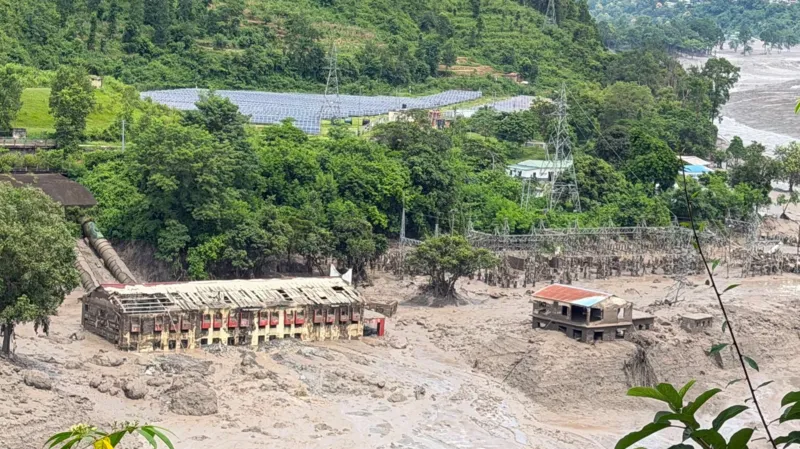
A massive flash flood and mudslide along the Nepal-Tibet border has washed away villages, damaged roads and infrastructure, and left authorities fearing a high number of casualties. Rescue teams are searching affected areas on both sides of the border as communication links, electricity supplies and transport routes have been disrupted.
The disaster struck early on Wednesday in Nepal’s Rasuwa district, north of Kathmandu, along the Bhote Koshi River, which originates in Tibet and flows into Nepal. Nepalese authorities said the full extent of the destruction was still being assessed, while officials warned that the death toll could rise as rescue workers reach areas cut off by floodwater and debris.
Reuters reported that at least eight people had been confirmed dead in Nepal by Wednesday morning, while officials continued to warn of potentially heavy casualties. Across the border in Tibet, Chinese state media reported major casualties and missing people after a mudslide struck the Gyirong area near the Nepal border.
The sudden surge of water caused extensive damage in and around Syapru Besi and Timure in Rasuwa, areas with a combined population of roughly 50,000. Roads and bridges were damaged, while several infrastructure and hydropower project sites were affected. Authorities also reported disruptions to communications and electricity.

Rescue operations have been complicated by the scale of the flooding. Helicopters sent to assist could not immediately land in some affected areas because water levels remained dangerously high. Nepalese security forces have been deployed alongside civilian emergency teams to search for missing people and assist those stranded by the disaster.
District administrator Narendra Pariyar warned that the final scale of casualties and property damage was not yet known. Residents living close to the Bhote Koshi River were urged to move to safer, higher ground because of the continuing risk of flooding and secondary landslides.
The destruction has also disrupted a strategically important transport corridor linking Nepal and China. On the Tibetan side, the mudslide affected the Gyirong border port, with reports of damaged roads, power infrastructure and communications in the surrounding Shigatse region. The disruption could have wider consequences for cross-border trade because the area serves as an important route between the two countries.
The suddenness of the disaster has added to concerns among people working in the region. A Chinese businessman based in Kathmandu told the BBC that his logistics company had seven container trucks in the affected area, staffed by Nepalese employees, but that he had lost contact with all of them because there was no communications signal.
The incident has also raised concern about people working on construction and infrastructure projects in Tibet. A resident of Sichuan province told the BBC that he had lost contact with his wife, who works for a state-owned construction company involved in building roads and bridges in Tibet. Efforts to inspect some areas by helicopter were reportedly hampered by strong winds.
Nepalese authorities have urged residents in vulnerable riverbank communities to remain alert and take immediate precautions. Prime Minister Balendra Shah said police and military personnel were joining rescue and relief operations and that authorities had instructed officials to move people from lower-lying areas to safer locations.
The disaster has also placed Nepal’s already vulnerable electricity infrastructure under pressure. Nepal’s energy ministry said about 430 megawatts of electricity supply had been affected, largely because of damage or disruption to hydropower projects. That represents more than 12% of the country’s total hydropower capacity, according to a Reuters calculation.
Authorities have not yet established the precise cause of Wednesday’s flooding. The Bhote Koshi basin, however, has experienced a similarly destructive event before. In July 2025, a major flood on the same river killed at least eight people, left dozens missing and washed away the Friendship Bridge connecting Nepal and China.
An investigation after the 2025 disaster found evidence that the earlier flood was triggered by the drainage of a supraglacial lake in Tibet. Satellite analysis by the International Centre for Integrated Mountain Development indicated that the lake had drained suddenly, sending a large volume of water into the river system. Experts have warned that such events are becoming an increasing concern across the Hindu Kush-Himalayan region.
The latest disaster therefore comes against a broader backdrop of increasing exposure to extreme weather in the Himalayan region. Mountain communities are particularly vulnerable because steep terrain can transform sudden water releases, heavy rainfall or landslides into destructive torrents within minutes.
The effects can also extend well beyond isolated villages. Roads, bridges, power stations, telecommunications networks and border crossings can all be damaged simultaneously, making emergency response more difficult and slowing the delivery of food, medicine and other essential supplies.
In the current disaster, the priority remains locating missing people and evacuating communities at risk. Authorities are continuing searches while monitoring river levels and unstable slopes. The Nepalese government has also called on people living near rivers to remain particularly cautious as the threat of further flooding and landslides remains.
China has likewise intensified its response on the Tibetan side. Chinese President Xi Jinping called for comprehensive search and rescue operations and stronger disaster monitoring and early-warning systems, according to Chinese state media cited by Reuters.

For families waiting for news from the affected areas, the lack of communications has made the situation especially difficult. Roads cut by floodwater and mudslides have limited physical access, while damaged communications infrastructure has prevented relatives from establishing contact with people in isolated communities.
The authorities now face the difficult task of reaching the worst-hit locations, accounting for missing people and assessing damage to critical infrastructure. As rescue teams work through the affected areas, officials continue to warn that the human and economic cost of the disaster may become clearer only after access is restored.
The flash flood has once again demonstrated the vulnerability of communities along the Nepal-Tibet border to sudden Himalayan disasters. With villages, transport links, power facilities and cross-border infrastructure exposed to the same hazards, the latest emergency is likely to renew calls for stronger early-warning systems, coordinated disaster response and closer monitoring of glacial and river conditions across the region.
Related News:
 Cyclone Vaianu Forces Mass Evacuations in New Zealand
 Venezuela Quake Death Toll Surpasses 4,000
 Powerful 7.7-Magnitude Earthquake Hits Eastern Indonesia
 Wildfires rage across Europe as hundreds arrested in France
 Storm Leonardo Triggers Election Delay Calls in Iberia
 Nine Killed in Karachi Consulate Protest
 North Korea Fires Missiles Amid US-South Korea Drills
 Anti-Regime Iranians Turn Anger Toward Trump
 Evacuations Ordered as California Wildfires Spread Fast
 Queensland Braces for Potential Second Severe Cyclone Hit
 Moldova River Crisis Exposes War’s Hidden Cost
 Chornobyl Still at Risk 40 Years After Disaster
 Southeast Asia Turns to Russia Amid Energy Crisis
 Escobar’s Hippos May Be Moved to India Zoo
 Capitalism ‘Suicidal’, Warns Petro at Climate Summit
 Coalition pushes fossil fuel phaseout plan
 China Fireworks Factory Blast Kills 21 in Hunan
 Australia pushes Pacific security pact amid China tension
 BJP Sweeps West Bengal in Historic Breakthrough
 Norway Doubles Down on Oil and Gas for Europe Energy Security
 Doomsday Clock Nears Midnight Amid Global Crises
 US Awaits Iran Reply on New Ceasefire Proposal
 One Nation Stuns Australia With Historic Farrer Win
 Hormuz Talks Near Critical Stage
 China mine blast death toll rises to 90
 Maldives Cave Diving Tragedy Raises Safety Alarm
 Pope Meets Families in Italy Toxic Waste Zone
 Discontent grows around Putin amid war strain
 UN Issues Urgent Warning: Imminent Return of El Niño
 Germany Summons Chinese Envoy Over Russian Troop Training
 Sydney Records Hottest June Since 1859 as Expert Warns New High a ‘Signature’ of Global Warming
 Millions Gather for Khamenei’s Six-Day State Funeral
 Olympus Awaits Unesco Heritage Recognition
 Houthis Strike Saudi Arabia as Middle East Tensions Rise
 Wildfires Force Mass Evacuations in France And Spain
 Taliban global ties grow as rights fears mount
 Seoul proposes historic peace talks to replace Korean War armistice
 Israeli Strike in Southern Lebanon Kills Seven
 Five Years of Taliban Rule Leave Afghanistan in Crisis
 Vietnam Youth Rally Behind Hanoi ‘Justice Tree’
 China Probes Alleged Formaldehyde Use on Cabbages
 Shein targets $27bn valuation in Hong Kong debut
 Nearly 90,000 ordered to flee Reno wildfire
 UK Must Act with Courage and Clarity on Israel-Palestine Conflict, Says Foreign Affairs Committee Report
 Channel Crossings Surge: Over 1,000 People Arrive in the UK in Small Boats in a Single Day
 Macron Phones Trump Over Traffic Jam in New York
 Comey Indictment Deepens Fears of Political Retribution Under Trump
 Yvette Cooper Signals Global Momentum Towards Gaza Peace Deal Amid Humanitarian Crisis
 Chaos at Ibrox as Martin’s Rangers Era Comes to an End
 Russia’s Latest Push to Win US Favors Shows Deep Desperation
 BBC to Apologise Over Edited Trump Speech Amid Backlash
 Greene Pushes Epstein Files Amid Trump Fallout
 Zelenskyy Signs Fighter Jet Deal Amid Russian Drone Attacks
 Shadow Fleet at Sea: Europe’s Battle Against Illicit Oil Shipping
 US Suspends Afghan Immigration After White House Shooting
 ‘Extinct’ Antelope Returns to Sahara, Bringing Hope
 Irish Beach Tragedy: Irish Drown at Whitehaven Beach in Australia
 Greenland Crisis Forces Europe to Draw a Line With Trump
 UK and US Drop in Global Corruption Index Rankings
 Canberra Poster Seizure Sparks Free Speech Row
 Jacinda Ardern Move Sparks Kiwi Reflection
 Middle East Airspace Crisis Strands Thousands
 Kelly Wilkinson Inquest Reveals Bail Failure
 Injured Mojtaba Khamenei Elevated as Iran Leader
 The Kill Line: A Shifting Vision of the American Dream
 Pakistan Targets Militant Hideouts in Afghanistan
 ICE detention warning sparks fear among immigrants
 Air Canada CEO Faces Outcry Over Recent Language Misstep
 Extreme Weather: Europe Shivers as Cyclone Narelle Hits
 Asia Turns Back to Coal Amid Middle East Energy Crisis
 Relationship with Trump may be beyond repair, Starmer warned
 Trump’s Six-Week Iranian War: The High Cost of Ignorance
 Ben Roberts-Smith Denies War Crime Allegations in First Statement
 RFU Backs Borthwick Despite England’s Poor Six Nations
 Trump Rejects Tehran Peace Plan as Regional Truce Crumbles
 Trump Sends 5,000 More US Troops to Poland
 Britain’s Crowning Butterfly Takes the Nation by Storm
 Fifa Official Under Investigation Over Hand Gesture Controversy
 Grief and Devotion Amidst the Rubble of Nabatieh
 England and Norway Fans Turn Miami Into World Cup Carnival