Published: 19 May 2026. The English Chronicle Desk. The English Chronicle Online.
The United States government has announced a sudden reversal regarding its international energy policy. Officials extended a crucial sanctions waiver allowing continued purchases of Russian seaborne crude oil. This emergency decision grants a thirty-day window to assist highly energy-vulnerable nations globally. These countries currently face severe economic strain caused by the ongoing war in Iran. The unexpected policy shift directly contradicts previous American promises to end such financial loopholes.
Treasury Secretary Scott Bessent confirmed the issuance of this temporary general licence today. The announcement followed the quiet expiration of a previous sanctions waiver last Saturday evening. This new window permits global buyers to access Russian oil stranded on tankers. Without this legal protection, merchants would violate severe American sanctions on Russian firms. Major state-backed entities like Rosneft and Lukoil remain primary targets of these sanctions.
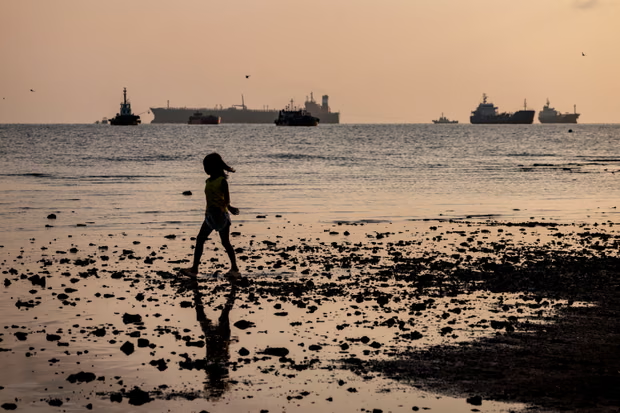
Secretary Bessent defended the controversial move during a press conference in Europe. He argued that the general licence will successfully stabilise the physical crude market. The policy ensures vital energy supplies reach the countries most vulnerable to disruptions. This intervention addresses severe shipping backlogs currently affecting global maritime trade routes today. Millions of barrels remain stuck at sea due to complex international legal blockades.
The decision represents a major policy U-turn for the current American administration. Last month, Secretary Bessent explicitly told reporters that no further extensions would happen. He informed the Associated Press that Washington intended to tighten the financial vice. However, shifting geopolitical realities on Monday forced a complete reconsideration of that stance. Officials now argue the measure reroutes existing oil supplies to desperate developing nations.
This mechanism allows those poorer states to compete effectively against wealthy Asian buyers. China has consistently purchased massive volumes of heavily discounted Russian crude for months. This pattern has crowded out smaller economies unable to pay premium spot prices. This announcement marks the second time Washington has allowed waivers to expire before renewing them. This repetitive pattern signals deep internal debates within American foreign policy circles today.
The domestic political reaction to the Treasury announcement was immediate and highly critical. Two senior Democratic senators launched a fierce rhetorical attack against the administration on Monday. Senator Jeanne Shaheen of New Hampshire expressed deep frustration with the policy shift. Senator Elizabeth Warren of Massachusetts joined her colleague in condemning the executive decision. They jointly blasted the temporary waiver as an indefensible gift to Moscow.
The senators argued that every additional dollar earned helps finance the Ukrainian conflict. Wealth flowing back to the Kremlin directly funds military operations against innocent civilians. Their joint statement emphasized that American sanctions relief has completely failed domestic consumers. Motorists across the United States have seen no relief at local petrol pumps. Global energy markets also remain highly volatile despite these repeated regulatory interventions.
The historical context of these measures dates back to aggressive actions taken last year. The Trump administration slapped strict sanctions on Russian oil majors to pressure Moscow. Washington aimed to deprive the Russian federation of vital revenue used for military expansion. Those original measures targetted the largest corporate pillars of the domestic Russian economy. However, subsequent military escalations in the Middle East severely disrupted global supply chains.
Recent military strikes involving Israel and Iran drove global oil prices up sharply. This severe supply crunch forced the American Treasury to adjust its strategy initially. Policymakers issued the first temporary licence in March to combat rising energy costs. They attempted to mitigate dramatic price spikes by releasing trapped Russian petroleum products. Thousands of tons of fuel sat completely unusable inside restricted maritime shipping containers.
Crucially, these specific waivers do not apply to newly extracted Russian crude oil. The legal exemptions only cover material already loaded onto ships weeks ago. Independent market analysts remain deeply skeptical about the true efficacy of these waivers. Experts suggest short-term exemptions might help a few specific nations dependent on Gulf oil. However, the policy will do very little to reduce retail fuel prices.
Former Treasury policy director Stephanie Connor shared her professional perspective on the matter. She stated that short-term authorizations rarely impact domestic petrol prices significantly. She also reminded reporters that British and European energy sanctions remain fully active. London and Brussels have refused to mirror the flexible approach adopted by Washington. This divergence creates a complex regulatory environment for international commodity trading firms.
The current licence restricts purchases to crude loaded prior to mid-April this year. This clever mechanism effectively limits the total volume of allowed international sales transactions. It prevents Moscow from dumping freshly harvested crude onto the global market immediately. However, critics argue the nuance matters little to the Russian treasury department. Any completed transaction provides liquid capital to a state facing immense financial pressure.
Charles Lichfield of the Atlantic Council offered an analysis of the economic impact. He stated that these waivers inevitably boost Russian oil revenues over time. Moscow already benefits significantly from artificially inflated global crude benchmarks every single day. This extra cash offsets recent successful Ukrainian drone strikes on Russian infrastructure. Kyiv has repeatedly targeted vulnerable oil refineries deep inside sovereign Russian territory lately.
Mr Lichfield suggested that the Russian economy currently faces severe internal structural weaknesses. Many economists believe this moment represents the perfect opportunity to increase sanctions pressure. He observed that the current administration seems entirely unwilling to take that risk. Washington appears far more concerned with managing immediate domestic inflation before the winter. This caution explains the reliance on short-term fixes rather than permanent structural solutions.
The immediate reaction from financial trading floors validated fears of a worsening shortage. Benchmark Brent crude futures prices surged roughly two and a half percent Monday. The global standard closed well above one hundred and twelve dollars per barrel. Traders remain deeply concerned about tightening supplies as geopolitical tensions escalate further weekly. Market liquidity continues to dry up as traditional shipping lanes become increasingly dangerous.
Secretary Bessent addressed these market anxieties while traveling through Europe this week. He is currently attending a Group of Seven finance leaders meeting in Paris. The secretary urged his international allies to enforce existing Iran sanctions more aggressively. Washington hopes that squeezing Tehran will eventually stabilise the broader Middle Eastern region. Until then, the global energy market faces a prolonged period of extreme uncertainty.
Related News:
 Capitol Attack Anniversary Sparks Deep Political Divide
 Saudi Officials Report Zubaidi Flee Before Yemen Peace Talks
 UK Targets in New York Bomb Threat Hoax: Man Jailed
 Gambia Supreme Court Hears Case to Overturn FGM Ban
 Trump targets Iran trade with 25% tariff warning
 US Senate rejects resolution limiting Trump military powers
 Gulf states warn Trump Iran strikes risk wider Middle East war
 Machado Trump medal gesture reshapes Venezuela power struggle
 Greenland defence seen as shared Nato duty amid troop arrivals
 Geopolitical football: Iran, Trump and the World Cup clash
 Canada-China trade gains momentum in new strategic partnership
 Syria President Declares Victory as Ceasefire Reached with SDF
 Shinzo Abe’s killer receives life sentence in Japan
 China General Under Investigation Amid Leadership Purge
 Philippines ferry disaster leaves 15 dead, dozens missing
 Cambridge Faces Scrutiny Over Arms Investment Transparency
 Epstein UAE Emails Shake British Royal Andrew’s Legacy
 Christchurch gunman seeks to vacate guilty plea
 Concerns rise for Canberra boy amid Iran detention fears
 Ukraine Sends Drone Experts to Defend US Bases in Jordan
 Abramovich Chelsea Sale Cash Faces Jersey Probe
 Yvette Cooper: UK Must Follow Principles, Not US Pressure
 Slovenia Election: A Nation at a Crossroads
 Jury Rules Meta and YouTube Liable for Addictive Design
 Saudi Arabia Urging US to Keep Up Iran Attacks
 The Woman Guarding Earth From the Threat of Asteroids
 IMF Predicts Global Economic Crisis Due to Gulf Unrest
 Germany Grapples With AI Abuse Following TV Star Scandal
 Exiled Tycoon Warns of New Russian Attacks on UK Soil
 LA 2028: Millions of Affordable Olympic Tickets Announced
 Trump Slams Europe as Transatlantic Tensions Boil Over
 Inside the Deceptive Machine: A Former Producer Speaks Out
 Italy Faces Third Successive World Cup Absence After Loss
 Spain Faces Backlash Over Xenophobic Chants in Egypt Draw
 A Global Voice For Justice: Stephen Lewis Dies At Age 88
 Hope and Fear as Iranians Flee Across the Turkish Border
 Reform UK Pledges To Halt Visas Over Reparations Demands
 US and Iran Agree to Two-Week Provisional Ceasefire
 Starmer visits Gulf as US and Iran agree ceasefire
 Gaza Child Arrives in UK for Life-Changing Care
 Israel Defies Ceasefire as Lebanon Operations Persist
 Pakistan Brokers Historic Peace Deal Amid Rising Tensions
 UK Holds Firm on Strait of Hormuz Amid Trump Pressure
 Trump Signals Hope for New Iran Talks as Ceasefire Fades
 Reeves Slams Trump Over Iran War Lack Of Exit Plan
 US and Iran Pursue Extension of Ceasefire via Pakistan
 Trump’s Islamabad Gamble: The High Stakes of a New Iran Deal
 Ian Katz to Step Down as Channel 4 Content Chief
 The General’s Gambit: Pakistan’s New Role in Global Peace
 Mexico, Spain and Brazil call for Cuba dialogue amid crisis
 Pakistan’s Ambitious Bid for Middle East Peace
 Trump Starts $166bn Tariff Refund Process
 Israeli Soldiers Jailed Over Vandalism of Lebanese Statue
 Trump Weighs Sending Afghan Allies to the Congo
 Pentagon Shakes Up Navy Leadership Amid Hormuz Blockade
 Trump Threatens UK With Big Tariff Over Tech Tax
 Prominent Voices Challenge Palestine Action Ban
 Security Scrutiny After Washington Shooting Incident
 Merz Criticises US Approach in Iran Conflict
 UK Envoy Sparks Controversy Over Special Relationship Claims
 Ukraine Urges UK to Seize Russian Oil Tankers
 US Calls Australia Media Law “Foreign Extortion”
 The Billionaire’s Secretary and the £1m Fraud
 Ukraine strikes Tuapse as oil disaster worsens
 Brewing Tension: Taiwan Baristas Rebrand for World Stage
 Tensions Emerge in Netanyahu-Trump Alliance
 Mission to the World’s Edge: A Heroic Rescue in Tristan
 US and Mexico Face Heatwave as Floods Batter South Africa
 Mexico’s Missing: State Complicity in a Growing Crisis
 French Patient Told Hantavirus Was Just Anxiety
 The Long Way Home: Australia’s High-Stakes Virus Mission
 Putin Signals War End as Russian Momentum Stalls
 Romania’s Judicial Crisis: A System Under Siege
 Lee Lai Makes History with Landmark Stella Prize Victory
 Philippine Senator Flees After Days Under Senate Siege
 Alberta Separatist Bid Blocked by Canadian Court
 Canadian Court Blocks Alberta Independence Referendum Bid
 Big Tobacco Under Fire Over Controversial New Ad Campaign
 Bolsonaro Son Tape Scandal Sparks Massive Brazil Backlash
 Court Upholds Landmark Win for Transgender Rights