Published: 22 May 2026. The English Chronicle Desk. The English Chronicle Online.
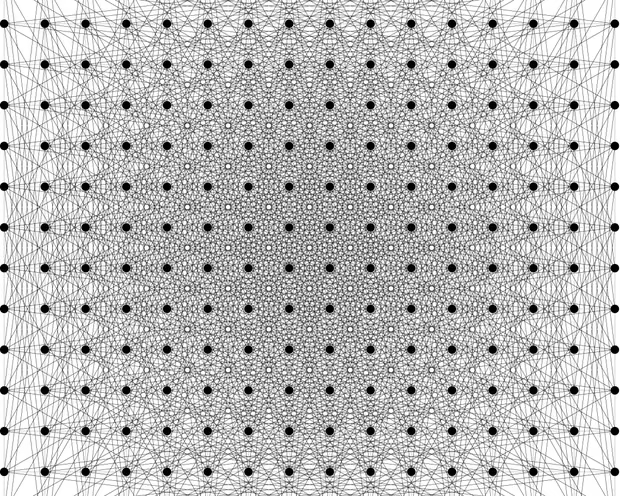
OpenAI has claimed another significant advance in artificial intelligence reasoning after its latest technology successfully tackled an eighty-year-old mathematical problem. The prominent company behind ChatGPT announced it had made a genuine breakthrough with a challenge first posed by legendary Hungarian mathematician Paul Erdős in nineteen forty-six. This specific puzzle is known within academic circles as the planar unit distance problem. The fundamental question posed by Erdős is deceptively simple for the average person to explain. If you take a plain sheet of paper and add some dots, how many pairs can be exactly the same distance apart? Erdős originally proposed that this number would rise only slightly faster than the total number of dots themselves.
The advanced OpenAI model concluded otherwise by drawing on entirely different branches of complex mathematics. This allowed the system to uncover a unique family of arrangements that completely break the theoretical limit in the famous conjecture. For nearly eighty years, traditional mathematicians firmly believed that the best possible solutions looked roughly like regular square grids. OpenAI proudly wrote on the social media platform X that its model has now completely disproved that long-standing belief. The system accomplished this by discovering an entirely new family of geometric constructions that performs significantly better than previous versions. While the groundbreaking work has greatly excited global mathematicians, the broader problem still remains technically unsolved. This is because the artificial intelligence did not actually come up with a definitive new answer for the puzzle. Instead, the model merely demonstrated that the maximum limit Erdős originally proposed was simply too low.
OpenAI is currently preparing to float its shares on the United States stock market in the near future. The company stated these historic calculations had been made by a general-purpose reasoning model. This specific system functions by breaking down massive problems into much smaller and more manageable steps. It represents a shift from using a system trained specifically and exclusively for complex mathematics. The ambitious startup has been publicly tripped up before by its previous attempts to solve these historic Erdős problems. The company hailed a supposed major breakthrough last year that was actually based on existing literature absorbed by the model.
This time, the new work from OpenAI has been rigorously validated by independent external mathematicians. This validation group includes Thomas Bloom, a respected researcher who actively maintains the official Erdős problems website. Bloom had previously criticised the prior Erdős claims made by OpenAI before this latest announcement. Now, Bloom has co-authored a comprehensive companion paper to the OpenAI blog post flagging this achievement. Bloom wrote that the system attained its results by persevering down paths a human may have dismissed. Human researchers often assume these tedious paths are not worth their valuable time to fully explore. However, he carefully added that human beings had still been heavily involved in the AI’s ultimate work.
While the original proof produced by the AI was completely valid, it was still significantly improved by human researchers. These researchers at OpenAI worked alongside many other mathematicians who were involved in the present paper. The human still plays a vital role in discussing, digesting, and continuously improving this complex mathematical proof. Humans are also essential for exploring the broader consequences of these new geometric arrangements. Mathematician Tim Gowers, also writing in the companion paper, described the fascinating result as a milestone in artificial intelligence mathematics.
Andrew Rogoyski belongs to the respected Institute for People-Centred AI at the University of Surrey. He stated the announcement showed these advanced systems were giving humans entirely new ways to look at old problems. It is becoming increasingly clear that artificial intelligence is impacting the world of creative human thought. The technology will undoubtedly become a fundamental tool of future scientific research across the globe. This specific achievement highlights how automated systems can find patterns that elude traditional academic methodologies. The collaboration between machine logic and human oversight represents a new era for scientific discovery.
Mathematicians have spent decades trying to push the boundaries of the planar unit distance problem without success. The traditional approach relied heavily on human intuition and established geometric frameworks that limited fresh perspectives. By utilizing a general-purpose reasoning model, the software avoided the cognitive biases that often restrict human researchers. The system evaluated millions of potential dot configurations that humans would find too tedious to calculate manually. This methodical perseverance allowed the machine to identify the flaws in the historical mathematical model. The discovery challenges the long-held assumption that human intuition is always superior in abstract reasoning tasks.
The validation by Thomas Bloom provides the scientific credibility that OpenAI desperately needed after past public failures. His previous skepticism ensured that this new claim faced the highest possible level of academic scrutiny. The companion paper serves as a bridge between commercial technology development and rigorous academic research. It demonstrates that profound scientific progress happens when tech giants cooperate transparently with independent university experts. This relationship could serve as a model for future artificial intelligence developments in other scientific fields. The success also arrives at a critical financial moment for the high-profile American technology company.
As OpenAI prepares for its highly anticipated stock market debut, technological validation is incredibly important for investors. Demonstrating practical reasoning capabilities helps justify the massive valuations currently placed on leading artificial intelligence startups. Investors are eager to see if these systems can generate genuine commercial and scientific value. Solving an eighty-year-old math problem provides concrete evidence that the technology is moving beyond simple text generation. It positions the company as a leader in true cognitive computing rather than just automated chat.
The implications of this breakthrough extend far beyond the realm of pure abstract mathematics. The ability to optimize spatial arrangements can influence logistics, microchip design, and advanced materials science. Understanding how objects relate to each other in space is fundamental to many engineering challenges. If an artificial intelligence can find better spatial configurations, it could revolutionize product manufacturing processes. This practical application makes the Erdős problem relevant to industries outside of elite academic institutions. The software has proven that it can optimize systems better than traditional human design principles.
However, the preservation of human oversight remains the most critical takeaway from this scientific milestone. The artificial intelligence generated the raw proof, but humans transformed it into a comprehensible academic narrative. This collaborative dynamic shows that computers are not replacing scientists, but rather enhancing their capabilities. The human mind excels at understanding context, meaning, and the broader philosophy of scientific exploration. The machine provides the raw computational power and unbiased logic needed to break through intellectual stalemates. Together, they achieved a goal that had eluded the scientific community for nearly a century.
Future research will focus on applying this reasoning model to other unsolved mathematical conjectures. There are numerous historical problems that could benefit from this fresh computational perspective. The University of Surrey notes that we are witnessing the birth of a new research methodology. Scientific exploration will increasingly rely on these hybrid teams of humans and intelligent machines. As these models continue to evolve, their capacity for creative problem solving will likely expand. The global scientific community must now adapt to a world where computers are active intellectual partners.
Related News:
 Capitol Attack Anniversary Sparks Deep Political Divide
 Saudi Officials Report Zubaidi Flee Before Yemen Peace Talks
 UK Targets in New York Bomb Threat Hoax: Man Jailed
 Gambia Supreme Court Hears Case to Overturn FGM Ban
 Trump targets Iran trade with 25% tariff warning
 US Senate rejects resolution limiting Trump military powers
 Gulf states warn Trump Iran strikes risk wider Middle East war
 Machado Trump medal gesture reshapes Venezuela power struggle
 Geopolitical football: Iran, Trump and the World Cup clash
 Canada-China trade gains momentum in new strategic partnership
 Syria President Declares Victory as Ceasefire Reached with SDF
 Shinzo Abe’s killer receives life sentence in Japan
 China General Under Investigation Amid Leadership Purge
 Philippines ferry disaster leaves 15 dead, dozens missing
 Cambridge Faces Scrutiny Over Arms Investment Transparency
 Epstein UAE Emails Shake British Royal Andrew’s Legacy
 Christchurch gunman seeks to vacate guilty plea
 Concerns rise for Canberra boy amid Iran detention fears
 Ukraine Sends Drone Experts to Defend US Bases in Jordan
 Abramovich Chelsea Sale Cash Faces Jersey Probe
 Yvette Cooper: UK Must Follow Principles, Not US Pressure
 Jury Rules Meta and YouTube Liable for Addictive Design
 Saudi Arabia Urging US to Keep Up Iran Attacks
 The Woman Guarding Earth From the Threat of Asteroids
 Germany Grapples With AI Abuse Following TV Star Scandal
 Exiled Tycoon Warns of New Russian Attacks on UK Soil
 LA 2028: Millions of Affordable Olympic Tickets Announced
 Trump Slams Europe as Transatlantic Tensions Boil Over
 Inside the Deceptive Machine: A Former Producer Speaks Out
 Spain Faces Backlash Over Xenophobic Chants in Egypt Draw
 A Global Voice For Justice: Stephen Lewis Dies At Age 88
 Hope and Fear as Iranians Flee Across the Turkish Border
 Reform UK Pledges To Halt Visas Over Reparations Demands
 US and Iran Agree to Two-Week Provisional Ceasefire
 Starmer visits Gulf as US and Iran agree ceasefire
 Gaza Child Arrives in UK for Life-Changing Care
 Pakistan Brokers Historic Peace Deal Amid Rising Tensions
 UK Holds Firm on Strait of Hormuz Amid Trump Pressure
 Trump Signals Hope for New Iran Talks as Ceasefire Fades
 Reeves Slams Trump Over Iran War Lack Of Exit Plan
 US and Iran Pursue Extension of Ceasefire via Pakistan
 Trump’s Islamabad Gamble: The High Stakes of a New Iran Deal
 Ian Katz to Step Down as Channel 4 Content Chief
 The General’s Gambit: Pakistan’s New Role in Global Peace
 Mexico, Spain and Brazil call for Cuba dialogue amid crisis
 Pakistan’s Ambitious Bid for Middle East Peace
 Israeli Soldiers Jailed Over Vandalism of Lebanese Statue
 Trump Weighs Sending Afghan Allies to the Congo
 Pentagon Shakes Up Navy Leadership Amid Hormuz Blockade
 Trump Threatens UK With Big Tariff Over Tech Tax
 Prominent Voices Challenge Palestine Action Ban
 Security Scrutiny After Washington Shooting Incident
 Merz Criticises US Approach in Iran Conflict
 UK Envoy Sparks Controversy Over Special Relationship Claims
 Ukraine Urges UK to Seize Russian Oil Tankers
 US Calls Australia Media Law “Foreign Extortion”
 The Billionaire’s Secretary and the £1m Fraud
 Ukraine strikes Tuapse as oil disaster worsens
 Brewing Tension: Taiwan Baristas Rebrand for World Stage
 Tensions Emerge in Netanyahu-Trump Alliance
 Mission to the World’s Edge: A Heroic Rescue in Tristan
 US and Mexico Face Heatwave as Floods Batter South Africa
 Mexico’s Missing: State Complicity in a Growing Crisis
 French Patient Told Hantavirus Was Just Anxiety
 The Long Way Home: Australia’s High-Stakes Virus Mission
 Putin Signals War End as Russian Momentum Stalls
 Romania’s Judicial Crisis: A System Under Siege
 Lee Lai Makes History with Landmark Stella Prize Victory
 Philippine Senator Flees After Days Under Senate Siege
 Alberta Separatist Bid Blocked by Canadian Court
 Canadian Court Blocks Alberta Independence Referendum Bid
 Big Tobacco Under Fire Over Controversial New Ad Campaign
 Bolsonaro Son Tape Scandal Sparks Massive Brazil Backlash
 Court Upholds Landmark Win for Transgender Rights
 Tragedy in the Maldives: Inside the Deep Sea Rescue
 Liberal Senator Criticises Immigration Rhetoric
 Senate Moves to Restrict Trump’s War Powers on Iran
 ICC Arrest Warrant Threat Sparks West Bank Retaliation
 Uefa Transforms Men’s Major Tournament Qualification
 Taliban Codifies Strict New Marriage and Divorce Legislation