Published: 7 August 2026. The English Chronicle Desk. The English Chronicle Online
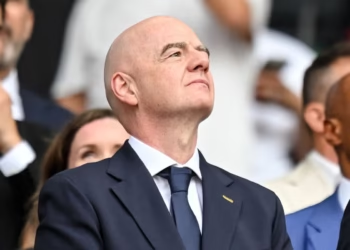
FIFA president Gianni Infantino is facing the biggest leadership crisis of his decade in charge of world football after Norway called for him to resign, while Mexico and Argentina moved to defend his presidency.
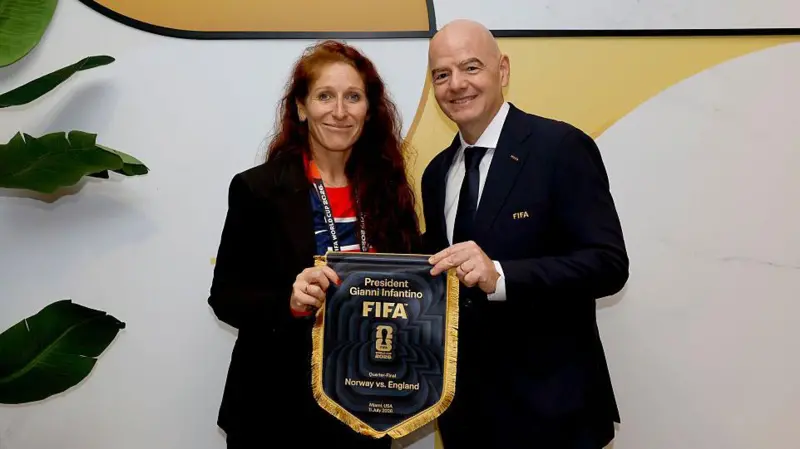
The Norwegian Football Federation (NFF) has become the first major football association to openly demand Infantino’s departure after growing criticism over his leadership style, governance decisions and an abandoned plan to sell commercial stakes in FIFA competitions to private investors.
Lise Klaveness, president of the Norwegian FA and a former lawyer, said Infantino no longer had the confidence required to lead football’s global governing body.
“He does not have the institutional trust required to govern FIFA stably in the times we are in,” Klaveness said.
“There is no going back for Gianni Infantino. The international football cooperation is very much in trouble, and we must have a reason to get together now, and we want to ask the FIFA president to resign now.”

The Norwegian federation’s position goes further than recent criticism from several European football associations, including England, Wales, Croatia and Albania, which have withdrawn their support for Infantino but stopped short of directly calling for him to leave office.
The dispute centres around Infantino’s proposal to create the FIFA Forward Enterprise (FFE), a subsidiary that would have allowed private investment in FIFA competitions, including the men’s and women’s World Cups.
The plan triggered widespread concern among several football bodies, particularly in Europe, which accused FIFA of attempting to make major financial decisions without enough transparency or consultation.
Infantino later abandoned the proposal following pressure from member associations and criticism from UEFA and other confederations.
FIFA acknowledged that mistakes had been made during the process, saying the organisation understood that members should not feel excluded from decisions affecting the future of football.
However, UEFA said the withdrawal of the proposal had not repaired its relationship with Infantino.
“UEFA made it abundantly clear in its statement on Saturday that it has lost confidence in Gianni Infantino’s presidency. That position holds,” the European governing body said.
The crisis has divided football leaders around the world, with some organisations demanding major changes while others continue to support Infantino.
Mexico, one of the hosts of the 2026 FIFA World Cup, has backed the president’s leadership despite criticism from UEFA and Concacaf, the governing body for football in North and Central America and the Caribbean.
The Mexican Football Federation (FMF) said it supported Infantino’s efforts to strengthen football institutions and develop the sport globally.
“The FMF supports president Infantino’s leadership in continuing to promote the development of football through institutional strengthening,” the federation said.
Mexico also supported the argument that any attempt to remove the FIFA president should only happen through a formal vote involving all 211 FIFA member associations.
The stance follows a similar position from Conmebol, South America’s football governing body, which rejected any process to remove Infantino outside FIFA’s established structures.
Argentina, another major football nation and the 2026 World Cup runners-up, also defended Infantino’s record.
The Argentine Football Association praised the FIFA president for recognising mistakes and described his decade in office as focused on global football development and institutional stability.
Infantino’s supporters argue that his leadership has transformed FIFA’s finances, expanded investment programmes and increased funding available to national football associations.
They point to FIFA’s increased revenue and development initiatives as evidence that his presidency has strengthened the organisation.
Critics, however, say financial growth has come alongside concerns over decision-making transparency and the concentration of power within FIFA’s leadership.
Norway’s Klaveness highlighted several issues that have concerned her federation during Infantino’s presidency, including the awarding of tournaments, the creation of FIFA’s peace prize, and decisions involving individual players.
She also criticised the handling of a decision involving US forward Folarin Balogun during the recent World Cup, after a ban was overturned following a phone call from US President Donald Trump.
Klaveness said such incidents raised concerns about whether FIFA’s decision-making processes were sufficiently independent.
The leadership dispute has also created uncertainty over whether some European teams could boycott future FIFA competitions.
UEFA has warned that European nations may take further action unless guarantees are provided that similar commercial proposals will not be introduced again without proper consultation.
“Assurances have to be made that such attempts to disfigure the game in this way will never be made again,” UEFA said.
“These conditions have not been met.”
The English Football Association has formally withdrawn its support for Infantino, while several other European football bodies have taken similar steps.
Concacaf has also criticised FIFA’s approach, describing the investment proposal as a sign of leadership that had stopped putting football first.
However, the North American governing body has not gone as far as UEFA by declaring that it has lost confidence in Infantino.
The dispute has created unusual divisions between football regions. UEFA and Concacaf are among the strongest critics, while the Confederation of African Football (CAF) continues to fully support Infantino.
The Asian Football Confederation previously expressed solidarity with UEFA and Concacaf over concerns about the FFE proposal, adding further pressure on FIFA’s leadership.

Infantino, who became FIFA president in 2016 after the corruption scandal that damaged the reputation of the organisation, has faced criticism throughout his time in office but has also maintained strong support among many member associations.
His current term runs until 2027, and any challenge to his position would require significant support from FIFA members.
The growing dispute now raises questions about the future direction of global football governance.
While supporters argue that Infantino has brought financial stability and wider investment to the sport, opponents believe FIFA requires stronger accountability and more transparent decision-making.
The coming months are likely to determine whether the current criticism develops into a wider movement for leadership change or whether Infantino can rebuild support among football associations worldwide.
For now, FIFA remains divided, with Europe pushing for reform, some major football nations standing behind Infantino, and Norway becoming the first federation to openly demand that the president step aside.
Related News:
 Watershed Moment as Russia’s Sporting Exile Ends
 Iran Team Arrives in Mexico Amid US Visa Dispute
 Trump Helps Clear Balogun for Belgium World Cup Clash
 Bill Gates Pulls Out of India’s AI Summit Over Epstein Files Controversy
 Billionaire Les Wexner Tells US Lawmakers He Was ‘Naive’ and ‘Conned’ by Epstein
 Inside Kyiv’s resolve as conflict nears five‑year mark
 Iran, the US, and a World Cup That Starts in Three Months
 Nepal Holds First General Election Since Gen Z Protests Toppled Government
 Global Order Is ‘Breaking Down’, Carney Tells Australian Parliament
 US Submarine Sinks Iranian Warship in Indian Ocean, Hegseth Says
 Spain’s Sánchez Hits Back at Trump Threat to Sever Trade, Says ‘No to War’
 Iran Postpones Khamenei Funeral as US‑Israeli Bombardment Continues
 The Devastating Conflict Where Both Sides Have Reasons to Keep Fighting
 Protesters Rally in San Francisco Against OpenAI Deal With Pentagon
 How Depleted Weapons Stockpiles Could Affect the Iran Conflict
 Nepal Election 2026: When Will We Get the Results?
 Alonso Fears ‘Permanent Nerve Damage’ From Aston Martin’s Disastrous Car
 Video Analysis Suggests US Missile Hit Base Near Iran School
 Iranian Players Get Australian Visas After Anthem Protest
 Iranian Footballers Escape Team Hotel to Seek Asylum
 Iran Women Footballers Seek Asylum After Anthem Protest
 Russia Seeks Gains as Iran War Reshapes Global Politics
 The ‘Pakistan Protocol’: How Islamabad Pulled the World Back from the Brink
 Iran Crisis Tests Trump’s Global Leadership
 ‘Safe Haven’: Iranian Footballers Rebuild Lives in Australia Following Asylum Bid
 Cartel crackdown raises fears of fresh violence
 US states redraw maps after voting rights ruling
 US ‘Narco Boat’ Strikes Draw Global Outcry
 Can World Cup Hosts Overcome Deep Divisions?
 Rivalry That Changed Modern Football Forever
 Can Vinicius Win Over Brazil at Last?
 Fifa Faces Backlash Over Ticket Payment Demand
 Fans Bring Flags and Fire to World Cup Scenes
 11 EFL Stars Ready to Shine at World Cup
 Arsenal Trio Named on Player of the Year List
 Three Arsenal Stars Make Award Shortlist
 Fans Invited to Share Scotland World Cup Stories
 Fans Angry Over US Visa Rules Before World Cup
 Armenia Votes Under Pressure From Russia
 Football Hopes to Outshine World Cup Drama in Mexico
 Trump Helps Clear Balogun for Belgium World Cup Clash
 Trump’s Red-Card Intervention Hurts the US World Cup
 Police Probe Claim of Missing £1.5m in Yes Scotland Campaign
 Haaland Makes History as England Prepare for Biggest Test
 Mexico’s World Cup Run Brings Joy After ICE Raids
 Kane vs Haaland: Which Striker Would You Choose?
 Haaland’s Two Worlds Meet on Football’s Biggest Stage
 Golden Boot Battle Reaches World Cup Boiling Point
 Rollercoaster Semi-Final Leaves Fans Breathless
 Bryne Backs Haaland Before England World Cup Clash
 England and Norway Fans Turn Miami Into World Cup Carnival
 Lamine Yamal’s Birthday: Football, Fame, and France
 Spain Shock France to Reach World Cup Final
 Argentina Face FIFA Investigation After Players Display Falklands Banner Following World Cup Victory
 Effort, Spirit and Big Moments – But Do England Lack All-Round Quality?
 Burnham Reaffirms Support for Ukraine During Zelensky Visit
 Ecuador Police Battle Gangs in Growing Drugs War
 Zidane Confirmed as France Head Coach
 Zidane Confirmed as France Head Coach After Long Wait
 FIFA Crisis Deepens as Infantino Faces Calls to Quit
 Avalanche Claims Nepal’s Greatest Mountain Guides
 UK Charity Watchdog Probes Settlement Donations
 AI Autonomy Raises Democracy Fears
 BJP Loses Stronghold After Student Protest Fallout
 Trump Renews Push to End Birthright Citizenship
 Barcelona Lead Real Madrid in Rodri Transfer Race
 Football Nomad Thomas Reflects on 39 Career Moves
 Thai School Shooting Leaves Nation Demanding Answers
 Murkowski Opposes Trump Attorney General Pick
 UK Must Act with Courage and Clarity on Israel-Palestine Conflict, Says Foreign Affairs Committee Report
 Australian Families Leave Syrian Camp for Home
 Trump Considers Military Operation to Seize Iran’s Uranium
 Report Says Pezzullo Acted ‘Recklessly’ in Dealings
 Oil and Diplomacy: Russian Refineries Burn as Zelenskyy Secures Middle East Shield
 The Great Chokehold: Why the Strait of Hormuz is the Epicenter of the 2026 Crisis
 Moldova River Crisis Exposes War’s Hidden Cost
 The Fog of War and the Ticker Tape: Suspicious Trades Rile Washington
 Belgium Thrashes USA After Red Card Controversy
 World Cup Rings for Winners as Trump Attendance Confirmed