Published: 28 September 2026. The English Chronicle Desk. The English Chronicle Online
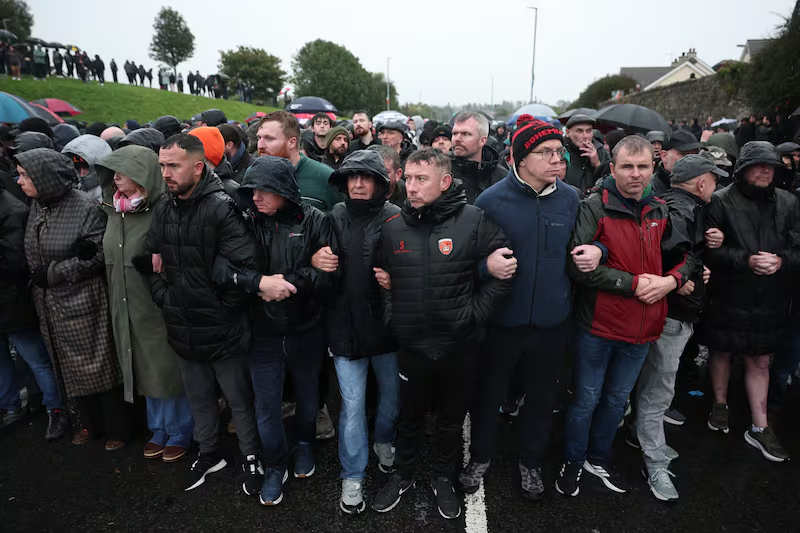
A tense confrontation over a controversial Orange Order parade in Portadown, Northern Ireland, eased early Monday after hundreds of protesters dispersed from the Garvaghy Road following a day-long blockade.
The standoff followed a late-night court ruling that allowed the loyalist parade to proceed along the mainly nationalist Garvaghy Road for the first time in almost three decades. The dispute has revived memories of some of the most difficult and violent periods of Northern Ireland’s recent history and has placed renewed pressure on the region’s political institutions.
The Orange Order had received permission from the Parades Commission to hold a restricted procession from Drumcree Church. The decision marked a major change after the organisation had been prevented from marching along the route since 1998.
The commission imposed several conditions on the parade. The number of participants was reduced to 35, the procession was required to begin at 8am rather than the originally proposed afternoon start, and the marchers were required to proceed in silence without bands. Supporters were also prohibited from accompanying or gathering along the route.

The decision immediately triggered a legal challenge from representatives of the Garvaghy Road community. A High Court judge initially blocked the parade, warning that the longstanding dispute had the potential to escalate.
The Orange Order challenged that decision, resulting in further hearings that continued late into Saturday night and into the early hours of Sunday. The Court of Appeal ultimately allowed the Parades Commission’s determination to stand, clearing the way for the march.
The ruling came only hours before the scheduled start, leaving residents and political leaders with little time to respond.
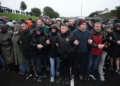
By Sunday morning, hundreds of nationalist protesters had gathered along the Garvaghy Road. Many linked arms across the road, while others sang and listened to announcements warning them that blocking the route could lead to arrest and prosecution.
The protest continued throughout the day as police maintained a security presence between the opposing sides.
At Drumcree Church, roughly a mile away, Orange Order members remained gathered near the proposed starting point. Rather than attempting to proceed through the police cordon, they waited for officers to indicate whether the road had become clear.
The result was an extended standoff rather than a direct confrontation between the marchers and protesters.
As darkness fell, there was little indication that the parade would be able to travel down the disputed road. The majority of Orange supporters eventually left the area, while significant numbers of nationalist protesters remained on Garvaghy Road.
Shortly after midnight, Breandán Mac Cionnaith of the Garvaghy Road Residents’ Coalition told protesters that commitments had been received indicating that the parade would not proceed overnight. He subsequently announced plans to meet Northern Ireland Secretary Chris Bryant and Police Service of Northern Ireland Chief Constable Jon Boutcher on Monday morning.
The announcement prompted most of the protesters to disperse in the early hours.
The immediate easing of the confrontation, however, did not resolve the underlying dispute.
The controversy has brought senior political figures directly into the confrontation. Sinn Féin president Mary Lou McDonald joined protesters on Garvaghy Road and described the decision to allow the parade as unacceptable. Northern Ireland First Minister Michelle O’Neill also attended the gathering and said the community had achieved a victory by preventing the march from proceeding.
Their involvement drew sharp criticism from unionist politicians, who argued that senior officeholders should not participate in an unauthorised protest.
Democratic Unionist Party leader Gavin Robinson accused Sinn Féin figures of undermining the rule of law, while DUP MP Carla Lockhart criticised O’Neill’s presence at the protest.
The dispute has therefore developed beyond a disagreement about a single parade. It has become a political argument over the authority of the Parades Commission, the responsibilities of elected representatives and the ability of Northern Ireland’s institutions to manage contentious issues involving competing national and community identities.
Northern Ireland Secretary Chris Bryant travelled to Belfast after cutting short his attendance at the Labour Party conference in Liverpool. He urged political leaders and protesters to reduce tensions and said that everyone involved needed to consider the potential consequences of escalating the dispute.
Bryant said he did not have the power to cancel the parade unless the police formally requested such action. He indicated that discussions with political parties and other representatives would continue on Monday.
The Irish government has also expressed concern. Taoiseach Mícheál Martin called for calm while criticising the Parades Commission decision as wrong and difficult to understand. He called for a mediated approach that would protect the progress made during years of relative peace.
The sensitivity surrounding the Garvaghy Road is rooted in the history of the Drumcree dispute.
During the 1990s, Orange Order attempts to march through the predominantly Catholic and nationalist area became a major source of confrontation between nationalist residents, loyalists and security forces. The dispute contributed to serious disorder and heightened sectarian tensions across Northern Ireland.
The route was subsequently blocked to Orange Order parades, with restrictions remaining in place for almost three decades.
For residents of Garvaghy Road, the renewed permission therefore carries memories extending well beyond the details of the latest parade application. Community representatives have argued that allowing the march again risks reopening divisions that had gradually eased after years of political and community efforts.
For the Orange Order and its supporters, however, the route has historical significance and the organisation has argued that its members should be able to exercise their right to parade under lawful conditions.
The disagreement over those competing claims has been at the centre of the dispute.
The latest decision was particularly controversial because the original application was for a larger procession. The Parades Commission reduced the number of participants and introduced restrictions intended to limit the potential for confrontation.
Yet those conditions did not prevent the political and community response.
The presence of senior Sinn Féin politicians on the protest line added another dimension to the situation. Their supporters viewed their attendance as solidarity with residents who opposed the parade, while unionist politicians argued that ministers were participating in an unlawful gathering.
The issue could now place additional pressure on Northern Ireland’s power-sharing arrangements. The region’s political system depends on cooperation between parties representing different constitutional and community traditions, making disputes over parades particularly sensitive.
The immediate confrontation has ended, but the political disagreement remains.
The legal position also remains important. The Court of Appeal’s decision allowed the Parades Commission determination to stand, while the subsequent events on the ground meant the authorised procession did not pass along the Garvaghy Road during the period covered by the permission.
Any future attempt to hold a procession along the route would therefore require consideration of the applicable legal and regulatory process.
Monday’s talks are expected to focus on what happens next and whether a process can be established to prevent the dispute from developing into a wider confrontation.
The challenge for political and community leaders will be to manage the competing claims without allowing the events in Portadown to become a catalyst for renewed disorder elsewhere.

For residents, the episode has already been deeply unsettling. For the Orange Order, the inability to complete the proposed route despite receiving permission represents a separate grievance. For the police and political authorities, the weekend has demonstrated the difficulty of enforcing legal decisions when they intersect with longstanding communal divisions.
The events in Portadown have consequently reopened a debate that many had hoped belonged to Northern Ireland’s past.
After almost 30 years of relative calm on the Garvaghy Road, the return of the Drumcree dispute has shown how quickly historical grievances can become politically relevant again.
With talks scheduled and questions remaining over the future of the parade, attention now turns to whether the parties involved can find a way forward that avoids further confrontation while addressing the competing legal, political and community concerns surrounding one of Northern Ireland’s most sensitive parade routes.
Related News:
 Ministers Condemn Far-Right Unrest in Portsmouth
 Patriot Platform Raises Concern Across Britain
 Mahmood Warns Far Right Over Asylum Protests
 UK Reviews Hague Child Abduction Cases Involving Abuse
 King Refers Jamaica Slavery Petition to Privy Council
 Far-Right Activist Arrested After Channel Dinghy Incident
 It’s time to come clean on the China spy case
 French Taxi Driver Cleared in David Lammy Theft Case After Fare Dispute
 Met Police Culture Makes Racial Harm ‘Inevitable’
 Remaining rebel Labour MPs have whip restored
 Undercover officer deceived women with ‘grotesque and cruel’ lies, spycops inquiry told
 Mass Arrests at London Palestine Protest Spark Debate
 NHS Safety Fears as Nurses Cover Doctor Gaps
 UK may ban protests amid rising antisemitism fears
 Barrister Criticises Trial After Suicide Case Verdict
 Victim says non-custodial rape sentence ‘rock in my face’
 Murder Probe Continues After Arrest Release
 Westminster Council Threatens Charing Cross Soup Kitchen
 BBC Warned About Missing Clothes of Murder Victim
 Cambridge Professor Jason Arday Found Dead at Home
 Masked Protesters Bring Dover Port Traffic to Standstill
 UN expert urges UK to rethink Israel policy
 Armed Suspect Attacks Ohio Governor Candidate
 Councils spend £125m on illegal children’s care
 Miliband Rejects Chief Rabbi’s West Bank Warning
 Reform UK Receives Record £36m Donation From Crypto Billionaire
 Election Candidate Abuse Raises Alarm in England
 UK Urged to Probe US Diplomat Case
 Lisa Nandy Calls for Tougher Action on Social Media Doxxing
 Piddington Votes for Symbolic Independence Over Asylum Plan
 Texas Transfers Raise Fears for Migrant Children
 Memphis Questions National Guard Crime Surge
 Disabled Travellers Seek Fairer UK Care Rules
 Briton Faces Cyprus Court Over Son’s Fatal Fall
 Democrat Says ICE Restricted Detention Camp Oversight
 Far-Right Activist Slashes Dinghy in Channel
 Tasers Introduced in UK Prisons to Combat Rising Violence and Protect Staff
 Police Advised to Disclose Ethnicity of Suspects in High-Profile Cases
 Jailed Georgian Opposition Leaders Warn UK of Iranian Links to Ruling Party
 FBI Director Kash Patel Defends Girlfriend Amid Government Jet Claims
 Just Stop Oil Protesters Convicted Amid Climate Defence Row
 Boris Johnson accused of undermining BBC leadership
 ‘Reckless’ cuts to victims’ services will cost more than they save
 Major Rent Reform Ends No-Fault Evictions in England
 Peers Flood Assisted Dying Bill with 942 Amendments
 UK Asylum Overhaul Sparks Debate Over Human Rights and Deportations
 UK Candidate Moved to Safe House After Election Threats
 South African Detained After Neo-Nazi Rally in Australia
 Serial Rapist and Former Cop Found Guilty Again
 Most Tories Expect to Support a Farage-Led Government
 Peers Get Extra Time to Debate Assisted Dying Bill
 ‘It’s a Complete Scandal’: Aristocrat’s Fight for Prison Children
 Tim Walz urges Trump to withdraw federal agents immediately
 UK and EU Signal Fresh Push for Defence Cooperation Talks
 Civil Service Pay: Union Urges Ministers to End ‘Barking Mad’ Limits
 Proposed Law Leaves Gap for Children of Convicted Paedophiles
 Melania Trump Epstein remarks spark survivor backlash
 Kezia Dugdale Warns of Possible Reversal of Equal Rights Gains
 Synagogue Arson Attempt Sparks Security Fears
 Crackdown Backfires on UK Climate Protesters
 John Terry Faces Backlash Over Political Posts
 Greens Face Internal Row Over Antisemitism Claims
 Immigration Judges Fear Pressure in Trump Era
 Farage and Reform UK Reshape British Politics
 Starmer Leadership Under Pressure After Setbacks
 Le Pen’s Popularity Holds Despite Conviction
 Three-Quarters of England’s Riverbanks Still Off Limits
 Burnham unveils £65m drought aid for farmers
 Unions Warn Labour Over Zero-Hours Contract Reforms
 RAF Barnham Protests Fuel Tensions in Norfolk Town
 Internal Exclusions Surge in England’s Schools
 UK plans tougher Israel stance with settlement trade ban
 Israel Accused of Undermining Palestinian Life
 UK Retailers Accused of Breaking Refund Laws
 Texas Charges Seven Noncitizens in Voting Crackdown
 Harrods Faces Dispute Over Fayed Abuse Compensation
 Lib Dems Prepare for Election Amid Reform Challenge
 Reform UK Faces Internal Debate Over £72m Spending
 Clancy Defense Seeks Inquiry Into Lone Juror
 Japan PM Backs International Criminal Court