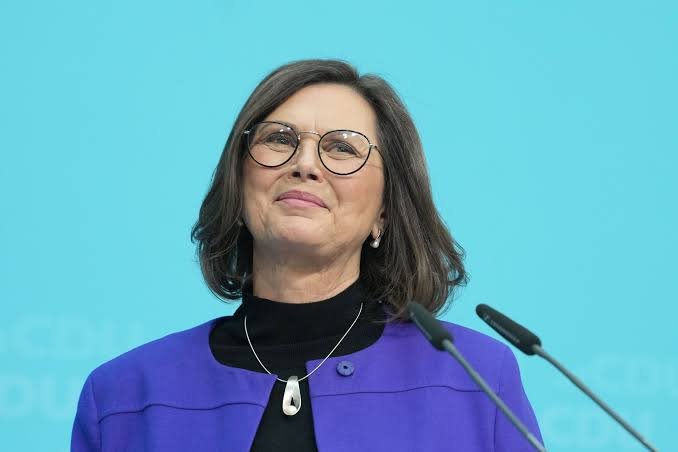
Germany is moving towards a historic political milestone as Ilse Aigner, a 61-year-old Bavarian politician and former helicopter manufacturing engineer, emerges as the leading candidate to become the country’s first female federal president. Backed by political figures across much of the parliamentary spectrum, Aigner’s expected election in January could end more than seven decades of male leadership in Germany’s highest state office.
Her nomination has attracted considerable attention not only because of its historical significance but also because of her unusual professional background, personal experiences and reputation for being approachable. At a time when Germany faces growing political divisions, economic uncertainty and increasing support for far-right movements, supporters believe Aigner could offer a unifying presence that the country’s political establishment urgently needs.
Chancellor Friedrich Merz, who leads the Christian Democratic Union (CDU), formally put forward Aigner as his preferred candidate this week after months of speculation about the next presidential election. He described the moment as an appropriate opportunity for a woman to assume the country’s highest state position, arguing that Germany had waited long enough for such a development.

Germany has had 12 presidents since the establishment of the Federal Republic in 1949, and every one of them has been a man. If elected in January, Aigner will succeed incumbent President Frank-Walter Steinmeier, becoming the first woman to occupy the largely ceremonial but constitutionally significant position.
Her prospects appear particularly strong because her candidacy has attracted support beyond her own political camp. Merz’s CDU, its coalition partner the Social Democratic Party (SPD) and the opposition Greens have indicated support for her nomination. This broad political backing has significantly strengthened her chances of securing the presidency.
Aigner’s potential election is being viewed as an important moment for women’s representation in German public life. Although women have occupied senior political positions, including the chancellorship under Angela Merkel, the presidency has remained exclusively male since the country’s postwar democratic foundation.
What makes Aigner particularly distinctive is her professional journey. Unlike many senior German politicians, she did not follow the traditional academic route or build her career through legal or political studies. Before entering politics, she trained as an electrical engineer and specialised in manufacturing helicopters.
Her technical qualification and experience in the engineering industry have become an unusual talking point during the presidential nomination process. Popular television presenter and liberal writer Jörg Thadeusz jokingly observed that she could become the first German head of state capable of personally repairing a government helicopter.
Aigner entered the German Bundestag in 1998 after developing her political career at the local level. She later became one of the prominent figures in Bavaria’s Christian Social Union (CSU), the conservative sister party of Merz’s CDU. Between 2008 and 2013, she served as Germany’s federal agriculture minister under former chancellor Angela Merkel.
Despite her experience in national government, Aigner has not traditionally been regarded as one of Germany’s most recognisable political personalities. Much of her public appeal comes from her connection to ordinary people, her relatively modest lifestyle and her continued association with her hometown.
She was born in Feldkirchen-Westerham, a Bavarian town south-east of Munich, where her parents operated an electronics shop. She still lives in the same community, sharing a family home with several generations of relatives, including her older sisters and their children.
Residents affectionately refer to her as ‘die Ilse’, a familiar expression reflecting her close relationship with the local community. Rather than maintaining the distance often associated with senior politicians, she regularly participates in local celebrations and is known for travelling by bicycle to everyday destinations, including shops, community events and the opening of renewable energy facilities.
This connection with her hometown has helped strengthen her image as a politician who remains grounded despite years of public service. Supporters believe that her ordinary lifestyle and personal warmth could be valuable qualities in a presidency that is expected to represent the entire nation rather than a particular political party.
Her personal history has also shaped public perceptions of her resilience. Aigner has spoken openly about surviving two serious tumour diagnoses. She experienced a tumour in her spinal cord when she was 17 and later developed thyroid cancer while serving as a federal minister in her forties.
She has previously indicated that these experiences changed her perspective on life and influenced her understanding of public responsibility. Her ability to overcome serious health challenges has become another important part of the personal story surrounding her possible elevation to the presidency.
However, Aigner’s political journey has not always been straightforward. In the early 1990s, when she was just 27, she attempted to become mayor of her hometown. Her ambitions were reportedly rejected by conservative party figures, who considered her unmarried status an obstacle to her suitability for the position.
At the time, her marital circumstances were viewed by some within the traditionally conservative political environment as an unclear condition for someone seeking public office. The episode highlights how expectations surrounding women’s personal lives once influenced political opportunities in parts of Germany’s conservative establishment.
More than three decades later, the same politician is being considered for the country’s highest state office. Her nomination therefore represents a significant change in the political environment and the expectations placed on women seeking leadership positions.
The proposed candidacy has also generated unusual public enthusiasm. Television presenter Jörg Thadeusz attracted considerable media attention after revealing that he had tattooed the name ‘Ilse’ on his upper left arm. His gesture became a widely discussed symbol of the excitement surrounding Aigner’s potential presidency.
Thadeusz described her as a candidate who could do Germany considerable good at a time when political divisions are becoming increasingly difficult to manage. He also argued that her understanding of regional identity and patriotism was different from the exclusionary nationalism promoted by far-right political movements.
Nevertheless, Aigner’s nomination has not received unanimous support. The Alternative for Germany (AfD), the country’s largest opposition force in the Bundestag, has criticised her decision not to appear before the party to present herself as a presidential candidate.
AfD co-leader Alice Weidel accused Aigner of disregarding democratic political traditions and showing insufficient respect for the millions of voters represented by her party. The disagreement has highlighted the difficult relationship between Germany’s established political parties and the increasingly influential far-right opposition.
Aigner’s supporters, however, argue that the presidency should not become an arena for strengthening political divisions. The German president is expected to serve as a representative figure for the entire country, uphold constitutional values and encourage democratic cooperation across political differences.
For Chancellor Merz, supporting Aigner may also carry political advantages. His leadership style has attracted criticism over its perceived lack of warmth and approachability, while his relationship with former chancellor Angela Merkel has remained a subject of political discussion.
Aigner’s more accessible public image could complement the chancellor’s political approach. German newspaper commentary has suggested that her popularity and ability to connect with ordinary citizens could help balance some of the qualities that critics believe are missing from Merz’s leadership.
Merkel’s legacy also remains relevant to the debate. As Germany’s first female chancellor, she became an internationally recognised political figure and an important symbol of women’s participation in leadership. Her departure from office five years ago left a significant space in the country’s political landscape for another prominent female figure.
Green Party parliamentary leader Britta Hasselmann has welcomed the prospect of Aigner becoming president, arguing that the time has come for a woman to occupy the highest state office. She has also emphasised that women’s representation remains insufficient across politics, business and wider society.
However, Hasselmann believes that Aigner’s most important responsibility would be helping to bring people together. Germany is experiencing growing ideological tensions, economic pressures and increasing support for political movements challenging the country’s traditional democratic centre.
In such circumstances, the presidency could play an important symbolic role by encouraging dialogue, mutual respect and confidence in democratic institutions. Hasselmann has expressed confidence that Aigner possesses the empathy, practical outlook and down-to-earth personality required to promote national unity.
If elected, Aigner would inherit a position that carries limited direct executive authority but substantial constitutional and representative importance. The German president signs legislation, represents the country internationally and can use public speeches to highlight important national issues and democratic values.

Her possible election would therefore be more than a change in the country’s presidential leadership. It would represent a historic breakthrough in women’s political representation and offer an opportunity to redefine the public image of Germany’s highest state office.
As January approaches, attention will increasingly turn towards the parliamentary vote and the responsibilities awaiting the next president. For many supporters, Aigner represents a combination of professional experience, personal resilience and social accessibility that could help Germany navigate an increasingly divided political environment.
Her journey from a small Bavarian town and helicopter manufacturing workshop to the threshold of the presidency is already an unusual chapter in German political history. If lawmakers deliver the expected support, she will make history as the country’s first female president, opening a new chapter in the Federal Republic’s democratic story.
Related News:
 Elif Eralp Emerges as Berlin’s Next Political Force
 France to Deploy 70,000 Police Amid Unrest Fears
 Denmark Seeks EU-Wide Ban on Fast-Growing Turbo Chickens
 Ceasefire Standoff Deepens in Ukraine War
 France Faces Record Presidential Crowded Race Amid Far-Right Surge
 Farage and Reform UK Reshape British Politics
 Starmer Leadership Under Pressure After Setbacks
 Deadly Russian Air Raids Strike Across Ukraine
 UK Nations Brace for Potential Breakup Amid Reform Surge
 British Man Faces Deportation Threat in Sweden
 Green Leader Targets Starmer’s Former Seat
 Bayeux Tapestry Revives Franco-British Ties
 Masked Protesters Bring Dover Port Traffic to Standstill
 British widow says deportation from Sweden feels like a death sentence
 Europe’s democracies face a growing far-right threat
 Lib Dems Prepare for Election Amid Reform Challenge
 King Refers Jamaica Slavery Petition to Privy Council
 Greece Pushes for Parthenon Marbles Reunification
 Three Die in Channel Crossing Attempt Near France
 Madrid Tent Camp Grows as Spain Housing Crisis Deepens
 French Student Protests Escalate Into Violent Clashes
 Burnham Opens Door to Possible UK Return to EU
 Drumcree Talks Falter as Legal Challenge Deepens
 UK-France Returns Deal Faces Expiry as Talks Stall
 Green Party faces dispute over Zionism motion
 French School Protests Escalate as 400 Schools Close
 Bosnia’s Young People Look Beyond Election Hope
 Spain Sets Snap Election as Housing Crisis Deepens
 Holborn and St Pancras Vote Tests Labour and Greens
 France Urges UK to Consider Returning to EU
 French Student Protests Grow Despite Government Pledge
 France Promises 3,000 Teachers as Student Protests Grow
 Labour Wins Key London By-election as Greens Fall Short
 Burnham Rises as Farage and Polanski Face Setbacks
 Labour Beats Greens in Crucial London By-election
 Jewish Greens Leader Calls for Polanski to Quit
 France Faces Debt Crisis as Protests and Markets Clash
 UK Gaza Refugee Route Criticised Over False Hope Claims
 French Students Protest Poor Conditions in Paris Suburbs
 UK Greens Face Crisis Over Zionism and Extremism Row
 Greta Thunberg Backs French Students in School Protests
 Farage Rejects Claims Reform Would Let Troops Shoot Migrants
 Trump Slams Ukraine Strikes as Russia Ceasefire Collapses
 Macron Condemns Violence as France Faces 2,400 Arrests
 Milan Luxury Stores Shut as Italy Plans Troop Deployment
 Milan Braces for Unrest as Debate Intensifies Over Lost Generation
 UK Aid Set to Fall Short of Reduced 2027 Target
 Brexit Deal Not Good Enough for Britain, Burnham Says
 Serbia’s Student Victory Sparks a ‘Smell of Freedom’
 King Charles Faces Caribbean Slavery Apology Demands
 Campbell Urges Australia to Defend Democratic Politics
 King Charles Faces Calls for Slavery Reparations Talks
 Spain Mourns 68 Dead After High-Speed Train Crash
 Albania Introduces $6,000 Fines for Violent Protests
 Novaya Gazeta to Close After Russian Government Pressure
King Charles Faces Reparations Protests at Antigua Summit
 European Peacekeepers Could Return Fire in Ukraine
 Australia Reviews UK Visa Rules Amid Worker Influx
 Exiled Journalists Defy Putin’s Growing Media Crackdown
 UK Parliament Faces Risk of Notre Dame-Style Fire
 UK Apologises to Ukrainian Refugees Over Russian GCSE
 German Politician Hubert Aiwanger Found Dead in Berlin
 France Braces for Nationwide Strike and Mass Protests
 English Mayors Warn Police Merger Could Weaken Local Policing
 EU Citizens Sue Home Office Over UK Residency Rights
 Burnham’s Christmas Homelessness Pledge Faces Uncertainty
 Zelenskyy Sees Peace Opportunity as US Envoys Meet Putin
 Gordon Brown urges court for crimes against children
 Relationship with Trump may be beyond repair, Starmer warned
 England and Norway Fans Turn Miami Into World Cup Carnival
 Badenoch Raises Prospect of 2027 UK Election
 Gosport Protesters Clash With Police Over Migrant Rescue
 France Schools Protests Draw 250,000 as Police Clash
 Trump Names Katie Zachariah as Next White House Press Secretary
 UK Visa Refusal Threatens Baby’s Family Christmas
 Up to 20 English Maternity Units Face Possible Closure
 Lula Supporters Make Final Push Ahead of Brazil Runoff
 UK Land Registry Plan Faces Opposition From Landowners
 Riot Police Deployed as Poland Court Row Escalates
 Early-Release Prisoners Face Rising Risk of Homelessness