Published: 16 October 2026. The English Chronicle Desk. The English Chronicle Online
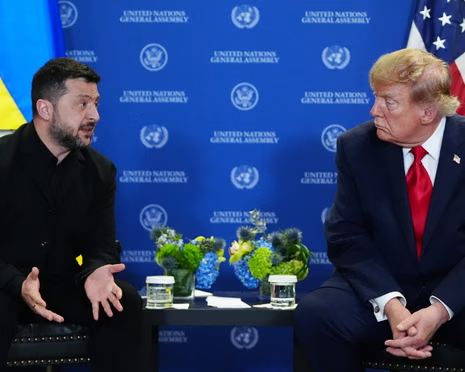
Donald Trump has condemned Ukraine’s renewed attacks on Russian oil refineries, describing the strikes as a “disgrace” and accusing Ukrainian President Volodymyr Zelenskyy of contributing to rising global oil prices. His remarks have exposed deepening tensions between Washington and Kyiv as efforts to secure a halt to attacks on energy infrastructure collapse, raising fresh questions about the future of American support for Ukraine and the prospects for a negotiated end to the war.
In an interview with the US news outlet Newsmax, broadcast on Thursday, Trump criticised Kyiv’s decision to resume strikes against Russian oil facilities following the breakdown of an energy ceasefire that he had announced the previous week. The US president argued that attacks on refineries producing diesel fuel could have consequences extending far beyond the battlefield, affecting international energy supplies and putting additional pressure on fuel prices.
“All he’s doing is making the world oil price higher. Well, I think that’s a disgrace,” Trump said, arguing that Ukraine should concentrate on other military targets rather than facilities responsible for producing fuel needed by international markets.

“There are a lot of targets you can hit,” he said, adding that striking diesel refineries was not serving the wider interests of the international community.
The comments marked another public confrontation between Trump and Zelenskyy, whose relationship has become increasingly strained over the direction of US policy towards Russia, the conditions for ending the war and the use of economic measures intended to influence Moscow.
The collapse of the proposed energy truce has also highlighted a fundamental disagreement over what constitutes a meaningful step towards peace. While the Trump administration has presented its approach as an attempt to stabilise energy markets and encourage Russia towards greater engagement, Ukraine has warned that concessions to Moscow could weaken its ability to defend itself against the continuing invasion.
The ceasefire announced by Trump last week was particularly controversial because neither Moscow nor Kyiv had publicly confirmed that it had agreed to the arrangement. Zelenskyy subsequently indicated that Ukraine was abandoning the proposed pause after the initiative failed to establish a mutually accepted framework for suspending attacks.
Ukraine then resumed strikes against Russian oil refineries, while Russia and Ukraine continued exchanging attacks on infrastructure and other targets. The developments underscored the difficulty of implementing even limited agreements when the two sides remain deeply divided over the terms of a settlement.
For Ukraine, Russian energy infrastructure has become an important military and economic target. Oil refineries and related facilities contribute to Russia’s ability to supply fuel to its armed forces, sustain transport operations and generate revenue. Ukrainian attacks on these facilities are intended to impose costs on Moscow and constrain its capacity to continue the war.
However, such operations can also affect international energy markets, particularly when they disrupt production or raise concerns about the availability of refined petroleum products. That broader economic impact has become central to Trump’s criticism, although the precise contribution of individual Ukrainian strikes to global oil prices cannot be established from his remarks alone.
The dispute has acquired additional political significance because the Trump administration recently eased certain sanctions on Russia in connection with an arrangement under which Moscow would release substantial quantities of diesel onto global markets. The move has been widely interpreted as an effort to increase fuel availability and limit price pressures ahead of the US midterm elections.
Zelenskyy has strongly criticised the approach, arguing that easing restrictions on Russia risks providing economic relief to a country continuing its full-scale invasion of Ukraine. From Kyiv’s perspective, measures that improve Moscow’s access to revenue or international markets could undermine the pressure needed to persuade Russian President Vladimir Putin to change course.
The disagreement reflects competing priorities. Trump has repeatedly emphasised the economic consequences of the conflict, including energy prices and the costs associated with prolonged military support. Ukraine, meanwhile, maintains that its immediate security requirements cannot be separated from the broader question of whether Russia will be able to continue its military campaign.
The US president reinforced his personal criticism of Zelenskyy during the Newsmax interview, saying he was not a strong supporter of the Ukrainian leader and describing him as more difficult to negotiate with than Putin.
“I’m not a big fan of Zelenskyy,” Trump said. He added that he believed both leaders would like the conflict to end but said he found Zelenskyy “more difficult to deal with than Putin”.
The remarks are likely to intensify concerns in Kyiv about the reliability of American backing at a time when Ukraine continues to depend on international assistance for its military operations, air defence and communications systems. They also raise questions about how Washington intends to balance pressure on Ukraine with efforts to persuade Moscow to participate in a lasting settlement.
Trump has repeatedly presented himself as capable of bringing the war to an end through direct engagement with both sides. However, efforts under his administration have yet to produce a durable agreement capable of resolving the central disagreements between Russia and Ukraine. Territorial control, security guarantees, military capabilities and the future relationship between Ukraine and Western institutions remain among the most difficult issues.
Tensions between Washington and Kyiv have been compounded by a dispute over access to Starlink satellite communications services. Ukraine said this week that restrictions on the system had disrupted important military activities, including drone operations and elements of its air defence network.
The reported disruption caused particular concern because satellite connectivity plays an important role in communications across the battlefield. Ukrainian forces rely on such systems to coordinate operations, transmit information and maintain links between units in areas where conventional communications infrastructure may be damaged or unavailable.
During a visit to London, Zelenskyy said the sudden restrictions had left him feeling personally betrayed by Trump. His comments reflected wider anxiety in Ukraine about the consequences of changes in US policy and the possibility that critical technological support could become subject to political disagreements.
British Defence Secretary Wes Streeting said on Thursday that his American counterpart, Pete Hegseth, had assured him during a face-to-face meeting that the satellite communications system had been restored. Speaking to the BBC, Streeting said the precise cause of the disruption remained unclear but noted that disagreements between Washington and Kyiv were not unprecedented.
The episode has reinforced concerns among European governments that uncertainty surrounding American policy could create vulnerabilities for Ukraine at a crucial stage of the war. Although Washington remains an influential military and diplomatic actor, European countries are increasingly aware of the need to maintain support for Kyiv if the conflict continues.
European leaders have responded to the latest tensions by publicly reaffirming their backing for Zelenskyy. During his visit to Brussels, the Ukrainian president met Nato Secretary General Mark Rutte and held bilateral discussions with European leaders before participating in an EU summit on Friday.
French President Emmanuel Macron said it was crucial for Ukraine to receive all the means necessary to protect itself. His statement emphasised the importance of maintaining Ukraine’s defensive capabilities regardless of the difficulties surrounding negotiations with Russia.
Polish Prime Minister Donald Tusk also issued a message of support, declaring online that Ukraine and its president were not alone. The comments highlighted the determination of several European governments to prevent Kyiv from becoming isolated as disagreements with Washington deepen.
For European leaders, the challenge is twofold: maintaining practical assistance for Ukraine while encouraging diplomatic efforts that could eventually reduce the intensity of the fighting. Their position reflects the belief that any sustainable peace must address Ukraine’s security rather than simply suspend hostilities temporarily.
Meanwhile, the conflict continues to inflict damage on civilian communities and essential infrastructure. During his meeting with Macron in Brussels, Zelenskyy said Russia had launched another drone attack against Ukrainian energy infrastructure in the city of Lutsk, causing power outages.
Such attacks can leave households without electricity, disrupt businesses and place additional pressure on emergency services as temperatures and seasonal energy requirements become increasingly important. Damage to power facilities can also complicate the operation of hospitals, public services and local transport, making energy infrastructure a central concern for civilians far removed from military positions.
The continued targeting of energy facilities by both sides demonstrates why the proposed ceasefire was considered significant. A genuine reduction in attacks could help protect civilian infrastructure, limit economic disruption and create space for broader diplomatic negotiations. Its collapse, however, has left both countries exposed to further rounds of strikes.
The Kremlin has accused Ukraine of undermining American peace efforts by resuming attacks on Russian refineries. Moscow’s position places responsibility for the latest breakdown on Kyiv, while Ukraine argues that the absence of a mutually agreed ceasefire and the continuation of Russian attacks make unilateral restraint difficult to justify.
The competing accusations illustrate the persistent lack of trust between the two governments. Neither side has demonstrated that it is prepared to accept arrangements that could leave it strategically disadvantaged, while the United States and European governments remain divided over how best to combine diplomatic pressure, economic measures and military assistance.
For Trump, the immediate concern appears to be the economic impact of attacks on oil facilities and the possibility that rising fuel costs could create additional political pressure at home. For Zelenskyy, the priority remains preventing Russia from exploiting diplomatic concessions or disruptions to Western support to strengthen its position on the battlefield.
The collapse of the energy truce therefore represents more than a disagreement over individual military targets. It exposes the competing calculations shaping international efforts to end the war: the pursuit of lower energy prices, Russia’s desire to protect its economic and military capacity, Ukraine’s determination to resist the invasion and Europe’s concern about the long-term security of the continent.

Whether these tensions can be overcome will depend on the willingness of the parties to establish clear, reciprocal commitments and maintain reliable channels of communication. Without an agreed framework, announcements of temporary pauses risk remaining political declarations rather than effective mechanisms for reducing violence.
As Ukraine and Russia continue exchanging attacks, the deterioration in relations between Trump and Zelenskyy adds another layer of uncertainty to an already difficult diplomatic landscape. European leaders have signalled that they intend to remain engaged, but the durability of international support and the prospects for a negotiated settlement remain uncertain.
For civilians facing damaged homes, interrupted electricity and the continuing threat of aerial attacks, the consequences are immediate and personal. The failure of the proposed energy ceasefire offers little reassurance that their situation will improve soon. Until the parties reach an arrangement they are prepared to honour, energy infrastructure will remain both a strategic target and a major obstacle to efforts to bring the war to an end.
Related News:
 Putin Declares Russia Victory at Scaled Victory Day Parade
 Former ICC prosecutor condemns US sanctions
 Houthis Strike Saudi Arabia as Middle East Tensions Rise
 Russian Missiles Intensify Pressure on Kyiv
 Trump Calls Strait of Hormuz ‘American Territory’
 Trump Faces Iran War Crisis Before Midterm Vote
 Netanyahu faces protests and pressure at UN
 Ukraine’s New FP-7 Missile Makes Combat Debut
 Trump Receives Machado’s Nobel Medal in White House Meeting
 EU Says US Ties Have Suffered ‘Big Blow’ After Greenland Crisis
 Thousands Protest ICE Operations in Nationwide US Day of Action
 Epstein Files Reveal Trump Officials’ Emails with Financier
 Thousands Protest ICE in New York Against Trump Deportation Campaign
 UK Prepares Aircraft Carrier for Middle East Crisis
 Ukraine Urges UK to Seize Russian Oil Tankers
 Trump orders US troop pullout from Germany
 Activists allege abuse after Gaza flotilla seizure
 Global order shifts amid Trump-era turmoil
 Ceasefire Standoff Deepens in Ukraine War
 Indiana Republicans Defy Trump in Key Vote Test
 Middle East Crisis Escalates as Oil Routes Shake Markets
 Tensions Emerge in Netanyahu-Trump Alliance
 France Faces Record Presidential Crowded Race Amid Far-Right Surge
 Trump’s Revenge Drive Deepens GOP Divide
 Zelenskyy warns over Oreshnik threat as Kyiv hit
 Trump’s Mount Rushmore Speech: A Divisive Anniversary
 Taliban global ties grow as rights fears mount
 Is America Ready for an AOC Presidential Run?
 Trump dismisses concerns over 250-day carrier deployment
 Trump announces major US oil deal with Venezuela
 Trump Hardens Canada Trade Stance as Talks Stall
 UN expert urges UK to rethink Israel policy
 US Greenland Security Deal Reshapes Arctic Ties
 Macron and Carney deepen France-Canada ties
 Elif Eralp Emerges as Berlin’s Next Political Force
 Iran Awaits Trump Response on Seven-Day Hormuz Plan
 Russia Targets Ukraine’s Digital Economy With Strikes
 Trump Asked Xi About Buying US Weapons
 Madrid Tent Camp Grows as Spain Housing Crisis Deepens
 South Korea-Ukraine Row Erupts Over North Korean POWs
 French Student Protests Escalate Into Violent Clashes
 French School Protests Escalate as 400 Schools Close
 Russian Strikes Disrupt Kyiv Bridge Traffic
 Families Await USS Abraham Lincoln Homecoming
 Bosnia’s Young People Look Beyond Election Hope
 Germany Pledges €1bn Military Aid to Ukraine
 Latin America women fear rollback of rights
 Spain Sets Snap Election as Housing Crisis Deepens
 Ukraine claims strikes have crippled Russia’s oil refining
 Lithuania Offers to Fund Permanent US Military Base
 Canadian Veterans Condemn Trump Allies’ Military Remarks
 Argentina Protesters Resist Milei’s Land Sale Drive
 Israeli Settlers Assault Palestinian Photographer
 Tanker Ablaze After Drone Strike Near Sochi
 Vance Demands Iran Cut Nuclear Enrichment
 Tanker Attacked Near Qatar as Hormuz Tensions Escalate
 USS Lincoln Ends Record 265-Day Deployment
 French Student Protests Grow Despite Government Pledge
 France Promises 3,000 Teachers as Student Protests Grow
 Bolsonaro Gains Key Endorsement Ahead of Brazil Runoff
 Trump Rules Out Iran Attack Before US Elections
 EU Divisions Deepen Over Israel Policy
 France Faces Debt Crisis as Protests and Markets Clash
 Trump Attacks Norway After Nobel Peace Prize Snub
 Trump Names Katie Zacharia as Next White House Spokesperson
 Trump Names Katie Zachariah as Next White House Press Secretary
 French Students Protest Poor Conditions in Paris Suburbs
 Ten US Midterm Races That Could Defy Expectations
 Greta Thunberg Backs French Students in School Protests
 Millions Face Tougher Medicaid Rules From January
 Ohio Airports Become Key Hubs for ICE Deportation Flights
 Brazil Cuts Working Week to 40 Hours in Lula Election Boost
 Talarico Faces Tough Voter Test in Texas Senate Race
 Serbia Leader Linked to Controversial Trump Tower Plan
 Investigation Into Anti-Trump Motives After Gala Shooting
 Fear and Betrayal: The Chilling Case of Kouri Richins
 England and Norway Fans Turn Miami Into World Cup Carnival
 Bayeux Tapestry Revives Franco-British Ties
 Democrat Says ICE Restricted Detention Camp Oversight
 France Schools Protests Draw 250,000 as Police Clash