Published: 10 October 2026. The English Chronicle Desk. The English Chronicle Online.
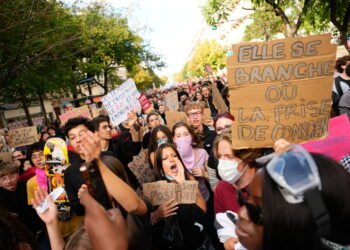
France is facing mounting economic and political pressure as street protests, rising borrowing costs and deep divisions among political parties complicate efforts to bring public finances under control. With President Emmanuel Macron approaching the end of his term in 2027, the government faces an increasingly difficult balancing act: responding to public demands for better-funded public services while reassuring financial markets that the country can manage its growing debt.
The crisis reflects a conflict between competing expectations. Demonstrators, including students and workers, want the government to protect public services and household living standards. Investors, meanwhile, are demanding credible plans to reduce borrowing and prevent debt from becoming an even heavier burden on the economy. France’s political fragmentation has made it difficult to establish a stable agreement on how to meet either set of expectations.
The situation recalls the unrest that swept France in 2018, when rising fuel prices helped trigger the gilets jaunes, or yellow vest, movement. That protest movement challenged Macron’s economic policies and exposed widespread frustration over living costs and perceived inequalities. Eight years later, demonstrations have returned, but the current turmoil is unfolding alongside growing anxiety in bond markets, where investors are increasingly concerned about the government’s ability to control spending.

France’s public finances have become a particular source of concern. The country’s debt-to-gross domestic product ratio reached 115.6% in 2025, while its budget deficit stood at 5.1% of GDP. The figures illustrate the scale of the challenge facing policymakers as they attempt to narrow the gap between government revenue and expenditure without undermining economic activity or provoking further public anger.
The pressure is expected to intensify because the deficit is projected to rise to 5.4% this year. Finance minister Roland Lescure has pledged to reduce it, but the government has yet to establish a convincing and politically sustainable route towards that objective. The difficulty is not simply identifying possible savings. Any serious adjustment would require decisions about taxation, public spending, pensions and welfare provisions, all of which are politically sensitive in France.
The contrast with the United Kingdom has attracted attention. Both countries are dealing with the consequences of extraordinary spending during the Covid-19 pandemic and subsequent support measures introduced after Russia’s full-scale invasion of Ukraine in 2022. However, France has experienced particularly severe pressure on its borrowing costs as investors reassess the risks associated with its fiscal outlook.
French government bond yields recently approached 5% for 10-year borrowing, reaching their highest level since July 2002. Bond yields generally rise when prices fall, reflecting investors’ demand for greater returns to compensate for perceived risks. Higher yields make it more expensive for a government to refinance existing obligations and borrow additional money, leaving less room in future budgets for public services and investment.
Investor unease has also been reinforced by developments in Japan. Japanese investors have traditionally been important buyers of French financial assets, but more attractive returns at home have encouraged some to reconsider their investments. If overseas demand weakens, France may have to offer higher interest rates to attract sufficient buyers for its bonds, adding further pressure to public finances.
Businesses are also struggling to plan against an uncertain political background. A survey by Medef, France’s largest employer federation, found that 82% of businesses were pessimistic about the economic consequences of the next government’s policies. Around 66% said their businesses could become vulnerable or even face bankruptcy if political deadlock continued for five years.
These findings suggest that uncertainty is affecting decisions well beyond the financial markets. Companies may delay investment, hiring and expansion when they cannot predict future taxes, regulations or government spending priorities. If investment weakens for a prolonged period, economic growth could suffer, making it harder for France to increase tax revenues and reduce its debt burden.
Antonio Fatas, an economics professor at Insead, has warned that the combination of weak growth, high debt and political instability presents a serious danger. He has argued that investors increasingly doubt whether the government is in control of the situation. He is also concerned that some political parties may see a financial crisis as an opportunity to improve their electoral prospects rather than as a problem requiring cooperation.
The country’s underlying economic strengths make the situation particularly difficult to interpret. France benefits from relatively low electricity prices, established infrastructure and a substantial public services system. Its schools are comparatively well funded against the average in the Organisation for Economic Co-operation and Development. Yet these strengths have not been sufficient to overcome sluggish growth, political uncertainty and mounting concerns over borrowing.
Pension reform remains one of the most contentious issues. Macron previously sought to increase the retirement age from 62 to 64, a change intended to reduce pressure on the pension system and generate savings over time. The proposal became a major political flashpoint and was subsequently suspended at 62 years and nine months after parliament became deadlocked. The failure to implement the original reform has limited one potential route to easing long-term spending pressures.
The dispute has become even more complicated as France looks towards its 2027 presidential election. Marine Le Pen, the National Rally leader and a leading potential contender, has advocated returning the retirement age to 62 while also proposing a debt brake through a referendum. The combination presents a political and economic puzzle: lowering the retirement age could increase pension expenditure, while a strict limit on borrowing would constrain the government’s ability to finance that commitment without raising revenue or cutting spending elsewhere.
Laurent Warlouzet, a history professor at the Sorbonne, has highlighted the tension between Le Pen’s fiscal promises and the demands of her supporters for more nurses, teachers, police officers and judges. The challenge illustrates how difficult it may be for any future government to satisfy voters who want both stronger public services and tighter controls on public debt.
Financial markets are also concerned about the possible presidential contest between Le Pen and Jean-Luc Mélenchon, leader of the left-wing La France Insoumise movement. Erik Britton, director of Fathom Consulting, has argued that the prospect of a contest between the political extremes has unsettled investors. He believes a victory for either candidate could revive concerns about France’s relationship with the European Union and the future of the euro.
The possibility of a French departure from the euro, often described as Frexit, remains speculative. Nevertheless, even the prospect of a major political confrontation over European integration could increase uncertainty among investors. France is one of the eurozone’s largest economies, and a serious crisis there would have consequences extending well beyond its borders. Higher French borrowing costs could push up yields across other eurozone bond markets as investors reassess the region’s financial stability.
The European Central Bank could potentially play a role in containing a severe market crisis, but its support is not necessarily unconditional. Assistance would generally be subject to requirements and safeguards, creating a potential clash if French political leaders demanded financial backing without accepting strict conditions. Such disagreements could make a rescue more complicated at precisely the moment when confidence would be most important.
Economist Paul Krugman has warned that France’s size could make a financial rescue exceptionally expensive. The country occupies a central position in the eurozone, meaning that difficulties in its public finances would pose a more complex challenge than those faced by smaller economies. A French debt crisis could reignite longstanding disagreements over whether European countries should share more responsibility for one another’s financial obligations.
Dhaval Joshi, an independent economist, has argued that France will ultimately need to make difficult adjustments to restore its public finances to a more sustainable path. Other European economies, including Italy, Spain and Greece, previously went through periods of painful fiscal correction. The central question for France is how much political and economic pressure will build before its leaders agree on a credible plan.
French central bank chief Emmanuel Moulin has rejected the suggestion that the country currently needs assistance from the European Central Bank, although his qualification that it was not necessary “at this point” did little to eliminate concerns. Some financial analysts believe the immediate pressure could ease if investors turn their attention to other vulnerable markets, including Japan, the United Kingdom or the United States. However, a temporary shift in market focus would not resolve France’s underlying fiscal problems.
The government’s challenge is therefore to develop a credible budget that can secure sufficient parliamentary support while addressing public concerns about living standards and essential services. A combination of gradual spending restraint, measures to improve economic growth and carefully designed revenue policies could help, but every option carries political risks. Abrupt cuts could deepen public anger, while delaying reform could further weaken market confidence.

France’s predicament is not simply a contest between protesters and investors. It is a test of whether a fragmented political system can agree on a long-term economic strategy before rising borrowing costs restrict its choices further. The country’s infrastructure, skilled workforce and established institutions remain important strengths, but they cannot indefinitely substitute for a sustainable fiscal framework.
As Macron’s presidency approaches its final months, the decisions taken over the budget will shape the economic conditions inherited by his successor. A durable solution will require political compromise, transparent choices and a realistic assessment of what the state can afford. Without that agreement, France risks entering its next electoral cycle with public frustration growing, businesses holding back investment and financial markets demanding increasingly expensive terms for lending to the government.
Related News:
 EU-China Talks Target Surge in Hybrid Car Imports
 Thinktank Calls for Abolition of UK State Pension
 Saudi intercepts Houthi missiles as oil fears grow
 Ukraine Faces $45m Hourly Cost From Missile Alerts
 French Debt Fears Put Euro Markets Under Pressure
 Reeves Fights to Keep Treasury Role Amid Labour Turmoil
 Dutch Bank Moves 86 Tonnes of Gold to London
 Trump Hardens Canada Trade Stance as Talks Stall
 UK House Prices Fall as Mortgage Rates Rise
 Oil nears $100 as Saudi attacks shake markets
 Thames Water Revises Oxfordshire Mega-Reservoir Plan
 UK Pay Growth Slows to 3.9% as Rate Decision Nears
 Bank Urged to Slow Bond Sales as UK Costs Rise
 UK Inflation Hits 3.1% as Household Pressure Grows
 Japan Raises Rates to 31-Year High
 Trump Eyes Major Belarus Fertiliser Deal Amid Canada Trade Dispute
 MPs Defend UK Economic Watchdog Against Critics
 Iran Rejects Claims of Shift in US Talks
 Tony Blair Calls for Britain to Rejoin EU Within a Decade
 Madrid Tent Camp Grows as Spain Housing Crisis Deepens
 Burnham Opens Door to Possible UK Return to EU
 Poundland Rescue Bid Could Protect 11,000 Jobs
 UK Diesel Reaches £2 as Inflation Surges Across Europe
 Minister Rejects Fears of UK Diesel Shortage
 Spain Sets Snap Election as Housing Crisis Deepens
 Informa Agrees £2.24bn Deal to Buy Clarion
 IMF Warns Governments Over Rising Debt Burdens
 France Urges UK to Consider Returning to EU
 Ministers Push ATO to Reconsider Credit Card Ban
 Oil Shock Sends Markets Lower as Middle East Risks Grow
 Australia Delays Tax Credit Card Payment Ban After Backlash
 BBC News Faces Deep Cuts in 2,000 Job Plan
 France Faces Record Presidential Crowded Race Amid Far-Right Surge
 Norway Doubles Down on Oil and Gas for Europe Energy Security
 US Awaits Iran Reply on New Ceasefire Proposal
 Hybrid village stores fight rural decline
 UK Pushes for New EU Goods Trade Deal
 Hungary Targets Oligarchs with Proposed Landmark Wealth Tax
 Severn Trent CEO Reward Package Doubled Despite Public Anger
 Weight-Loss Drugs Transform Fashion Shopping Habits
 Labour MPs Urge Burnham to Revive UK Aid Target
 Canada to Match Trump’s 50% Tariffs Dollar for Dollar
 Firms on both sides fear damage from US-Canada trade war
 Europe Faces Winter Gas Supply Anxiety
 UK Households Could Save £173 on Fixed Energy Deals
 Burnham Faces Mounting Budget Challenges
 Green Leader Targets Starmer’s Former Seat
 Reform Faces Fresh Financial Controversy
 Swedish Mining Push Puts Sami Land Rights Under Pressure
 Trump Pledges $5,000 if Republicans Win Midterms
 Saudi Arabia Shuts Oil Pipeline After Drone Attack
 Oil Prices Surge as Saudi Pipeline Closure Deepens Crisis
 UK State Pension Set to Rise 3.9% as Triple Lock Holds
 Slave-Trade Wealth Embedded in Britain’s Financial System
 Trump Threatens EU With Tariffs Over Canada Proposal
 Trump Threatens EU Over Canada Partnership Proposal
 UK Retail Sales Rebound as Consumers Spend More
 UK Rent Gap Puts Low-Income Families Under Pressure
 Macron and Carney deepen France-Canada ties
 Chinese Hybrid Car Surge Raises EU Auto Industry Concerns
 Elif Eralp Emerges as Berlin’s Next Political Force
 Should Savers Lock Into 5.25% Fixed Rates?
 Why Americans Feel Ripped Off by Rising Prices
 French Student Protests Escalate Into Violent Clashes
 Healey urged to act as UK energy bills rise 4%
 UK house price growth slows as mortgage rates rise
 UK borrowing costs surge as global bond sell-off deepens
 UK Assures Public Over Diesel Supply
 Badenoch Raises Prospect of 2027 UK Election
 French School Protests Escalate as 400 Schools Close
 Bosnia’s Young People Look Beyond Election Hope
 Asos Investigates Hack Claims After Customer Alerts
 Shell Refineries Set for Record Refining Profits
 Tanker Attacked Near Qatar as Hormuz Tensions Escalate
 South Korea Probes Fuel Shipments to Russia
 Google Maps Brings Live Fuel Prices to UK Drivers
 Tesco Raises Profit Forecast as Consumer Confidence Holds
 French Student Protests Grow Despite Government Pledge
 US Senate Debates Turn Bitter as Midterms Near
 Turkey Rules Out Troops in Saudi Arabia’s Houthi Conflict