Published: 09 October 2026. The English Chronicle Desk. The English Chronicle Online
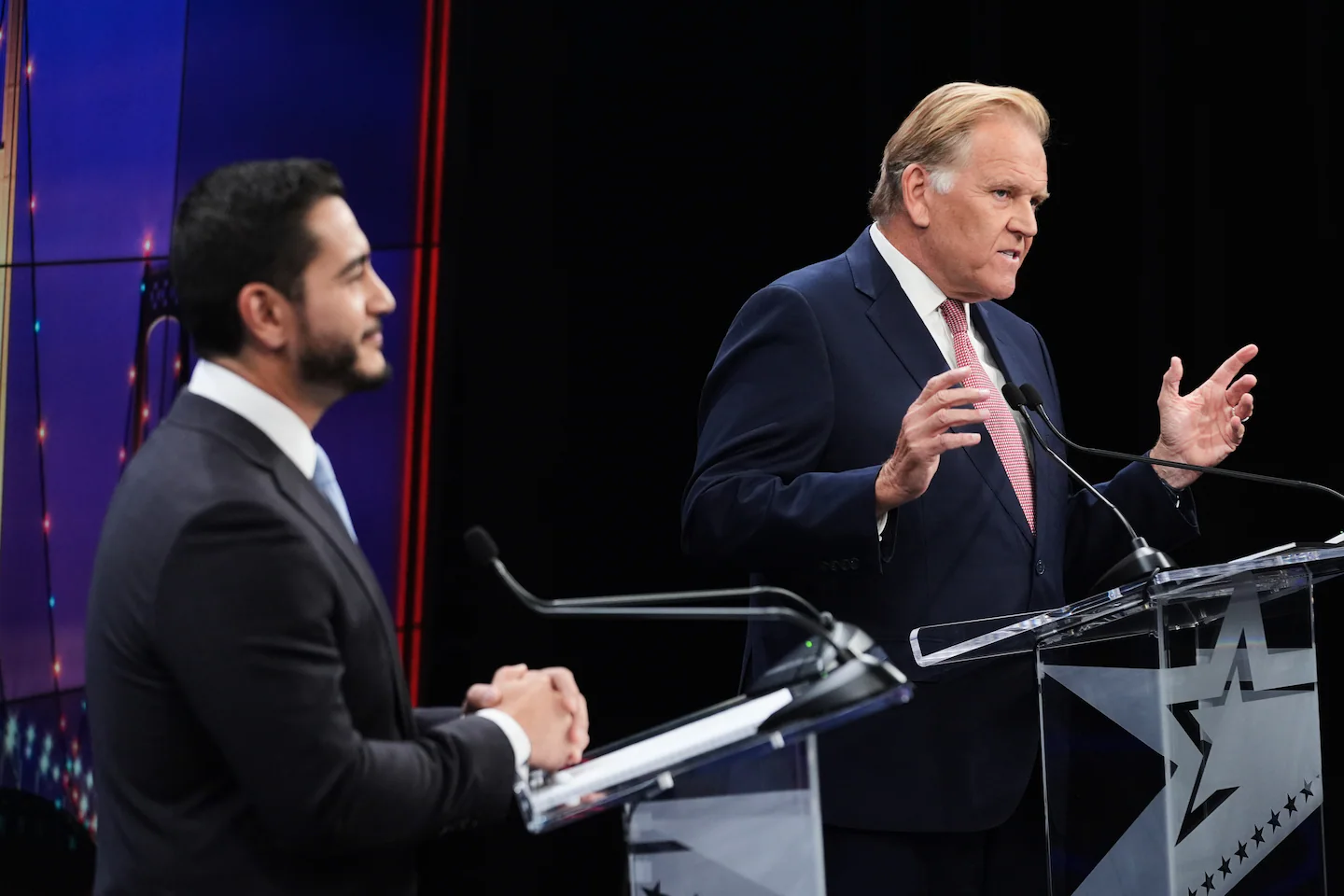
With the US midterm elections approaching, candidates in three closely contested Senate races have exchanged sharp personal attacks over the economy, immigration-related security concerns, tariffs, the war in Iran and abortion rights. The debates in Georgia, Michigan and Maine on Thursday highlighted the deep political divisions shaping the campaign, with both major parties fighting for control of the Senate and the direction of national policy.
The contests have attracted particular attention because Democrats need to win four Republican-held Senate seats to secure a majority. With voters expressing growing concern about household expenses, healthcare costs, energy prices and the consequences of President Donald Trump’s policies, the candidates faced pressure to demonstrate how their decisions would affect ordinary Americans.
In Georgia, Democratic Senator Jon Ossoff faced Republican Representative Mike Collins. Michigan’s open Senate seat brought Democrat Abdul El-Sayed into a confrontation with Republican Mike Rogers, while Maine’s longtime Republican senator Susan Collins debated Democratic challenger Troy Jackson. Across the three contests, the candidates sought to portray their opponents as out of touch with voters, while offering competing explanations for the country’s economic and political challenges.

Affordability emerged as one of the most prominent issues throughout the evening. Rising prices for groceries, fuel, housing, healthcare and household energy have become central concerns for voters, making the cost of living a defining theme of the midterm campaign.
In Michigan, El-Sayed challenged Rogers over the financial pressures facing families and accused him of supporting policies that benefited President Trump at the expense of ordinary residents. He questioned whether voters could afford to continue backing a politician who, in his view, would approve whatever the president demanded.
Both candidates expressed support for suspending fuel taxes as a way to ease pressure on consumers. El-Sayed also argued that the war in Iran was contributing to higher petrol prices and said the conflict needed to end. He attacked Rogers over the growth of his personal wealth during his time in Congress, attempting to connect the Republican candidate’s financial position with the economic difficulties facing households.
Rogers responded with forceful accusations of his own, portraying El-Sayed as politically compromised and attempting to associate him with billionaire George Soros and militant organisations Hamas and Hezbollah. Rogers argued that Michigan could not afford to elect a candidate whose political outlook he considered dangerous. The exchange reflected a broader Republican strategy of raising questions about Democratic candidates’ national security positions and political associations.
Economic concerns also dominated the Georgia debate. Ossoff repeatedly challenged Collins to explain his support for Trump’s international tariff policies, arguing that the measures had harmed Georgia families and restricted economic growth. Ossoff pressed his opponent to justify his voting record, making tariffs a central point of disagreement between the two candidates.
Collins blamed inflation on policies adopted under the previous Biden administration, particularly government spending measures that Ossoff had supported. The disagreement reflected the wider national argument over the causes of higher prices, with Republicans highlighting earlier spending decisions and Democrats criticising the effects of the current administration’s trade policies.
In Maine, Jackson concentrated on household energy expenses, particularly the sharp rise in heating oil costs. The issue carries particular significance for residents who depend on heating oil during the colder months. Senator Susan Collins defended her record, pointing to a $50bn rural health transformation fund included in Trump’s major tax and spending legislation. She argued that the measure would provide important benefits to rural communities.
The Georgia debate became especially confrontational when the candidates discussed government support for data centres. Ossoff accused Collins of backing measures that redirected public resources away from local communities and towards data-centre developers. The exchange connected the debate over economic affordability with growing questions about the costs and benefits of expanding artificial intelligence infrastructure.
Ossoff also accused Collins of tolerating extremist views among people associated with his political operation. Referring to reports about staff members who had expressed white nationalist, antisemitic or other extremist views online, Ossoff used the issue to question Collins’s judgement and political associations. He invoked the legacy of civil rights leader John Lewis, arguing that Collins’s political circle had been linked to people whose views contradicted the principles of equality and civil rights.
Collins rejected the accusations and attempted to turn the criticism back on Ossoff, describing the senator as a radical whose record had left Georgia less safe and more expensive. When questioned about controversial social media posts attributed to his son-in-law, Collins said he opposed racism, antisemitism and hatred, regardless of where such views originated. He also referred to a recent threat against his life, underscoring the increasingly personal nature of political disputes.
The clash demonstrated how campaign debates are increasingly shaped not only by policy disagreements but also by questions about candidates’ judgement, associates and personal conduct. For both campaigns, the challenge is to convince voters that allegations against their opponents reveal genuine concerns about leadership rather than serving merely as political distractions.
Trade policy produced another heated exchange in Michigan, where the state’s close economic relationship with Canada makes tariffs especially consequential. Rogers had recently moved away from his earlier support for Trump’s tariffs on Canada, saying in a campaign advertisement that Canada was not an enemy and that the trade conflict needed to end.
During Thursday’s debate, Rogers said he had spoken with Commerce Secretary Howard Lutnick about securing an agreement between the two countries. He acknowledged that some tariffs were too high and were not helping American interests.
El-Sayed accused Rogers of changing his position because of declining poll numbers. He argued that Michigan needed a consistent approach to trade that protected manufacturing without imposing unpredictable costs on businesses and consumers. While supporting targeted tariffs designed to protect domestic industry, El-Sayed criticised Trump’s measures as chaotic and self-serving.
The dispute is particularly relevant to Michigan’s manufacturers, workers and businesses that rely on cross-border trade. Tariffs can raise the cost of imported components and materials, potentially affecting production expenses, consumer prices and employment. The candidates’ disagreement therefore offered voters competing visions of how to protect American industry while maintaining productive economic relationships with neighbouring countries.
In Maine, the war in Iran became a source of sharp tension between Jackson and Collins. Jackson argued that Collins, as chair of the Senate Appropriations Committee, had influence over government funding and could use that position to challenge the administration’s military actions.
Collins responded that she had repeatedly supported war powers resolutions intended to halt Trump’s military action in Iran. Jackson nevertheless accused the senator and her husband of benefiting financially from the conflict, prompting Collins to describe the allegation as outrageous and demand an apology.
The exchange placed Collins’s record on military oversight under scrutiny. It also illustrated the difficulty facing lawmakers who seek to criticise a president’s foreign policy while remaining part of the governing party’s congressional majority.
Reproductive rights formed another important battleground in Maine, where voters have closely examined both candidates’ records on abortion. Jackson criticised Collins for supporting the confirmation of Supreme Court Justice Brett Kavanaugh, whose appointment preceded the court’s 2022 decision overturning the constitutional protection for abortion established by Roe v Wade.
Collins has said she received private assurances from Kavanaugh before his 2018 confirmation that he would not overturn the landmark ruling. Despite the subsequent decision, she has maintained that she does not regret voting to confirm him. Although Collins is among the Republican senators who support abortion rights, her role in Kavanaugh’s confirmation remains a contentious issue for critics.
Collins countered by questioning Jackson’s earlier positions on abortion, arguing that his record had included restrictions that many voters would consider extreme. Jackson maintained that his position had improved, while Collins pointed to legislation she had helped draft that sought to establish nationwide protections for abortion rights. That proposal did not pass the Senate.
The Michigan debate also featured repeated arguments over national security and terrorism. Rogers attempted to link El-Sayed to Hamas and other militant organisations, raising questions about his family and accusing him of failing to condemn attacks. El-Sayed rejected the characterisation and said he had condemned both a terrorist attack in Michigan earlier in the year and the 7 October Hamas attacks.
El-Sayed accused Rogers of using painful events for political advantage rather than addressing his own record. He also challenged Rogers over his personal wealth, prompting an exchange about whether the Republican had owned yachts in Florida. The argument continued even during a commercial break, according to moderator Rick Albin, who said he had rarely seen candidates continue sparring when the cameras were not formally broadcasting the debate.
The confrontations in all three states underscored the increasingly combative character of the midterm campaign. Economic anxiety remains central, but questions about political extremism, national security, trade, foreign policy and reproductive rights are also influencing how voters assess the candidates.

With control of the Senate at stake, the races in Georgia, Michigan and Maine could have consequences extending far beyond the three states. The outcome will help determine how much room the president has to advance his legislative agenda and how effectively congressional opponents can challenge it.
The debates did not resolve the sharp disagreements separating the candidates. Instead, they offered a snapshot of a campaign in which personal credibility and political identity are competing with policy detail for voters’ attention. As election day approaches, the candidates will face the challenge of turning their arguments into support at the ballot box, while voters weigh the promises, accusations and records presented during one of the country’s most consequential political contests.
Related News:
 Trump Refuses to Sign Housing Bill, But Law Takes Effect
 Trump and Mamdani Hold Cordial Gracie Mansion Meeting
 US Labor Department in turmoil after secretary resigns
 Judge Blocks Trump Bid for Arizona Voter Data
 US Court Weighs Fate of TPS for Migrants
 Immigration Judges Fear Pressure in Trump Era
 Trump’s Revenge Drive Deepens GOP Divide
 Trump Orders Signs Criticising Smithsonian Museum
 Armed Suspect Attacks Ohio Governor Candidate
 Trump gives $45,000 holiday gifts to White House aides
 Trump Pledges $5,000 if Republicans Win Midterms
 Reform UK Receives Record £36m Donation From Crypto Billionaire
 Reform Faces Questions Over £72m Donations
 UK Retailers Accused of Breaking Refund Laws
 US House Passes Russia Sanctions Bill Amid Debate
 Omar Proposes Bill to Redirect ICE Funding
 Texas Transfers Raise Fears for Migrant Children
 Memphis Questions National Guard Crime Surge
 Reform UK Faces Internal Debate Over £72m Spending
 Democrat Says ICE Restricted Detention Camp Oversight
 Thinktank Calls for Abolition of UK State Pension
 Trump Ads Trigger Fight Over Taxpayer Money
 Burnham Opens Door to Possible UK Return to EU
 Senators warn US childcare policies could raise costs
 Badenoch Raises Prospect of 2027 UK Election
 DOJ Declines to Reopen Powell Renovation Probe
 Pritzker’s National Profile Grows Ahead of 2028
 Latin America women fear rollback of rights
 Tanker Attacked Near Qatar as Hormuz Tensions Escalate
 Botstein Quits Bard Amid Epstein Investigation Calls
 ICE Agent Shoots Man in New York as Child Escapes Harm
 US National Guard Member Killed in DC Shooting
 Government Unveils Northern Powerhouse Rail Plans
 Trump Fed bid heads to Supreme Court
 Partial US Government Shutdown Hits Homeland Security Funding
 Thousands Protest ICE Operations in Nationwide US Day of Action
 White House Security Case Sparks Political Firestorm
 Trump approval plunges amid Iran war fears
 Florida Surgeon ‘Devastated’ Over Fatal Surgery Error
 US Awaits Iran Reply on New Ceasefire Proposal
 Kevin Warsh sworn in as Fed chair amid economic backlash
 US green card applicants must apply from abroad, DHS says
 Tulsi Gabbard exits after turbulent intelligence tenure
 Nationwide Faces Governance Scrutiny Ahead of AGM
 Trump’s Mount Rushmore Speech: A Divisive Anniversary
 Le Pen’s Popularity Holds Despite Conviction
 Burnham unveils £65m drought aid for farmers
 Unions Warn Labour Over Zero-Hours Contract Reforms
 Trump Hardens Canada Trade Stance as Talks Stall
 Trump Calls Iran War ‘Small Potatoes’ Despite US Deaths
 UK Subsidence Claims Surge After Record-Breaking Summer
 UK plans tougher Israel stance with settlement trade ban
 Councils spend £125m on illegal children’s care
 New Mexico Takes Facebook to Trial Over Data Scandal
 Farage Threatens Union Funding Ban Over Reform Donations
 UK Pay Growth Slows to 3.9% as Rate Decision Nears
 Bank Urged to Slow Bond Sales as UK Costs Rise
 Texas Charges Seven Noncitizens in Voting Crackdown
 Entain Plans 400 Job Cuts After Profit Update
 Trump Threatens EU With Tariffs Over Canada Proposal
 Mahmood Warns Far Right Over Asylum Protests
 UK Rent Gap Puts Low-Income Families Under Pressure
 US Networks Suspend Trump White House Pool Coverage
 MPs Defend UK Economic Watchdog Against Critics
 Xi urges Trump to avoid US-China military conflict
 Lula accuses Trump of seeking control over Brazil
 Republican Senator Questions Trump Ad Spending
 Free Speech Emerges as Key UK Election Issue
 Tennessee Set to Execute Woman After Clemency Denied
 Cornell Fraternity Assault Investigation Reopened
 UK University Strikes Spread as Financial Pressure Grows
 Poundland Rescue Bid Could Protect 11,000 Jobs
 Healey urged to act as UK energy bills rise 4%
 French School Protests Escalate as 400 Schools Close
 Salinas Struggles to Keep the American Dream Alive
 Families Await USS Abraham Lincoln Homecoming
 Gosport Protesters Clash With Police Over Migrant Rescue
 IMF Warns Governments Over Rising Debt Burdens
 Ministers Push ATO to Reconsider Credit Card Ban
 Trump Says He Deserves Nobel Peace Prize