Published: 31 October 2026. The English Chronicle Desk. The English Chronicle Online
Poland has been plunged into another major political and constitutional confrontation after riot police were deployed outside the country’s Constitutional Tribunal in Warsaw following the suspension of its president, Bogdan Święczkowski, and his deputy, Bartłomiej Sochański. The decision has intensified a decade-long dispute over the legitimacy, independence and political influence of the country’s highest constitutional court, drawing opposition politicians, government representatives, protesters and international observers into an increasingly tense standoff.
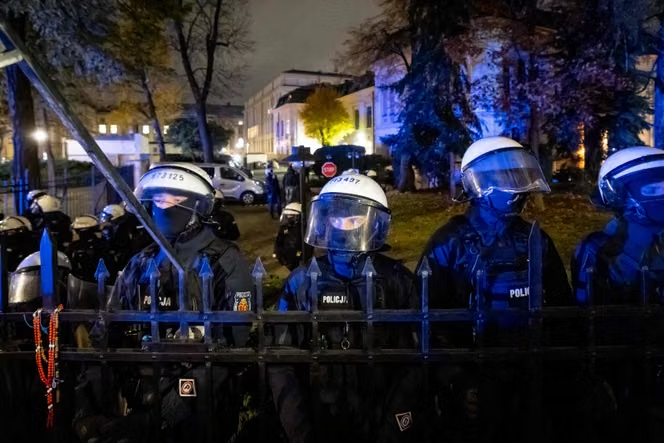
The confrontation unfolded on Friday night as hundreds of people gathered outside the Constitutional Tribunal to demonstrate their support for the suspended judicial leadership. Among those present were members of the opposition Law and Justice party, commonly known as PiS, which strongly criticised the decision. Police officers equipped with riot-control equipment established a security cordon around the building as tensions increased and some demonstrators attempted to enter the premises.
According to police, three people were detained after several protesters breached the tribunal’s perimeter fence, while others allegedly threw objects towards officers. The situation remained tense throughout the night, with security personnel attempting to prevent further disturbances and maintain control of the court premises.

The controversy began when a group of judges appointed by the current parliamentary majority moved to suspend Święczkowski and his deputy, Sochański. The judges argued that procedural control of the institution needed to be restored amid continuing disagreements over the legitimacy of its membership and leadership.
Anna Korwin-Piotrowska, one of five judges elected by the current parliamentary majority but not formally sworn in by President Karol Nawrocki, subsequently announced that she had assumed the tribunal’s top position. She justified the move by referring to her longer professional experience within the judiciary.
However, the decision immediately triggered competing interpretations of constitutional law. Supporters of the suspended leadership questioned whether the judges responsible for the decision had the legal authority to remove the tribunal’s president. Government-aligned representatives, meanwhile, maintained that the changes were necessary to enable the institution to operate with judges whose appointments they consider constitutionally valid.
The dispute took an extraordinary turn when President Nawrocki interrupted his journey to Senegal, where he was scheduled to undertake a state visit, and returned to Warsaw to intervene in the developing crisis. His decision to abandon the planned journey highlighted the political importance attached to the confrontation and brought the presidency directly into the centre of the dispute.
Shortly before 1am on Saturday, Nawrocki arrived outside the Constitutional Tribunal. He moved through the police security cordon and attempted to enter the building. Video footage circulated online showed the president involved in a tense encounter with security personnel and other judges as he sought access to the premises.
In a recording published online, Nawrocki was heard questioning the authority of the government-appointed judges, declaring that they were not legitimate judges of the Constitutional Tribunal. His intervention reflected the presidential position that the current developments represented a serious violation of Poland’s constitutional arrangements.
By approximately 4am local time, the president was still inside the building. Later, in a statement delivered on his behalf outside the tribunal at around 5am, Nawrocki accused those involved of violating the country’s constitutional order. He described the situation as the forceful seizure of a constitutional institution and called on security forces to leave the premises.
The president’s position received strong support from the opposition Law and Justice party. Its leader, Jarosław Kaczyński, condemned the suspension of the tribunal’s leadership, describing the developments as an assault on the institution. Opposition figures also accused the government of attempting to take control of the judiciary through politically motivated measures.
The latest confrontation cannot be understood without examining the prolonged institutional conflict that has shaped Poland’s political and judicial landscape since 2015. At that time, a change of government produced competing efforts to appoint judges to the Constitutional Tribunal. The outgoing centrist administration and the incoming rightwing government both made appointments under circumstances that subsequently became the subject of legal and political controversy.
The disagreements over judicial appointments gradually undermined the tribunal’s ability to function normally. The dispute became particularly contentious during the eight years of government led by PiS, when Poland experienced repeated disagreements with the European Union over judicial independence, constitutional safeguards and the rule of law.
The European Union raised concerns about reforms introduced during that period, arguing that changes to the judicial system weakened institutional independence and increased political influence over the courts. Poland’s Constitutional Tribunal also became a major focus of European criticism after repeatedly issuing decisions that placed Polish legislation above conflicting European Union legal requirements.
The controversy created significant uncertainty about the relationship between national constitutional authority and the legal obligations associated with Poland’s membership of the European Union.
Donald Tusk’s return to government in 2023 brought renewed efforts to reverse several controversial judicial reforms. His administration pledged to restore judicial independence, rebuild confidence in public institutions and improve relations with European partners, particularly Brussels.
However, implementing those changes has proved difficult. President Nawrocki, who unexpectedly defeated Tusk’s preferred candidate in the 2025 presidential election, has repeatedly used his constitutional powers to challenge government initiatives. His refusal to swear in five judges elected by the current parliament has become another major obstacle in the continuing dispute.
Earlier in October, the Venice Commission, an advisory body of the Council of Europe specialising in constitutional matters and the rule of law, expressed concern about the implications of the presidential refusal. It stated that the failure to swear in the five elected judges should not prevent them from taking up their judicial positions.
That position has added another dimension to the disagreement, although it has not resolved the competing legal interpretations surrounding the tribunal’s composition and leadership.
Legal experts have also expressed sharply different views about the latest suspension. Marcin Matczak, a prominent Polish constitutional law expert and critic of the previous PiS government, questioned the legal basis for removing Święczkowski. Despite his longstanding opposition to the former government’s judicial policies, Matczak said he had not expected to find himself defending the suspended tribunal president. He nevertheless argued that the legal grounds for the suspension appeared to be non-existent.
His assessment illustrates the complexity of the dispute, where disagreements over judicial appointments and institutional legitimacy cannot necessarily be resolved through political arguments alone.
Meanwhile, Justice Minister Waldemar Żurek confirmed that he had requested the removal of legal immunity from Święczkowski and Sochański to allow possible prosecution over allegations that they obstructed the tribunal’s work. The request could open another legal confrontation involving the suspended judicial leadership and the government.
Prime Minister Tusk defended his administration’s approach, insisting that restoring the rule of law was a constitutional responsibility. He acknowledged that the process would be difficult and sometimes painful after years of institutional controversy under the previous government. Nevertheless, he maintained that there was no alternative to taking action to restore the proper functioning of the judiciary.
Earlier this month, Tusk also indicated that the Constitutional Tribunal would eventually operate in accordance with the constitution, regardless of opposition to the government’s approach.
Foreign Minister Radosław Sikorski offered a similar explanation while speaking to journalists on the sidelines of a G20 meeting in Atlanta. He argued that the tribunal had become politicised under the previous administration and said the latest developments were intended to allow a majority of properly elected judges to restore its operations.
The opposition, however, rejected that interpretation and described the events as a judicial coup. The tribunal’s social media account also accused the government of carrying out an attempted seizure of the institution.
The dispute has attracted attention beyond Poland, with several prominent European rightwing political figures criticising the government’s actions. Britain’s Nigel Farage and former prime minister Liz Truss, alongside Dutch politician Geert Wilders, were among those expressing opposition to the developments.
The United States also voiced concern. Tom Rose, the US ambassador to Poland, described the unfolding events as extremely serious in a statement published on social media. He acknowledged that the opposing sides were presenting sharply different accounts of what had happened and why.
Rose warned that the gathering of thousands of people around the tribunal could make an already dangerous situation more volatile. He stressed that Poland needed to avoid a confrontation that could escalate into a much more serious crisis.
The latest developments have raised concerns about the country’s political stability as Poland approaches its next parliamentary election in 2027. The confrontation has exposed the continuing divisions between Tusk’s governing coalition and the conservative opposition, with the presidency emerging as a central arena for the struggle over the country’s constitutional future.
Beyond the immediate political consequences, the dispute also raises fundamental questions about public confidence in the judiciary. A constitutional court is expected to provide an independent mechanism for interpreting the constitution, resolving institutional disagreements and protecting the legal rights of citizens. When the legitimacy of its judges and leadership becomes a subject of prolonged political confrontation, the consequences can extend well beyond the courtroom.

For ordinary citizens, uncertainty surrounding the country’s highest constitutional institution could undermine confidence in the consistency and independence of the legal system. Businesses, public authorities and other institutions also depend on predictable constitutional arrangements and the effective resolution of legal disputes.
Poland now faces the challenge of finding a way through competing claims of constitutional authority without allowing political disagreements to further weaken its institutions. The suspension of the tribunal’s leadership, the president’s dramatic intervention and the deployment of riot police have transformed an already complicated judicial dispute into a highly visible political confrontation.
Whether the government and opposition can reach a legally sustainable resolution remains uncertain. What is clear is that the controversy has brought Poland’s unresolved judicial crisis back into the international spotlight, placing constitutional independence, presidential authority and the future of democratic institutions at the centre of the country’s political debate.
Related News:
 Hungary election: Orbán faces biggest test amid scandal
 Former ICC prosecutor condemns US sanctions
 Irish Gangland Figure Fails in Dublin Election Bid
 French Student Protests Escalate Into Violent Clashes
 French School Protests Escalate as 400 Schools Close
 Lithuania Offers to Fund Permanent US Military Base
 France Suspends Stun Grenades After Student Injury
 EU Divisions Deepen Over Israel Policy
 Ukrainian Soldier Faces Trial Over Nord Stream Blast
 Macron Condemns Violence as France Faces 2,400 Arrests
 Massive Student-Led Movement Marches in Belgrade Ahead of Serbian Vote
 Milan Braces for Unrest as Debate Intensifies Over Lost Generation
 Serbia’s Student Victory Sparks a ‘Smell of Freedom’
 Albania Introduces $6,000 Fines for Violent Protests
 China-critical UK academics face ‘extremely heavy’ pressure from Beijing
 US Justice Department Files Lawsuit Against California Over Partisan Voting Maps
 Trump Deploys DHS to Charlotte in Major Arrest Operation
 Chinese & Japanese Boats Clash Near Disputed Islands
 UK and EU Signal Fresh Push for Defence Cooperation Talks
 Thousands Protest ICE Operations in Nationwide US Day of Action
 Italian Town Buys Mussolini Villa to Keep Away Fascist Fans
 Report Says Pezzullo Acted ‘Recklessly’ in Dealings
 Suspected Plot Targets Pipeline Before Hungary Vote
 Cartel crackdown raises fears of fresh violence
 Judge halts deportation of Yemeni refugees in US
 Trump warns Iran as Middle East tensions surge again
 France Faces Record Presidential Crowded Race Amid Far-Right Surge
 Deadly Russian Air Raids Strike Across Ukraine
 Le Pen to Run for President Despite Embezzlement Conviction
 Le Pen’s Popularity Holds Despite Conviction
 Russian Missiles Intensify Pressure on Kyiv
 Ukraine Villagers Demand Answers After Deadly Arms Depot Strike
 Bayeux Tapestry Revives Franco-British Ties
 UK plans tougher Israel stance with settlement trade ban
 Europe’s democracies face a growing far-right threat
 Sweden Election Hangs on Far-Right Breakthrough
 Israel Accused of Undermining Palestinian Life
 Saudi Pact Raises Risk of Pakistan Entering War
 US Networks Suspend Trump White House Pool Coverage
 Japan PM Backs International Criminal Court
 King Refers Jamaica Slavery Petition to Privy Council
 Elif Eralp Emerges as Berlin’s Next Political Force
 Republican Senator Questions Trump Ad Spending
 Madrid Tent Camp Grows as Spain Housing Crisis Deepens
 Burnham Opens Door to Possible UK Return to EU
 Drumcree Talks Falter as Legal Challenge Deepens
 UK-France Returns Deal Faces Expiry as Talks Stall
 Trump Immigration Policy Faces New Legal Tests
 Bosnia’s Young People Look Beyond Election Hope
 Germany Pledges €1bn Military Aid to Ukraine
 Ukraine claims strikes have crippled Russia’s oil refining
 Former German Intelligence Chief Arrested Over Espionage
 France Schools Protests Draw 250,000 as Police Clash
 UK Mission in East Jerusalem to Remain Open
 Trump Says He Deserves Nobel Peace Prize
 Delhi Detains Protest Leaders as Youth Rally Escalates
 French Students Protest Poor Conditions in Paris Suburbs
 Glucksmann Urges French Left to Fight Far Right
 Brazil Court Scandal Threatens Lula as Bolsonaros Rise
 Greta Thunberg Backs French Students in School Protests
 Ohio Airports Become Key Hubs for ICE Deportation Flights
 India’s Voter Roll Crisis Sparks Nationwide Protests
 Judge Blocks Trump White House Media Ban
 Gadi Eisenkot: Israel’s Anti-Netanyahu Challenger
 Trump Rallies GOP as Senate Democrats Boost Key Races
 Talarico Faces Tough Voter Test in Texas Senate Race
 Serbia Leader Linked to Controversial Trump Tower Plan
 Albania’s Rama Defies Calls to Quit Amid Student Protests
 French Police Face Scrutiny Over Injured Teenagers
 UK Could Rejoin EU Through a Switzerland Plus Deal
 Milan Luxury Stores Shut as Italy Plans Troop Deployment
 Suu Kyi Appears in Rare Photos After Royal Gift
 Omar Claims US Raid on Residence Was Meant to Intimidate
 Liechtenstein Prince Exercises First Veto of Reign to Block Abortion Reform
 Greens Face Leadership Test as Jordon Steele-John Misconduct Claims Leave Party in Limbo
 Spain Deepfake Ad Sparks Election Outrage
 Ukraine Peace Talks Set to Resume in November
 Flávio Bolsonaro Reportedly Leaves Brazil After Election Defeat
 Spain Mourns 68 Dead After High-Speed Train Crash
 Novaya Gazeta to Close After Russian Government Pressure