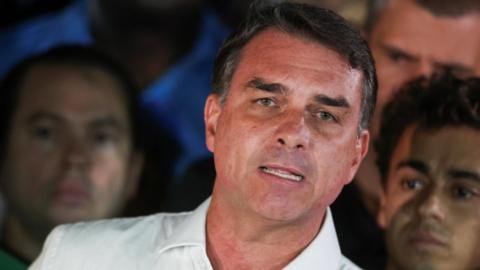
The developments have intensified political tensions in Brazil, where Bolsonaro faces legal scrutiny and had reportedly been ordered to surrender his passport to federal police. His apparent departure has also raised questions about the future leadership of the Brazilian right, particularly following the electoral defeat of a candidate who had sought to maintain the political influence of the Bolsonaro family.
Argentina’s government confirmed that Flávio Bolsonaro and his family entered the country with valid travel documents before departing on a private flight to Ecuador. The confirmation provided an important element of the developing story, although reports concerning his ultimate destination and plans in the United States remained subject to verification.

Argentina’s National Directorate of Migration stated that Bolsonaro, his wife and their two daughters crossed into Argentina and boarded a private aircraft at approximately 11.30pm on Tuesday. The agency said the family entered through the Tancredo Neves International Bridge crossing in Misiones province.
According to the Argentine authorities, the journey was recorded by the relevant officials and took place without any legal impediment to entering the country. The aircraft was reportedly operated by Baires Fly S.A. and was bound for Guayaquil, Ecuador, a city situated approximately 260 kilometres south-west of Quito.
The confirmation contradicted some earlier accounts suggesting that Bolsonaro had travelled directly to the United States. Brazilian media outlets, including Metrópoles and Folha de S.Paulo, reported that people close to the senator or his political circle believed he was planning to continue to the US.
Those reports also suggested that Florida could be his intended destination and that an application for political asylum was under consideration. However, the reported plans were not equivalent to confirmation that he had reached American territory or formally requested asylum.
A spokesperson for the US State Department was reported as saying that visas would be granted to Bolsonaro and his family to permit entry into the United States. The circumstances surrounding any prospective arrival, the purpose of the travel and the family’s eventual destination remained central questions as the story developed.
President Luiz Inácio Lula da Silva criticised Bolsonaro’s reported departure, describing the decision to leave Brazil after an electoral defeat as shameful. Speaking in Brasília during an event marking his 81st birthday, Lula questioned why a politician who believed he had done nothing wrong would leave the country amid legal scrutiny.
Lula also accused the Bolsonaro family of placing its political interests ahead of Brazil’s national interests, using sharply worded remarks about its relationship with the United States.
The comments reflected the deep divisions that have characterised Brazilian politics throughout the Bolsonaro era. Lula’s return to the presidency represented a significant setback for the far-right movement, while the latest developments have created fresh uncertainty about its capacity to maintain a unified opposition.
Bolsonaro had not publicly conceded defeat, according to the reports, and his apparent absence from Brazil added another dimension to the post-election confrontation.
For Lula’s supporters, the reported departure could reinforce criticism of the Bolsonaro family’s conduct and its approach to democratic institutions. For the defeated candidate’s supporters, however, the circumstances may be interpreted through the wider dispute over criminal investigations and the treatment of the political right.
The competing interpretations are likely to shape public debate as Brazilian authorities seek to establish the senator’s movements and determine whether any legal orders have been breached.
Bolsonaro’s reported departure followed a judicial decision concerning his passport. According to the supplied reports, a Supreme Court justice cancelled the document in connection with a criminal investigation and directed him to surrender it to federal police by 11am on Tuesday.
The senator reportedly failed to meet that deadline, prompting questions about whether he had left Brazil without passing through a regular immigration checkpoint.
Federal police were said to be seeking information from Argentine authorities to establish whether there was an official record of his entry into the neighbouring country. The lack of a confirmed record at a conventional Brazilian immigration checkpoint had complicated efforts to reconstruct his movements.
The investigation involving Bolsonaro reportedly concerns allegations of participation in a money-laundering scheme valued at approximately £680 million, or $905 million, involving betting companies. These allegations remain accusations and should not be treated as proof of criminal wrongdoing.
The senator has also faced longstanding allegations relating to the handling of salaries paid to members of his political staff. Those accusations have contributed to his controversial public profile, although individual allegations must be distinguished from any findings established through judicial proceedings.
Reports also indicated that Bolsonaro holds Italian citizenship, which he obtained in 2023, and may possess an Italian passport. The potential significance of that citizenship could depend on the relevant legal circumstances and any applicable restrictions on his travel.
The legal situation remains particularly sensitive because the passport order and the reported journey occurred immediately after a closely contested presidential election. Any further action by the courts could influence both Bolsonaro’s personal position and the political movement associated with his family.
Members of Lula’s Workers’ Party reportedly asked Brazil’s Supreme Court to order Bolsonaro’s arrest. They also requested that his name be placed on Interpol’s Red Notice list, an international mechanism used to seek the location and provisional arrest of individuals wanted by a member country, subject to applicable legal requirements.
Such requests do not automatically result in an arrest or establish that an individual is guilty of an offence. Any action would depend on the relevant legal process, the status of domestic judicial orders and the procedures governing international cooperation.
The developments have placed additional attention on relations between Brazilian institutions and foreign governments. If Bolsonaro travels to the United States, questions about his immigration status, any asylum application and possible legal proceedings could become important.
His family’s political connections in the United States have also attracted scrutiny. Eduardo Bolsonaro, one of his brothers, has been living in the country in self-imposed exile, according to the reports.
Eduardo reportedly faces an outstanding arrest warrant in Brazil following a four-year prison sentence related to alleged efforts to influence proceedings involving his father by lobbying Donald Trump to impose sanctions on the justices handling the case.
The political and legal circumstances surrounding the family are complex, and the outcome of any international action would depend on decisions by the relevant authorities rather than political statements alone.
Beyond the immediate questions about Bolsonaro’s whereabouts, his reported departure has intensified a broader debate about the future of Brazil’s right-wing politics.
Flávio Bolsonaro secured 48.21 per cent of the vote, according to the figures in the reports, demonstrating that the movement retains considerable support despite its electoral defeat. His result also highlighted the difficulty facing conservative and far-right politicians seeking to challenge Lula’s political coalition.
The senator’s campaign had been closely associated with the legacy of his father, former president Jair Bolsonaro. Jair Bolsonaro remains under house arrest over proceedings concerning an alleged attempt to overturn the previous election result, according to the supplied account.
Flávio’s candidacy was reportedly shaped by the absence of his brother Eduardo from Brazil and the political constraints surrounding their father. Before the election, the senator was said to have been reluctant to seek the presidency because of the personal and political pressures associated with a national campaign.
Political observers have questioned whether Flávio possesses the same public appeal and political instincts that helped his father win the presidency in 2018. His previous career included service as a state legislator and senator, while his earlier attempt to win executive office ended in defeat in Rio de Janeiro’s 2016 mayoral election.
Nevertheless, his presidential campaign demonstrated that the Bolsonaro name continues to mobilise a substantial electoral constituency.
Senator Rogério Marinho, who led Bolsonaro’s campaign, reportedly expressed surprise at reports that the defeated candidate had left the country. Marinho said he had expected Bolsonaro to assume a leading role in the opposition, pointing to the millions of votes received during the election.
Asked whether the senator could lead the opposition from abroad, Marinho referred to Venezuelan opposition figure María Corina Machado as an example of political leadership exercised under difficult circumstances.
The comparison highlighted the possibility that Bolsonaro’s supporters could attempt to maintain political influence even if their candidate remains outside Brazil. Whether such a strategy would succeed remains uncertain.
Political scientists cited in the reports suggested that the election result and the reported departure could create an opening for other conservative figures.
Magna Inácio, a political scientist at the Federal University of Minas Gerais, argued that resistance among Brazilian voters to a more extremist political direction could intensify competition for leadership within the right.
Camila Rocha, who studies Brazil’s emerging right-wing movements, suggested that the political influence previously concentrated among members of the Bolsonaro family could gradually shift towards other figures.
Potential contenders include Michelle Bolsonaro, Jair Bolsonaro’s wife, who was reported to have been elected to the Senate, and São Paulo governor Tarcísio de Freitas. Both have been discussed as possible figures in the future of the conservative movement.
However, any transition could prove difficult. The Bolsonaro family’s political relationships have been marked by disagreements, including reported tensions between Michelle and her stepsons Carlos Bolsonaro and Jair Renan Bolsonaro.
Carlos was reported to have been elected to the Senate, while Jair Renan was reported to have been elected to Congress. Their respective political ambitions could complicate efforts to establish a unified leadership structure.
The future of the movement may therefore depend on whether established political figures can attract Bolsonaro supporters without relying exclusively on family loyalty.
Flávio Bolsonaro’s reported journey out of Brazil has created a rapidly evolving situation involving electoral politics, criminal investigations and international travel. Although Argentine authorities confirmed that the senator and his family departed for Ecuador, claims that he would subsequently travel to the United States remained a separate matter requiring confirmation.

The immediate questions concern his whereabouts, his compliance with judicial orders and whether Brazilian authorities will pursue further legal measures. The longer-term implications concern the organisation of the opposition after Lula’s election victory.
With a substantial share of the electorate having supported Bolsonaro, the far right is unlikely to disappear from Brazilian politics. However, the reported departure of its presidential candidate, the legal difficulties confronting members of the family and divisions over future leadership could weaken its ability to act as a coordinated political force.
Brazil’s coming political period will test whether the movement can move beyond the personal leadership of the Bolsonaro family or whether internal disputes will further fragment the right.
For now, the distinction between confirmed movements and reported intentions remains essential. Argentina has confirmed the family’s journey to Ecuador, while the broader claims surrounding an onward trip to the United States, political asylum and potential legal consequences require further authoritative confirmation.
Related News:
 Gunman Killed After White House Security Shootout
 Latin America women fear rollback of rights
 Trump Administration Threatens California Election Officials
 Omar Claims US Raid on Residence Was Meant to Intimidate
 Trump’s Midterm Campaign Faces Racism and Political Backlash
 Thousands Protest ICE Operations in Nationwide US Day of Action
 Swalwell Faces Pressure to Quit Governor Race
 Harmeet Dhillon Faces Scrutiny in DOJ Role Debate
 US Court Ruling Reshapes Voting Rights Landscape
 Cartel crackdown raises fears of fresh violence
 US states redraw maps after voting rights ruling
 Judge halts deportation of Yemeni refugees in US
 Trump warns Iran as Middle East tensions surge again
 US ‘Narco Boat’ Strikes Draw Global Outcry
 US Court Restores Abortion Pill Access Temporarily
 US judge dismisses Kilmar Abrego Garcia indictment
 Trump’s Revenge Drive Deepens GOP Divide
 Former ICC prosecutor condemns US sanctions
 Irish Gangland Figure Fails in Dublin Election Bid
 Mystery Grows Over Mitch McConnell’s Health
 UN expert urges UK to rethink Israel policy
 Armed Suspect Attacks Ohio Governor Candidate
 Miliband Rejects Chief Rabbi’s West Bank Warning
 Israel Accused of Undermining Palestinian Life
 UK Urged to Probe US Diplomat Case
 Texas Transfers Raise Fears for Migrant Children
 Memphis Questions National Guard Crime Surge
 Trump Media Ban Triggers First Amendment Clash
 ICE Shooting in Austin Sparks Calls for Transparency
 US Networks Suspend Trump White House Pool Coverage
 Democrat Says ICE Restricted Detention Camp Oversight
 Japan PM Backs International Criminal Court
 King Refers Jamaica Slavery Petition to Privy Council
 Republican Senator Questions Trump Ad Spending
 French Student Protests Escalate Into Violent Clashes
 Trump Ads Trigger Fight Over Taxpayer Money
 Trump Immigration Policy Faces New Legal Tests
 French School Protests Escalate as 400 Schools Close
 Japan PM condemns alleged killing by US Marine
 Lithuania Offers to Fund Permanent US Military Base
 Okinawa US Troops Face Curfew After Murder Case
 Trump Rally Faces Protests as Texas Race Tightens
 Tanker Attacked Near Qatar as Hormuz Tensions Escalate
 Botstein Quits Bard Amid Epstein Investigation Calls
 Trump Says He Deserves Nobel Peace Prize
 Pentagon Says Fort Hood Shooter’s Execution Will Be Streamed
 ICE Agent Shoots Man in New York as Child Escapes Harm
 EU Divisions Deepen Over Israel Policy
 Navi Pillay Wins Nobel Peace Prize for Justice
 US Execution Livestream Plan Sparks Global Outrage
 Trump Attacks Norway After Nobel Peace Prize Snub
 Ten US Midterm Races That Could Defy Expectations
 Brazil Court Scandal Threatens Lula as Bolsonaros Rise
 Ohio Airports Become Key Hubs for ICE Deportation Flights
 Judge Blocks Trump White House Media Ban
 Trump Warns Alaska Voters Over Rival Dan Sullivans
 Trump Targets Arizona and Montana Amid GOP Election Worries
 Brazil Cuts Working Week to 40 Hours in Lula Election Boost
 Trump Rallies GOP as Senate Democrats Boost Key Races
 Talarico Faces Tough Voter Test in Texas Senate Race
 Trump’s Ambassador Picks Face Growing Controversy
 Serbia Leader Linked to Controversial Trump Tower Plan
 Trump Falsely Questions Ossoff’s Election Legitimacy
 Macron Condemns Violence as France Faces 2,400 Arrests
 Marseille Activist Defies France’s Powerful Drug Gangs
 Obama Warns Against Threat to Ilhan Omar’s Citizenship
 Zelenskyy Accuses US of Delaying Ukraine Missile Supplies
 Meta Faces Election Bias Claims Ahead of Brazil Runoff
 Helen Haines Loses Both Legs After Alleged Attack
 Russia Strikes Kyiv After Agreeing to Resume Peace Talks
 US Midterms Could Reshape Trump’s Second Term
 Serbia’s Student Victory Sparks a ‘Smell of Freedom’
 Albanese Vows Swift Action on MP Safety Threats
 Greene Pushes Epstein Files Amid Trump Fallout
 Ben Roberts-Smith Denies War Crime Allegations in First Statement
 Trump gives $45,000 holiday gifts to White House aides
 British Columbia Sues OpenAI Over School Shooting
 South Africa Withdraws Directive on Asylum Applications
 Trump Names Katie Zachariah as Next White House Press Secretary
 Lula Supporters Make Final Push Ahead of Brazil Runoff