Published: 09 October 2026. The English Chronicle Desk. The English Chronicle Online
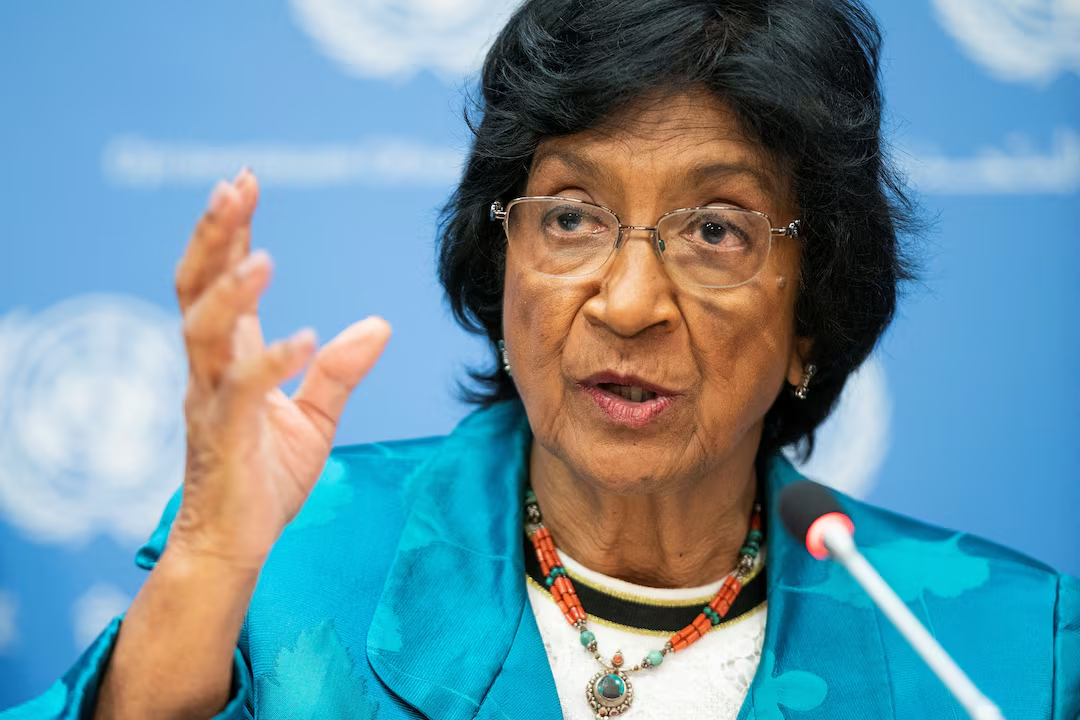
South African human rights lawyer Navi Pillay has been awarded the Nobel Peace Prize in recognition of her longstanding efforts to strengthen international law, advance human rights and ensure accountability for some of the gravest crimes committed against humanity. The award recognises a career dedicated to challenging impunity and defending the principle that those responsible for war crimes, crimes against humanity and genocide must face justice, regardless of their position or power.
The Norwegian Nobel Committee announced the award on Friday, 9 October 2026, during a press conference in Oslo. Committee chair Jørgen Watne Frydnes highlighted Pillay’s contribution to bringing serious international crimes within the reach of judicial institutions. Her work has spanned national courts, international criminal tribunals and the United Nations, placing her at the centre of several important developments in modern human rights law.
The decision also comes at a time when international legal institutions face mounting political pressure and questions about their ability to hold powerful states and individuals accountable. In announcing the award, Frydnes warned that the international legal system was under considerable strain and that institutions responsible for upholding it were facing attacks. He expressed concern that global respect for legal frameworks and justice was increasingly giving way to power politics.

Pillay’s career reflects the importance of maintaining independent courts and credible international mechanisms for investigating serious abuses. The Nobel Committee recognised not only her contribution to developing international law and justice institutions but also her judicial determination, personal integrity and courage. Her work has repeatedly addressed the difficult question of whether legal principles can be enforced when political interests, national divisions or powerful institutions stand in the way.
Born in 1941 in Durban, South Africa, Pillay grew up in a family of Indian Tamil heritage during a period when racial discrimination shaped almost every aspect of public life. Her professional journey began against the backdrop of apartheid, the system of institutionalised racial segregation and discrimination that denied the majority of South Africans equal rights and opportunities.
After studying law, she began providing legal representation to people involved in the struggle against apartheid. In 1967, she established her own legal practice in Durban, becoming the first non-white woman in South Africa to establish a law firm. Her achievement was significant in a profession and society in which racial and gender barriers restricted access to positions of influence.
Rather than limiting her work to individual cases, Pillay’s legal career developed around the broader principle that the law should protect people who are vulnerable to discrimination and abuse. Her early experience in South Africa helped shape her understanding of how legal institutions can either reinforce injustice or provide a means of challenging it.
She later continued her legal education at Harvard University in the United States, where she earned a doctorate in law in 1988. Her academic background, combined with years of practical legal experience, helped prepare her for a career that would extend beyond national boundaries and contribute to the development of international human rights standards.
In 1995, Pillay was appointed a judge of South Africa’s High Court, becoming the first non-white woman to hold that position. The appointment marked another milestone in a career that had challenged racial exclusion within the legal profession. It also placed her in a position to contribute directly to the administration of justice during South Africa’s transition away from apartheid.
Her international judicial career expanded in 1999, when she became a judge and later president of the International Criminal Tribunal for Rwanda. The tribunal was established to prosecute individuals responsible for serious crimes committed during the 1994 genocide against the Tutsi and related violations of international humanitarian law.
Pillay’s work at the tribunal contributed to the development of international criminal jurisprudence, particularly in relation to sexual violence, rape and the use of hatred to encourage mass atrocities. Such crimes had often been inadequately recognised or prosecuted in earlier legal proceedings. International tribunals faced the challenge of establishing how acts of sexual violence and organised persecution could form part of crimes against humanity and genocide.
The tribunal’s work helped strengthen the recognition that sexual violence could be a central instrument of systematic persecution and mass violence rather than merely an incidental consequence of conflict. This legal approach has had lasting significance for survivors seeking recognition and accountability, as well as for efforts to prevent such abuses from being dismissed or overlooked during investigations.
Pillay subsequently served as a judge of the International Criminal Court, another major institution in the international justice system. While the court and the Rwanda tribunal operate under different legal mandates, both form part of broader efforts to establish that individuals may be held criminally responsible for grave violations of international law.
From 2008 to 2014, she served as the United Nations High Commissioner for Human Rights. In that role, she was responsible for leading the UN human rights office and promoting international standards relating to fundamental freedoms, equality and protection from abuse. The position required engagement with governments, international organisations and civil society at a time when human rights violations and conflicts continued to generate international concern.
The High Commissioner’s office plays an important role in monitoring human rights conditions, documenting abuses, advising governments and supporting international efforts to improve protection. Pillay’s tenure formed a significant part of her transition from judicial work to wider international advocacy, placing her in a prominent position within the United Nations system.
Her responsibilities later included leading the United Nations Independent International Commission of Inquiry on the Occupied Palestinian Territory, including East Jerusalem, and Israel. She chaired the commission from 2021 to 2025. The body examined human rights and international law issues connected to the Israeli-Palestinian conflict, an area in which investigations and accountability efforts have frequently faced intense political disagreement.
In 2019, Pillay also served as an ad hoc judge at the International Court of Justice in proceedings concerning allegations of genocide against Myanmar. The case, brought by The Gambia, raised fundamental questions about the international community’s obligations under the Genocide Convention and the legal mechanisms available to address allegations of mass atrocities.
These roles illustrate the range of institutions through which Pillay has pursued questions of accountability. Her career has connected national struggles against discrimination with international efforts to prosecute atrocities, investigate alleged violations and establish legal standards that can be applied across borders.
The Nobel Peace Prize announcement places renewed attention on the relationship between peace and justice. While peace negotiations and diplomatic agreements can help end violence, the absence of accountability may leave victims without recognition and create conditions in which serious abuses can be repeated. International law seeks to provide a framework for addressing such crimes, although enforcement often depends on political cooperation, institutional independence and the willingness of states to respect judicial decisions.
The challenges facing international justice remain considerable. Investigations may be obstructed, judicial institutions can encounter political pressure, and enforcement of international decisions is not always consistent. Powerful actors may reject allegations or question the legitimacy of courts and investigative bodies. These difficulties have intensified wider debates about whether international legal standards are applied equally and whether victims can obtain meaningful remedies.
Pillay’s recognition highlights the importance of legal professionals who work to preserve the independence of judicial institutions and maintain the principle that serious crimes should not go unanswered. Her career has involved difficult and politically sensitive questions, but its central theme has remained the role of law in protecting human dignity and establishing responsibility for abuses.
For survivors of genocide, sexual violence, racial discrimination and other grave violations, international legal proceedings can provide an opportunity to have their experiences formally recognised. Such proceedings cannot reverse the harm suffered or guarantee justice in every case, but they can establish an authoritative record, clarify individual responsibility and strengthen standards intended to prevent future crimes.

The award also sends a message about the value of sustained legal work, often carried out through institutions whose impact develops over many years. Pillay’s path from a legal practice in apartheid-era South Africa to some of the most influential positions in international justice demonstrates how national experiences of discrimination can inform a broader commitment to human rights.
Her Nobel Peace Prize recognises a career that has helped shape the legal response to atrocities and reinforced the idea that peace is inseparable from accountability, fairness and respect for international law. At a time when global institutions face significant pressure, the honour draws attention to the continuing struggle to ensure that justice remains a principle capable of reaching beyond political power.
Related News:
 King Refers Jamaica Slavery Petition to Privy Council
 Latin America women fear rollback of rights
 Ebola outbreak in DRC overwhelms health system as cases surge
 Dreyfus Statue Finally Gets Permanent Paris Home
 UN expert urges UK to rethink Israel policy
 Miliband Rejects Chief Rabbi’s West Bank Warning
 Israel Accused of Undermining Palestinian Life
 Texas Transfers Raise Fears for Migrant Children
 South Africa’s Femicide Crisis Deepens
 Japan PM Backs International Criminal Court
 French Student Protests Escalate Into Violent Clashes
 French School Protests Escalate as 400 Schools Close
 South Sudan Trauma Wards Struggle as Fighting Intensifies
 South Africa Withdraws Directive on Asylum Applications
 EU Divisions Deepen Over Israel Policy
 Files Link Andrew to Epstein Dinner After Prison Release
 Emails Show Epstein Funded Mandelson’s Husband After Jail
 Police Suspect Help in Missing Alice Springs Girl Case
 Cartel crackdown raises fears of fresh violence
 Judge halts deportation of Yemeni refugees in US
 UK may ban protests amid rising antisemitism fears
 Immigration Judges Fear Pressure in Trump Era
 US judge dismisses Kilmar Abrego Garcia indictment
 China mine blast death toll rises to 90
 Trump’s Revenge Drive Deepens GOP Divide
 Victim says non-custodial rape sentence ‘rock in my face’
 Former ICC prosecutor condemns US sanctions
 Gunman Killed After White House Security Shootout
 Irish Gangland Figure Fails in Dublin Election Bid
 New Footage Revives Peter Falconio Mystery
 Ukraine Creates Long-Range Strike Command
 Le Pen’s Popularity Holds Despite Conviction
 Teen Charged After Layla Jeffery Found Dead
 Israeli Strike in Southern Lebanon Kills Seven
 Five Years of Taliban Rule Leave Afghanistan in Crisis
 US immigration arrests hit record high in July
 Ukraine Villagers Demand Answers After Deadly Arms Depot Strike
 Argentina Orders Return of Nazi-Looted Painting
 Masked Protesters Bring Dover Port Traffic to Standstill
 Armed Suspect Attacks Ohio Governor Candidate
 Ministers Condemn Far-Right Unrest in Portsmouth
 Patriot Platform Raises Concern Across Britain
 Iran School Strike Raises War Crimes Questions, UN Says
 Gaza Strike Kills Child and Paramedic
 Memphis Questions National Guard Crime Surge
 Mahmood Warns Far Right Over Asylum Protests
 Saudi Pact Raises Risk of Pakistan Entering War
 Clancy Defense Seeks Inquiry Into Lone Juror
 Briton Faces Cyprus Court Over Son’s Fatal Fall
 UK Reviews Hague Child Abduction Cases Involving Abuse
 Democrat Says ICE Restricted Detention Camp Oversight
 UK Pauses Chagos Deal Amid US Opposition
 Paris child pickpocketing gang leader jailed for eight years
 Far-Right Activist Arrested After Channel Dinghy Incident
 Portadown protest ends after tense Orange Order standoff
 Three Die in Channel Crossing Attempt Near France
 Tennessee Set to Execute Woman After Clemency Denied
 Fayed Survivors Demand Inquiry Into Medical Regulator
 Israel-bound Plane Lands in Saudi Arabia After Cockpit Fight
 Burnham Opens Door to Possible UK Return to EU
 Drumcree Talks Falter as Legal Challenge Deepens
 UK-France Returns Deal Faces Expiry as Talks Stall
 Hundreds of UK prisoners released early amid overcrowding
 Drumcree Talks End Without Agreement Ahead of Appeal
 Almost Half of Fayed Accusers May Be Trafficking Victims
 Gosport Protesters Clash With Police Over Migrant Rescue
 Iran Nobel Laureate Reveals Prison Torture and Fears
 Police accused of failing abuse victims
 Christa Pike Wakes After Failed Tennessee Execution
 Botstein Quits Bard Amid Epstein Investigation Calls
 NSW Police Bid Delays Inquiry Into Sydney Protest
 ICE Agent Shoots Man in New York as Child Escapes Harm
 France Promises 3,000 Teachers as Student Protests Grow
 Israel Promotes Film Challenging Controversial Gaza Documentary
 Greene Pushes Epstein Files Amid Trump Fallout
 Ben Roberts-Smith Denies War Crime Allegations in First Statement
 British Columbia Sues OpenAI Over School Shooting
 Republican Senator Questions Trump Ad Spending
 London Facial Recognition Trial Ends With False Alert
 Badenoch Raises Prospect of 2027 UK Election