Published: 18 September 2026. The English Chronicle Desk. The English Chronicle Online.
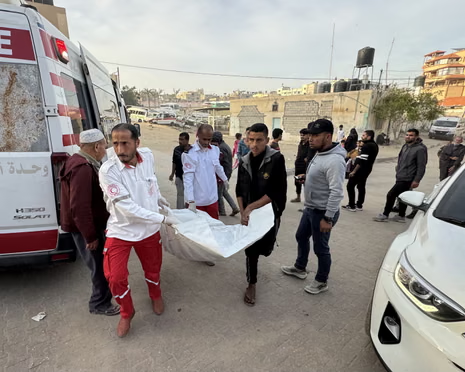
A 15-year-old Palestinian boy was killed in northern Gaza City after rushing towards an injured man following an Israeli strike, in an incident that witnesses and weapons experts said raises questions about the circumstances surrounding a second attack at the same location.
Mohammad Abdul Zinati had been walking home from school through the heavily damaged Salah Khalaf Street when he stopped at a supermarket where several classmates and friends had gathered. Shortly before 3.30pm, an explosion shook the area, prompting people nearby to move towards the scene.
When the smoke and dust began to clear, witnesses said they saw a wounded man lying on the road. The man was seriously injured but remained alive and was calling for assistance. Mohammad was among those who moved towards him.
According to witnesses interviewed after the incident, Mohammad’s cousin noticed an Israeli drone approaching the area and attempted to warn the teenager. The cousin said he shouted for Mohammad to stop and later urged him to run away, but the teenager continued towards the injured man.
A second explosion then struck the area, killing Mohammad.

The circumstances of the attack have drawn particular attention because of the short interval between the initial explosion and the subsequent strike. The pattern has been described by some observers as a “double-tap” attack, referring to situations in which a second strike hits an area after people have arrived to assist those wounded in an earlier attack.
Footage of the incident was reviewed as part of an investigation into the circumstances surrounding the deaths. Witness accounts were also examined alongside assessments from weapons experts.
Tamer Lubbad, who said he filmed the attack, recalled seeing the wounded man after the first explosion. According to his account, several people approached the injured man after discovering that he was still alive and asking for help.
The wounded man was subsequently identified by Gaza’s civil defence authorities as Sharif Shadi Labad, a paramedic.
The Israeli military said Labad was a member of Hamas and described him as a militant belonging to the organisation’s Nukhba forces. The Israeli military said he had participated in the 7 October 2023 attacks at the Erez border crossing and was targeted because he was allegedly preparing for further operations.
The Israeli military has repeatedly rejected allegations that it deliberately targets civilians. Its stated position is that it considers the potential risk to civilians when conducting military operations.
In response to questions about the second strike, the Israeli military said it was aware of reports that an uninvolved person had been harmed during an attack targeting the alleged militant. It expressed regret over harm to uninvolved individuals and said efforts were made to minimise civilian casualties.
The military also said the incident was being reviewed.
The death of Mohammad has nevertheless prompted questions about whether the teenager could have been identified by the operators of the weapon before the second strike was carried out.
Trevor Ball, a conflict researcher and drone specialist associated with Bellingcat, examined available footage and identified the weapon visible before impact as a Mikholit, a munition deployed by Israeli unmanned aerial vehicles.
Ball said the drones involved have high-quality cameras capable of observing people approaching an injured person. He also noted that at least some variants of the weapon can reportedly be redirected towards another target or location while in flight.
His assessment does not establish what the operators saw or knew at the time of the attack, but it highlights the technical capabilities that could potentially have allowed activity around the strike location to be monitored.
For Mohammad’s family and neighbours, the incident has had a deeply personal impact. His cousin described him as a polite, respectful and helpful boy who was known in the local community.
According to his cousin, Mohammad regularly helped older residents collect water from distribution trucks. His death prompted people from the neighbourhood to gather and mourn him.
Later footage showed Mohammad’s body covered by a white shroud outside al-Shifa hospital in Gaza City. His father was seen mourning his son and reciting verses from the Qur’an.
The death occurred amid continuing reports of civilian casualties in Gaza, despite the fragile ceasefire that began in October 2025.
Medical sources in Gaza reported another Israeli strike on Tuesday in the al-Bureij refugee camp that killed an adult and a five-year-old child identified as Udai al-Muridi.
Other recent incidents have also involved children. According to UNICEF-related reporting cited in the investigation, several children were among those killed in Israeli attacks in recent days, including two sisters aged six and 12 who were killed alongside their parents in an airstrike on Beit Lahia while they were sleeping. Three other girls, aged three, eight and nine, were also reported killed by gunfire.
The continuing deaths have added to concerns about the protection of civilians and children in Gaza, where large parts of the territory have been devastated by the conflict.
Another recent case involved Iman Shalouf, a 27-year-old pregnant Palestinian woman who, according to her family, paramedics and witnesses, died after being shot in the head in the Mawasi area south of Khan Younis. She was reportedly nearly eight months pregnant and had been inside her family’s tent when the shooting occurred.
The Israeli military said it had no information about the reported killing of Shalouf.
The broader casualty figures reported by Gaza health authorities underline the scale of the humanitarian consequences. According to the territory’s health ministry, 1,369 Palestinians had been killed and 4,627 wounded since the ceasefire took effect on 11 October 2025. Since the beginning of Israel’s war in Gaza on 7 October 2023, the ministry reported at least 73,783 Palestinians killed and 174,738 wounded.
Those figures are provided by Gaza health authorities and cover casualties reported within the territory. Independent verification of individual cases and the overall figures can be difficult amid the continuing conflict and the destruction of medical and administrative infrastructure.
The incident involving Mohammad has therefore become another focus of scrutiny over how Israeli drone strikes are conducted in densely populated areas. The presence of civilians near military targets presents a persistent challenge, particularly when people approach wounded individuals following an initial attack.
International humanitarian law places obligations on parties to armed conflicts concerning the protection of civilians and the conduct of attacks. Determining whether a particular strike violated those obligations requires examination of the circumstances, including the intended target, information available to those conducting the attack, the expected civilian risk and the precautions taken.
In Mohammad’s case, the Israeli military has maintained that the initial target was a Hamas militant and that it seeks to minimise harm to uninvolved people. It has not provided a public explanation for why the second strike occurred despite witnesses saying that people, including the teenager, were visible at the scene.
The Israeli military’s decision to review the incident could provide further information about the circumstances and the chain of events that led to the second explosion.
For residents of northern Gaza City, however, the technical and military questions surrounding the attack are inseparable from the human consequences. Mohammad had been returning from school when he encountered the aftermath of an explosion. He moved towards an injured person in an attempt to help and was killed moments later.
His death illustrates the risks faced not only by people directly involved in the fighting but also by civilians who approach the wounded after attacks. In an environment where drones remain overhead and subsequent strikes can occur rapidly, even attempts to provide emergency assistance can become dangerous.

The incident also highlights the wider uncertainty surrounding aerial attacks in Gaza, where residents and humanitarian workers continue to face difficult decisions about how to respond when people are wounded.
As the Israeli military reviews the circumstances of the strike, questions remain about what was observed before the second attack, what information was available to the operators and how the potential presence of civilians was assessed.
For Mohammad’s family, those questions follow the loss of a child who, according to relatives, was known for helping others in his community. His final moments came not while taking part in fighting, but while moving towards a wounded man in the aftermath of an explosion.
Related News:
 Israel Accused of Undermining Palestinian Life
 Police Suspect Help in Missing Alice Springs Girl Case
 New Footage Revives Peter Falconio Mystery
 Dreyfus Statue Finally Gets Permanent Paris Home
 Israeli Strike in Southern Lebanon Kills Seven
 Five Years of Taliban Rule Leave Afghanistan in Crisis
 Ukraine Villagers Demand Answers After Deadly Arms Depot Strike
 Daughter Finds Bones in Parents’ Burned-Out Car
 Argentina Orders Return of Nazi-Looted Painting
 Miliband Rejects Chief Rabbi’s West Bank Warning
 Royal Crown Branded Enslaved Africans in Britain’s Slave Trade
 Undercover officer deceived women with ‘grotesque and cruel’ lies, spycops inquiry told
 Death, displacement and military duties: children plunged into crisis
 Iran Crisis Tests Trump’s Global Leadership
 Ben Roberts-Smith Denies War Crime Allegations in First Statement
 Walsall Rapist Jailed After Hate-Filled Online Trail
 Chornobyl Still at Risk 40 Years After Disaster
 Two Children Die in Wolverhampton House Fire Tragedy
 Aid Crisis Grows as Hormuz War Disrupts Supply
 Two Dead in Adelaide Airport Plane Crash Fire
 Cartel crackdown raises fears of fresh violence
 China Fireworks Factory Blast Kills 21 in Hunan
 US ‘Narco Boat’ Strikes Draw Global Outcry
 Search Intensifies for Missing Hiker on WA Bibbulmun Track
 Barrister Criticises Trial After Suicide Case Verdict
 Immigration Judges Fear Pressure in Trump Era
 Israeli Strikes in Lebanon Kill 10 Amid Ceasefire Strain
 China mine blast death toll rises to 90
 Ebola outbreak in DRC overwhelms health system as cases surge
 Victim says non-custodial rape sentence ‘rock in my face’
 Former ICC prosecutor condemns US sanctions
 Ukraine Creates Long-Range Strike Command
 Teen Charged After Layla Jeffery Found Dead
 Westminster Council Threatens Charing Cross Soup Kitchen
 BBC Warned About Missing Clothes of Murder Victim
 Is America Ready for an AOC Presidential Run?
 Cambridge Professor Jason Arday Found Dead at Home
 Survivor Sues Musk’s xAI Over AI Abuse Images
 Nepal Flood Survivors Face Unimaginable Loss
 Trump Calls Iran War ‘Small Potatoes’ Despite US Deaths
 Nepal Tunnel Rescue Offers Hope Amid Flood Devastation
 Masked Protesters Bring Dover Port Traffic to Standstill
 UN expert urges UK to rethink Israel policy
 Susan Sarandon Says Palestine Stand Costs Roles
 Councils spend £125m on illegal children’s care
 Patriot Platform Raises Concern Across Britain
 Man Arrested in Mississippi Woman’s Death

 Yemen War Displaces 125,000 as Fighting Intensifies
 Iran School Strike Raises War Crimes Questions, UN Says
 Greene Pushes Epstein Files Amid Trump Fallout
 Deadly Russian Strikes Hit Western Ukraine, 20 Killed in Ternopil
 Two National Guard Soldiers Critically Injured Near White House
 American Mother Extradited From UK to U.S. on Murder Charges
 SA Police Intensify Search in Gus Lamont Case
 El Mencho Killed as Mexico Faces Violence
 Kelly Wilkinson Inquest Reveals Bail Failure
 Tehran Strikes Mark War’s Most Devastating Night
 Injured Mojtaba Khamenei Elevated as Iran Leader
 US Missile Strike on Iran School Sparks Global Shock
 Gaza Detainee Abuse: Israel Drops Charges Against Soldiers
 Lebanon Ground Campaign Raises Occupation Fears
 Fugitive Dezi Freeman Killed in Rural Victoria Shootout
 M&S Demands Urgent Action on Rising Violent Retail Crime
 Trump’s Six-Week Iranian War: The High Cost of Ignorance
 Trump Announces 3-Day Russia–Ukraine Ceasefire Deal
 Trump Rejects Tehran Peace Plan as Regional Truce Crumbles
 Tensions Flare as Israeli Nationalists March in Jerusalem
 Maldives Cave Diving Tragedy Raises Safety Alarm
 Pope Meets Families in Italy Toxic Waste Zone
 Farage and Reform UK Reshape British Politics
 Grief and Devotion Amidst the Rubble of Nabatieh
 England and Norway Fans Turn Miami Into World Cup Carnival
 Olympus Awaits Unesco Heritage Recognition
 Houthis Strike Saudi Arabia as Middle East Tensions Rise
 Former Diplomats Urge UK and France to Act on Palestine
 Ghent Professors Questioned Cofnas Appointment
 British Museum Faces Questions Over Peter Thiel’s Private Bayeux Viewing
 Abusive ex used Tesla to control and harass former partner
 Turkey LGBTQ Crackdown Expands With New Arrests