Published: 17 September 2026. The English Chronicle Desk. The English Chronicle Online
Turkish authorities have expanded a nationwide investigation targeting LGBTQ+ organisations, activists and associated venues, with dozens of people detained or placed in pre-trial custody and journalists also caught up in the crackdown. The operation, which began with coordinated raids in several Turkish cities, has triggered street protests, the use of tear gas by police and growing criticism from international rights organisations.
The authorities have described the campaign as an effort to protect children, family values and social order. Human rights groups, however, say the arrests represent a widening restriction on LGBTQ+ advocacy, civil society and freedom of expression. Recent Reuters reporting said eight members of the prominent LGBTQ+ rights organisation Kaos GL had been jailed pending trial, while others, including a journalist, were released under judicial supervision.
The operation, known as “My Family is Safe”, began with coordinated police action in cities including Istanbul, Ankara, İzmir, Aydın and Mersin. Prosecutors have investigated people and organisations under allegations involving obscenity, prostitution and other offences. Authorities have also targeted online material and social media accounts as part of the broader investigation.
The scale of the operation has changed rapidly as arrests and court decisions have continued. Amnesty International reported on 15 September that more than 60 people had been arrested across 15 provinces, while at least 23 had been placed in pre-trial detention. The organisation also said criminal investigations had been opened against more than 160 people and that more than 180 social media accounts and several websites had been blocked or restricted.

Reuters subsequently reported that eight Kaos GL members had been jailed pending trial. The organisation has been one of Turkey’s longest-established LGBTQ+ rights groups and also operates a news platform. The investigation has therefore raised concerns beyond the treatment of activists, particularly over the effect of the arrests on independent journalism and civil society organisations.
One of the journalists caught up in the operation was Tuğba Tekerek, who was arrested at her home in Istanbul and taken to Ankara for questioning. The Committee to Protect Journalists said on 16 September that Turkish authorities should release Tekerek and stop detaining or intimidating journalists for their professional work.
The case has drawn particular attention because Tekerek had worked with Kaos GL on reporting concerning the LGBTQ+ community in neighbouring Georgia. Her arrest has added to concerns among press-freedom organisations that broad obscenity-related investigations could affect journalists who report on LGBTQ+ issues.
Turkish officials have defended the operation. Justice Minister Akın Gürlek has said the campaign is intended to protect children, the institution of the family and social order. Authorities have argued that some of the locations and individuals investigated were connected to activities they associate with prostitution, obscene material or exposure of children to inappropriate content.
The government’s position places the operation within a wider demographic and family-policy agenda promoted by President Recep Tayyip Erdoğan. Turkish officials have linked concerns over falling fertility rates, later marriage and changing family patterns to policies described as supporting families and encouraging population growth.
The government’s arguments have not persuaded human rights organisations. Amnesty International has called for an end to what it describes as an escalating crackdown and has demanded the release of detained activists. The organisation says LGBTQ+ people and their advocates should not be targeted through criminal investigations simply because of their identity or human rights work.
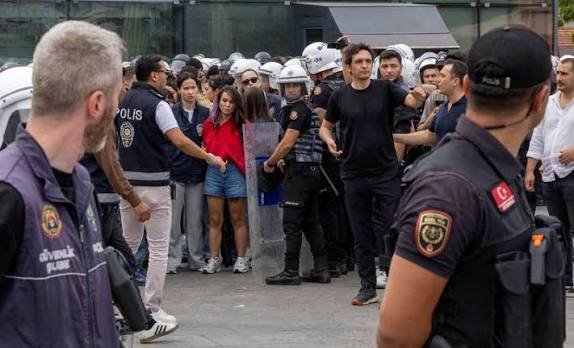
The protests that followed the raids have become another part of the confrontation. Demonstrations were reported in İzmir, Istanbul and Ankara, with police using tear gas during at least some of the protests. Reuters reported that more than 100 people were detained during demonstrations in Ankara and Istanbul as opposition to the raids intensified.
In İzmir, protesters gathered after people were detained during the government operation. Police used chemical irritants to disperse demonstrators, according to reports. In Istanbul, arrests also took place around a courthouse as supporters gathered in solidarity with those facing detention.
The crackdown has also involved restrictions on online expression. Amnesty said its Türkiye X account was among the accounts blocked in the country. The organisation said it had not received enough information to independently scrutinise the legal basis of the restriction.
The legal framework surrounding the cases remains a central issue. Homosexuality itself is not illegal in Turkey, but prosecutors have increasingly relied on broadly worded provisions concerning obscenity and public morality in cases involving LGBTQ+ people and organisations.
That approach has already resulted in criminal proceedings against LGBTQ+ activists. Earlier in 2026, 11 members of the Genç LGBTI+ organisation went on trial over allegations connected to family values and the publication of images involving same-sex couples. The cases have contributed to a wider debate over how Turkey’s existing laws are being applied to LGBTQ+ expression and advocacy.
The current operation follows a period in which proposals for tougher restrictions on LGBTQ+ people have repeatedly emerged in Turkish public debate. Human Rights Watch reported in June that proposed measures could further criminalise certain LGBTQ+-related conduct and its promotion, while noting that the reported proposals had not at that point been formally introduced as legislation.
The latest raids therefore form part of a broader pattern that rights organisations have been monitoring for several years. Human Rights Watch’s 2026 country report said Turkish authorities had used concepts such as “public morality” and obscenity to justify restrictions affecting LGBTQ+ people and other forms of expression. It also reported repeated restrictions on Pride events.
The Turkish government’s stated justification remains focused on family policy and the protection of children. Officials argue that investigations into alleged obscenity and other offences are necessary to maintain social order. Rights organisations dispute the application of those laws to LGBTQ+ advocacy and say that legitimate civil-society activity and journalism risk being treated as criminal conduct.

The growing number of arrests has also attracted attention from European institutions. Reuters reported that the European Commission had expressed concern over the arrests, legal actions against rights groups and restrictions affecting media and civil society.
For those affected, the immediate issue is now the legal process. Some detainees have been released under judicial supervision, while others remain in pre-trial custody. The authorities continue to investigate a much larger group of suspects, meaning that the final scale of the operation could change as prosecutors and courts consider individual cases.
The developments have placed Turkey’s treatment of LGBTQ+ organisations, journalists and protesters under renewed international scrutiny. They also highlight a wider tension between the government’s stated emphasis on family values and the concerns of rights and press-freedom organisations over freedom of expression, association and peaceful assembly.
As the investigations continue, the distinction between allegations and proven offences will remain important. Turkish prosecutors have presented allegations involving obscenity and other offences, while rights organisations maintain that the operation is being used to stigmatise LGBTQ+ people and restrict legitimate advocacy. The courts will ultimately determine the legal status of individual cases, while international observers are continuing to monitor the wider implications for civil liberties in Turkey.
Related News:
 Amnesty Finds Coordinated Abuses in Iran Protest Crackdown
 Cartel crackdown raises fears of fresh violence
 US states redraw maps after voting rights ruling
 Immigration Judges Fear Pressure in Trump Era
 Trump’s Revenge Drive Deepens GOP Divide
 Le Pen’s Popularity Holds Despite Conviction
 Is America Ready for an AOC Presidential Run?
 Five Years of Taliban Rule Leave Afghanistan in Crisis
 Ghent Professors Questioned Cofnas Appointment
 Pavlohrad Strike Kills Five, Injures 67
 Patriot Platform Raises Concern Across Britain
 Reform UK Receives Record £36m Donation From Crypto Billionaire
 Israel Accused of Undermining Palestinian Life
 Election Candidate Abuse Raises Alarm in England
 Fugitive Developer Rants at NSW Corruption Inquiry
 Slave-Trade Wealth Embedded in Britain’s Financial System
 New Evidence Deepens Church of England Slavery Reckoning
 Piddington Votes for Symbolic Independence Over Asylum Plan
 Texas Charges Seven Noncitizens in Voting Crackdown
 Trump Administration Dismisses 17 Immigration Judges, Sparking Debate Over Judicial Independence
 Jailed Georgian Opposition Leaders Warn UK of Iranian Links to Ruling Party
 UK Extradition Law Change Sparks Fears Among Hong Kong Dissidents
 Johnson Approved China’s London ‘Super-Embassy’ in 2018
 China-critical UK academics face ‘extremely heavy’ pressure from Beijing
 Trump Urges Herzog to Grant Netanyahu Full Pardon
 US Justice Department Files Lawsuit Against California Over Partisan Voting Maps
 Trump Deploys DHS to Charlotte in Major Arrest Operation
 Congress Approves Release of Epstein Files, Trump Expected to Sign
 Texas Governor Faces Lawsuit From CAIR
 Chinese & Japanese Boats Clash Near Disputed Islands
 Putin Meets US Envoy Amid Key Ukraine Peace Talks
 Guterres Warns Global Cooperation Under Threat at UN’s 80th Year
 South Korea Jails Ex-President in Martial Law Ruling
 UK and EU Signal Fresh Push for Defence Cooperation Talks
 Thousands Protest ICE Operations in Nationwide US Day of Action
 Sydney Protest Clash Triggers Police Probe
 Report Says Pezzullo Acted ‘Recklessly’ in Dealings
 Hungary election: Orbán faces biggest test amid scandal
 Moldova River Crisis Exposes War’s Hidden Cost
 Suspected Plot Targets Pipeline Before Hungary Vote
 Iran Crisis Tests Trump’s Global Leadership
 Ben Roberts-Smith Denies War Crime Allegations in First Statement
 MoD Has Lost Track of Veteran Recall List, Says Adviser
 Black Forest Tragedy Remembered 90 Years On
 Ukraine Urges UK to Seize Russian Oil Tankers
 US Court Weighs Fate of TPS for Migrants
 US Court Ruling Reshapes Voting Rights Landscape
 Judge halts deportation of Yemeni refugees in US
 Trump warns Iran as Middle East tensions surge again
 US ‘Narco Boat’ Strikes Draw Global Outcry
 Florida Surgeon ‘Devastated’ Over Fatal Surgery Error
 France Faces Record Presidential Crowded Race Amid Far-Right Surge
 Barrister Criticises Trial After Suicide Case Verdict
 Former ICC prosecutor condemns US sanctions
 Gunman Killed After White House Security Shootout
 Farage and Reform UK Reshape British Politics
 Starmer Leadership Under Pressure After Setbacks
 New Footage Revives Peter Falconio Mystery
 Dreyfus Statue Finally Gets Permanent Paris Home
 Trump Orders Signs Criticising Smithsonian Museum
 Westminster Council Threatens Charing Cross Soup Kitchen
 BBC Warned About Missing Clothes of Murder Victim
 Israeli Strike in Southern Lebanon Kills Seven
 Cambridge Professor Jason Arday Found Dead at Home
 RAF Barnham Protests Fuel Tensions in Norfolk Town
 Exeter Approves Saudi Military Training Partnership
 Ukraine Villagers Demand Answers After Deadly Arms Depot Strike
 Internal Exclusions Surge in England’s Schools
 Nepal Flood Survivors Face Unimaginable Loss
 Green Leader Targets Starmer’s Former Seat
 Trump Calls Iran War ‘Small Potatoes’ Despite US Deaths
 Nepal Tunnel Rescue Offers Hope Amid Flood Devastation
 Masked Protesters Bring Dover Port Traffic to Standstill
 UN expert urges UK to rethink Israel policy
 UK plans tougher Israel stance with settlement trade ban
 Councils spend £125m on illegal children’s care
 Europe’s democracies face a growing far-right threat
 New Mexico Takes Facebook to Trial Over Data Scandal
 Australia’s Indigenous Population Was Far Larger Before Colonisation
 Lisa Nandy Calls for Tougher Action on Social Media Doxxing