Published: 17 September 2026. The English Chronicle Desk. The English Chronicle Online
More than 125,000 people have been displaced in Yemen since the beginning of September as renewed fighting pushes families from their homes and places additional pressure on communities already struggling with years of conflict and humanitarian hardship.
The latest wave of displacement has been particularly severe in and around Taiz, where fighting has spread through rural districts and forced families to seek safety in areas with limited shelter, employment and humanitarian resources. The United Nations humanitarian office has estimated that the renewed violence has displaced about 18,000 households since the start of September.
The scale of the movement comes after months of growing insecurity in parts of Yemen. Recent International Organization for Migration monitoring has recorded substantial displacement in Taiz and neighbouring areas, with thousands of households forced to move during successive periods of fighting. IOM’s displacement tracking system recorded 13,500 people displaced between 30 August and 5 September alone, with Taiz accounting for the overwhelming majority of those movements.
For families caught in the fighting, leaving home has often been a decision made within hours. Many have travelled with children and whatever possessions they could carry, while livestock, household goods and livelihoods have been left behind.

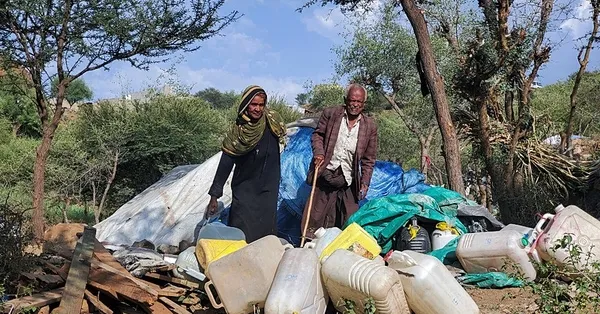
Asma Taleb, a woman in her 50s from the Maqbanah district, told the Guardian that she fled with her two sons and five grandchildren after fighting reached her community. Her family had previously lived in a large home, but after arriving at a displacement camp they struggled to find even basic shelter.
She described the experience as one that had affected families regardless of their economic circumstances. People who had previously been able to provide for themselves were suddenly dependent on relatives, humanitarian organisations and overcrowded camps.
When Taleb arrived in Al-Shimayateen district, she found that newly displaced families were continuing to arrive. Several families were sharing individual tents, while others were staying with relatives because there was not enough accommodation.
The situation reflects a wider challenge facing humanitarian agencies. Displacement is happening faster than available shelter and assistance can be provided in some locations, leaving families to find temporary solutions while fighting continues.
IOM’s latest publicly available displacement tracking shows how quickly the numbers have been changing. Between 6 and 12 September, the agency recorded 9,892 households, equivalent to 59,352 people, experiencing displacement at least once. From the beginning of the year through 12 September, IOM had recorded 17,432 households, or 104,592 individuals, who had experienced displacement at least once through its tracking system.
These figures use a different reporting period and methodology from the broader UN estimate of people displaced since the beginning of September, so they should not simply be added together. The data nevertheless demonstrates the speed and scale of population movement in the affected areas.
Taiz has been particularly exposed. IOM’s earlier September tracking found that most displacement recorded between 30 August and 5 September occurred within or into Taiz governorate, including movements involving Maqbanah, Mawza and Jabal Habashi. The majority of those movements were internal, meaning families generally remained within Yemen rather than crossing an international border.
For rural families whose livelihoods depend on agriculture and livestock, displacement also means the loss of their primary source of income.
Hatem Qasem, a farmer from Al-Wazeyah district west of Taiz city, told the Guardian that his family had been forced to leave after fighting and shelling reached their village. His family and several others travelled together, while livestock had to be sold at low prices because there was no practical way to take the animals with them.
The immediate priority for families such as Qasem’s is safety. But once they reach an area away from the fighting, another problem begins: how to survive without employment, housing or access to their previous livelihoods.
Qasem’s family of eight was staying with other displaced families in a rented house, with each family occupying a single room in order to divide the cost. Such arrangements can provide temporary protection but offer little certainty if displacement continues for weeks or months.
In makeshift camps, the difficulties can be even greater. Families may have access to basic food and hygiene supplies through humanitarian organisations, but employment opportunities are scarce. People who previously supported themselves through farming, livestock or local businesses can find themselves dependent on assistance.
The renewed displacement is also affecting children. Save the Children reported that at least 19 children were killed and 49 injured between 1 August and 9 September amid the escalation in violence. The organisation said 117 civilians were killed and 206 injured during that period. It also reported that 175 casualties occurred during a single week from 3 to 9 September, including 43 children.
Save the Children said more than 85,000 people had fled their homes since July, with displacement continuing as fighting intensified. The organisation has warned that the latest violence is placing further pressure on an already fragile health system serving children and families affected by the conflict.
The humanitarian consequences extend beyond immediate physical safety. Displacement can interrupt children’s education, separate families from established support networks and make access to healthcare more difficult. Save the Children’s 2026 assessment of conflict-affected communities in Aden, Lahj and Taiz found that displacement and economic hardship were major barriers to children’s access to education.
Yemen was already facing one of the world’s most severe humanitarian crises before the latest escalation. The UN estimates cited in the supplied report indicate that 22.3 million people in the country require humanitarian assistance and protection services in 2026, including millions of people who have already been displaced.
The new fighting therefore risks deepening existing needs rather than creating an entirely new humanitarian emergency. Communities that have endured years of instability are now being asked to absorb additional displaced families while humanitarian organisations face significant constraints in reaching people in active conflict zones.
Ali Qaid, who manages the executive unit responsible for internally displaced people in Taiz governorate, told the Guardian that displacement from western districts was continuing. He also said that some civilians remained trapped in areas where fighting was active, making it difficult for humanitarian organisations to reach them.
That problem is particularly serious because displacement figures do not necessarily capture everyone affected immediately. Families who remain trapped in conflict zones may not yet have been registered as displaced, while others may move repeatedly as fighting shifts from one area to another.
Yemen’s geography also means that some people seeking safety have attempted to move beyond the country’s borders. The International Organization for Migration monitors movements between Yemen and countries across the Gulf of Aden. Its August data recorded 1,666 migrants leaving Yemen, with most travelling towards Obock in Djibouti. These movements include different categories of migrants and should not be equated directly with the internally displaced population.
For families displaced inside Yemen, however, the immediate question remains whether they can eventually return home.
For Taleb, returning to her village remains a hope, but the continuing fighting has made any timetable uncertain. Qasem similarly indicated that his family would have to wait and assess the situation before deciding whether returning would become possible.
That uncertainty is one of the defining features of displacement in Yemen. A family may leave expecting to remain away for only a few days, only to discover that returning home is impossible for weeks or months. Temporary accommodation can become prolonged displacement, while the loss of livestock, crops, employment and household possessions makes rebuilding increasingly difficult.
Humanitarian organisations have responded with food, hygiene supplies and other emergency assistance, but the needs are growing rapidly. IOM’s displacement tracking system is designed to provide frequent estimates precisely because population movements in emergencies can change quickly and require continued verification.
The latest figures also show why the situation cannot be understood only through the number of people who have crossed borders. Most of the displacement documented in the recent escalation has been internal, with families moving from villages and districts affected by fighting to safer parts of the same governorate or neighbouring areas.

For those families, reaching a safe location is only the first stage of the crisis. They then need somewhere to sleep, food and clean water, healthcare, education for children and a way to earn money. If fighting continues, they may have to move again.
The renewed violence has therefore placed Yemen’s humanitarian system under another severe test. The immediate priority is protecting civilians and reaching people trapped by the fighting, while longer-term assistance will be needed to help displaced families recover their livelihoods and rebuild their lives.
For tens of thousands of people who have left their homes in recent weeks, the future remains uncertain. Their belongings, farms, livestock and communities remain behind them, while the places where they have sought refuge can offer safety without offering permanence.
As fighting continues in parts of Taiz and surrounding areas, the number of displaced people may change rapidly. What is already clear from humanitarian monitoring is that the latest escalation has forced a large number of Yemeni families to make the same decision: leave home in search of safety, even when they have nowhere secure to go next.
Related News:
 Israeli Strike in Southern Lebanon Kills Seven
 Five Years of Taliban Rule Leave Afghanistan in Crisis
 NHS Safety Fears as Nurses Cover Doctor Gaps
 Cartel crackdown raises fears of fresh violence
 China Fireworks Factory Blast Kills 21 in Hunan
 US ‘Narco Boat’ Strikes Draw Global Outcry
 Barrister Criticises Trial After Suicide Case Verdict
 Maldives Cave Diving Tragedy Raises Safety Alarm
 Dreyfus Statue Finally Gets Permanent Paris Home
 Is America Ready for an AOC Presidential Run?
 Ghent Professors Questioned Cofnas Appointment
 Ukraine Villagers Demand Answers After Deadly Arms Depot Strike
 Nepal Flood Survivors Face Unimaginable Loss
 Nepal Tunnel Rescue Offers Hope Amid Flood Devastation
 Masked Protesters Bring Dover Port Traffic to Standstill
 Pavlohrad Strike Kills Five, Injures 67
 Patriot Platform Raises Concern Across Britain
 Israel Accused of Undermining Palestinian Life
 Fugitive Developer Rants at NSW Corruption Inquiry
 Slave-Trade Wealth Embedded in Britain’s Financial System
 New Evidence Deepens Church of England Slavery Reckoning

 Piddington Votes for Symbolic Independence Over Asylum Plan
 Seven Women’s Deaths Renew South Africa Femicide Anger
 Sahel Islamist Violence Set for Record Levels in 2026
 Texas Charges Seven Noncitizens in Voting Crackdown
 Amnesty Finds Coordinated Abuses in Iran Protest Crackdown
 Turkey LGBTQ Crackdown Expands With New Arrests
 Fiji Declares National HIV Emergency as Cases Surge
 CDC Plunged Into Turmoil as Ousted Chief Susan Monarez Refuses to Step Down
 Channel Crossings Surge: Over 1,000 People Arrive in the UK in Small Boats in a Single Day
 Jailed Georgian Opposition Leaders Warn UK of Iranian Links to Ruling Party
 Kosovo agrees to host Britain’s refused asylum seekers
 UK University Faces Counter-Terror Probe Over China Pressure
 Ukraine-Russia war latest: Putin’s troops exploit bad weather to force Kyiv withdrawal from multiple towns
 New review urges UK to repatriate Shamima Begum, others from Syria
 Indian authorities demolish Kashmir home linked to Red Fort blast
 Greene Pushes Epstein Files Amid Trump Fallout
 Venezuela Threatens Nobel Winner Machado with Fugitive Status
 Trump Envoy to Discuss Ukraine Peace at Kremlin
 Video shows Israeli troops kill Palestinians after surrender
 Teen Admits Filming Westfield Chair Prank
 Melania Trump Epstein remarks spark survivor backlash
 Iran Crisis Tests Trump’s Global Leadership
 Ben Roberts-Smith Denies War Crime Allegations in First Statement
 Two Children Die in Wolverhampton House Fire Tragedy
 Southeast Asia Turns to Russia Amid Energy Crisis
 Two Dead in Adelaide Airport Plane Crash Fire
 Florida Surgeon ‘Devastated’ Over Fatal Surgery Error
 France Faces Record Presidential Crowded Race Amid Far-Right Surge
 US Awaits Iran Reply on New Ceasefire Proposal
 Immigration Judges Fear Pressure in Trump Era
 Hormuz Talks Near Critical Stage
 Pope Meets Families in Italy Toxic Waste Zone
 Discontent grows around Putin amid war strain
 Farage and Reform UK Reshape British Politics
 Starmer Leadership Under Pressure After Setbacks
 Millions Gather for Khamenei’s Six-Day State Funeral
 New Footage Revives Peter Falconio Mystery
 Ukraine Creates Long-Range Strike Command
 Le Pen’s Popularity Holds Despite Conviction
 Venezuela Quake Death Toll Surpasses 4,000
 Houthis Strike Saudi Arabia as Middle East Tensions Rise
 Westminster Council Threatens Charing Cross Soup Kitchen
 BBC Warned About Missing Clothes of Murder Victim
 Vietnam Youth Rally Behind Hanoi ‘Justice Tree’
 China Probes Alleged Formaldehyde Use on Cabbages
 Australia Races to Find Tourists Missing in Nepal
 Nepal Flood Death Toll Tops 300 as Second Flood Feared
 RAF Barnham Protests Fuel Tensions in Norfolk Town
 Nepal-Tibet Flood Death Toll Rises as 2,478 Remain Missing
 Trump Calls Iran War ‘Small Potatoes’ Despite US Deaths
 Councils spend £125m on illegal children’s care
 Europe’s democracies face a growing far-right threat
 Saudi Arabia Shuts Oil Pipeline After Drone Attack
 Nearly 50,000 Flee as Houthis Advance in Yemen
 Man Arrested in Mississippi Woman’s Death
 Royal Crown Branded Enslaved Africans in Britain’s Slave Trade
 Australia’s Indigenous Population Was Far Larger Before Colonisation
 2025 Among World’s Driest Years for Rivers