“Yesterday was a big victory, so today is the smell of freedom,” said Radomir Dalic, one of the volunteers working in Pioneers Park, opposite Serbia’s National Assembly building. “We are in garbage, but it’s the smell of freedom.”
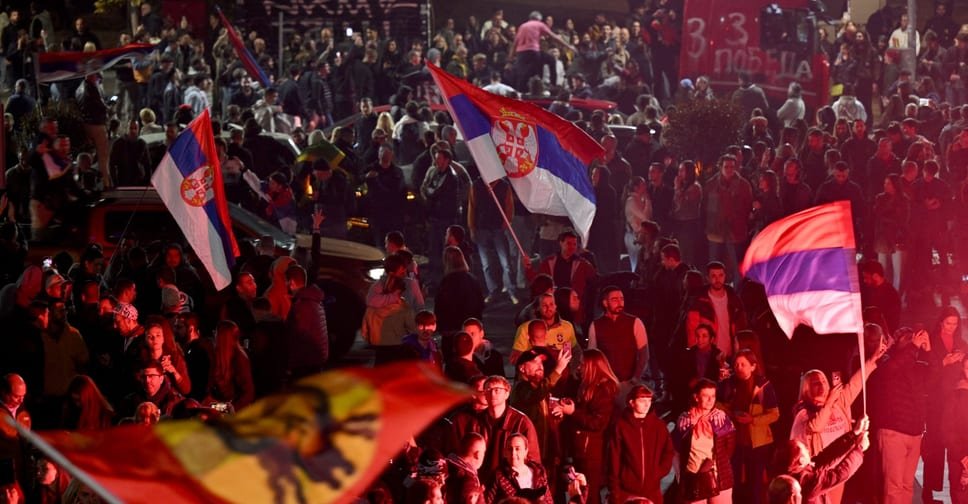
His words captured the mood among supporters celebrating what the supplied report describes as a decisive defeat for President Aleksandar Vučić and his governing Serbian Progressive Party, known by its Serbian initials, SNS.

Yet behind the celebrations lies a more complicated question: can a movement united by opposition to corruption and political intimidation translate its electoral success into a stable, accountable government capable of delivering lasting reform?
Pioneers Park, a small green space with established trees and a children’s playground, had become the centre of a prolonged political confrontation.
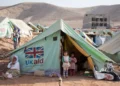
For approximately 18 months, the area had been occupied by a pro-government encampment known as Ćaciland. White tents and makeshift structures transformed the park, restricting public access and creating an atmosphere that opponents of the government described as intimidating.
According to the original report, people associated with the camp included individuals with criminal convictions, and journalists and other visitors had faced violence or threats when approaching the area. Critics also accused police of failing to intervene adequately when confrontations occurred.
The camp became a visible symbol of the tensions surrounding Serbia’s anti-corruption protests. What might ordinarily have been a place for families, children and everyday recreation was increasingly associated with political confrontation.
Its location made the symbolism particularly powerful. Positioned opposite the National Assembly, the encampment stood close to the institutions at the heart of Serbian political life.
For opponents of the government, reclaiming the park therefore meant recovering more than a public amenity. It meant challenging the idea that politically connected groups could occupy public spaces indefinitely while ordinary citizens were left feeling excluded or unprotected.
The events surrounding election night appeared to bring that confrontation to a turning point.
Tensions were reportedly high as voting approached its conclusion. Around half an hour before polling stations closed, groups of masked men dressed in black gathered in and around Pioneers Park, raising fears that the political contest could spill over into violence.
The presence of the groups prompted concerns among some observers that the governing party might resist an unfavourable result or that confrontations could erupt as the outcome became clear.
However, the subsequent developments surprised many people in Belgrade.
According to the supplied report, Vučić addressed supporters at SNS headquarters shortly after polls closed and acknowledged that his party had suffered a comprehensive defeat to the Student List movement. He also said he did not want unrest or violence on the streets.
Riot police subsequently stood aside, barriers restricting access to the park were removed and the groups gathered around the encampment dispersed.
Student List supporters entered the area, celebrating the apparent end of the camp’s occupation. Some tents were damaged and set alight during the celebrations, underscoring the anger that had accumulated over the preceding months.
The following morning, however, the atmosphere had changed. Rather than allowing the site to remain a symbol of confrontation, volunteers began dismantling the structures and restoring the surrounding area.
Hundreds joined municipal workers to remove damaged tents, collect rubbish and clean playground equipment. Some painstakingly disinfected climbing frames, swings and slides that had been part of the public park before the encampment took over.
The clean-up became a striking contrast to the disorder and hostility associated with the site.
Among the volunteers was Tamara Tomic, who wore yellow rubber gloves as she helped restore the park.
Her explanation for taking part reflected the aspirations of many people who had joined Serbia’s wider protest movement.
“Gathering here and cleaning this place just shows that we want to live nicely,” she said. “We want to enjoy the city, enjoy a normal life without violence and without anyone torturing us.”
Such sentiments help explain why the restoration of an ordinary public space could become a powerful political moment.
For many participants, the protests were not simply about changing the people in government. They were also about rebuilding trust in public institutions, restoring accountability and ensuring that public spaces remained accessible to everyone.
The clean-up offered a tangible way to express those demands. Instead of waiting for politicians to announce reforms, volunteers took immediate action to improve their surroundings.
The approach also reflected a pattern associated with the student-led demonstrations, whose participants have frequently organised collective efforts to remove rubbish and restore public spaces after large gatherings.
Dalic, who worked across the grass to collect cigarette ends and other debris, said he was delighted that the park had been cleared of people he believed had intended to intimidate opponents.
For him and other volunteers, the physical labour became an expression of political hope: a willingness to repair what had been damaged and create space for a different kind of public life.
Despite the celebrations, the Student List movement now faces a challenge that could prove more difficult than defeating an established political party.
Unlike a conventional party built around a prominent leader and a clearly defined hierarchy, the movement has presented itself as a collective initiative shaped by student assemblies and a broad range of professional and civic backgrounds.
Its candidates reportedly include academics, athletes, economists, engineers and other professionals. The candidate ranked first on the list, Ilija Srdanović, is a cardiologist at the University of Novi Sad, the city where a deadly roof collapse helped trigger the student protests.
Srdanović has participated in demonstrations since the early stages of the movement. However, he has stressed that being ranked first does not automatically make him the future prime minister.
He has described the movement as democratic and said it wants to avoid Serbia’s historical tendency to concentrate political authority around a single personality.
The movement’s 250 candidates, he argued, should be regarded as equal participants in the struggle, with several people potentially capable of taking on senior government responsibilities.
That approach could offer an alternative to highly personalised politics. It may also make decision-making more complicated, particularly when the movement must agree on a government programme, distribute ministerial responsibilities and respond quickly to unexpected crises.
A coalition can remain united while campaigning against a common opponent but encounter serious disagreements once it must make decisions about budgets, appointments, foreign policy and public services.
The Student List has published an 11-point plan that places anti-corruption measures at the centre of its domestic agenda.
Other commitments include judicial reform, greater media freedom, affordable housing and improved access to healthcare. One of its stated ambitions is to ensure access to a doctor in every village.
These proposals address concerns that have become central to Serbia’s political debate: whether public institutions operate independently, whether public money is managed transparently and whether ordinary citizens can access essential services without facing entrenched inequalities.
The emphasis on anti-corruption reform carries a particular historical irony. Vučić and the SNS previously benefited from public promises to tackle corruption and improve governance when they came to power in 2012.
The Student List now faces the same test that confronted its predecessors: demonstrating that campaign commitments can be converted into practical changes.
Achieving meaningful reform would require more than replacing senior officials. It could involve strengthening judicial independence, improving oversight of public procurement, protecting journalists and ensuring that allegations of misconduct are investigated fairly.
The movement will also need to establish how it intends to fund its social commitments, implement administrative changes and measure progress.
Without a clear implementation strategy, even popular promises risk becoming a source of disappointment.
While the Student List’s domestic priorities are relatively clear, its positions on international affairs remain less developed.
Serbia occupies a complicated geopolitical position, maintaining aspirations for European Union membership while preserving important relationships with Russia and navigating longstanding disputes in the Western Balkans.
The country’s relationship with Kosovo remains particularly sensitive. Kosovo declared independence from Serbia in 2008, but Belgrade does not recognise it. The dispute continues to influence regional diplomacy and Serbia’s relationship with European institutions.
Michael Davenport, a former EU and UK ambassador to Serbia, has warned that major policy questions remain unresolved within the broad movement.
He has pointed to uncertainty over the country’s approach to EU accession and regional issues involving Bosnia and Herzegovina and Kosovo. The absence of a clearly articulated foreign policy could become a significant challenge once the movement begins negotiating government priorities.
Its diverse membership may contain different views on relations with Moscow, cooperation with Brussels and the future of Serbia’s regional diplomacy.
Those disagreements do not necessarily make governing impossible, but they will require careful negotiation and a coherent strategy.
Kurt Bassuener, co-founder of the Democratization Policy Council, has expressed concern about the difficulties the movement could face once the initial excitement surrounding its victory fades.
He has suggested that the movement would need credible people prepared to take responsibility for specific policy areas and a practical plan that allows a new government to begin working immediately.
The danger, he warned, is that divisions within a broad coalition could emerge soon after an electoral victory.
That concern reflects a wider challenge faced by movements formed around public dissatisfaction. Opposition can unite people with different political beliefs, but governing requires decisions that inevitably produce winners, losers and competing priorities.
The Student List will have to demonstrate that its collective structure can support effective leadership without abandoning its commitment to democratic participation.
It must also show that anti-corruption promises will apply consistently, including when investigations or reforms affect people associated with the movement itself.
The treatment of public institutions, the independence of law enforcement and the protection of political opponents will be important tests of whether Serbia’s political culture is genuinely changing.
For now, many supporters appear content to celebrate the removal of an encampment that had become a visible reminder of political division.
Throughout Monday, car horns reportedly continued to sound as drivers passed the volunteers working in Pioneers Park. Municipal workers and residents continued clearing the debris, restoring playground equipment and recovering the public space for ordinary use.
The scene offered a vivid contrast between the confrontations of previous months and the practical cooperation unfolding after the election.

Yet the park’s restoration is only one part of the challenge ahead. Rebuilding trust in institutions, improving public services and ensuring political accountability will require sustained work long after the tents and rubbish have disappeared.
The Student List has emerged from a prolonged protest movement with significant public expectations attached to its success. Its supporters hope that the end of the encampment signals the beginning of a broader transformation in Serbian political life.
Whether that hope becomes reality will depend on the movement’s ability to turn its anti-corruption message into credible institutions, workable policies and accountable government.
For the volunteers in Belgrade, however, the immediate achievement was unmistakable. A contested public park was being returned to the people who lived around it.
As Dalic put it, the work may have involved rubbish and damaged tents, but to those who believed they had reclaimed their city, it carried a more powerful meaning: the possibility of freedom, dignity and a more peaceful public life.
Related News:
 French Student Protests Escalate Into Violent Clashes
 French School Protests Escalate as 400 Schools Close
 Latin America women fear rollback of rights
 French Police Face Scrutiny Over Injured Teenagers
 Macron Condemns Violence as France Faces 2,400 Arrests
 Cartel crackdown raises fears of fresh violence
 Irish Gangland Figure Fails in Dublin Election Bid
 Ukraine Villagers Demand Answers After Deadly Arms Depot Strike
 Patriot Platform Raises Concern Across Britain
 Israel Accused of Undermining Palestinian Life
 Iran School Strike Raises War Crimes Questions, UN Says
 Democrat Says ICE Restricted Detention Camp Oversight
 King Refers Jamaica Slavery Petition to Privy Council
 Elif Eralp Emerges as Berlin’s Next Political Force
 Drumcree Talks Falter as Legal Challenge Deepens
 UK-France Returns Deal Faces Expiry as Talks Stall
 Hundreds of UK prisoners released early amid overcrowding
 Drumcree Talks End Without Agreement Ahead of Appeal
 Former German Intelligence Chief Arrested Over Espionage
 NSW Police Bid Delays Inquiry Into Sydney Protest
 ICE Agent Shoots Man in New York as Child Escapes Harm
 France Promises 3,000 Teachers as Student Protests Grow
 EU Divisions Deepen Over Israel Policy
 Navi Pillay Wins Nobel Peace Prize for Justice
 UAE Says Co-Pilot Planned Suicide Attack on Israel
 Controversial Vaccine Trial Approved in Guinea-Bissau
 Trump Attacks Norway After Nobel Peace Prize Snub
 Delhi Braces for Youth Protests Over Voter Roll Dispute
 French Students Protest Poor Conditions in Paris Suburbs
 Greta Thunberg Backs French Students in School Protests
 Ohio Airports Become Key Hubs for ICE Deportation Flights
 England and Wales Begin Second Wave of Early Prison Releases
 Farage Rejects Claims Reform Would Let Troops Shoot Migrants
 Ukrainian Soldier Faces Trial Over Nord Stream Blast
 Camera Discovery Triggers Navy Ship Investigation
 Gadi Eisenkot: Israel’s Anti-Netanyahu Challenger
 Marseille Activist Defies France’s Powerful Drug Gangs
 Milan Luxury Stores Shut as Italy Plans Troop Deployment
 Zelenskyy Accuses US of Delaying Ukraine Missile Supplies
 Helen Haines Loses Both Legs After Alleged Attack
 French Fast-Track Courts Face Backlash Over Riot Cases
 Milan Braces for Unrest as Debate Intensifies Over Lost Generation
 France to Deploy 70,000 Police Amid Unrest Fears
 Hungary election: Orbán faces biggest test amid scandal
 Ben Roberts-Smith Denies War Crime Allegations in First Statement
 US ‘Narco Boat’ Strikes Draw Global Outcry
 Barrister Criticises Trial After Suicide Case Verdict
 New Footage Revives Peter Falconio Mystery
 Westminster Council Threatens Charing Cross Soup Kitchen
 BBC Warned About Missing Clothes of Murder Victim
 Europe’s democracies face a growing far-right threat
 Turkey LGBTQ Crackdown Expands With New Arrests
 Mahmood Warns Far Right Over Asylum Protests
 Lib Dems Prepare for Election Amid Reform Challenge
 US Networks Suspend Trump White House Pool Coverage
 Japan PM Backs International Criminal Court
 Republican Senator Questions Trump Ad Spending
 Free Speech Emerges as Key UK Election Issue
 Madrid Tent Camp Grows as Spain Housing Crisis Deepens
 London Facial Recognition Trial Ends With False Alert
 Burnham Opens Door to Possible UK Return to EU
 Badenoch Raises Prospect of 2027 UK Election
 Gosport Protesters Clash With Police Over Migrant Rescue
 Trump Says He Deserves Nobel Peace Prize
 Sri Lanka Ex-First Lady Arrested Over Donation Probe
 Israel Promotes Film Challenging Controversial Gaza Documentary
 South Africa Withdraws Directive on Asylum Applications
 Delhi Tightens Security Ahead of Election Protest
 US Execution Livestream Plan Sparks Global Outrage
 British Military School Abuse Victims Denied Justice
 Elizabeth Struhs Inquest Examines Child Safety Failures
 Brazil Court Scandal Threatens Lula as Bolsonaros Rise
 India’s Voter Roll Crisis Sparks Nationwide Protests
 Senegal LGBTQ+ Crackdown Drives People Into Hiding
 Serbia Leader Linked to Controversial Trump Tower Plan
 UK Bill Faces Warning Over Fayed Trafficking Victims
 Zelenskyy Says US Failed to Warn Kyiv of Russian Strikes
 Greens Face Leadership Test as Jordon Steele-John Misconduct Claims Leave Party in Limbo
 Fire Engulfs Hitler’s Eagle’s Nest Retreat
 Ukraine Peace Talks Set to Resume in November