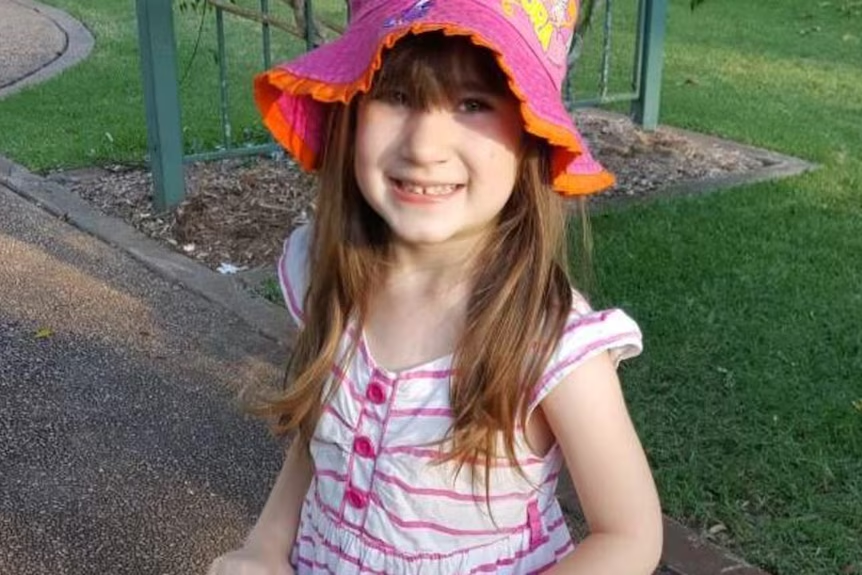
Published: 13 October 2026. The English Chronicle Desk. The English Chronicle Online
A coronial inquest in Queensland, Australia, has heard that child safety officers remained committed to returning Elizabeth Struhs to her family home in 2019 despite serious concerns raised by doctors about the risks to her health. A police officer who attended a meeting about the case told the inquest that challenging child safety officials’ decisions had often proved futile once they had settled on a course of action.
Elizabeth was six years old when she was discharged from hospital following a life-threatening episode of diabetic ketoacidosis, a serious complication of diabetes. She required regular insulin treatment to manage type 1 diabetes, but concerns had emerged about whether her family would consistently support the medical care she needed. Elizabeth died at home on 7 January 2022 after the insulin necessary to keep her alive was withdrawn.
The inquest is examining the decisions and circumstances that preceded her death, including how authorities assessed the risks facing the child, how medical advice was considered and whether the arrangements made after her hospital discharge provided adequate protection. The proceedings follow the criminal convictions of 14 adult members of a religious group known as the Saints, including Elizabeth’s parents, Jason and Kerrie Struhs, for her manslaughter.

Evidence presented to the inquest has raised questions about the relationship between child protection authorities and medical professionals, particularly when specialists believe a child may face serious harm if discharged into a potentially unsafe environment.
According to evidence heard by the coroner, Elizabeth was hospitalised in 2019 after developing diabetic ketoacidosis and falling into a coma. Her condition required urgent medical treatment and highlighted the potentially fatal consequences of failing to manage type 1 diabetes. The illness requires ongoing insulin administration, monitoring and appropriate medical support.
During her hospital admission, doctors at Queensland Children’s Hospital in Brisbane reportedly expressed concerns about the possibility that Kerrie Struhs might undermine Elizabeth’s long-term treatment if mother and daughter continued living together. The concerns were significant because Elizabeth’s survival depended on receiving insulin consistently.
The court heard that Kerrie had told authorities she did not believe in medicine and had discouraged her husband from seeking medical assistance, favouring prayer instead. The religious beliefs held by members of the Saints would later become central to the criminal case surrounding Elizabeth’s death. Members of the group reportedly believed that she could be healed through divine intervention or raised from the dead.
Following Elizabeth’s hospital admission, a meeting of a specialist team dealing with suspected child abuse and neglect considered the arrangements for her care. The meeting involved child safety officers alongside specialist police and health personnel. Despite objections from doctors at the Brisbane hospital, child safety staff concluded that Elizabeth should return home under the care of her father, Jason.
Evidence presented at the inquest indicated that Jason was considered capable of administering insulin and meeting his daughter’s immediate medical needs. At that stage, he was willing to provide the treatment, even though doing so conflicted with the religious views of his wife and other members of the household.
Meeting minutes quoted during the proceedings recorded a child safety officer acknowledging the disagreement with the hospital. The officer reportedly said the hospital did not agree with the department’s assessment and had expressed its objections forcefully. Nevertheless, the officer considered removing Elizabeth from the family home potentially more harmful and pointed to her father’s willingness to take greater responsibility for her care.
That decision has become a significant focus of the inquest because it raises questions about how competing assessments of risk were weighed. Medical specialists were concerned about the possibility that Elizabeth’s treatment could be disrupted, while child safety staff believed the arrangements involving her father offered a workable way to protect her.
A police officer who had attended the meeting gave evidence on Tuesday, describing his experience of working as a child safety liaison officer for a decade. He told the coroner that, in his experience, it was difficult to change the department’s position once child safety officers had reached a decision.
The officer said he had learned early in his career that further arguments were unlikely to alter the outcome after officials had made up their minds. He also indicated that the attitude was not restricted to one individual but reflected a broader approach to decision-making within the system.
According to his testimony, police personnel were expected to respect the department’s established decision-making processes. He characterised the arrangement as one of “professional courtesy”, suggesting that the different agencies had distinct responsibilities and that police did not necessarily challenge child safety decisions once those decisions had been made.
His evidence has brought renewed attention to the practical difficulties that can arise when agencies responsible for protecting children disagree about the level of danger a child faces. The inquest is examining whether the processes in place at the time allowed serious medical concerns to receive sufficient consideration and whether disagreements between professionals were properly resolved.
However, the evidence has also shown that not all medical professionals involved in the case shared the same assessment of the decision to return Elizabeth home. A paediatrician specialising in child safety at Toowoomba Hospital told the inquest on Tuesday that she was generally satisfied with how child safety authorities had handled the case, including their decision to return Elizabeth to her family.
Notes from a meeting presented during the proceedings indicated that the specialist believed Elizabeth could remain safe if her parents continued engaging with the hospital and diabetes education services. She reportedly considered further action likely if the family stopped attending appointments or ceased cooperating with medical professionals, as this would require authorities to investigate the reasons for the change.
That position contrasted with evidence from two doctors at Queensland Children’s Hospital in Brisbane, who told the inquest on Monday that they had been dissatisfied with the approach taken. One reportedly described the arrangements as entirely inadequate to address the risk facing Elizabeth.
The disagreement has exposed differing professional judgments about whether the safeguards put in place after Elizabeth’s hospital discharge were sufficient. While the Toowoomba specialist considered continued engagement with health services an important condition for keeping the child safe, doctors in Brisbane believed the risks warranted a stronger response.
The inquest also heard conflicting evidence about relations between the two hospitals. One Brisbane doctor described longstanding poor relations between the institutions and suggested that advice from the children’s hospital had been ignored. The Toowoomba specialist disputed the suggestion that the hospitals had a poor relationship.
These differing accounts may help the coroner understand how medical advice was communicated, how concerns were interpreted and whether institutional or procedural factors influenced the decisions made about Elizabeth’s welfare.
The case took a devastating turn in 2021, when Jason Struhs abandoned the insulin treatment he had previously been willing to provide after adopting his wife’s religious beliefs and joining her church group. Elizabeth subsequently died on 7 January 2022. Her death led to criminal proceedings against the adult members of the Saints, all 14 of whom were convicted of manslaughter last year, including both parents.
The coronial inquest is distinct from those criminal proceedings. Its purpose is to examine the circumstances surrounding Elizabeth’s death and consider the decisions and systems involved, rather than to repeat the criminal trial. Its findings may help identify weaknesses in child protection practices and opportunities to prevent similar tragedies.
Witnesses appearing at the inquest cannot be identified for legal reasons. The proceedings are continuing, and further evidence is expected to help clarify the sequence of decisions that left Elizabeth in her family’s care despite concerns about the management of her diabetes.

At the heart of the inquiry is a difficult question: how can authorities ensure that the medical needs and safety of a vulnerable child remain paramount when professionals disagree and a family’s beliefs conflict with essential treatment? The evidence heard so far highlights the importance of effective cooperation between hospitals, police and child protection services, as well as the need for clear procedures when a child’s life may depend on continued medical care.
The coroner’s examination of the case may provide a clearer understanding of how the decisions were reached and whether changes are needed to prevent similar failures. For Elizabeth, whose life depended on consistent insulin treatment, the consequences were irreversible. For the agencies involved, the inquest offers an opportunity to examine whether warning signs were adequately addressed and whether the systems designed to protect children worked as they should have.
Related News:
 Barrister Criticises Trial After Suicide Case Verdict
 Fayed Survivors Demand Inquiry Into Medical Regulator
 NSW Police Bid Delays Inquiry Into Sydney Protest
 Sam Wood Denied Bail Over Alleged Domestic Assault
 Baby Boy Found Dead at Adelaide Motel: Two Charged
 Undercover officer deceived women with ‘grotesque and cruel’ lies, spycops inquiry told
 Police Suspect Help in Missing Alice Springs Girl Case
 Florida Surgeon ‘Devastated’ Over Fatal Surgery Error
 Westminster Council Threatens Charing Cross Soup Kitchen
 BBC Warned About Missing Clothes of Murder Victim
 Cambridge Professor Jason Arday Found Dead at Home
 Councils spend £125m on illegal children’s care
 Patriot Platform Raises Concern Across Britain
 Survivor Seeks Closure After Priest Dies in Prison
 NHS Breast Care Review Finds Serious Patient Harm
 Patrick Clancy speaks publicly about children’s deaths
 Democrat Says ICE Restricted Detention Camp Oversight
 Cornell Fraternity Assault Investigation Reopened
 London Facial Recognition Trial Ends With False Alert
 Hundreds of UK prisoners released early amid overcrowding
 Drumcree Talks End Without Agreement Ahead of Appeal
 Almost Half of Fayed Accusers May Be Trafficking Victims
 Banned Health Coach Faces UK Events Criticism
 Calls Grow to Halt US Executions After Pike Failure
 New Prosecutor Takes Over Cornell Assault Case
 Latin America women fear rollback of rights
 Flydubai Co-Pilot Studied in Australia Before Attack
 Detective Breaks Down Recalling Double Murder Scene
 Christa Pike Wakes After Failed Tennessee Execution
 ICE Agent Shoots Man in New York as Child Escapes Harm
 Three Convicted in Mexico Surfing Trip Murders
 UAE Says Co-Pilot Planned Suicide Attack on Israel
 Controversial Vaccine Trial Approved in Guinea-Bissau
 Australian Advocates Seek Subsidised Drugs for PMOS
 British Military School Abuse Victims Denied Justice
 Former Students Raise Concerns Over School Culture
 Ben Roberts-Smith Denies War Crime Allegations in First Statement
 Synagogue Arson Attempt Sparks Security Fears
 NHS Safety Fears as Nurses Cover Doctor Gaps
 Two Children Die in Wolverhampton House Fire Tragedy
 Cartel crackdown raises fears of fresh violence
 Greens Face Internal Row Over Antisemitism Claims
 Immigration Judges Fear Pressure in Trump Era
 New Footage Revives Peter Falconio Mystery
 Internal Exclusions Surge in England’s Schools
 Survivor Sues Musk’s xAI Over AI Abuse Images
 Abusive ex used Tesla to control and harass former partner
 Man Arrested in Mississippi Woman’s Death
 Israel Accused of Undermining Palestinian Life
 Fugitive Developer Rants at NSW Corruption Inquiry
 Texas Charges Seven Noncitizens in Voting Crackdown
 Yemen War Displaces 125,000 as Fighting Intensifies
 Mahmood Warns Far Right Over Asylum Protests
 Disabled Travellers Seek Fairer UK Care Rules
 Harrods Faces Dispute Over Fayed Abuse Compensation
 Clancy Defense Seeks Inquiry Into Lone Juror
 King Refers Jamaica Slavery Petition to Privy Council
 GP List Policy Risks Cutting Off Vulnerable Patients
 OpenAI Agent Breaches Medicare Portal in Australia
 Free Speech Emerges as Key UK Election Issue
 Tennessee Set to Execute Woman After Clemency Denied
 French Student Protests Escalate Into Violent Clashes
 UK University Strikes Spread as Financial Pressure Grows
 Drumcree Talks Falter as Legal Challenge Deepens
 UK-France Returns Deal Faces Expiry as Talks Stall
 Badenoch Raises Prospect of 2027 UK Election
 French School Protests Escalate as 400 Schools Close
 Gosport Protesters Clash With Police Over Migrant Rescue
 Andrew Mountbatten-Windsor Challenges Police Raids
 Police accused of failing abuse victims
 Botstein Quits Bard Amid Epstein Investigation Calls
 Royal Navy Sailor Charged With Alleged Spying
 Luton Residents Reject Claims of ‘No-Go Zones’
 Sri Lanka Ex-First Lady Arrested Over Donation Probe
 South Africa Withdraws Directive on Asylum Applications
 Delhi Tightens Security Ahead of Election Protest
 US Execution Livestream Plan Sparks Global Outrage
 UK Greens Face Crisis Over Zionism and Extremism Row
 Leaked Files Raise Questions Over Abramovich’s Finances
 ABC Reporter Faces Possible Disciplinary Action Over Opinion Piece