Published: 17 September 2026. The English Chronicle Desk. The English Chronicle Online
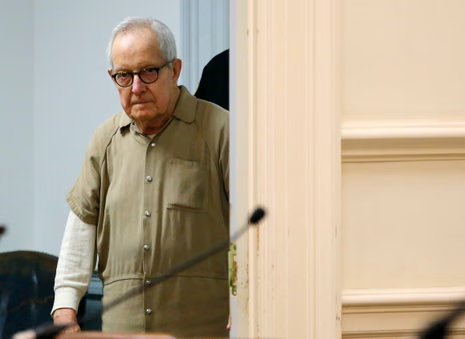
For Keith Townsend, the death of former Catholic priest Ronald Paquin has brought a complicated mixture of reflection, grief and hope for closure. Townsend, who was abused by Paquin as a child, spent years pursuing justice after learning that the former priest had been released from prison.
Paquin died in custody in Maine on 11 September at the age of 83, more than seven years after he was sentenced to another 16 years in prison following his conviction for sexually abusing Townsend. His death closes the criminal proceedings against him, but for survivors and their families, the consequences of the abuse can continue long after a perpetrator is no longer alive.
Townsend, now 52 and living in New Hampshire, said he hopes Paquin’s death will allow victims and their families to continue moving forward. He described the lasting emotional burden carried by survivors while emphasising that his own life after the abuse is also part of the story.
Townsend’s experience is closely connected to one of the most significant clergy sexual-abuse scandals in the United States. Paquin became one of the priests whose conduct was exposed during investigations into abuse within the Roman Catholic Archdiocese of Boston, a scandal that contributed to major institutional changes and the resignation of Archbishop Bernard Law in 2002.

Paquin had pleaded guilty that year to sexually abusing an altar server between 1989 and 1992 while serving at St John the Baptist Church in Haverhill, Massachusetts. He was subsequently removed from the priesthood and imprisoned.
The abuse involving Paquin became publicly known through reporting by the Boston Globe’s Spotlight investigative team. The newspaper’s investigation documented allegations of widespread abuse by Catholic clergy and questions about how church authorities had handled allegations against priests.
For Townsend, however, Paquin’s story was not simply something he encountered through newspaper reports. He had also been an altar server at St John the Baptist and said he was abused by Paquin during camping trips to Kennebunkport, Maine, between 1985 and 1989.
Townsend was between eight and 13 years old at the time. He later described the impact of the abuse on his life, including struggles with substance misuse and periods of imprisonment. He said the consequences extended well beyond the years in which the abuse occurred.
His decision to come forward was influenced by Paquin’s release from prison in 2015. Townsend subsequently reported his own experience to authorities, helping lead to a new criminal case in Maine.
A grand jury indicted Paquin in 2017 on charges of gross sexual misconduct involving Townsend and another person. Paquin went to trial in November 2018. The jury found him guilty in relation to Townsend but acquitted him of abusing the other individual.
In May 2019, Maine judge Wayne Douglas sentenced Paquin to an additional 16 years in prison. Paquin was serving that sentence at the Mountain View Correctional Facility in Charleston when he died, according to the Maine Department of Corrections.
Townsend said he learned of Paquin’s death from his wife, who saw reports circulating through news and social media. He acknowledged that some people responded to the news with anger or satisfaction because of what Paquin had done.
His own response was different. Rather than focusing solely on Paquin’s death, Townsend said he reflected on the life he had managed to build after overcoming the consequences of his childhood abuse.
He spoke about overcoming addiction and creating a family, describing that progress as one of the most difficult challenges he had faced. His comments underline an important distinction between the end of a criminal case and the longer process of recovery for people affected by abuse.
Townsend said he had pursued Paquin’s imprisonment partly because he wanted to protect children from the possibility of further abuse. He criticised Massachusetts for releasing Paquin in 2015 and credited Maine authorities with pursuing the subsequent case.
For Townsend, bringing the case forward was therefore not only about his own experience. He viewed the prosecution as an opportunity to prevent other children from potentially being harmed.
The wider story was also immortalised in the 2015 film Spotlight, which dramatized the Boston Globe’s investigation into sexual abuse within the Catholic Church. The film won the Academy Award for Best Picture and introduced the story to audiences around the world.
Paquin appears as one of the figures represented in the film. A scene depicts a journalist confronting a character based on him about allegations involving children at St John the Baptist Church. The scene became one of the film’s notable moments because of the character’s acknowledgement of inappropriate conduct.
Townsend said he had not watched Spotlight and therefore had not seen that particular portrayal. For him, the events represented in the film were not historical material but part of his own childhood and the subsequent struggle to obtain justice.
Attorney Mitchell Garabedian, who represented numerous survivors of clergy sexual abuse, including people who accused Paquin, has a different connection to the film. Garabedian was portrayed by Stanley Tucci in Spotlight.
Garabedian said the film had an important effect on survivors because it showed that people who had experienced abuse were not alone. Public discussion of the scandal helped challenge the isolation and shame that many survivors had experienced.
The significance of such representation goes beyond the individual cases depicted on screen. The Boston Globe’s investigation helped prompt a much broader examination of how allegations against Catholic clergy had been handled and whether institutions had adequately protected children.
The scandal led to major public scrutiny of the Archdiocese of Boston and contributed to changes in policies concerning allegations of abuse within Catholic institutions across the United States. It also encouraged survivors in other places to come forward with their own accounts.
Townsend’s experience demonstrates how those developments could intersect with an individual’s decision to seek justice many years after the original abuse. His case emerged years after Paquin’s first conviction and after the former priest had already served a prison sentence.
The delay between abuse and disclosure is not unusual in cases involving childhood sexual abuse. Survivors may face complicated emotional, family and social circumstances that affect whether and when they feel able to report what happened. Legal systems have also changed over time in their treatment of historic allegations.
Townsend’s case therefore illustrates both the possibility of accountability years later and the limitations of criminal justice in addressing the full impact of abuse.
Paquin’s death means he can no longer face additional legal proceedings. But for Townsend, the meaning of his prosecution lies partly in what happened before Paquin’s death. He believes that securing another prison sentence helped prevent the former priest from having further opportunities to harm children.
His comments also suggest that closure does not necessarily mean forgetting. Instead, he described moving forward as something that survivors and families must continue doing, even after a perpetrator’s death.
The emotional consequences can be particularly complex when a case becomes part of a much larger public scandal. Survivors may see their private experiences discussed in newspapers, documentaries, films and court proceedings. Such attention can provide recognition and validation while also bringing difficult memories back into public view.
The Spotlight investigation helped expose institutional failures that might otherwise have remained less visible. Garabedian’s comments about survivors recognising that they were not alone point to the broader importance of acknowledging victims and separating responsibility for abuse from those who experienced it.
For Townsend, however, the most important measure of what happened is personal. He said that after everything he experienced, he can now look at the family and life he built after overcoming serious difficulties.
He remains grateful that Paquin’s actions were exposed and that the former priest ultimately returned to prison following the Maine prosecution. Townsend believes the imprisonment was important not only for accountability but also for protecting others.
The death of Paquin does not erase the damage described by his survivors, nor does it resolve the broader questions raised by the clergy-abuse scandal. Those issues involve institutions, safeguarding practices, accountability and the treatment of survivors over decades.

But Townsend’s response to Paquin’s death is also a story about life after abuse. His emphasis on moving forward reflects the reality that survivors can continue rebuilding their lives even while carrying memories of what happened.
As the legal chapter surrounding Paquin comes to an end, Townsend hopes other survivors and their families can find their own path forward. His account remains connected to a much larger history of institutional scrutiny in the Catholic Church, but ultimately his message is personal: the life built after abuse can become part of the recovery process.
For Townsend, the fact that Paquin died in prison is less important than what happened before that point. He believes the prosecution helped protect others and brought a measure of accountability after decades had passed.
His story therefore leaves a complicated legacy. A criminal conviction cannot undo childhood abuse, and a prison sentence cannot remove its lasting consequences. But for one survivor, pursuing justice provided an opportunity to confront the past while continuing to build a future beyond it.
Related News:
 Texas Charges Seven Noncitizens in Voting Crackdown
 Undercover officer deceived women with ‘grotesque and cruel’ lies, spycops inquiry told
 Police Suspect Help in Missing Alice Springs Girl Case
 FBI Links Brown University Shooting to Long-Term Grievances
 US Charges Sinaloa Governor in Major Cartel Case
 Florida Surgeon ‘Devastated’ Over Fatal Surgery Error
 Barrister Criticises Trial After Suicide Case Verdict
 Immigration Judges Fear Pressure in Trump Era
 Westminster Council Threatens Charing Cross Soup Kitchen
 BBC Warned About Missing Clothes of Murder Victim
 Cambridge Professor Jason Arday Found Dead at Home
 Armed Suspect Attacks Ohio Governor Candidate
 Councils spend £125m on illegal children’s care
 Patriot Platform Raises Concern Across Britain
 Man Arrested in Mississippi Woman’s Death
 Piddington Votes for Symbolic Independence Over Asylum Plan
 NBC Helicopter Crash in Los Angeles Kills Three
 Iran School Strike Raises War Crimes Questions, UN Says
 Australia Post Worker Jailed Over Stolen Bank Cards
 Franklin Turtle, Sabrina Carpenter Slam US Social Media Use
 Melania Trump Epstein remarks spark survivor backlash
 Swalwell Faces Pressure to Quit Governor Race
 Prevent Failings Exposed After Southport Attack
 Ben Roberts-Smith Denies War Crime Allegations in First Statement
 Synagogue Arson Attempt Sparks Security Fears
 Harmeet Dhillon Faces Scrutiny in DOJ Role Debate
 Walsall Rapist Jailed After Hate-Filled Online Trail
 Two Children Die in Wolverhampton House Fire Tragedy
 US Labor Department in turmoil after secretary resigns
 Trump DOJ Targets James Comey Again
 Judge Blocks Trump Bid for Arizona Voter Data
 US Court Weighs Fate of TPS for Migrants
 Rebel Wilson Rejects Phone Dump Claim
 Cartel crackdown raises fears of fresh violence
 US states redraw maps after voting rights ruling
 Greens Face Internal Row Over Antisemitism Claims
 US ‘Narco Boat’ Strikes Draw Global Outcry
 US judge dismisses Kilmar Abrego Garcia indictment
 Trump’s Revenge Drive Deepens GOP Divide
 Victim says non-custodial rape sentence ‘rock in my face’
 Gunman Killed After White House Security Shootout
 Murder Probe Continues After Arrest Release
 New Footage Revives Peter Falconio Mystery
 Dreyfus Statue Finally Gets Permanent Paris Home
 Teen Charged After Layla Jeffery Found Dead
 Trump Orders Signs Criticising Smithsonian Museum
 Is America Ready for an AOC Presidential Run?
 Woman speaks after teacher jailed for historic rape
 Internal Exclusions Surge in England’s Schools
 Survivor Sues Musk’s xAI Over AI Abuse Images
 Argentina Orders Return of Nazi-Looted Painting
 Judge Allows Pentagon Firings at Stars and Stripes
 Ministers Condemn Far-Right Unrest in Portsmouth
 Singaporean Man Admits Role in $245m Crypto Heist
 New Mexico Takes Facebook to Trial Over Data Scandal
 Reform UK Receives Record £36m Donation From Crypto Billionaire
 Israel Accused of Undermining Palestinian Life
 Election Candidate Abuse Raises Alarm in England
 UK Urged to Probe US Diplomat Case
 Fugitive Developer Rants at NSW Corruption Inquiry
 New Evidence Deepens Church of England Slavery Reckoning
 Lisa Nandy Calls for Tougher Action on Social Media Doxxing
 Seven Women’s Deaths Renew South Africa Femicide Anger
 Sahel Islamist Violence Set for Record Levels in 2026
 Amnesty Finds Coordinated Abuses in Iran Protest Crackdown
 ICAC Examines Greenwood Payments and Nassif Links
 Turkey LGBTQ Crackdown Expands With New Arrests
 Yemen War Displaces 125,000 as Fighting Intensifies
 Targeted Attack in Bury Sparks Murder Investigation as Community Awaits Justice
 Merseyside Police Helicopter Crew Cleared After Low-Altitude Pursuit of Suspect
 No Evidence Found to Substantiate Alleged Rape in Oxfordshire Churchyard, Police Confirm
 Paedophile Singer Ian Watkins Dies After Prison Attack
 Man Denies Stealing Bronze Age Gold from Museum
 Runaway Driver Caught by DNA Evidence
 US National Guard Member Killed in DC Shooting
 American Mother Extradited From UK to U.S. on Murder Charges
 Partial US Government Shutdown Hits Homeland Security Funding
 British Museum Faces Questions Over Peter Thiel’s Private Bayeux Viewing
 Trump gives $45,000 holiday gifts to White House aides
 Entain Plans 400 Job Cuts After Profit Update