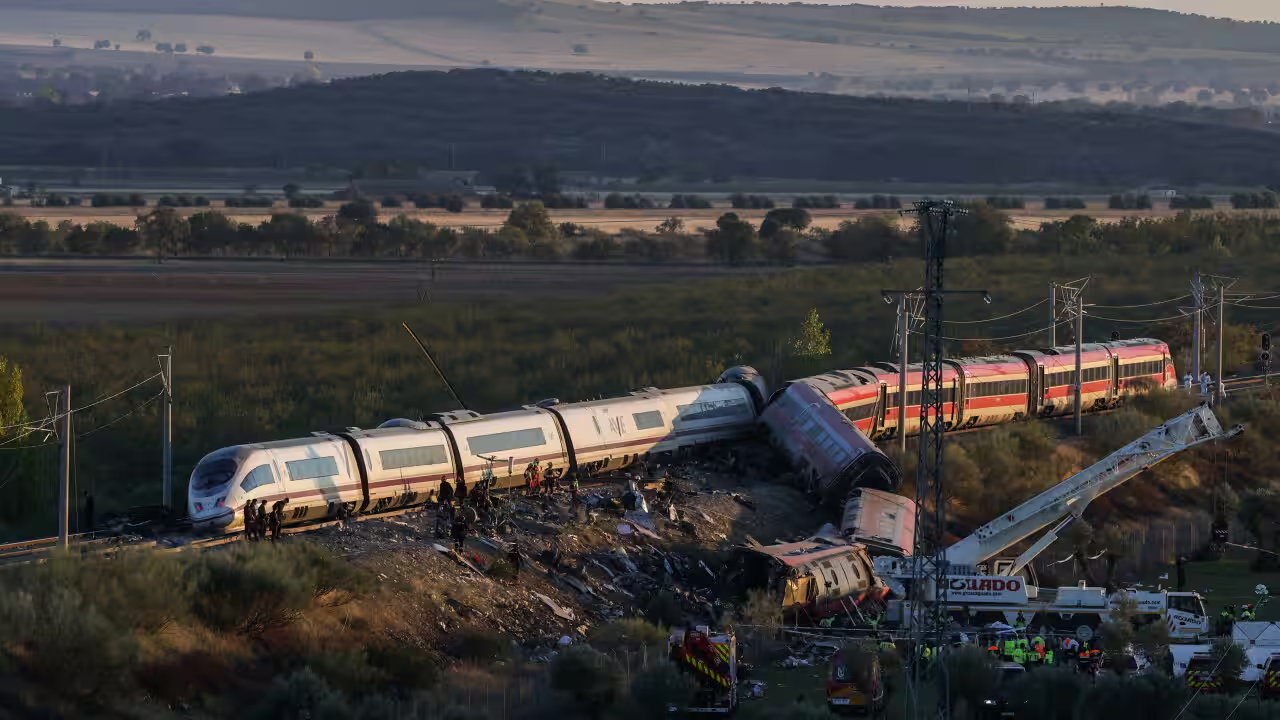
Spain has begun three days of national mourning after a devastating high-speed train collision killed 68 people and injured scores of others, leaving families desperately searching for missing loved ones and raising serious questions about the safety of the country’s railway network. Emergency crews continued working through the night amid twisted metal and shattered carriages, while authorities established support centres to help relatives identify victims and obtain information about those who remain unaccounted for.
The collision, which occurred on Wednesday morning near the town of Urda in central Spain, marks the country’s second deadly high-speed rail disaster this year. The repeated involvement of trains operated by the state-owned Renfe and private rail company Iryo has intensified public concern over railway safety, infrastructure management and the effectiveness of the systems designed to prevent such tragedies.
According to initial accounts from officials, the two trains were travelling in the same direction along the railway line connecting Madrid with the southern region of Andalusia. After the Iryo train came to a halt, a Renfe train travelling behind it crashed into its rear. The impact sent several carriages off the tracks, leaving passengers trapped amid severely damaged sections of the trains.

The circumstances surrounding the initial stoppage and the subsequent collision remained unclear as investigators began examining the incident. Authorities have not yet established a definitive cause, and questions remain about whether a technical malfunction, signalling failure, operational error or another factor contributed to the disaster.
The scale of the damage presented a formidable challenge for emergency responders. Rescue workers spent the night searching through the wreckage, using cranes to lift heavy pieces of twisted metal and gain access to areas where additional victims might have been trapped. The operation required careful coordination because damaged carriages and unstable debris made it difficult for rescuers to reach every section safely.
Officials warned that the death toll could rise as the search continued. Emiliano García-Page, head of the regional government of Castilla-La Mancha, said rescue teams had not yet been able to reach the bottom sections of the carriages. His warning underscored the uncertainty facing authorities and families as the operation moved into its next phase.
The reported number of injured passengers also highlighted the extensive human cost of the crash. Officials said another 107 people had required hospital treatment, including 15 whose conditions were described as serious. Medical teams worked to treat those injured, while emergency services coordinated the response and assisted survivors who had escaped the wreckage but remained traumatised by the experience.
For relatives waiting for information, the hours after the collision became an agonising period of uncertainty. Families travelled to designated assistance centres, hoping to establish whether their loved ones had survived. Some were unable to obtain immediate answers because the condition of the wreckage and the difficulty of identifying victims complicated the process.
Spain’s Civil Guard established four offices in Madrid, Toledo, Córdoba and Seville to help relatives provide DNA samples and support the formal identification of victims. The process is particularly important when bodies cannot be identified immediately through conventional means. Authorities must establish identities reliably before providing definitive information to families.
A school in Urda, approximately 130 kilometres south of Madrid, was also being used as a centre where relatives could ask questions about missing family members. Red Cross personnel were present to offer emotional support to people arriving at the facility. Some relatives were visibly distressed, reflecting the psychological burden of waiting for news following a sudden and catastrophic event.
Carmen Garcia, a Red Cross psychologist involved in the response, warned that the coming hours would be difficult for families coping with the tragedy. She said people respond differently to traumatic events, with some experiencing shock, others struggling to accept what has happened and many feeling anger, sadness or intense anxiety.
Her assessment highlighted the importance of psychological assistance alongside the immediate rescue and medical response. For families who have lost relatives, the process of grieving may be complicated by the circumstances of the disaster, particularly when uncertainty continues over the identities or whereabouts of loved ones.
Authorities also established blood donation points in Madrid and Castilla-La Mancha to support the medical response. Such arrangements reflected the wider mobilisation of emergency resources as hospitals and rescue teams dealt with the consequences of the collision.
The disaster has placed renewed scrutiny on Spain’s high-speed railway network, which has long been regarded as an important part of the country’s transport infrastructure. The transport minister reportedly referred to an error and circumstances that remained difficult to explain, but investigators had yet to determine precisely what caused the trains to collide.
The investigation is expected to examine the movements of both trains, the circumstances surrounding the Iryo train’s stoppage and the operational and technical systems responsible for maintaining safe distances between trains. Investigators will also need to establish whether procedures were followed correctly and whether any warning systems or safeguards failed to prevent the impact.
The latest crash has drawn particular attention because Spain suffered another deadly collision in January. In that incident, 46 people were killed and dozens more injured when two trains, again involving Renfe and Iryo services, collided near Adamuz in Andalusia.
The fact that two major train disasters have occurred in the same year has prompted fresh demands for accountability and a comprehensive examination of railway safety. Although the circumstances of the two accidents may differ, their combined impact has raised questions about whether additional safeguards or changes to operational practices are necessary.
Prime Minister Pedro Sánchez expressed his concern over the repeated tragedies, saying it was unacceptable for a country such as Spain to experience two high-speed train accidents in the same year. He stressed that the causes of the latest disaster remained under investigation and pledged that any failures identified would be addressed with the utmost seriousness.
Sánchez said that if investigators established that weaknesses in the security systems or negligence had contributed to the collision, the shortcomings would be dealt with firmly. His comments reflected the pressure on the government to provide answers while ensuring that the investigation proceeds on the basis of evidence rather than speculation.
The prime minister’s response also carries broader implications for public confidence in the country’s transport system. High-speed rail is central to travel between major Spanish cities, serving commuters, business travellers and tourists. Repeated fatal accidents can undermine confidence in the reliability of the network and increase calls for greater transparency over maintenance, safety procedures and investment.
Opposition People’s Party leader Alberto Núñez Feijóo called for an immediate investigation into the collision and a complete, independent review of Spain’s railway network. He argued that the public had a right to understand the condition of the country’s infrastructure and the circumstances behind the latest disaster.
His demand for an independent assessment adds to the political pressure on the government as rescue operations continue and investigators begin reconstructing the events leading to the crash. Any comprehensive review would need to distinguish between the specific causes of the collision and wider questions concerning railway management, infrastructure and safety oversight.
Among the first victims publicly identified was José Manuel Chacón, a 31-year-old member of Spain’s Civil Guard. The national law enforcement agency expressed its deepest condolences to his family, friends and colleagues, as the country began mourning those killed.
Spanish media reports also indicated that several other people remained missing, including a former minister associated with the People’s Party and foreign nationals believed to have been visiting the country. Authorities faced the difficult task of confirming identities and notifying families while avoiding premature conclusions about those whose whereabouts had not been established.
The three-day mourning period offers Spain an opportunity to remember the victims and recognise the suffering experienced by survivors and their families. Yet the national response will extend beyond public expressions of grief. The continuing rescue operation, identification process and formal investigation will be essential to establishing what happened and determining whether the tragedy could have been prevented.
For the families still waiting for news, the immediate priority remains clear: finding their loved ones and receiving reliable information from authorities. For survivors, the physical injuries and emotional consequences may continue long after the wreckage has been cleared.

Spain now faces the challenge of supporting those affected while establishing the facts behind a disaster that has shaken confidence in its railway system. The investigation will need to provide clear answers about the collision, identify any failures and establish whether corrective measures are required.
As rescue workers continue searching the damaged carriages, the country’s mourning is accompanied by a growing demand for accountability. The findings of the investigation will be closely watched by victims’ families, railway passengers and the wider public, all of whom will want assurances that the lessons of this tragedy are fully understood and acted upon.
The immediate priority remains the recovery and identification of victims, the treatment of injured passengers and support for grieving families. The longer-term task will be to determine the causes of the collision and restore public confidence in the safety of Spain’s high-speed rail network.
Related News:
 Elif Eralp Emerges as Berlin’s Next Political Force
 French Students Protest Poor Conditions in Paris Suburbs
 Greta Thunberg Backs French Students in School Protests
 Serbia’s Student Victory Sparks a ‘Smell of Freedom’
 France Faces Record Presidential Crowded Race Amid Far-Right Surge
 England and Norway Fans Turn Miami Into World Cup Carnival
 Is America Ready for an AOC Presidential Run?
 Five Years of Taliban Rule Leave Afghanistan in Crisis
 Ukraine Villagers Demand Answers After Deadly Arms Depot Strike
 Europe’s democracies face a growing far-right threat
 Lib Dems Prepare for Election Amid Reform Challenge
 Madrid Tent Camp Grows as Spain Housing Crisis Deepens
 French Student Protests Escalate Into Violent Clashes
 Drumcree Talks Falter as Legal Challenge Deepens
 UK-France Returns Deal Faces Expiry as Talks Stall
 Green Party faces dispute over Zionism motion
 French School Protests Escalate as 400 Schools Close
 Bosnia’s Young People Look Beyond Election Hope
 Germany Pledges €1bn Military Aid to Ukraine
 Latin America women fear rollback of rights
 Spain Sets Snap Election as Housing Crisis Deepens
 Former German Intelligence Chief Arrested Over Espionage
 French Student Protests Grow Despite Government Pledge
 France Promises 3,000 Teachers as Student Protests Grow
 India’s Youth Movement Alleges Mass Detentions Before Protest
 Gaza War Deepens India’s Strategic Ties With Israel
 Bolsonaro Gains Key Endorsement Ahead of Brazil Runoff
 UAE Says Co-Pilot Planned Suicide Attack on Israel
 Controversial Vaccine Trial Approved in Guinea-Bissau
 France Faces Debt Crisis as Protests and Markets Clash
 Trump Attacks Norway After Nobel Peace Prize Snub
 Delhi Braces for Youth Protests Over Voter Roll Dispute
 Trump Names Katie Zacharia as Next White House Spokesperson
 UK Gaza Refugee Route Criticised Over False Hope Claims
 PTI Announces Swabi Rally Ahead of Long March Plans
 UK Greens Face Crisis Over Zionism and Extremism Row
 Millions Face Tougher Medicaid Rules From January
 Ohio Airports Become Key Hubs for ICE Deportation Flights
 Farage Rejects Claims Reform Would Let Troops Shoot Migrants
 Ukrainian Soldier Faces Trial Over Nord Stream Blast
 Gadi Eisenkot: Israel’s Anti-Netanyahu Challenger
 French Police Face Scrutiny Over Injured Teenagers
 Trump Slams Ukraine Strikes as Russia Ceasefire Collapses
 Macron Condemns Violence as France Faces 2,400 Arrests
 Milan Luxury Stores Shut as Italy Plans Troop Deployment
 Fifth Foreign Firm Withdraws From Jerusalem Cable Car Plan
 Milan Braces for Unrest as Debate Intensifies Over Lost Generation
 France to Deploy 70,000 Police Amid Unrest Fears
 Ukraine Peace Talks Set to Resume in November
 Taylor Faces Backlash Over Response to Haines Attack
 Melting Dolomites Glaciers Reveal 250 WWI Explosives
 Trump’s Midterm Campaign Faces Racism and Political Backlash
 McKenzie Warns MP Safety Fears Could Weaken Democracy
 King Charles Faces Calls for Slavery Reparations Talks
 Italian Town Buys Mussolini Villa to Keep Away Fascist Fans
 US ‘Narco Boat’ Strikes Draw Global Outcry
 Pope Meets Families in Italy Toxic Waste Zone
 Farage and Reform UK Reshape British Politics
 Olympus Awaits Unesco Heritage Recognition
 Ghent Professors Questioned Cofnas Appointment
 Bayeux Tapestry Revives Franco-British Ties
 Trump Calls Iran War ‘Small Potatoes’ Despite US Deaths
 Turkey LGBTQ Crackdown Expands With New Arrests
 US Networks Suspend Trump White House Pool Coverage
 Democrat Says ICE Restricted Detention Camp Oversight
 Republican Senator Questions Trump Ad Spending
 Free Speech Emerges as Key UK Election Issue
 Burnham Opens Door to Possible UK Return to EU
 Badenoch Raises Prospect of 2027 UK Election
 France Schools Protests Draw 250,000 as Police Clash
 Trump Says He Deserves Nobel Peace Prize
 Houthi Missile Claim Sparks Riyadh Airport Disruption
 Australian Advocates Seek Subsidised Drugs for PMOS
 Trump Names Katie Zachariah as Next White House Press Secretary
 Brazil Court Scandal Threatens Lula as Bolsonaros Rise
 India’s Voter Roll Crisis Sparks Nationwide Protests
 Greens Face Leadership Test as Jordon Steele-John Misconduct Claims Leave Party in Limbo
 Lula Supporters Make Final Push Ahead of Brazil Runoff
 Fire Engulfs Hitler’s Eagle’s Nest Retreat
 Xi Jinping Tightens China’s Anti-Corruption Campaign