Published: 09 October 2026. The English Chronicle Desk. The English Chronicle Online
India’s relationship with Israel has grown increasingly close during the war in Gaza, highlighting a major shift in New Delhi’s foreign policy under Prime Minister Narendra Modi. While several Western governments have taken steps against Israeli officials over their statements and policies concerning Palestinians, India has continued strengthening its diplomatic, defence and commercial engagement with Israel, raising questions about its longstanding support for Palestinian statehood.
The contrast became particularly visible in September 2025, when Israeli Finance Minister Bezalel Smotrich visited India. Smotrich, a far-right politician who has advocated policies involving the annexation of the occupied West Bank and made controversial remarks about Palestinians, faced entry restrictions or sanctions from several Western countries. The European Union also announced sanctions targeting Smotrich and National Security Minister Itamar Ben-Gvir during that period.
India, by contrast, welcomed Smotrich and arranged visits to several cities. His programme included a trade agreement in New Delhi, a visit to the Mumbai stock exchange and a stop at an investment centre in Gujarat, Modi’s home state. The visit took place amid Israel’s devastating military campaign in Gaza, where Palestinian civilians continued to face widespread death, displacement and destruction.

The episode illustrated the growing distance between India’s approach and that of some traditional Western supporters of Israel. It also reflected the transformation of India-Israel relations from a relationship once handled cautiously into an increasingly public strategic partnership.
For decades, India had been among the prominent international supporters of Palestinian self-determination. Its foreign policy was shaped partly by its anti-colonial history and its support for national liberation movements. Although India eventually established diplomatic relations with Israel in 1992, successive governments generally sought to maintain support for Palestinian statehood alongside growing cooperation with Israel.
The relationship began changing more visibly after Modi and his Bharatiya Janata Party, or BJP, came to power in 2014. Under his leadership, cooperation with Israel has expanded in areas including defence, intelligence, technology and trade. Analysts say the Gaza war has accelerated the public and political dimensions of this closer relationship, even as Israel faces increasing international criticism.
A major turning point came after the Hamas-led attacks on Israel on 7 October 2023. Modi quickly condemned the attacks, describing them as terrorist violence and expressing shock at the events. Analysts argue that this framing helped establish a political basis for closer alignment with Israel by placing the conflict within a broader narrative of counterterrorism.
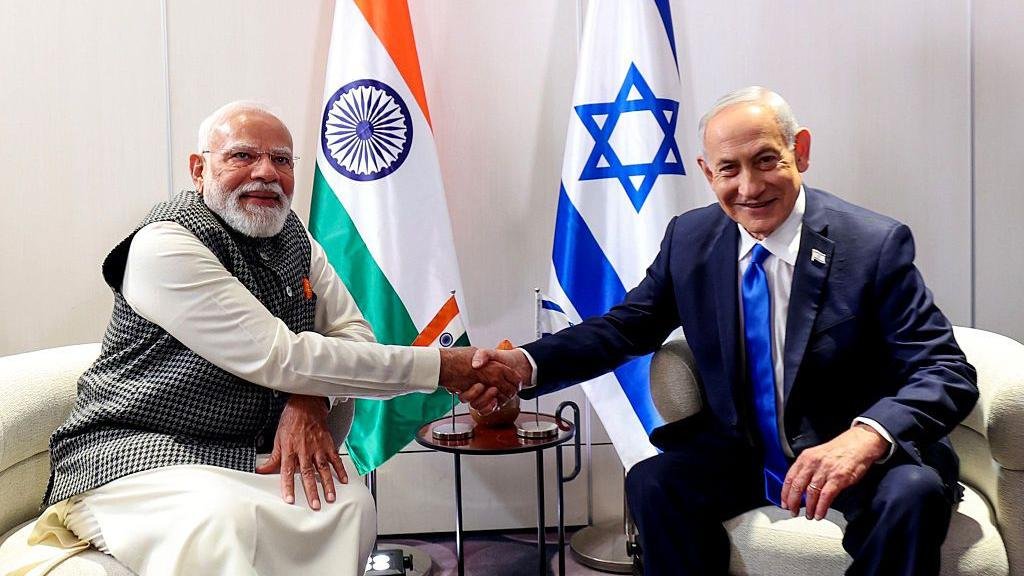
During his visit to Israel in February 2026, Modi again emphasised the importance of combating terrorism. Referring to the 2008 Mumbai attacks, which India has attributed to Pakistan-based militants, he said India and Israel shared a policy of zero tolerance towards terrorism and rejected double standards on the issue.
Political observers say this approach resonates with important elements of the BJP’s domestic political messaging. The party’s Hindu nationalist ideology has often emphasised national security and portrayed Islamist extremism as a major threat. According to analysts, the Israeli government’s security-focused rhetoric and its military response to attacks have therefore found an audience among sections of India’s political right.
Political analyst Rashid Kidwai has argued that the relationship with Israel complements narratives already present in Indian domestic politics. In his assessment, the BJP’s emphasis on security and its criticism of Islamist extremism help explain why closer ties with Israel have become politically advantageous.
Analysts also point to ideological similarities perceived by sections of the Hindu right between Hindutva, the BJP’s Hindu nationalist outlook, and Zionism, the movement associated with establishing and maintaining a Jewish national homeland. These ideologies have different histories and political contexts, but supporters of closer India-Israel relations sometimes draw parallels between their respective ideas of national identity and security.
The growing relationship is not based on ideology alone. India views Israel as an important defence and intelligence partner, while cooperation can provide access to military technology, surveillance capabilities and security expertise. Former Indian diplomat Navdeep Suri, who served as ambassador to Egypt and the United Arab Emirates, has described security cooperation as a central pillar of the bilateral relationship.
Suri has also emphasised the role of people-to-people ties and public attitudes in sustaining the partnership. In India, support for Israel is particularly visible among sections of society attracted to its assertive security policies. Calls for India to adopt a similarly hard-line approach have surfaced in debates concerning Kashmir, Pakistan and domestic security.
According to Suri, the relationship’s movement into the public spotlight began before the Gaza war. What had previously been a more discreet partnership has become increasingly visible under Modi, reflecting both strategic cooperation and a political environment more comfortable with openly embracing Israel.
The shift has become more striking as some European governments have moved beyond criticism of Israeli policy towards concrete measures. Several countries have imposed restrictions connected with Israeli settlements in the occupied West Bank, while others have sanctioned settlers and individuals accused of involvement in violence against Palestinians. Measures against Israeli ministers have also reflected growing concern over statements and policies relating to Gaza and the occupied territories.
India, meanwhile, has continued to express support for a two-state solution and has called for humanitarian assistance to reach Gaza. New Delhi has also issued statements advocating peace and diplomacy. Critics, however, argue that these diplomatic positions have not been matched by meaningful pressure on Israel or a willingness to publicly challenge its conduct.
Suri has suggested that India could adopt a more principled approach while continuing to maintain diplomatic and security ties with Israel. He has also pointed to the political closeness between the two governments as a factor that may make Indian officials reluctant to criticise Israeli actions, including settlement expansion, violence against Palestinians and military operations in the region.
The relationship was on prominent display during Modi’s February 2026 visit to Israel, when he addressed the Israeli parliament alongside Prime Minister Benjamin Netanyahu. Netanyahu described Modi as a great friend and more than a friend, calling him a brother. The warm language underscored the unusually close political rapport between the two leaders.
The visit also came at a time when Netanyahu was facing growing international isolation over the war in Gaza and allegations of war crimes. The International Criminal Court had issued an arrest warrant for Netanyahu in connection with the situation in the Palestinian territories. Despite these developments, Modi proceeded with the visit, signalling that India’s strategic partnership with Israel remained a priority.
Max Rodenbeck, who directs the Israel-Palestine programme at the International Crisis Group, previously described Modi’s visit as a gesture that could strengthen Netanyahu’s image as an internationally respected leader. The timing, during the run-up to an Israeli election campaign, gave the visit added political significance.
The contrast with India’s earlier foreign policy is considerable. India opposed Israel’s establishment in 1948 and supported a United Nations resolution in 1975 that characterised Zionism as a form of racism, a resolution later revoked by the General Assembly in 1991. India was also the first non-Arab country to recognise the Palestine Liberation Organization and among the early countries to recognise the State of Palestine.
Nevertheless, India maintained discreet contacts with Israel for years before formally establishing diplomatic relations in 1992. Cooperation gradually expanded under successive governments, and Modi became the first sitting Indian prime minister to visit Israel in 2017. His government has since made the partnership more prominent, reflecting changes in security priorities, economic interests and domestic politics.
The Congress party, which governed India for much of the period after independence, traditionally placed greater emphasis on support for the Palestinian cause. Analysts have argued that this position also reflected the political importance of India’s Muslim population, one of the largest in the world. Under the BJP, critics say, a Hindu-first political approach has reduced the domestic political incentive to prioritise Palestinian concerns.
The wider geopolitical environment has also complicated India’s choices. Even the United States, Israel’s principal ally, has at times expressed frustration with Israeli military actions while continuing to provide substantial military support. Such contradictions demonstrate the difficulty of translating criticism of Israel into a fundamental change in strategic relations.

For India, the central question is whether close cooperation with Israel can be reconciled with its stated support for Palestinian statehood, international law and a negotiated settlement. Maintaining defence and intelligence ties does not necessarily require silence on civilian suffering or settlement expansion, critics argue. However, the political and strategic alignment between Modi and Netanyahu has made a sharper Indian response less likely.
As the Gaza conflict reshapes international attitudes towards Israel, India’s position highlights a broader transformation in its foreign policy. New Delhi continues to endorse a two-state solution in diplomatic statements, yet its expanding cooperation with Israel suggests that strategic interests and domestic political calculations increasingly shape its practical choices. The challenge for India will be to demonstrate that its commitment to Palestinian rights and international principles remains meaningful even as its partnership with Israel deepens.
Related News:
 Five Years of Taliban Rule Leave Afghanistan in Crisis
 India’s Youth Movement Alleges Mass Detentions Before Protest
 Israeli Strike in Southern Lebanon Kills Seven
 Is America Ready for an AOC Presidential Run?
 Nepal Flood Survivors Face Unimaginable Loss
 Nepal Tunnel Rescue Offers Hope Amid Flood Devastation
 Yemen War Displaces 125,000 as Fighting Intensifies
 Lib Dems Prepare for Election Amid Reform Challenge
 Elif Eralp Emerges as Berlin’s Next Political Force
 Nepal PM calls deadly flood a global climate warning
 Drumcree Talks Falter as Legal Challenge Deepens
 UK-France Returns Deal Faces Expiry as Talks Stall
 Green Party faces dispute over Zionism motion
 Germany Pledges €1bn Military Aid to Ukraine
 Latin America women fear rollback of rights
 Pacific Climate Summit Draws Limited Global Leaders
 Israel Promotes Film Challenging Controversial Gaza Documentary
 Iran Crisis Tests Trump’s Global Leadership
 Southeast Asia Turns to Russia Amid Energy Crisis
 Cartel crackdown raises fears of fresh violence
 China Fireworks Factory Blast Kills 21 in Hunan
 US ‘Narco Boat’ Strikes Draw Global Outcry
 France Faces Record Presidential Crowded Race Amid Far-Right Surge
 US Awaits Iran Reply on New Ceasefire Proposal
 Immigration Judges Fear Pressure in Trump Era
 Hormuz Talks Near Critical Stage
 Maldives Cave Diving Tragedy Raises Safety Alarm
 Discontent grows around Putin amid war strain
 Farage and Reform UK Reshape British Politics
 Starmer Leadership Under Pressure After Setbacks
 Millions Gather for Khamenei’s Six-Day State Funeral
 Le Pen’s Popularity Holds Despite Conviction
 Venezuela Quake Death Toll Surpasses 4,000
 Houthis Strike Saudi Arabia as Middle East Tensions Rise
 Ghent Professors Questioned Cofnas Appointment
 RAF Barnham Protests Fuel Tensions in Norfolk Town
 Nepal-Tibet Flood Death Toll Rises as 2,478 Remain Missing
 Ukraine Villagers Demand Answers After Deadly Arms Depot Strike
 Trump Calls Iran War ‘Small Potatoes’ Despite US Deaths
 Masked Protesters Bring Dover Port Traffic to Standstill
 Europe’s democracies face a growing far-right threat
 Saudi Arabia Shuts Oil Pipeline After Drone Attack
 Israel Accused of Undermining Palestinian Life
 Amnesty Finds Coordinated Abuses in Iran Protest Crackdown
 Turkey LGBTQ Crackdown Expands With New Arrests
 US Networks Suspend Trump White House Pool Coverage
 Democrat Says ICE Restricted Detention Camp Oversight
 Japan PM Backs International Criminal Court
 King Refers Jamaica Slavery Petition to Privy Council
 UK Plans New Centre to Counter Information Warfare
 Iran Rejects Claims of Shift in US Talks
 Greece Pushes for Parthenon Marbles Reunification
 Ukraine and Russia Escalate Long-Range Drone War
 Xi urges Trump to avoid US-China military conflict
 Lula accuses Trump of seeking control over Brazil
 Saudi intercepts Houthi missiles as oil fears grow
 Republican Senator Questions Trump Ad Spending
 Free Speech Emerges as Key UK Election Issue
 Madrid Tent Camp Grows as Spain Housing Crisis Deepens
 South Korea-Ukraine Row Erupts Over North Korean POWs
 Economic growth and political strain reshape Benin
 French Student Protests Escalate Into Violent Clashes
 Burnham Opens Door to Possible UK Return to EU
 New Maps Reveal Gaza’s Vast Destruction
 Pilot Recalls Fight to Save Flydubai Passengers
 Badenoch Raises Prospect of 2027 UK Election
 French School Protests Escalate as 400 Schools Close
 North Korea Fires Missile Amid DMZ Tensions
 Families Await USS Abraham Lincoln Homecoming
 Bosnia’s Young People Look Beyond Election Hope
 Former German Intelligence Chief Arrested Over Espionage
 Israel Marks Three Years Since October 7 Attack
 South Korea Probes Fuel Shipments to Russia
 Luton Residents Reject Claims of ‘No-Go Zones’
 Trump Says He Deserves Nobel Peace Prize
 Sri Lanka Ex-First Lady Arrested Over Donation Probe
 USS Lincoln Ends Record 265-Day Deployment
 Japan’s Princess Aiko Fuels Debate Over Royal Succession
 Houthi Missile Claim Sparks Riyadh Airport Disruption
 Labour Wins Key London By-election as Greens Fall Short