Published: 24 September 2026. The English Chronicle Desk. The English Chronicle Online.
Greece’s long-running campaign to secure the return of the Parthenon marbles from Britain has entered another important phase, with Prime Minister Kyriakos Mitsotakis saying an agreement could still be reached if there is sufficient political will and courage on both sides. However, Athens has made clear that it would not accept an arrangement requiring Greece to recognise the British Museum’s ownership of the ancient sculptures.
The Greek prime minister has drawn a firm distinction between returning the Parthenon sculptures to Athens and temporarily borrowing objects that Greece regards as belonging to its own cultural heritage. His comments come as discussions between Greek officials and the British Museum continue, amid conflicting reports about whether negotiations have made significant progress or are approaching an impasse.
Mitsotakis has argued that any eventual settlement should lead to the reunification of the sculptures in Athens rather than simply creating a system under which individual pieces move between Britain and Greece. He has also rejected the idea of treating the sculptures as a conventional museum loan, saying Greece could not accept a situation in which it effectively borrowed parts of its own ancient monument.
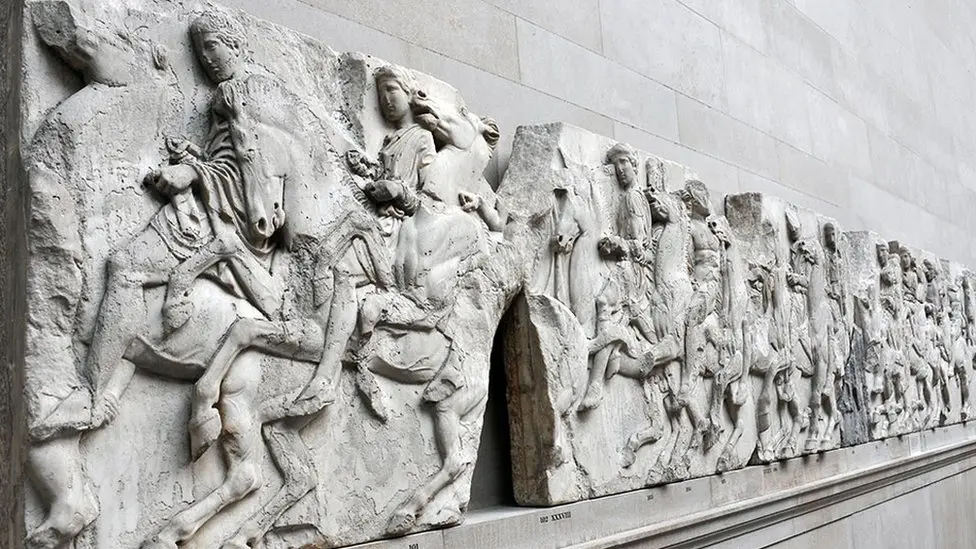
The dispute centres on sculptures removed from the Parthenon more than two centuries ago by Lord Elgin, a British diplomat who served as ambassador to the Ottoman Empire when Athens was under Ottoman rule. The sculptures, which include significant sections of the Parthenon’s architectural decoration, were later acquired by the British government and transferred to what is now the British Museum.

The Parthenon itself dates back around 2,500 years and was constructed on the Acropolis in Athens during the height of ancient Greek civilisation. Its sculptural decoration is traditionally associated with the workshop of Phidias, one of the most celebrated sculptors of classical Greece. The surviving fragments of the monument are now divided between Greece and collections elsewhere, with a substantial portion held in London.
For Greece, the division of the sculptures represents an unresolved cultural issue that goes beyond the normal movement of museum objects between countries. Greek governments have repeatedly argued that the sculptures were removed under circumstances that did not amount to legitimate ownership and that their continued separation from the monument prevents the complete presentation of one of the world’s most significant ancient architectural ensembles.
Britain and the British Museum have maintained a different legal position. The museum has said that it acquired the sculptures lawfully and that it has a responsibility to preserve and display objects in its collection. British law also places restrictions on the permanent disposal of objects held by the British Museum.
The legal framework is one of the central obstacles to a permanent transfer. The British Museum Act 1963 limits the circumstances in which the institution can dispose of objects from its collection. Previous discussions about the marbles have therefore focused on whether a solution could be constructed through a long-term cultural agreement rather than through a conventional permanent transfer of ownership.
The latest disagreement has been influenced by a proposal involving the Bayeux tapestry. France recently loaned the historic tapestry to the British Museum for a temporary exhibition, and British Museum director Nicholas Cullinan suggested that the arrangement demonstrated how international cultural partnerships could provide a possible model for other disputed objects.
Mitsotakis has rejected that comparison. He argues that the Parthenon sculptures are fundamentally different because they form part of a monument that remains standing in Athens. A significant section of the frieze is already displayed in Greece, while other pieces are held in London. In his view, treating the sculptures as independent objects available for periodic loans would fail to address the central issue of reunification.
The Greek prime minister has used the Bayeux tapestry comparison to underline his position. The tapestry is a single continuous work, and its temporary movement between countries does not involve separating it permanently between different institutions. The Parthenon sculptures, by contrast, were created as part of a larger architectural and artistic composition.
Mitsotakis has said Greece would be prepared to work towards a broader cultural partnership with Britain if an agreement on the sculptures could be reached. Such cooperation could include exhibitions, academic research, conservation projects and exchanges between Greek and British museums.
For Athens, that broader partnership could offer a way to transform a decades-old dispute into a new period of cultural cooperation. Instead of treating the return of the sculptures as the conclusion of the relationship, Greece has suggested that reunification could become the starting point for closer collaboration between museums and cultural institutions in both countries.
The possibility of an agreement remains uncertain. Reports have suggested that talks between the British Museum and the Greek government have faced difficulties and could be close to breaking down. People familiar with the discussions have disputed the suggestion that negotiations are about to collapse, while acknowledging that substantial differences remain between the two sides.
The British Museum has indicated that its position has not fundamentally changed and that it remains open to reaching a suitable agreement with Greece. At the same time, previous statements from British museum officials have made clear that negotiations do not necessarily involve changing the underlying law governing the institution’s collection.
George Osborne, the former British chancellor who became chair of the British Museum, confirmed several years ago that discussions with Greece were taking place. He also indicated that he was not seeking to amend the law that restricts the museum’s ability to permanently dispose of objects.
One idea previously discussed involved the sculptures being displayed in London and Athens at different periods, potentially alongside the exchange of other Greek antiquities. Such an arrangement could allow visitors in both countries to see important works while avoiding an immediate legal dispute over permanent ownership.
However, the ownership question remains central to Greece’s position. Mitsotakis has now stated explicitly that Athens would not accept an agreement that required it to acknowledge British Museum ownership of the sculptures. This condition significantly narrows the range of possible arrangements that could satisfy both parties.
The debate also has a wider significance for museums around the world. Many major cultural institutions hold artefacts acquired during periods of empire, colonial expansion or unequal political relationships. Governments and cultural organisations increasingly face demands for the return of objects whose histories of acquisition are disputed.
The Parthenon marbles have become one of the most prominent examples of that debate. Supporters of their return argue that cultural objects should be reunited with the monuments and societies from which they originated. Museums holding disputed artefacts often emphasise their role in preserving objects, making them accessible to international audiences and maintaining collections that represent different cultures.
The issue therefore involves questions of history, law, cultural identity, museum practice and international diplomacy. Neither side has accepted the other’s fundamental position on ownership, but the continuation of dialogue indicates that there remains an interest in finding a practical arrangement.
For Greece, reunification in Athens remains the stated objective. Mitsotakis has suggested that political leadership could create an opportunity to resolve a dispute that has continued for generations. He has also presented the issue as an opportunity for Britain and Greece to develop a new cultural relationship rather than remain defined by disagreement over the sculptures.

For Britain, any agreement would have to operate within the legal responsibilities of the British Museum and the existing position concerning its collection. That means negotiations are likely to require considerable diplomatic and legal creativity if both sides are to reach an arrangement that satisfies their respective concerns.
The next stage of discussions could therefore be crucial. If the two sides can narrow their differences over ownership, display and the legal structure of any agreement, the Parthenon marbles could become the centrepiece of a new cultural partnership between Greece and Britain. If those differences remain unresolved, the sculptures are likely to continue to be divided between Athens and London.
After more than two centuries of controversy, the future of the Parthenon marbles remains closely tied to the willingness of both countries to find common ground. Greece has made clear that it wants reunification rather than a simple loan, while the British Museum continues to indicate that it is open to a negotiated solution. Whether those positions can ultimately be reconciled will determine whether the latest diplomatic effort becomes another chapter in the dispute or a pathway towards a historic cultural agreement.
Related News:
 British Man Faces Deportation Threat in Sweden
 Bayeux Tapestry Revives Franco-British Ties
 British widow says deportation from Sweden feels like a death sentence
 Escobar’s Hippos May Be Moved to India Zoo
 China Fireworks Factory Blast Kills 21 in Hunan
 Ceasefire Standoff Deepens in Ukraine War
 France Faces Record Presidential Crowded Race Amid Far-Right Surge
 Sycamore Gap Artwork Chosen After Public Vote
 Pope Meets Families in Italy Toxic Waste Zone
 Farage and Reform UK Reshape British Politics
 Starmer Leadership Under Pressure After Setbacks
 Deadly Russian Air Raids Strike Across Ukraine
 UK Nations Brace for Potential Breakup Amid Reform Surge
 Dreyfus Statue Finally Gets Permanent Paris Home
 England and Norway Fans Turn Miami Into World Cup Carnival
 Five Years of Taliban Rule Leave Afghanistan in Crisis
 Australia Races to Find Tourists Missing in Nepal
 British Museum Faces Questions Over Peter Thiel’s Private Bayeux Viewing
 Nepal Flood Survivors Face Unimaginable Loss
 Green Leader Targets Starmer’s Former Seat
 Nepal Tunnel Rescue Offers Hope Amid Flood Devastation
 Masked Protesters Bring Dover Port Traffic to Standstill
 Renoir Museum hit by €9m art theft on French Riviera
 Australia gives users control over social media algorithms
 Europe’s democracies face a growing far-right threat
 Lib Dems Prepare for Election Amid Reform Challenge
 Middle powers seek new alliances amid Trump era
 Briton Faces Cyprus Court Over Son’s Fatal Fall
 King Refers Jamaica Slavery Petition to Privy Council
 Roman Finds Reveal Bath’s Suburban Past
 Just Stop Oil Protesters Convicted Amid Climate Defence Row
 Palace May Restore Hyphen to Andrew Mountbatten-Windsor’s Name
 Royal Navy Shadows Russian Warships Entering the Channel
 Starmer Condemns ‘Depraved’ Russian Strikes on Ukraine
 Trump Tariffs Threat Spark UK and EU Alarm
 Iranian Australian community divided after vigils
 UK Rescue Flight Delayed Amid Middle East War
 Gordon Brown urges court for crimes against children
 Rising Costs Force Families to Rethink Days Out
 Teen Admits Filming Westfield Chair Prank
 Army Probes Apache Flyover at Kid Rock’s Nashville Estate
 Relationship with Trump may be beyond repair, Starmer warned
 Italian Town Buys Mussolini Villa to Keep Away Fascist Fans
 UK Stands Firm on Falklands Amid US Rift
 Unveiling Hidden Masters: Female Artists Take Centre Stage
 Greens Face Internal Row Over Antisemitism Claims
 RFU Backs Borthwick Despite England’s Poor Six Nations
 Barrister Criticises Trial After Suicide Case Verdict
 US Awaits Iran Reply on New Ceasefire Proposal
 Fear and Betrayal: The Chilling Case of Kouri Richins
 Maldives Cave Diving Tragedy Raises Safety Alarm
 Cannes filmmakers split over AI’s role in cinema
 Discontent grows around Putin amid war strain
 Papal Visit Offers Political Lifeline to Spanish Premier
 Britain’s Crowning Butterfly Takes the Nation by Storm
 British Teens in EU Face Soaring UK University Fees
 Le Pen to Run for President Despite Embezzlement Conviction
 UK Schools Struggle as Classrooms Top 40C
 London Tube Heat Reaches Dangerous Levels
 Olympus Awaits Unesco Heritage Recognition
 Houthis Strike Saudi Arabia as Middle East Tensions Rise
 Wildfires Force Mass Evacuations in France And Spain
 Powerful 7.7-Magnitude Earthquake Hits Eastern Indonesia
 Westminster Council Threatens Charing Cross Soup Kitchen
 Burnham unveils £65m drought aid for farmers
 Former Diplomats Urge UK and France to Act on Palestine
 Queue row erupts on Wales’ highest mountain
 Ghent Professors Questioned Cofnas Appointment
 RAF Barnham Protests Fuel Tensions in Norfolk Town
 Ukraine Villagers Demand Answers After Deadly Arms Depot Strike
 UK Subsidence Claims Surge After Record-Breaking Summer
 UK plans tougher Israel stance with settlement trade ban
 Sweden Election Hangs on Far-Right Breakthrough
 Royal Crown Branded Enslaved Africans in Britain’s Slave Trade
 UK Retailers Accused of Breaking Refund Laws
 Mahmood Warns Far Right Over Asylum Protests
 UK Rent Gap Puts Low-Income Families Under Pressure
 Headteachers Warn New Ofsted System Is Harming Wellbeing
 Tropics May Wait Longest for Net-Zero Climate Benefits
 Trump gives Xi red-carpet welcome as trade truce extends