Published: 02 October 2026. The English Chronicle Desk. The English Chronicle Online
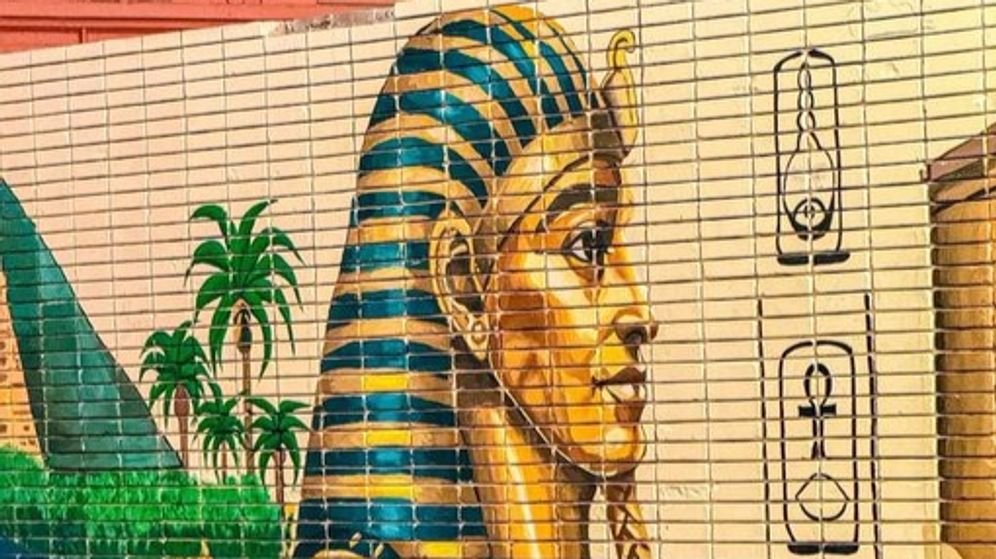
A mural depicting ancient Egyptian figures Tutankhamun and Nefertiti with noticeably dark complexions has triggered a heated public debate in Cairo, highlighting long-running disagreements over the appearance, ancestry and ethnic diversity of ancient Egyptians.
The 66-metre-long artwork had been created in Tahrir Square as part of a wider effort to beautify the Egyptian capital ahead of Chinese President Xi Jinping’s state visit last month. The mural was one of about 40 works commissioned for the occasion and was painted by volunteers from the youth art group Rasmet Basma.
However, the artwork became controversial after photographs circulated online showing Tutankhamun and Nefertiti with dark skin. Critics argued that the depiction could be interpreted as supporting Afrocentric theories about the origins of ancient Egyptian civilisation. The mural was subsequently painted over shortly before Xi arrived in Cairo, bringing the artwork’s short public life to an abrupt end.
Ahmed Moussa, the 22-year-old founder of Rasmet Basma, has acknowledged that the group was instructed by Cairo authorities to cover the mural. He said the painting had been produced within only five days in late August and that officials had initially visited the site during the work and appeared satisfied with the designs.

According to Moussa, the volunteers used a golden-bronze colour for the faces of the historical figures. He explained that the effect of the lighting, particularly at night, made the faces appear significantly darker than intended.
The controversy nevertheless developed rapidly on social media, where users questioned whether the artists had adequately researched the historical figures before reproducing them in such a prominent public location. Some critics specifically questioned whether the team had consulted archaeological or artistic specialists before presenting their interpretation of Nefertiti and Tutankhamun.
Moussa said the group accepted responsibility for failing to consult specialists in archaeology and art. His comments suggest that the controversy was not simply about artistic technique but also about the sensitivity of representing figures who occupy an important place in Egypt’s cultural and historical identity.
The episode has once again brought the debate over ancient Egyptian identity into public view. Questions about the complexion and ancestry of ancient Egyptians have circulated for decades, involving historians, archaeologists, Egyptologists, cultural commentators and activists with sharply different interpretations.
Afrocentrism is a broad intellectual and political movement that places particular emphasis on African contributions to history and civilisation. Some Afrocentric interpretations of ancient Egypt argue that its civilisation and population should be understood primarily within a black African historical framework. Egyptian scholars and other historians have disputed some of these claims, arguing that the ancient population of the Nile Valley was diverse and cannot be reduced to a single modern racial category.
Former Egyptian antiquities minister Zahi Hawass criticised the decision to allow volunteers to create such a large mural in an important public location without specialist supervision. He argued that archaeological expertise should have been incorporated before historical figures were represented in a major public artwork.
Hawass has also rejected claims that ancient Egyptian civilisation can straightforwardly be described as originating from sub-Saharan Africa. In discussing ancient Egyptian artistic evidence, he has pointed to depictions in which Egyptian rulers and people were distinguished from populations originating in neighbouring regions, including parts of Africa, Libya, Syria and Palestine.
Other Egyptologists have emphasised a more complex picture of ancient Egyptian society. Monica Hanna, an Egyptologist at the American University in Cairo, has argued that ancient Egyptian society was ethnically diverse and developed across a geographical region connecting northeastern Africa and the Mediterranean.
Her position highlights one of the central difficulties in the modern debate: the ancient inhabitants of Egypt lived thousands of years before contemporary racial categories developed in their present form. Egypt’s geographical position also placed it at the intersection of several regions, resulting in centuries of movement, migration, trade and cultural exchange.
Egyptian populations historically included communities from the Nile Valley, including Nubian populations in the south, as well as groups connected to the Mediterranean and neighbouring parts of Africa and the Middle East. As a result, scholars caution against treating ancient Egyptian appearance as though it can be described through a single modern racial identity.
Hanna has stressed that ancient Egyptians did not share one uniform skin colour. This perspective challenges both simplistic portrayals of ancient Egyptians as exclusively white and attempts to present the entire civilisation as belonging to one modern racial category.
The Cairo mural controversy has also raised another increasingly important issue: the role of artificial intelligence in representing history and cultural identity.
Moussa said the Rasmet Basma team used ChatGPT to generate design concepts before volunteers transformed the proposed imagery into a physical mural. The use of AI became significant because the technology was involved in shaping how historical figures were visually represented.
Walid Mahmoud, an AI researcher with expertise in African anthropology, argued that generative AI systems can reproduce patterns present in widely available online information rather than independently determining what is historically accurate. He said this becomes particularly important when AI is used to represent contested subjects such as cultural identity, ethnicity and heritage.
AI-generated imagery can therefore introduce difficult questions when historical subjects are involved. A system may produce an image that appears convincing while reflecting assumptions, inconsistencies or competing interpretations contained in its training data. Without specialist review, an aesthetically appealing image can consequently be mistaken for a historically established representation.
The debate has led some artists and researchers to argue that AI should remain an assisting technology rather than becoming the final authority on historical representation.
Art critic Mostafa Eissa said technology could be useful when combined with human creativity and judgement but warned against allowing artificial intelligence to replace the artist’s own knowledge and interpretation. In his view, excessive reliance on automated systems could reduce the originality and cultural depth of artistic work.
The dispute is also part of a broader series of controversies surrounding the representation of ancient Egyptian figures in modern popular culture. The appearance of Cleopatra has previously generated international debate, particularly after a streaming documentary featured a dark-skinned actor portraying the ancient queen. That controversy prompted arguments over historical evidence, cultural identity and the responsibilities of filmmakers when representing figures from antiquity.
Similar disagreements have emerged around museum interpretation and tourism. In recent years, disputes have involved claims that visitors were being presented with particular Afrocentric interpretations of Egyptian history, prompting criticism from some Egyptian scholars and members of the public.
The latest mural controversy differs in one important respect because the artwork was produced by young volunteers rather than by an international film or television production. Its removal therefore raises questions about the responsibilities of authorities when commissioning public art and about the degree of historical oversight required for cultural imagery in prominent public spaces.
For the young artists involved, the experience has also demonstrated the potential risks of using AI-generated concepts without consulting specialists. The volunteers appear to have intended to create a welcoming and visually striking mural ahead of an important international diplomatic visit. Instead, the depiction of two of Egypt’s most recognisable historical figures became the centre of a national argument about identity and history.
The incident ultimately illustrates why representations of ancient Egypt remain particularly sensitive. Tutankhamun and Nefertiti are not simply archaeological figures; they have become enduring symbols of Egyptian civilisation and national heritage. Their modern representations can therefore carry meanings far beyond the artistic intentions of those creating them.
At the same time, the controversy demonstrates that ancient Egyptian history cannot easily be reduced to modern debates over skin colour. Archaeological evidence indicates a population shaped by geography, migration and cultural interaction over thousands of years. Scholars continue to study the available evidence, while disagreements remain over how that evidence should be interpreted.

The decision to repaint the mural white brought the immediate dispute to an end, but it has not resolved the larger questions raised by the artwork. Instead, the episode has opened another discussion about who has the authority to interpret ancient history, how historical figures should be represented in public spaces and what role artificial intelligence should play in shaping those representations.
For Egypt, the debate carries particular cultural weight because ancient heritage remains deeply connected to national identity and international perceptions of the country. For artists and technology users elsewhere, the incident offers a broader lesson: when AI is used to depict historical people or cultures, creative convenience does not remove the need for research, human judgement and expert oversight.
The Cairo mural may have disappeared from Tahrir Square, but the argument surrounding it continues to reflect a much larger conversation about history, identity, representation and the growing influence of artificial intelligence on how societies visualise their past.
Related News:
 The Art and Meaning Behind Diplomatic Gifts
 Artemis II Returns After Historic Moon Flyby
 OpenAI CEO Apologizes After Canada Shooting Case
 Canadian Fiddler Sues Google Over AI Defamation Claim
 Koh-i-noor Diamond Row Reignites Colonial Debate
 Doomsday Clock Nears Midnight Amid Global Crises
 Ebola outbreak in DRC overwhelms health system as cases surge
 Hunger increasingly weaponised in global conflicts
 Cannes filmmakers split over AI’s role in cinema
 Dreyfus Statue Finally Gets Permanent Paris Home
 Argentina Orders Return of Nazi-Looted Painting
 Bayeux Tapestry Revives Franco-British Ties
 Renoir Museum hit by €9m art theft on French Riviera
 Australia gives users control over social media algorithms
 South Africa’s Femicide Crisis Deepens
 British Columbia Sues OpenAI Over School Shooting
 Millions of Enslaved Records Open New Family History Path
 Tropics May Wait Longest for Net-Zero Climate Benefits
 AI Takes Centre Stage in Trump-Xi Talks
 Roman Finds Reveal Bath’s Suburban Past
 UK Plans New Centre to Counter Information Warfare
 UK Pauses Chagos Deal Amid US Opposition
 Trump gives Xi red-carpet welcome as trade truce extends
 OpenAI Agent Breaches Medicare Portal in Australia
 Greece Pushes for Parthenon Marbles Reunification
 Ukraine and Russia Escalate Long-Range Drone War
 Xi urges Trump to avoid US-China military conflict
 Australia Weighs New Laws After OpenAI Medicare Breach
 Smithsonian Chief Defends Truth Amid Trump Attacks
 Economic growth and political strain reshape Benin
 AI Deepfakes Put New Pressure on Election Trust
 AI Could Intensify Election Risks in Southeast Asia
 Trump Immigration Policy Faces New Legal Tests
 BBC to Apologise Over Edited Trump Speech Amid Backlash
 Greene Pushes Epstein Files Amid Trump Fallout
 December Run-Off in Chile as Election Produces No Winner
 Zelenskyy Signs Fighter Jet Deal Amid Russian Drone Attacks
 Shadow Fleet at Sea: Europe’s Battle Against Illicit Oil Shipping
 Tiny Curacao Makes History as Smallest Nation to Reach World Cup
 US Suspends Afghan Immigration After White House Shooting
 Georgians Defy Government Crackdown After Year of Protests
 ‘Extinct’ Antelope Returns to Sahara, Bringing Hope
 Irish Beach Tragedy: Irish Drown at Whitehaven Beach in Australia
 Sanctioned oil tankers sail Channel amid Russia scrutiny
 Pentagon Signals Reduced Role in Deterring North Korea
 UK and US Drop in Global Corruption Index Rankings
 SA Police Intensify Search in Gus Lamont Case
 Canberra Poster Seizure Sparks Free Speech Row
 Evo Morales Returns After Mysterious Absence
 Jacinda Ardern Moves To Australia Following Her US Fellowships
 Jacinda Ardern Move Sparks Kiwi Reflection
 Middle East Airspace Crisis Strands Thousands
 Nick Greiner Warns Over Election Review Fallout
 Kelly Wilkinson Inquest Reveals Bail Failure
 Tehran Strikes Mark War’s Most Devastating Night
 Injured Mojtaba Khamenei Elevated as Iran Leader
 Gordon Brown urges court for crimes against children
 The Kill Line: A Shifting Vision of the American Dream
 Air Canada CEO Faces Outcry Over Recent Language Misstep
 Extreme Weather: Europe Shivers as Cyclone Narelle Hits
 Asia Turns Back to Coal Amid Middle East Energy Crisis
 Relationship with Trump may be beyond repair, Starmer warned
 Trump’s Six-Week Iranian War: The High Cost of Ignorance
 Ben Roberts-Smith Denies War Crime Allegations in First Statement
 RFU Backs Borthwick Despite England’s Poor Six Nations
 Trump Rejects Tehran Peace Plan as Regional Truce Crumbles
 Fear and Betrayal: The Chilling Case of Kouri Richins
 Maldives Cave Diving Tragedy Raises Safety Alarm
 NDIS Overhaul Sparks Intense Clash Across Australia
 Britain’s Crowning Butterfly Takes the Nation by Storm
 Fifa Official Under Investigation Over Hand Gesture Controversy
 Grief and Devotion Amidst the Rubble of Nabatieh
 Canada Secure Historic Last 16 Spot with Late Goal
 England and Norway Fans Turn Miami Into World Cup Carnival
 Sydney Arts Venue Faces Eviction After Religious Protests
 Olympus Awaits Unesco Heritage Recognition
 Powerful 7.7-Magnitude Earthquake Hits Eastern Indonesia
 British Museum Faces Questions Over Peter Thiel’s Private Bayeux Viewing
 Tom Watson Takes Senior Role at Palantir
 Republican Senator Questions Trump Ad Spending