Published: 26 September 2026. The English Chronicle Desk. The English Chronicle Online
Diplomatic gifts can be much more than ceremonial objects exchanged between political leaders. They can represent friendship, historical memory, cultural identity, strategic interests and, at times, carefully calculated political messages. From France’s monumental Statue of Liberty to China’s famous tradition of giving giant pandas, gifts exchanged between nations have long been used to communicate ideas that may extend far beyond the value of the objects themselves.
The tradition has deep historical roots. Powerful rulers once exchanged elaborate presents to demonstrate wealth, strengthen alliances, acknowledge victories or establish relationships with foreign courts. In the modern era, the scale of diplomatic gifts has generally become more restrained, but the underlying principle remains: a carefully selected object can communicate something about the country giving it and the relationship it hopes to build.
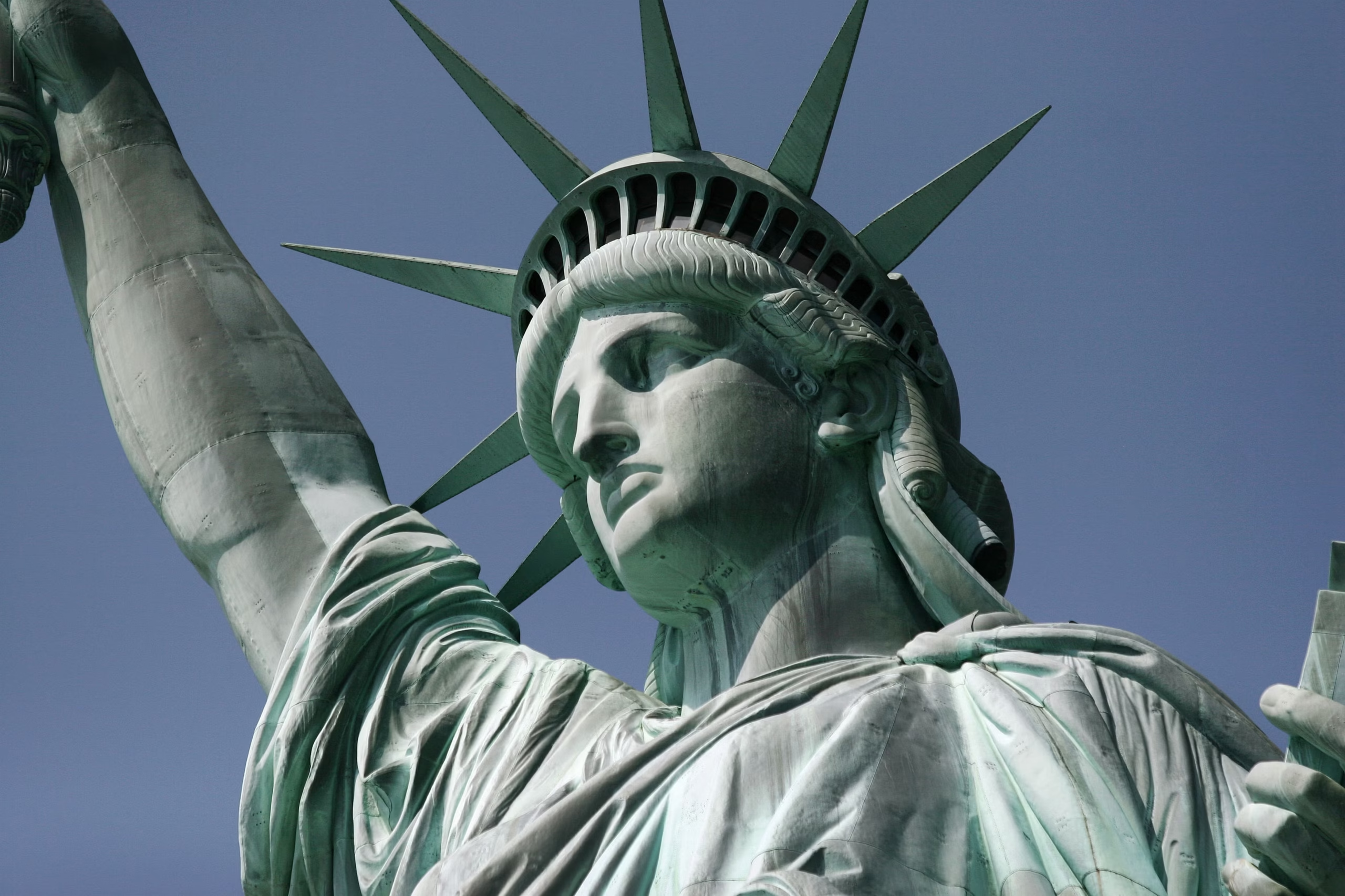
Few examples illustrate the power of such symbolism better than the Statue of Liberty. Created in France and presented to the people of the United States in the late 19th century, the enormous neoclassical sculpture was conceived as a representation of liberty and friendship between the two countries. Its original name, Liberty Enlightening the World, captured the broader political message behind the project.

The statue was intended to commemorate the centenary of the American Declaration of Independence. Yet its symbolism also carried a distinctly French dimension. Its supporters hoped the monument would reinforce Franco-American relations while expressing ideas about political liberty that were particularly significant in France at the time.
The project was associated with French politician Édouard Laboulaye and sculptor Frédéric Auguste Bartholdi. Laboulaye had proposed the idea during a dinner at Versailles in 1865. Bartholdi, meanwhile, was already interested in monumental sculpture and had previously developed a concept for a giant lighthouse in the form of an Egyptian woman carrying a torch at the entrance to the Suez Canal.
The Statue of Liberty project developed over many years. Construction eventually took place in France, with the completed statue transported in sections to the United States before being assembled in New York. When it was finally inaugurated in 1886, it became a physical expression of the relationship between France and the United States.
Its importance has grown considerably since then. The statue is now recognised around the world as a symbol of freedom, migration and the United States itself, while its origins as a French diplomatic gesture are sometimes less prominent in popular understanding.
A major exhibition at Paris’s Musée d’Orsay is now drawing renewed attention to Bartholdi and the history behind his most famous creation. Featuring around 100 works, the exhibition explores the sculptor’s career and the artistic, political and international dimensions of the Statue of Liberty project.
Diplomatic gifts do not always need to be enormous to make an impression. China’s use of giant pandas is perhaps the most famous modern example of a living diplomatic gift. After US President Richard Nixon visited Beijing in 1972, China sent two pandas, Ling-Ling and Hsing-Hsing, to the United States. The exchange helped create what became known as “panda diplomacy”.
The pandas quickly became a public attraction in Washington, drawing enormous crowds and helping create a new point of contact between American citizens and a country with which the United States was beginning to establish a dramatically different relationship.
The tradition has continued in different forms. In 2026, Chinese President Xi Jinping again used pandas as a symbol of friendship by sending two animals to Atlanta. During a state dinner for Xi, US President Donald Trump presented the Chinese leader with a sculpture depicting a bald eagle, the national symbol of the United States.
Such exchanges demonstrate how diplomatic gifts can be designed around national symbols. The panda has become closely associated with China’s international cultural diplomacy, while the bald eagle represents American national identity. Neither object needs a lengthy explanation to communicate the basic message.
Elsewhere, diplomatic gifts have been used for more explicitly political purposes. North Korea’s International Friendship Exhibition houses an enormous collection of presents given to former leaders Kim Il-sung and Kim Jong-il. The collection includes objects from governments, political figures and prominent individuals around the world.
The exhibition serves not merely as a display of unusual objects but as part of a broader political narrative. The accumulation of gifts is presented as evidence of international respect and relationships, helping communicate a message of legitimacy to a population with limited access to outside information.
Other diplomatic gifts have been remembered for very different reasons. In 2009, then-British Prime Minister Gordon Brown presented US President Barack Obama with a specially made pen holder using timber from a Royal Navy ship associated with Britain’s campaign against the transatlantic slave trade. Obama, in return, gave Brown a collection of DVDs featuring films selected from the president’s favourites.
Another gift from the same period became famous because of an embarrassing translation error. During an attempt to signal an improvement in relations between the United States and Russia, US Secretary of State Hillary Clinton presented Russian Foreign Minister Sergei Lavrov with a symbolic button labelled with a Russian word intended to mean “reset”. Instead, the translation conveyed a different meaning, creating an awkward diplomatic moment.
The problem of choosing an appropriate gift is not restricted to national leaders. Former British diplomat Peter Ricketts has described ministerial gifts as particularly complicated because of rules governing the acceptance and declaration of presents. High-value objects can create administrative obligations or raise questions about whether a politician should keep them personally.
At the highest level of diplomacy, however, gifts can be more carefully designed to create a lasting impression. Ricketts has pointed to examples involving the British royal family, where gifts have sometimes combined personal relevance, historical significance and national symbolism.
King Charles has previously presented Trump with a brass bell associated with the Second World War submarine HMS Trump. The object combined a connection to British history with an unusually personal association, making it distinct from a generic ceremonial gift.
Queen Elizabeth II also had a reputation for selecting personal presents. During French President Valéry Giscard d’Estaing’s 1976 state visit to Britain, she gave him a black Labrador puppy. The personal nature of the gift helped distinguish it from conventional diplomatic objects.
Royal collections demonstrate the extraordinary variety of gifts that can accumulate over generations. Queen Elizabeth II received unusual presents ranging from an elaborate grasshopper-shaped wine cooler from France to gifts from communities with highly distinctive cultural traditions.
Some diplomatic gifts have involved animals on a much larger scale. In 1826, Muhammad Ali, the ruler of Egypt, sent a giraffe named Zarafa to French King Charles X. The animal became a public attraction in Paris and remained there for many years.
A camel presented to French President François Hollande during a 2013 visit to Mali had a less fortunate story. The animal was left with a family in Timbuktu for safekeeping but was later slaughtered and eaten. Mali subsequently promised to replace it with another camel.
Not every successful diplomatic gift is connected to an immediate political event. Some have become enduring examples of what is often described as soft power. In 1912, Tokyo donated thousands of cherry trees to Washington DC. The trees became an important part of the city’s landscape and remain closely associated with the relationship between Japan and the United States.
Other traditions have similarly survived for generations. Norway has sent a Christmas tree to London each year since 1947, commemorating Britain’s welcome to Norway’s government during the Second World War. The Netherlands has also maintained a tradition of sending tulip bulbs to Canada, reflecting Canada’s role in providing refuge to members of the Dutch royal family during the war.

These examples show why diplomatic gifts can have a life well beyond the ceremony in which they are exchanged. The most enduring gifts become part of public memory, cultural landscapes or national stories.
Choosing such a gift is therefore rarely simply a matter of selecting something expensive. The object may need to reflect history, culture, personal interests, national identity or the particular relationship between two countries. A successful gift can communicate friendship without requiring a formal speech, while a poorly chosen one can create confusion or embarrassment.
The history of diplomatic gifts ultimately reveals an unusual aspect of international relations: sometimes a carefully selected object can carry a message that words cannot. Whether it is a monumental sculpture, a pair of pandas, a national symbol, a historic artefact or a collection of plants, the meaning of the gift often depends on the story surrounding it.
That is why diplomatic gift-giving remains an intricate art. Governments change, political relationships evolve and international tensions rise and fall, but symbolic objects can survive for decades or even centuries, continuing to tell the story of how one country once wanted to be seen by another.
Related News:
 Argentina Orders Return of Nazi-Looted Painting
 US Citizens Warned to Venezuela Flee Amid Paramilitary Threats
 Gulf states warn Trump Iran strikes risk wider Middle East war
 Machado Trump medal gesture reshapes Venezuela power struggle
 Gulf states warn Trump Iran strikes risk wider Middle East war
 Iran unrest slows under brutal crackdown and global tensions
 Thousands Protest ICE Operations in Nationwide US Day of Action
 Epstein Files Reveal Trump Officials’ Emails with Financier
 Thousands Protest ICE in New York Against Trump Deportation Campaign
 Sydney Protest Pepper Spray Clash During Herzog Visit
 Cuba Kills Exiles in Speedboat Attack from US Waters
 Yvette Cooper: UK Must Follow Principles, Not US Pressure
 Washington Enlists Musk to Battle Global Hostility Online
 Macron Urges Stability as Trump Jolts Nato and Iran
 Trump Address Sparks Global Backlash Over Iran War Tactics
 Trump Sets Tuesday Deadline for Iran to Reopen Vital Strait
 Ben Roberts-Smith Arrested Over Alleged War Crimes
 Trump and Tehran Find Common Ground in Landmark Ceasefire
 Reeves Slams Trump Over Iran War Lack Of Exit Plan
 US and Iran Pursue Extension of Ceasefire via Pakistan
 Mexico, Spain and Brazil call for Cuba dialogue amid crisis
 Ukraine Urges UK to Seize Russian Oil Tankers
 US Calls Australia Media Law “Foreign Extortion”
 Oil Prices Surge Above $120 Amid Iran Blockade Fears
 Tragic End to Search for Missing Girl in Alice Springs
 Questions Remain Over The Tragic Bondi Massacre
 Trump orders US troop pullout from Germany
 Activists allege abuse after Gaza flotilla seizure
 Ukraine strikes Tuapse as oil disaster worsens
 Japan Protests Erupt Over Plans to Revise Constitution
 Australia pushes Pacific security pact amid China tension
 Koh-i-noor Diamond Row Reignites Colonial Debate
 The Burning Lens: An Iranian Artist’s Visual Resistance
 Middle East Crisis Escalates as Oil Routes Shake Markets
 FIFA Confirms Global Ban for Benfica Star Prestianni
 New South Wales Wetland Rescue Legislation Passes
 Tensions Emerge in Netanyahu-Trump Alliance
 US and Mexico Face Heatwave as Floods Batter South Africa
 The Long Way Home: Australia’s High-Stakes Virus Mission
 Trump Warns Iran Ceasefire Is Now on Life Support
 Putin Signals War End as Russian Momentum Stalls
 Fear and Betrayal: The Chilling Case of Kouri Richins
 Lee Lai Makes History with Landmark Stella Prize Victory
 Scepticism and tight security as Beijing braces for Trump
 UN Faces Crucial Vote on Landmark ICJ Climate Ruling
 US-Mexico Crisis: Cartel Allegations Push Ties to Brink
 Philippine Senator Flees After Days Under Senate Siege
 Solomon Islands Elects China Critic Matthew Wale as Leader
 Tragedy in the Maldives: Inside the Deep Sea Rescue
 US Ebola Case Sparks Urgent Global Screening Measures
 Xi Hosts Putin in Beijing Days After Landmark Trump Summit
 Fragile Truce Shattered as Violence Escapes Diplomatic Control
 The Hunt for Bato: Inside the Hunt for the Fugitive Senator
 Israeli Strikes in Lebanon Kill 10 Amid Ceasefire Strain
 Cannes filmmakers split over AI’s role in cinema
 Discontent grows around Putin amid war strain
 Former ICC prosecutor condemns US sanctions
 Bondi Tragedy Survivors Face Online Abuse After Inquiries
 Japan Suffers Plastic Shortage Due to Middle East Crisis
 Aukus Deal Facing Fierce Backing and Historic Criticism
 Thai Princess Bajrakitiyabha Passes Away at 47
 Sentenced to 30 Years: Former Leader’s Secret Drone Plot
 Kyiv Heritage Blazes After Night of Brutal Russian Strikes
 Grief and Devotion Amidst the Rubble of Nabatieh
 Canada Secure Historic Last 16 Spot with Late Goal
 Keiko Fujimori Claims Dramatic Victory in Peru Runoff
 Rotterdam Museum Honours Artist With Peanut Butter Floor
 Dreyfus Statue Finally Gets Permanent Paris Home
 Houthis Strike Saudi Arabia as Middle East Tensions Rise
 Russian Missiles Intensify Pressure on Kyiv
 Trump Calls Strait of Hormuz ‘American Territory’
 Former Diplomats Urge UK and France to Act on Palestine
 Trump Hardens Canada Trade Stance as Talks Stall
 Bayeux Tapestry Revives Franco-British Ties
 UN expert urges UK to rethink Israel policy
 Renoir Museum hit by €9m art theft on French Riviera
 Nearly 50,000 Flee as Houthis Advance in Yemen
 Roman Finds Reveal Bath’s Suburban Past
 Greece Pushes for Parthenon Marbles Reunification
 Smithsonian Chief Defends Truth Amid Trump Attacks