Published: 6 July 2026 | The English Chronicle Desk | The English Chronicle Online
Bangladesh is pursuing a careful diplomatic strategy aimed at strengthening its longstanding partnership with China while simultaneously rebuilding momentum in its relationship with neighbouring India, reflecting Dhaka’s broader commitment to maintaining balanced foreign relations amid intensifying geopolitical competition in Asia.
The approach has drawn increasing international attention as South Asia becomes a focal point of strategic rivalry between major regional powers. Rather than aligning exclusively with one partner, Bangladesh has continued to emphasise a foreign policy centred on economic development, regional cooperation and strategic autonomy, seeking to maximise opportunities with both Beijing and New Delhi without allowing relations with either country to deteriorate.
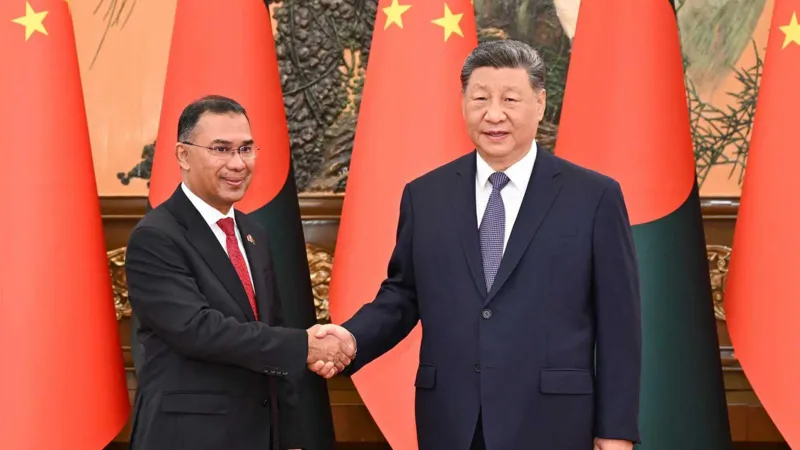
Recent diplomatic engagements, infrastructure cooperation and high-level meetings have illustrated Dhaka’s determination to deepen economic ties with China while also working to improve dialogue and practical cooperation with India following periods of political and diplomatic strain.
Government officials have consistently maintained that Bangladesh’s foreign policy is guided by national interests rather than geopolitical rivalry. They argue that maintaining constructive relations with all major partners is essential for supporting economic growth, trade, investment and regional stability.
China remains one of Bangladesh’s largest development and infrastructure partners.

Over the past decade, Beijing has financed or supported numerous large-scale infrastructure projects across Bangladesh, including bridges, highways, power generation facilities, industrial zones and port-related developments. Chinese investment has contributed significantly to the country’s efforts to modernise transport networks and expand industrial capacity as Bangladesh seeks to sustain its rapid economic growth.
Trade between the two countries has also expanded considerably.
China is among Bangladesh’s largest trading partners and an important source of machinery, industrial equipment, electronics and manufactured goods. Meanwhile, Bangladesh continues to seek greater access for its exports to the vast Chinese market, particularly garments, agricultural products and pharmaceuticals.
Officials in Dhaka view continued cooperation with China as an important component of their long-term development strategy.
At the same time, Bangladesh has taken visible steps to improve relations with India, recognising the importance of close cooperation with its largest neighbour.
The two countries share more than 4,000 kilometres of border, one of the longest international borders in the world, making bilateral cooperation essential in areas including trade, border management, water resources, connectivity, security and energy.
Recent diplomatic contacts have indicated a willingness on both sides to strengthen dialogue and address outstanding issues through peaceful negotiation.
Analysts note that Bangladesh and India have historically maintained complex but deeply interconnected relations.
Since Bangladesh gained independence in 1971, the two countries have cooperated extensively across multiple sectors while also experiencing periodic disagreements over issues such as river water sharing, border security, migration and trade imbalances.
Despite these challenges, economic cooperation has continued to expand.
India has become one of Bangladesh’s largest regional trading partners, with increasing investment in infrastructure, transport links and energy connectivity. Cross-border railway services, road transport projects and electricity cooperation have strengthened economic integration while facilitating greater movement of goods and people.
Regional connectivity initiatives remain central to both governments’ development priorities.
Improved transport networks linking Bangladesh with India, Nepal and Bhutan have the potential to enhance regional trade, reduce logistics costs and stimulate investment throughout South Asia.
Dhaka has repeatedly emphasised that stronger regional integration benefits all participating countries regardless of broader geopolitical competition.
Foreign policy experts argue that Bangladesh’s balanced diplomatic approach reflects changing realities across the Indo-Pacific.
As competition between China and India increasingly intersects with wider strategic interests involving the United States, Japan and other international partners, middle-sized countries are seeking to preserve flexibility rather than becoming drawn into great-power rivalry.
Bangladesh has consistently stated that it does not wish to choose between competing powers.
Instead, successive governments have promoted what they describe as a pragmatic foreign policy focused primarily on economic development, national sovereignty and mutually beneficial international partnerships.
This strategy enables Dhaka to pursue Chinese infrastructure investment while maintaining productive cooperation with India and expanding engagement with Western economies simultaneously.
Economic considerations remain a major factor behind this approach.
Bangladesh has emerged as one of Asia’s fastest-growing economies over the past two decades, driven by its globally competitive garment industry, expanding manufacturing sector, improving infrastructure and rising domestic consumption.
Maintaining strong international partnerships is widely regarded as essential for sustaining this growth.
Chinese investment contributes to infrastructure development and industrial expansion, while India offers important opportunities for regional trade, energy cooperation and cross-border connectivity.
Officials believe both relationships are complementary rather than mutually exclusive.
Security cooperation also remains an important element of Bangladesh’s regional diplomacy.
Dhaka continues working with India on counterterrorism, border management and efforts to combat cross-border crime. Simultaneously, Bangladesh maintains defence cooperation with several international partners, including China, reflecting its broader policy of diversified security relationships.
Defence analysts note that Bangladesh has historically sourced military equipment from multiple countries while avoiding excessive dependence on any single supplier.
This diversified approach aligns with its wider diplomatic objective of maintaining strategic balance.
International observers generally view Bangladesh as one of South Asia’s most successful examples of multi-vector diplomacy.
Rather than allowing geopolitical competition to dictate foreign policy, the country has sought to cultivate constructive relations with a wide range of international partners, including China, India, Japan, the European Union, the United States and Gulf nations.
Such diversification helps reduce economic vulnerability while expanding opportunities for trade, investment and technological cooperation.
Regional experts caution, however, that maintaining this balance may become increasingly challenging as strategic competition intensifies.
China continues expanding its influence through investment, infrastructure financing and regional economic initiatives, while India seeks to reinforce its traditional leadership role in South Asia through enhanced diplomatic and economic engagement.
Both countries recognise Bangladesh’s growing strategic importance due to its geographical location, expanding economy and access to the Bay of Bengal.
The maritime dimension has become increasingly significant as well.
The Bay of Bengal represents an important corridor for regional trade, energy transportation and maritime security. Consequently, infrastructure development, port modernisation and shipping connectivity have become central topics within Bangladesh’s discussions with both Beijing and New Delhi.
Business leaders in Bangladesh generally support balanced international engagement.
They argue that attracting investment from multiple partners encourages competition, improves infrastructure financing opportunities and supports continued industrial development.
Economists similarly note that diversified international relationships provide greater resilience during periods of global economic uncertainty.
For ordinary Bangladeshis, foreign policy decisions ultimately carry practical implications.
Improved infrastructure, increased employment, expanded export markets and enhanced regional connectivity all contribute directly to economic opportunity and rising living standards.
Government officials therefore continue emphasising that diplomatic partnerships should be evaluated according to their contribution to national development rather than geopolitical alignment alone.

As South Asia undergoes profound strategic transformation, Bangladesh appears determined to preserve its independent diplomatic course.
By strengthening cooperation with China while rebuilding momentum in relations with India, Dhaka is seeking to demonstrate that constructive engagement with multiple partners remains both possible and desirable.
Whether this balancing strategy can be sustained amid evolving regional competition will depend on continued diplomatic skill, economic pragmatism and careful management of relations with all major powers.
For now, Bangladesh’s foreign policy reflects a broader reality confronting many middle-income nations: navigating an increasingly competitive international landscape while keeping national development, regional stability and sovereign decision-making firmly at the centre of diplomatic priorities.
Related News:
 Japan Braces as Takaichi Begins New Term with Huge Mandate for Low‑Tax, Ultra‑Conservative Agenda
 Gulf Oil Shock Sends Global Economic Ripples
 Southeast Asia Turns to Russia Amid Energy Crisis
 US Awaits Iran Reply on New Ceasefire Proposal
 Hormuz Talks Near Critical Stage
 Xi Jinping to Make Rare North Korea Visit
 Modi’s London Visit Seals Historic UK-India Trade Pact Amid Global Tensions
 Rachel Reeves to lead UK trade push in Saudi Arabia amid rights debate
 Canada Passes Carney’s First Budget in Tight Parliamentary Vote
 India’s Labour Law Overhaul Sparks Fierce Debate
 After the Landslide: Can India Reset Ties with BNP Bangladesh?
 China Strikes at Japan’s Core — Will PM Takaichi Back Down?
 South Korea’s Ex-President Faces Death Penalty in Insurrection Trial
 US and Indonesia Finalise Deal to Cut Tariffs to 19%
 Kim Jong Un Reappointed as Ruling Party Chief
 What Now for Asia After Trump’s Tariffs Were Struck Down?
 Japan to Deploy Missiles on Island Near Taiwan by 2031
 Why Asian Firms Are Not Cheering Trump Tariff Ruling
 Why Asian Firms Are Not Cheering Trump Tariff Ruling
 Could Kim’s Teen Daughter Become North Korea’s Next Leader?
 Nepal Holds First General Election Since Gen Z Protests Toppled Government
 Nepal Election 2026: When Will We Get the Results?
 Iran War Raises Questions Over China’s Global Plan
 Sri Lanka Takes Control of Second Iranian Vessel a Day After US Sub Attack
 China Moves to Enshrine ‘Ethnic Unity’ Law
 Iran Rejects Ceasefire, Warns Trump With Chilling Message
 Nepal Election 2026: Balendra Shah’s Party Nears Historic Supermajority
 US Says 16 Iranian Mine Ships Destroyed in Hormuz
 Point-Blank Gunshot Misses Indian Politician
 Anti-Regime Iranians Turn Anger Toward Trump
 Sri Lanka Sets Weekly Shutdown to Save Fuel
 PM Seeks to Reassure Australians Over Fuel Supply
 Zelensky Looks to Gulf to Protect Him from Putin
 Iran Strikes Kuwaiti Desalination Plant, Killing Worker as ‘Water War’ Escalates
 Epic Fury: The Strategic Logic and Uncertain Horizon of the 2026 Iran War
 Nepal Gen Z Protests Succeed, Bangladesh Struggles
 Oil and Diplomacy: Russian Refineries Burn as Zelenskyy Secures Middle East Shield
 “A Perfect Storm”: UK Small Businesses Face Doubling Energy Bills as Iran War Rattles Markets
 A Bridge to Peace? Taiwan’s Opposition Leader Lands in China
 The $100 Billion Peace: Trump’s ‘Grand Bargain’ Ends Iran Conflict at a Staggering Cost
 ‘No Gas, No Food’: LPG Shortage Triggers Reverse Migration in Indian Metros
 The Great Chokehold: Why the Strait of Hormuz is the Epicenter of the 2026 Crisis
 Global Commerce Crisis: Cooper Demands Immediate, Toll-Free Access to Hormuz
 The Prediction Prohibition: White House Staff Barred from Betting on Political Markets
 Relief at the Pump: Irish PM Unveils €505m Package to Stem Fuel Crisis
 Diplomatic Deadlock: Lebanon Enters High-Stakes Border Talks with ‘No Cards to Play’
 Trump Slams UK Ties and Threatens To Rewrite Trade Deal
 The Fog of War and the Ticker Tape: Suspicious Trades Rile Washington
 High-Seas Seizure: US Navy Intercepts Iranian Cargo Ship in Gulf of Oman
 ‘Table of Surrender’: Tehran Vows ‘New Cards’ as Islamabad Peace Talks Teeter on Brink
 Brinkmanship in Islamabad: Tehran Vows ‘New Battlefield Cards’ as Ceasefire Wanes
 Resilience and Rupture: Why the Middle East Crisis is Succeeding Where Trade Wars Failed
 Red Lines in Ottawa: PM Carney Insists US “Won’t Dictate Terms” of Trade Review
 “Industrial-Scale Extraction”: White House Memo Accuses China of Mass AI Theft
 Return of the “Skiffs”: Threat Level Raised as Somali Pirates Seize Second Vessel in a Week
 The “Long Tail” of War: Minister Warns Economic Scarring Could Last Eight Months Post-Conflict
 US Calls Australia Media Law “Foreign Extortion”
 Capitalism ‘Suicidal’, Warns Petro at Climate Summit
 Crude Surge: Oil Hits Four-Year High as Trump Weighs “New Options” for Iran
 “The Art of the Withdrawal”: Trump Targets Germany Troops as Iran Row Boils Over
 “Grounded”: Beijing Implements Total Ban on Drone Sales Citing Capital Security
 The Coastal Crossroads: Santa Marta Caught at the Heart of the Global Energy Shift
 The $126 Spike: Oil Hits Four-Year High as Trump Weighs “Powerful” New Iran Strikes
 Trump Threatens UN Budget Cuts as US Pushes ‘Trade Over Aid’ Agenda
 Australia pushes Pacific security pact amid China tension
 BJP Sweeps West Bengal in Historic Breakthrough
 Norway Doubles Down on Oil and Gas for Europe Energy Security
 Beijing Becomes Centerstage for Global Diplomatic Ballet
 UK Pushes for New EU Goods Trade Deal
 Reeves Fights to Keep Treasury Role Amid Labour Turmoil
 Discontent grows around Putin amid war strain
 US House Votes to Curb Trump’s Iran War Powers
 Trump-Netanyahu Call Fuels Iran Talk Crisis
 Israeli Strikes Kill 11 in Gaza City
 Albania Protests Erupt Over Luxury Resort Plan
 Fuel and Supply Crisis Pushes Gaza Toward Collapse
 Xi Arrives in North Korea for Rare Summit
 Why Xi’s North Korea Visit Matters Now
 Drone Attacks Overshadow Russia Economic Forum
 China Missile Test Raises Pacific Security Concerns