Published: 18 September 2026. The English Chronicle Desk. The English Chronicle Online.
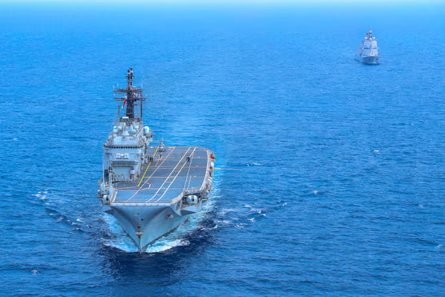
Indonesia has received its first aircraft carrier, marking a significant development in the country’s naval capabilities and opening a new debate over the cost, purpose and long-term usefulness of the vessel. The former Italian warship, the ITS Giuseppe Garibaldi, arrived at the Tanjung Priok naval base in North Jakarta on Friday morning and was welcomed with a military ceremony.
The 41-year-old vessel was retired by Italy in 2024 and subsequently offered to Indonesia as part of a broader effort by Rome to deepen defence cooperation with the south-east Asian country. The transfer is expected to expand Indonesia’s ability to conduct maritime operations, humanitarian missions and disaster response across its vast archipelago.
The ship, which can operate helicopters and aircraft capable of short takeoff and vertical landing, is expected to be formally commissioned into the Indonesian Navy next week under the name KRI Gajah Mada. The name refers to the famous 14th-century military leader of the Majapahit era, who is associated with efforts to unify territories across the Indonesian archipelago.
The arrival of the carrier makes Indonesia only the second country in south-east Asia to operate an aircraft carrier. Thailand was the first, commissioning the HTMS Chakri Naruebet in 1997 after acquiring it from Spain. Thailand’s carrier was designed to operate aircraft and helicopters, although questions have subsequently been raised about its operational use and the resources required to maintain it.

Indonesia’s decision to acquire the Garibaldi has generated considerable discussion among defence analysts, economists and opposition politicians. While the government has described the vessel as a tool for strengthening maritime security and responding to natural disasters, critics have questioned whether operating an ageing carrier represents an appropriate allocation of public funds.
The debate has been intensified by uncertainty over the total cost of the programme. Indonesia’s finance ministry approved $450 million in financing for the aircraft carrier programme in 2025. However, parliament member TB Hasanuddin of Commission I has warned that the cost of retrofitting the ship alone could reach 16 trillion rupiah, equivalent to about $900 million.
The difference between the approved financing and the potentially higher modernisation estimate has raised questions about how much Indonesia could ultimately spend on bringing the vessel into service and maintaining it over the longer term.
For the government, however, the carrier is not necessarily intended to perform the same role as the large nuclear- or conventionally powered aircraft carriers operated by major military powers. Indonesia has thousands of islands spread across a vast maritime area, and officials have presented the Garibaldi primarily as a mobile command and support platform.
The ship is expected to support helicopters, drones and other maritime operations while providing a platform from which Indonesian authorities can respond to emergencies in remote areas. President Prabowo Subianto has also linked the vessel to disaster management and environmental emergencies.
During a disaster-management meeting earlier this month, Prabowo said the carrier could be used to support efforts against forest and peatland fires, which regularly affect parts of Indonesia and neighbouring countries with smoke and hazardous haze. He said the vessel could accommodate up to 10 medium-sized helicopters and transport large quantities of water to areas experiencing extensive fires.
The proposed disaster-response role reflects Indonesia’s vulnerability to natural disasters. The country lies along the Pacific Ring of Fire and regularly experiences earthquakes, volcanic eruptions, floods, landslides and other emergencies. A large aviation-capable naval vessel could potentially provide logistical support when roads, airports or other infrastructure are damaged or inaccessible.
Prabowo has also outlined plans to operate drones from the vessel, potentially allowing the ship to serve as a mobile surveillance and coordination platform during military and humanitarian operations.
Italy’s decision to transfer the ship also has a broader strategic dimension. Rome has sought to strengthen defence ties with Indonesia and is interested in potential contracts involving submarines and aircraft. Giving Indonesia the Garibaldi also allows Italy to avoid some of the costs associated with decommissioning an ageing warship.
For Indonesia, the acquisition provides an opportunity to obtain a large aviation-capable vessel without purchasing a newly built aircraft carrier. Nevertheless, acquiring the ship is only one part of the challenge. Operating an aircraft carrier requires trained personnel, maintenance facilities, fuel, spare parts, aviation support, weapons systems and a broader network of ships and infrastructure.
These continuing expenses have become central to the criticism surrounding the programme. Indonesia is simultaneously facing fiscal pressures as the government funds major domestic programmes and attempts to expand defence capabilities.
President Prabowo has made military modernisation one of his administration’s priorities. His government has pursued plans involving submarines, frigates, fighter aircraft, missiles and expanded defence cooperation with several countries.
The carrier therefore forms part of a broader effort to strengthen Indonesia’s military capabilities. The question for analysts is how the vessel fits into the country’s overall maritime defence strategy.
Muhammad Fauzan Malufti of the Center for Strategic and International Studies said the acquisition should be determined by Indonesia’s actual operational requirements and its ability to sustain the ship rather than considerations of national prestige.
His concerns include not only the initial acquisition and refurbishment costs but also the continuing expense of keeping the vessel operational. An aircraft carrier requires a substantial supporting infrastructure, including personnel, maintenance systems, fuel supplies and other naval assets.
Fauzan also pointed to Thailand’s experience with the HTMS Chakri Naruebet as a potential lesson for Indonesia. The Thai carrier has spent significant periods in port, with operational and financial constraints affecting its use.
From this perspective, Indonesia faces a strategic choice over whether a carrier provides capabilities that cannot be obtained more efficiently through other types of naval assets.
Military analyst Khairul Fahmi of the Institute for Security and Strategic Studies has argued that aircraft carriers are not currently among Indonesia’s most urgent maritime requirements. He said the country’s immediate focus is protecting its territorial waters and preventing potential adversaries from operating freely within them.
Submarines, frigates and asymmetric weapons systems could therefore play an important role in Indonesia’s maritime defence planning, according to Fahmi.
At the same time, Fahmi acknowledged that an aircraft carrier could have significance beyond conventional combat operations. If Indonesia seeks to establish itself as a major maritime power, a carrier could serve as a symbol of national capability while also functioning as a platform for military, humanitarian and disaster-response missions.
The contrasting views highlight the complexity of the decision. Supporters can point to Indonesia’s enormous maritime geography and its frequent exposure to disasters, while critics emphasise the age of the vessel and the potentially substantial cost of modernisation and operation.
The government’s stated intention to use the Garibaldi for disaster response could also give the carrier a role that extends beyond traditional naval warfare. Helicopters, drones and large logistical capacity could be useful during emergencies in remote islands where rapid deployment of personnel and equipment can be difficult.
However, whether those capabilities justify the long-term cost remains a matter of debate. The ship was originally commissioned more than four decades ago, meaning that Indonesia will need to consider its remaining service life alongside the expense of upgrading systems and maintaining the vessel.

The arrival of the Garibaldi therefore represents more than the addition of a new ship to Indonesia’s naval inventory. It is also a test of how the country balances military modernisation, maritime security, disaster preparedness and public finances.
As the vessel prepares to enter formal Indonesian naval service as the KRI Gajah Mada, attention is likely to focus on how frequently it is deployed, what missions it performs and how much the government ultimately spends on keeping it operational.
For Indonesia, the carrier could become an important mobile platform linking military and humanitarian operations across its dispersed islands. But its long-term role will depend on operational planning, financial sustainability and the wider direction of the country’s defence strategy.
The debate is consequently unlikely to end with the ship’s arrival. Instead, the commissioning of Indonesia’s first aircraft carrier begins a new discussion over what kind of maritime power the country wants to build and how that ambition should be balanced against other national priorities.
Related News:
 China mine blast death toll rises to 90
 UK New Car Discounts Near £6,000 as Prices Are Slashed
 ABC Staff Strike Over Pay and AI Concerns
 Apple at 50: Three Products That Changed How We Live
 Southeast Asia Turns to Russia Amid Energy Crisis
 US Awaits Iran Reply on New Ceasefire Proposal
 Hormuz Talks Near Critical Stage
 Turkmenistan Begins Fixing Major Methane Mega-Leaks
 North Korea Expands Uranium Facility at Yongbyon
 Saudi Arabia Shuts Oil Pipeline After Drone Attack
 British AI Startup Outshines Human Forecasters in Global Prediction Contest
 Virgin Trains Moves Closer to Challenging Eurostar Monopoly
 Britain deploys RAF specialists to assist Belgium with drone threats
 New laws to bolster UK’s defences against cyber attacks on NHS, transport and energy
 Hitler’s DNA Confirms He Truly Had Only One Testicle
 Canada Passes Carney’s First Budget in Tight Parliamentary Vote
 UK Taskforce Unveils Plan to Streamline Nuclear Reactor Rules
 India’s Labour Law Overhaul Sparks Fierce Debate
 ‘Black Tax’: Burden, Pride and Survival for African Workers
 AI job losses UK: Britain faces sharper employment shock
 UK AI avatar firm Synthesia valuation jumps to $4bn
 SpaceX Plans $1.5tn IPO Amid Planetary Alignment
 BT Names New Openreach Chief Amid Major Fibre Expansion
 AI fears hit UK wealth and comparison sites
 Trump Tower Gold Coast to Redefine Skyline
 Gulf shipping crisis as war risk cover pulled
 UK Firms Warned of Rising Iran Cyber Threats
 Global markets face turmoil as Hormuz crisis deepens
 Tesla Enters British Energy Market Following Ofgem Approval
 The Kill Line: A Shifting Vision of the American Dream
 The Truth Behind Rising Energy Costs and Fossil Fuel Myths
 North Korea Fires Missiles Amid US-South Korea Drills
 Oil Slides, Stocks Jump on Trump Peace Signals
 Australian Growth Slows as Global Inflation Spike Looms
 Trump to Deploy “God Squad” Over Gulf Wildlife Protections
 Iran Drone Strike Hits Kuwaiti Oil Tanker in Dubai Port
 Artemis II: Humanity Returns to the Moon After Decades
 US Senators Slam Ticketmaster Over Sneaky New Fee Hikes
 Artemis II Returns After Historic Moon Flyby
 IMF Warns Iran War Could Spark Deep Global Recession
 Trump Slams UK Ties and Threatens To Rewrite Trade Deal
 Robots Outpace Humans in Beijing Half-Marathon
 Ukraine Urges UK to Seize Russian Oil Tankers
 Capitalism ‘Suicidal’, Warns Petro at Climate Summit
 Oil Prices Surge Above $120 Amid Iran Blockade Fears
 $13bn World Cup Set to Break All Revenue Records
 Disney+ Wins Champions League Rights in Key Markets
 Germany to Return Rare Irritator Dinosaur Skull to Brazil
 Trump approval plunges amid Iran war fears
 China Fireworks Factory Blast Kills 21 in Hunan
 DeepMind Staff Vote to Unionize Over US Military Contract
 Global Conflict Hits Home As Bullock Warns Of Economic Pain
 High Street Crisis: Fears Grow Over Post Office Closures
 Oil Markets Face ‘Red Zone’ Threat Amid Iran Crisis
 Maldives Cave Diving Tragedy Raises Safety Alarm
 Discontent grows around Putin amid war strain
 SpaceX Prepares for Historic Valuation Launch
 Silicon Valley Shifts South as AI Boom Transforms City Housing
 UK Economy Suffers a Sharp Downturn as Iran Conflict Bites
 Trump Faces Backlash Over $2bn Earnings Since Return
 Record £28m Fine for Virgin Media Over Cancellation Woes
 Ukraine Creates Long-Range Strike Command
 Houthis Strike Saudi Arabia as Middle East Tensions Rise
 Powerful 7.7-Magnitude Earthquake Hits Eastern Indonesia
 Weight-Loss Drugs Offer Food Savings Mainly to High Earners
 Canada to Match Trump’s 50% Tariffs Dollar for Dollar
 UK Risks Falling Behind in AI Race
 Europe Faces Winter Gas Supply Anxiety
 London Launches First Self-Driving Taxis
 Trump Hardens Canada Trade Stance as Talks Stall
 Trump Calls Iran War ‘Small Potatoes’ Despite US Deaths
 Nepal Tunnel Rescue Offers Hope Amid Flood Devastation
 Swedish Mining Push Puts Sami Land Rights Under Pressure
 UK plans tougher Israel stance with settlement trade ban
 Oil nears $100 as Saudi attacks shake markets
 McLaren to Create 1,000 UK Jobs in £450m Investment
 Nats Boss Summoned as UK Flight Chaos Continues
 Iceland to Open First UK High Street Store in Falklands
 AI CEOs Call for Slower Development
 Russia’s Max App Raises Surveillance Concerns