Published: 07 October 2026. The English Chronicle Desk. The English Chronicle Online
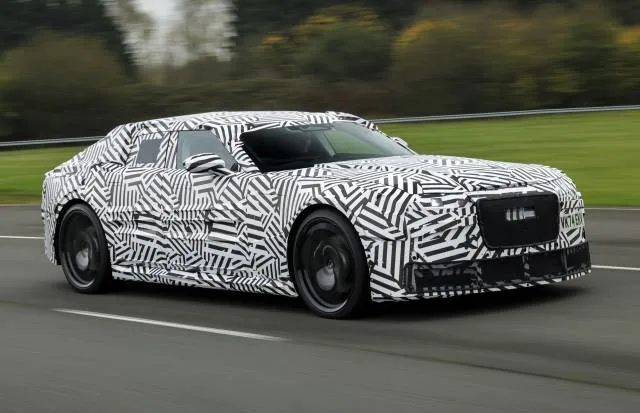
Jaguar has unveiled its new Type 01 electric vehicle in New York, launching one of the most ambitious and closely watched stages of the British luxury carmaker’s transformation as it seeks to attract a younger and wealthier generation of customers.
The striking new electric model is designed primarily with affluent American buyers in mind and represents a dramatic departure from Jaguar’s traditional approach to luxury motoring. With a starting price of about £130,000, equivalent to roughly $172,000, the Type 01 is positioned firmly in the premium market and is intended to appeal to wealthy technology professionals, entrepreneurs and other high-income consumers.
Its size alone makes clear how different the new Jaguar is from many vehicles designed for the British market. The car is more than 5.2 metres long and approximately two metres wide, meaning it is considerably larger than a standard UK parking space, which is typically around 4.8 metres long.

That could create an unusual problem for British customers. While Jaguar is a distinctly British brand and the Type 01 is being designed, engineered and built in Britain, its proportions appear to be better suited to the expansive roads and large parking areas of North America than the tighter streets, car parks and country lanes commonly found across the UK.
Jaguar’s management, however, believes the car’s size and unconventional design are part of its appeal rather than weaknesses.
Rawdon Glover, Jaguar’s managing director, said the company was deliberately seeking customers who were younger, wealthier and more comfortable making unconventional choices. He described the intended buyer as someone who is highly interested in design and technology and who wants a vehicle that immediately stands apart from conventional luxury cars.
The Type 01 features an exceptionally long bonnet, a low roofline and a muscular body that represents a major visual break from the Jaguar F-Type, the company’s previous sports-car flagship. Its starting price is roughly twice that of the F-Type, highlighting Jaguar’s strategy of moving away from the traditional volume-focused premium market.
The new car also represents a major gamble for Jaguar Land Rover, which is attempting to reposition Jaguar as an exclusive electric luxury marque rather than competing for a larger share of the conventional premium-car market.
The strategy comes at a difficult moment for JLR. The company has faced weaker sales, intense competition from Chinese manufacturers and continuing uncertainty in major international markets. Its financial difficulties have been compounded by the impact of a major cyberattack last year, which disrupted operations and was estimated to have caused significant damage to the wider UK economy.
JLR recently announced plans to cut around 4,000 jobs as part of a wider effort to save approximately £1.7bn over two years. The company has cited intense competition and geopolitical uncertainty as major factors behind the restructuring. Employees involved in the Type 01 programme were also offered voluntary redundancy as part of reductions affecting the company’s non-manufacturing workforce.
Against that background, Jaguar is betting that selling fewer vehicles at substantially higher prices can provide a stronger financial foundation.
Glover has argued that remaining in the volume premium market for another decade would not provide the company with the financial security it needs. Instead, Jaguar intends to become a much more exclusive brand, with the Type 01 acting as one of the clearest expressions of that strategy.
The car is scheduled to go on sale in early 2027, with initial deliveries expected during the second half of the year.
North America is at the centre of the new strategy. JLR chief executive PB Balaji has previously indicated that the company wants to increase its focus on the region and attract more wealthy customers, including millionaires and billionaires.
The decision to launch the Type 01 in New York rather than Britain reflects that commercial ambition. Jaguar executives have acknowledged that Silicon Valley could have been an equally appropriate location because of the vehicle’s technology-focused target audience.
The company has already taken prototypes to major technology businesses in California. Among those to experience the vehicle was Jensen Huang, chief executive of Nvidia, who reportedly responded positively to the car.
The Type 01’s technology and performance are intended to reinforce its premium positioning. Jaguar says the electric vehicle will produce more than 1,000 horsepower and have a range of up to 400 miles on a single charge.
One of its most distinctive features is the absence of a conventional rear window. Instead, a rear-facing camera provides the driver with a view behind the vehicle. The unusual arrangement contributes to the car’s futuristic appearance while reflecting Jaguar’s determination to move away from traditional automotive design.
The company also insists that the vehicle will be highly manoeuvrable despite its considerable dimensions. Glover has compared its turning capability to that of a much smaller city car, pointing to its all-wheel-steering system as evidence that its physical size will not necessarily make it difficult to drive.
That argument may be particularly important in Britain, where the Type 01’s dimensions could prove challenging. At two metres wide, it would occupy a substantial portion of narrow roads and could feel cumbersome in older car parks. Its length of more than 5.2 metres also exceeds the dimensions of many standard UK parking bays.
Jaguar nevertheless believes there is a growing market for large luxury vehicles, particularly among wealthy customers who prioritise design and presence over practicality.
The Type 01 is also the latest product of Jaguar’s controversial rebranding campaign. The transformation began publicly in late 2024 with an advertising campaign that featured fashion-oriented imagery and did not prominently display a vehicle. The campaign triggered a strong online reaction, with critics questioning the direction of the historic marque.
The subsequent Type 00 concept intensified the debate. Its dramatic design and distinctive pink presentation became a focus of political and cultural criticism, with some high-profile commentators accusing Jaguar of embracing an overly ideological brand identity.
Glover has acknowledged that the reaction to the rebrand was difficult but maintains that Jaguar needed to attract a new audience. The company had become increasingly dependent on an ageing customer base, and executives concluded that simply refining the existing formula would not be enough to secure the brand’s future.
That makes the Type 01 more than just another electric car. It is effectively a test of whether Jaguar can persuade affluent consumers that the brand deserves a place alongside the world’s most exclusive luxury manufacturers.
The company is also facing a changing global luxury-car market. China, once an important growth market for premium manufacturers, has become increasingly difficult as demand has weakened and domestic electric-vehicle manufacturers have become stronger competitors.
Jaguar does not plan to introduce the Type 01 in China immediately. Glover said the company would wait for a couple of years before entering the market with the new model, although he acknowledged that China remains too important for any major carmaker to ignore indefinitely.
The decision reflects Jaguar’s broader strategy of concentrating first on markets where its new positioning is most likely to succeed.
Britain remains important to the programme despite its American focus. Business Secretary Jonathan Reynolds described the electric model as an important part of JLR’s plans to maintain major investment in the UK automotive industry.
The Type 01 is being designed, engineered and built in Britain, with production expected to support employment and industrial activity in the West Midlands and North West. The government has highlighted JLR’s wider investment programme, worth more than £15bn, as an example of continued confidence in Britain’s automotive manufacturing capabilities.
For Jaguar, however, the challenge will ultimately be measured by customers rather than government support or publicity.

The company is asking buyers to pay a substantial premium for a vehicle that deliberately breaks with the Jaguar many customers have known for decades. Its unconventional proportions, camera-based rear visibility, powerful electric drivetrain and dramatic styling are designed to create an emotional response as much as a practical one.
That strategy may work particularly well in American cities and technology centres, where wealth, large vehicles and distinctive design can carry significant status. In Britain, however, the Type 01’s sheer size could make everyday ownership more complicated.
Jaguar’s gamble is therefore straightforward but significant: sell fewer cars, charge considerably more and build a brand around exclusivity, technology and bold design.
The Type 01 will reveal whether that approach can restore Jaguar’s financial strength and cultural relevance. For a company undergoing one of the most dramatic transformations in its history, the new electric car is not simply a new model. It is a statement about what Jaguar believes its future should look like.
Related News:
 UK Risks Falling Behind in AI Race
 Ukraine Moves to Seize Water Company
 UK retailers plan 100,000 placements for young people
 Billionaire Chris Rokos poised to leave UK
 Oil nears $100 as Saudi attacks shake markets
 McLaren to Create 1,000 UK Jobs in £450m Investment
 Nats Boss Summoned as UK Flight Chaos Continues
 JPMorgan Boss Warns Against UK Bank Tax Rise
 Iceland to Open First UK High Street Store in Falklands
 John Lewis Losses Widen to £124m as Confidence Falls
 Thames Water Revises Oxfordshire Mega-Reservoir Plan
 UK Retailers Accused of Breaking Refund Laws
 UK Trade Losses Grow Without EU Product Deal
 AO Acquires Jessops in Camera Retail Expansion
 TalkTalk Races to Sell Arms as Administration Looms
 Avanti West Coast Set for Public Ownership in March
 Beaverbrooks Boss Calls for Relief on Business Costs
 Dale Vince Plans New London-Wide News Operation
 Poundland Rescue Bid Could Protect 11,000 Jobs
 Bank Chief Calls for Power to Intervene in AI
 UK Bookmakers Linked to Offshore Casino Deal
 Boots Sale Nears as Weston Family Eyes $9bn Deal
 BBC Three and Scotland Face Online-Only Future
 Royal Nursing Union Ends Partnership With Teva UK
 Palantir Lobbyist Had Role in Burnham Campaign
 Feeld Founders Receive Record Dividend as Sales Rise
 UK Diesel Reaches £2 as Inflation Surges Across Europe
 Minister Rejects Fears of UK Diesel Shortage
 BT Broadband Pauses Raise Digital Switchover Concerns
 UK Faces Calls to Review Bank Failure Bets
 UK Weighs Chinese Car Tariffs Amid EU Trade Push
 BT Agrees £400m TalkTalk Rescue Deal
 Informa Agrees £2.24bn Deal to Buy Clarion
 Asos Investigates Hack Claims After Customer Alerts
 Reeves Faces Setback as Labour May Miss Homes Target
 Trump’s UK Ambassador Urges North Sea Drilling to Strengthen US Ties
 M&S Profits More Than Halve After Cyber-Attack
 Millionaires group urge Reeves to introduce wealth tax to ‘lift kids out of poverty’
 Starmer Says Labour’s Economic Plan Needs Years to Deliver
 Virgin Media Fined £23.8m Over Telecare Safety Failures
 Starmer Faces Parliamentary Battles Over UK-EU ‘Reset’ Plan
 ScottishPower Tops List of Worst UK Energy Suppliers
 City & Guilds pay surge sparks backlash amid £22m cuts
 UK Unemployment Rate Climbs to 5.2% Peak
 UK shelves £110m border project amid trade strain
 Switching Energy Deal Can Save £200 as Price Cap Falls
 Rachel Reeves Faces Middle East Conflict Test
 Grocery Inflation Rises Amid War Fears
 BrewDog sold Highland estate for knockdown price after abandoning reforestation plans
 UK Energy Reform Could Cut Bills by £200
 Rising Costs Force Families to Rethink Days Out
 Aegon Sells Historic UK Arm to Standard Life for £2bn
 UK Staycations Rise as Travel Fears Grow
 Silent Tracks: Rail Line Without Passengers
 Lotus Boss Pledges Future to Norfolk and Seeks State Support
 UK Firms Freeze Spending as Iran Conflict Bites
 Reeves to Fast-Track Clean Energy Amid Iran Crisis
 Tube Strike Brings Capital to a Standstill Over Shift Disputes
 Tube Strike Brings Capital to a Standstill Over Shift Disputes
 EU Slashes Steel Quotas But Grants UK Favourable Rates
 Sainsbury’s Boss Optimistic As Grocery Inflation Eases
 Burnham unveils £65m drought aid for farmers
 Unions Warn Labour Over Zero-Hours Contract Reforms
 London Launches First Self-Driving Taxis
 Swedish Mining Push Puts Sami Land Rights Under Pressure
 Mayors Could Gain Greater Powers Over Water Firms
 Entain Plans 400 Job Cuts After Profit Update
 Tom Watson Takes Senior Role at Palantir
 UK Rent Gap Puts Low-Income Families Under Pressure
 Calls Grow to Expand UK National Wealth Fund
 MPs Defend UK Economic Watchdog Against Critics
 Chinese Hybrid Car Surge Raises EU Auto Industry Concerns
 Frome Community Loses Bid for Major Regeneration Site
 The Tests Awaiting Andy Burnham After Labour Conference
 UK University Strikes Spread as Financial Pressure Grows
 Burnham Opens Door to Possible UK Return to EU
 Healey urged to act as UK energy bills rise 4%
 UK house price growth slows as mortgage rates rise
 Badenoch Raises Prospect of 2027 UK Election
 North Sea Strike Threatens UK Fuel Supplies