Published: 02 October 2026. The English Chronicle Desk. The English Chronicle Online
Staff at the BBC are facing growing uncertainty over the future of two television channels as the corporation prepares to announce another stage of a major cost-cutting programme. Internal changes to the broadcaster’s TV and streaming division have fuelled expectations that BBC Three and BBC Scotland could move to online-only services as the organisation seeks to reduce spending and adapt to changing viewing habits.
The BBC has begun a redundancy process within its TV and streaming operations, with employees being asked to express interest in voluntary redundancy and other arrangements designed to reduce the number of compulsory job losses. The process includes possible job-sharing, reduced working hours and relocation to other BBC bases around the UK.
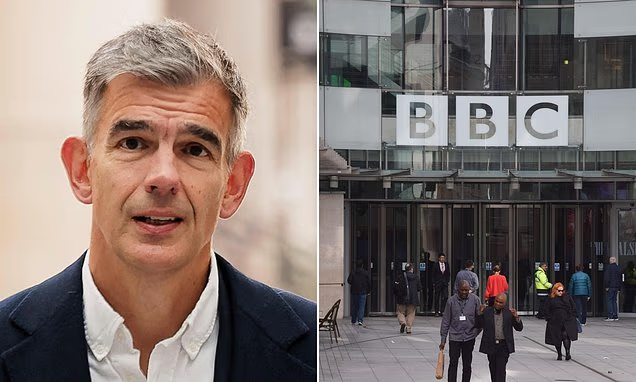
The move comes as Director General Matt Brittin prepares to outline the next phase of a wider programme intended to save around £500m and potentially reduce the BBC workforce by as many as 2,000 jobs. The corporation has been examining its television, radio and digital services as audiences increasingly move away from traditional broadcasting towards streaming and on-demand platforms.

The latest developments have prompted speculation among BBC staff that BBC Three and BBC Scotland may be among the services affected. Neither channel has been confirmed for closure or conversion to online-only operation, and the BBC has declined to comment on the speculation.
The uncertainty surrounding BBC Three is particularly notable because the channel has already undergone a major transformation. Originally launched in 2003 as a television service aimed primarily at younger audiences, BBC Three was taken off traditional television in 2016 as part of an earlier cost-saving strategy.
The channel later returned to linear television in 2022, but its revival came at a time when viewers were increasingly turning to streaming platforms, social media and online video services. The changing habits of younger audiences have made it more difficult for traditional television channels to attract large live audiences.
BBC Three nevertheless has a significant place in the corporation’s recent broadcasting history. Programmes associated with the channel have included Gavin and Stacey, Fleabag, Killing Eve and Normal People, several of which went on to attract audiences far beyond the channel’s original demographic.
The service has also faced difficult financial decisions in recent months. Its cancellation of RuPaul’s Drag Race UK was attributed to financial pressures, while recent audience figures have highlighted the challenge of maintaining a dedicated linear channel for a relatively small live audience.
On one recent evening, the channel’s highest-rated programme, Stacey Dooley Sleeps Over, attracted an average audience of about 74,000 viewers in its 9pm slot. Across a typical week, around 4% of the UK population watches BBC Three live.
The BBC’s own cost figures also illustrate why services such as BBC Three are being examined as part of the corporation’s broader financial review. Its cost per user hour was reported at 26p in 2023-24 before falling to 18p in 2024-25. By comparison, BBC One’s cost per user hour was 10p, BBC Two’s was 9p and BBC Four’s was 6p in the latter year.
BBC Three’s budget also changed substantially after its return to linear broadcasting. Its budget was increased to about £80m when the channel returned to television, rising to around £90m in 2023-24 before being reduced to approximately £66m in 2024-25.
The figures have intensified questions about whether maintaining a separate linear channel remains the most effective way to deliver BBC Three content. If audiences increasingly consume its programmes through iPlayer rather than live television, the BBC may conclude that an online-first or online-only model would provide greater flexibility at lower cost.
A similar debate is taking place around BBC Scotland, which was launched in 2019 to provide programming specifically for Scottish audiences, operating separately from the Gaelic-language BBC Alba service.
BBC Scotland has faced persistent questions about audience reach. According to the BBC’s latest annual figures, around 12% of people in Scotland watch the television channel live, while 54% of Scottish adults consume BBC Scotland content each week through a combination of television, iPlayer, radio and online services.
That distinction is important because it demonstrates that relatively limited live television viewing does not necessarily mean there is little demand for Scottish-focused BBC content. Much of that content may be reaching audiences through digital platforms and other BBC services rather than the dedicated television channel.
The BBC Scotland television service had a budget of approximately £42m in 2024-25, while its cost per user hour was reported at 13p. Since its launch, the channel has received about £250m in funding, according to the figures supplied for the report.
The BBC has already announced further savings in Scotland. In June, it said it planned to cut 60 jobs in the country as part of an effort to save £10m.
The channel has also experienced changes to its programming. Its flagship news magazine programme, The Nine, was discontinued two years ago following periods of very low audience figures. Some editions reportedly attracted only a few thousand viewers.
For staff, the possibility of BBC Scotland moving online would therefore raise questions not only about the future of a television channel but also about jobs, production facilities and the long-term structure of broadcasting in Scotland.
The wider financial programme is affecting other areas of the BBC as well. Brittin has indicated that radio services are also being reviewed, with between 350 and 400 hours of audio content due to be removed by the end of the next financial year.
Other cost-saving measures have already been announced. The Radio 4 Today programme is reducing the number of regular presenters following the departure of Amol Rajan, while The World Tonight, an evening news programme that had been broadcast for more than five decades, has also been discontinued.
The current restructuring echoes earlier attempts by the BBC to reduce the cost of services. In 2010, then director general Mark Thompson proposed closing the Asian Network and 6 Music. Both services survived following significant public and political opposition, although the Asian Network has since undergone other structural changes.
The BBC’s current financial pressures are taking place against a rapidly changing media environment. Traditional broadcasters face competition not only from established streaming services but also from platforms such as YouTube, where viewers can access enormous quantities of free video content on demand.
For the BBC, the challenge is particularly complicated because it has obligations that extend beyond audience figures alone. Its public-service role requires it to provide content across the UK and serve different communities, even where a dedicated service may not attract the largest live audience.
That creates a difficult balance between financial efficiency and maintaining distinctive services for particular groups. Moving a channel online could reduce transmission and operational costs while potentially allowing programmes to reach audiences through the BBC’s digital platforms. However, it could also change how audiences discover and access those programmes.
The question is especially relevant for BBC Scotland, where the broader reach of Scottish content through iPlayer, radio and online services suggests that audiences may remain interested even if fewer people watch the dedicated television channel live.
For BBC Three, the debate also reflects the evolution of younger audiences. A generation accustomed to watching programmes whenever and wherever they choose may have less attachment to fixed television schedules. An online-only service could therefore represent a return to the model the BBC adopted for the channel between 2016 and 2022.
At the same time, staff concerns demonstrate the human consequences of the corporation’s financial restructuring. Voluntary redundancy schemes, reduced hours and possible relocations are being considered as ways of limiting compulsory job losses, but the wider programme could still result in significant changes across the organisation.

The BBC has not confirmed that either BBC Three or BBC Scotland will close their linear services. Any final decision would have implications for programming, employees, audiences and the wider public-service broadcasting landscape.
As the corporation prepares to communicate the next stage of its savings programme, attention will remain focused on whether the two channels are retained in their current forms, moved towards online-only operation or subjected to another form of restructuring.
Whatever decisions emerge, the debate illustrates the broader transformation facing public-service broadcasters in Britain. As audiences increasingly consume television through digital platforms, the traditional distinction between television channels and online services is becoming less clear. For the BBC, the financial challenge is to adapt to that transformation while continuing to provide distinctive programming to audiences across the United Kingdom.
Related News:
 TalkTalk Races to Sell Arms as Administration Looms
 Bank Chief Calls for Power to Intervene in AI
 UK rejects EV charging VAT cut amid Treasury clash
 UK Risks Falling Behind in AI Race
 Billionaire Chris Rokos poised to leave UK
 Oil nears $100 as Saudi attacks shake markets
 McLaren to Create 1,000 UK Jobs in £450m Investment
 Nats Boss Summoned as UK Flight Chaos Continues
 JPMorgan Boss Warns Against UK Bank Tax Rise
 John Lewis Losses Widen to £124m as Confidence Falls
 Thames Water Revises Oxfordshire Mega-Reservoir Plan
 UK Retailers Accused of Breaking Refund Laws
 Next Raises Profit Forecast After Strong Summer Sales
 UK Productivity Improves as Bank Weighs Interest Rates
 Chinese Hybrid Car Surge Raises EU Auto Industry Concerns
 UK Trade Losses Grow Without EU Product Deal
 AO Acquires Jessops in Camera Retail Expansion
 Beaverbrooks Boss Calls for Relief on Business Costs
 Poundland Rescue Bid Could Protect 11,000 Jobs
 UK Bookmakers Linked to Offshore Casino Deal
 Boots Sale Nears as Weston Family Eyes $9bn Deal
 Oprah enjoys Meghan’s jam on English muffins
 North Sea oil workers must lose weight or face job loss
 UK Taskforce Unveils Plan to Streamline Nuclear Reactor Rules
 UK Car Sales Pass 2 Million as Chinese Brands Surge
 MPs warn AI financial risks threaten UK stability
 MPs warn AI financial risks threaten UK stability
 AI job losses UK: Britain faces sharper employment shock
 UK New Car Discounts Near £6,000 as Prices Are Slashed
 Wealthy Britons Flee Gulf War but Avoid UK Taxes
 UK Wage Growth Slows as Jobs Market Holds Firm
 Oil and Gas Prices Surge Amid Iran-Israel Attacks on Gasfields
 OpenAI Halts Stargate UK Project Amid Energy Crisis
 Heavier SUVs Accelerate Britain’s Pothole Crisis
 Student Loan Interest May Rise Despite 6% Cap
 Carmakers Face £3bn Gap in UK Loan Payout Scandal
 Reform UK funding: mystery billionaire revealed
 BBC News Faces Deep Cuts in 2,000 Job Plan
 Reeves Fights to Keep Treasury Role Amid Labour Turmoil
 UK firms accused of ‘AI washing’ boom
 EasyJet Takeover Sparks Fears Over Passengers’ Future
 Weight-Loss Drugs Offer Food Savings Mainly to High Earners
 Is This the End of Harry and Meghan’s US Dream?
 Pubs and Hotels Face Business Rates Reform Review
 UK Households Could Save £173 on Fixed Energy Deals
 Burnham Faces Mounting Budget Challenges
 London Launches First Self-Driving Taxis
 UK Subsidence Claims Surge After Record-Breaking Summer
 Reform Faces Fresh Financial Controversy
 Ukraine Moves to Seize Water Company
 Spire Healthcare Agrees £1bn Takeover by Toscafund
 UK House Prices Fall as Mortgage Rates Rise
 Iceland to Open First UK High Street Store in Falklands
 AI CEOs Call for Slower Development
 Farage Threatens Union Funding Ban Over Reform Donations
 JLR Eyes NATO Market With New Defender Military Vehicle
 Horse Hill Oil Site Sold as New Drilling Bid Emerges
 Horse Hill Oil Site Sold for £1m as Drilling Bid Returns
 Entain Plans 400 Job Cuts After Profit Update
 Trump Threatens EU Over Canada Partnership Proposal
 Barclays Staff Push Back Against Office Return Plan
 Tom Watson Takes Senior Role at Palantir
 UK Retail Sales Rebound as Consumers Spend More
 UK Rent Gap Puts Low-Income Families Under Pressure
 Reform UK Faces Internal Debate Over £72m Spending
 Nvidia chief rejects AI extinction fears
 Calls Grow to Expand UK National Wealth Fund
 UK Borrowing Hits £18.3bn Ahead of Budget
 MPs Defend UK Economic Watchdog Against Critics
 Tony Blair Calls for Britain to Rejoin EU Within a Decade
 Norfolk Broads Housing Levy Faces Environmental Criticism
 Elizabeth Holmes Set for Halfway House Transfer
 Should Savers Lock Into 5.25% Fixed Rates?
 Avanti West Coast Set for Public Ownership in March
 UK Diesel Prices Hit Record High Amid Iran Conflict
 New UK Homes in Flood Zones Face Insurance Risk
 Dale Vince Plans New London-Wide News Operation
 Healey urged to act as UK energy bills rise 4%
 UK house price growth slows as mortgage rates rise
 UK borrowing costs surge as global bond sell-off deepens