Published: 24 June 2026. The English Chronicle Desk. The English Chronicle Online.
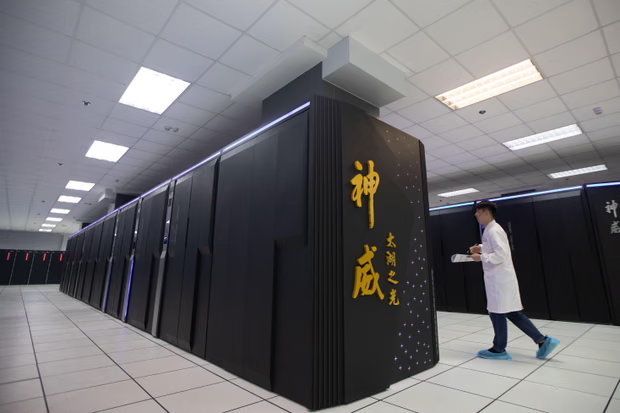
The global landscape of high-performance computing has experienced a monumental and historic shift this week. A newly unveiled supercomputer in China has officially outranked its formidable United States counterparts. This incredible machine now stands proudly as the most powerful computing system in the world. It marks the first time since June of 2017 that China has achieved this achievement. The top spot on this prestigious international list represents a massive victory for eastern technology. Many global experts view these specific rankings as a definitive measure of national technological prowess. Nations compete fiercely to showcase their computational supremacy on this grand and visible stage. The latest rankings have sparked intense discussions among scientists and policymakers across the entire globe. This dramatic development shifts the balance of power in the ongoing technological rivalry. The world is watching closely as this digital arms race enters a new phase.
This remarkable new Chinese computer is officially known to the public as LineShine. The system is located at the prestigious National Supercomputing Center in the city of Shenzhen. LineShine managed to displace the previously top-ranked United States system known as El Capitan. This historic shift occurred in the official Top500 rankings released to the public on Tuesday. Interestingly, this impressive announcement also marked the absolute debut of LineShine on the list. To claim the top spot upon a first appearance is an incredibly rare feat. The international computing community has expressed immense surprise at the sheer scale of LineShine. The sudden arrival of this machine changes existing projections for global technological development. It proves that China has been working diligently in secret to advance its capabilities. This achievement will undoubtedly influence future investments in western research and development facilities.
The internal architecture of China’s LineShine differs significantly from other modern high-performance computers. Most contemporary supercomputers rely heavily on graphics processors to accelerate their complex daily calculations. These graphics processors, commonly known as GPUs, are heavily utilised for advanced artificial intelligence applications. In stark contrast, the LineShine system runs entirely on traditional and conventional computer chips. These standard units, known as CPUs, handle the massive workload without modern graphics acceleration. This unique engineering choice has surprised many hardware experts around the world today. Utilizing conventional chips requires an incredibly sophisticated architectural design to achieve such high efficiency. It demonstrates a different philosophical approach to solving the world’s most complex computational problems. This engineering strategy could potentially redefine how future supercomputers are designed and constructed.
Operating such a massive computing infrastructure requires a truly staggering amount of electrical energy. According to the official published list, LineShine requires about 42.2 megawatts of electricity. This massive power consumption highlights the immense environmental and logistical challenges of modern computing. Housing and powering these digital behemoths demands a highly specialized and robust infrastructure. The sheer volume of electricity consumed could easily power a small modern city today. Managing the immense heat generated by these conventional chips is another engineering marvel. Specialized cooling systems must work constantly to prevent the delicate components from melting down. This high energy requirement is becoming a central point of debate in technology. As systems grow larger, finding sustainable ways to power them becomes increasingly critical.
To understand this achievement, one must grasp what these extraordinary machines can actually do. Supercomputers are generally more than 1,000 times faster than a standard home desktop computer. These machines are regularly used by global scientists to hunt for critical medical breakthroughs. They can model complex global climate systems to predict future environmental changes quite accurately. Governments also utilize them to simulate intense nuclear explosions safely without actual physical detonations. They can predict complex human behaviour patterns on a massive scale for various industries. Furthermore, these systems are highly capable of performing advanced virtual weapons testing for militaries. The practical applications of this technology directly impact national security and human progress. Whoever holds the fastest computer possesses a significant advantage in scientific discovery worldwide.
Scientists involved in the Top500 project provided detailed statistics regarding LineShine’s processing capabilities. They confirmed that the Shenzhen-based machine successfully achieved an astonishing score of 2.198 exaflops. This mathematical terminology means the system can perform more than 2 quintillion calculations every second. Such a number is almost impossible for the human mind to fully comprehend realistically. This incredible speed allows researchers to process vast oceans of data in mere seconds. Tasks that once took decades can now be completed during a single afternoon. The sheer processing power opens up entirely new frontiers for modern scientific exploration. It allows for high-fidelity simulations that were previously deemed completely impossible to execute. China’s scientific community now possesses an unprecedented tool for driving national innovation forward.
Meanwhile, the former champion El Capitan has officially dropped down into the second position. This American machine is located at the Lawrence Livermore National Laboratory in sunny California. Despite dropping in rank, El Capitan remains an incredibly potent symbol of American innovation. It still ranks ahead of two other powerful American supercomputers located at national laboratories. These impressive sister systems are currently operating in the states of Tennessee and Illinois. The United States still maintains a very strong presence at the top of the list. However, losing the ultimate crown to a chief economic rival is a psychological blow. American officials will likely face increased pressure to accelerate their own next-generation systems. The friendly yet fierce rivalry between these two superpowers shows no signs of slowing.
Looking further down the list, Germany’s famous Jupiter supercomputer has dropped to fifth place. These top five machines represent a very exclusive club within the global scientific community. They are currently the only publicly verified exascale computers operating in the world today. Achieving exascale status is considered the holy grail of modern high-performance computer engineering. Other prominent nations with impressive machines in the top ten include Italy, Switzerland, and Japan. This distribution shows that technological excellence is spread across several highly developed nations. Each country brings its own unique expertise and engineering philosophies to the global stage. The competition drives innovation, pushing the boundaries of what humanity can achieve through technology.
The United Kingdom also maintains a respectable presence within this highly competitive global arena. Specifically, the UK currently has 11 machines operating within the comprehensive list of 500. The University of Bristol’s Isambard-AI is the highest ranked machine of that British group. It currently sits at rank 11, down two places since the last official publication. Isambard-AI is famously fitted with 5,400 highly advanced Nvidia brand artificial intelligence superchips. This impressive British machine sits securely inside a formidable black metal cage for safety. The entire structure is topped with menacing razor wire to ensure absolute physical security. This intense security highlights the immense value and sensitivity of modern artificial intelligence infrastructure.
Last year, the European Union revealed an ambitious twenty billion euro infrastructure development plan. This massive investment aims to build specialized sites equipped with vast and powerful supercomputers. Europe desperately attempts to catch up with the clear technology leaders in America and China. These planned facilities are being described by European officials as artificial intelligence gigafactories. They will specifically target incredible moonshot innovations across several vital sectors of human society. These critical areas include modern healthcare, advanced biotechnology, heavy industry, robotics, and scientific discovery. The European Union hopes this massive financial injection will secure its own digital sovereignty. They want to ensure Europe remains a major player in the rapidly evolving future.
The best-performing artificial intelligence factories currently feature up to 25,000 advanced AI processors. However, a true gigafactory would comfortably exceed 100,000 AI processors, according to European documents. These power-hungry facilities naturally require absolutely massive amounts of fresh water for essential cooling purposes. European Union officials stated these sites should run as much as possible on green energy. Plans are also being developed for recycling the water used within these cooling systems. Despite these eco-friendly promises, environmental campaigners remain deeply concerned about the overall impact. They fear these power-hungry datacentres could severely undermine Europe’s ambitious statutory climate targets. Balancing rapid technological progress with environmental sustainability remains one of the greatest challenges today.
Related News:
 Reeves Faces Setback as Labour May Miss Homes Target
 Kate Winslet to Narrate Film Highlighting King’s Environmental Mission
 Trump’s UK Ambassador Urges North Sea Drilling to Strengthen US Ties
 UK Bans Fake Numbers: Scammers Lose Their Trick
 Vibe coding’ named Collins dictionary’s word of the year
BBC to Apologise Over Edited Trump Speech Amid Backlash
Vibe coding’ named Collins dictionary’s word of the year
BBC to Apologise Over Edited Trump Speech Amid Backlash
 Millionaires group urge Reeves to introduce wealth tax to ‘lift kids out of poverty’
 Reeves rejects £1bn plea for NHS redundancy payouts
 PM Condemns Leaks, Vows Loyalty to Ministers and Stability
 Phillipson Accused of Appeasing Unions by Diluting EBacc
 Saka Solidifies Role as Tuchel’s Key England Lieutenant
 Greene Pushes Epstein Files Amid Trump Fallout
 Zelenskyy Signs Fighter Jet Deal Amid Russian Drone Attacks
 Sundar Pichai Cautions on AI Hype and Market Risks
 Shadow Fleet at Sea: Europe’s Battle Against Illicit Oil Shipping
 Snow and Ice Cause Travel Chaos in North Yorkshire
 Director Michael Caton-Jones Reflects on Career and Beginnings
 Inside the Helpline Protecting Missing Children in the UK
 PlayStation PS5 Deals Hit Lowest Prices Ahead of Black Friday
 US Suspends Afghan Immigration After White House Shooting
 Five-Year-Old Dies After Rare Tonsil Surgery Complication
 Starmer Says Labour’s Economic Plan Needs Years to Deliver
 ‘Extinct’ Antelope Returns to Sahara, Bringing Hope
 IndiGo Cancels Hundreds of Flights Amid Pilot Shortages
 Young Britons Face Heaviest Burden from Ageing Population, Lords Warn
 U‑Turn on Farmers’ Inheritance Tax Sparks Political Firestorm
 Aston Villa Remain Arsenal’s Key Obstacle in Title Pursuit
 Irish Beach Tragedy: Irish Drown at Whitehaven Beach in Australia
 Starmer Faces Parliamentary Battles Over UK-EU ‘Reset’ Plan
 Met Police Vetting Failures Let Serial Rapists Remain
 Federal Immigration Shift: Officers Leave Louisiana for Minneapolis
 Fatal Bolton Taxi Crash Claims Three Teens and Driver
 Australia grants Asio powers to designate hate groups under new laws
 Friedman Uninvited From 2024 Adelaide Writers’ Week
 US and Iran Agree to Two-Week Provisional Ceasefire
 Battle of Britain Tower to House Tourists and Bats
 The Challenger: Will Péter Magyar End the Orbán Era?
 UK Government Poised to Revive Stalled Hillsborough Law
 Democrats Move to Impeach Defense Secretary Pete Hegseth
 Security Alert Near Israeli Embassy as Police Investigate
 Ben Roberts-Smith Denies War Crime Allegations in First Statement
 Home Office Faces Legal Risks Over Asylum Hotel Living
 US-Iran Standoff: Will Trump Deploy Ground Troops?
 Crisis in NHS Surgery Scheduling Hits Patients Hard
 Investigation Into Anti-Trump Motives After Gala Shooting
 Dubai Assets Linked to Sudan’s RSF Militia Exposed
 Blue Badge Abuse: The Rising Tide of Public Hostility
 Tragedy Strikes at Parafield Airport
 Scott Parker Leaves Burnley After Premier League Drop
 Silent Tracks: Rail Line Without Passengers
 Arteta urges Arsenal to step up in Atlético semi-final
 RFU Backs Borthwick Despite England’s Poor Six Nations
 Major test for Labour as polls open in Great Britain
 High-Profile Murder Trial Begins for Ian Watkins Death
 Trump Rejects Tehran Peace Plan as Regional Truce Crumbles
 Wes Streeting faces narrow road to Labour members’ favour
 Keir Starmer Struggles to Secure His Grip on Downing Street
 Trump and Xi Convene in Beijing for Historic High-Stakes Summit
 Farage Faces Standards Probe Over Cash Property Purchase
 Closing the Gap: UK Pensions Commission Demands Action
 Reality TV Under Scrutiny Following Serious Allegations
 UK Eases Russian Oil Sanctions as Fuel Costs Soar
 Alice Capsey Sparks England Win With Brilliant Fifty
 Maldives Cave Diving Tragedy Raises Safety Alarm
 Russian Electronic Attack Targets UK Defence Chief Jet
 UK Shoppers Face Prolonged Price Rises At Tills
 Tube Strike Brings Capital to a Standstill Over Shift Disputes
 Makerfield Voters Demand Real Change as Election Looms
 Man City Threaten Legal Action Over Haaland Real Madrid Shirt
 Celestial Waltz: Venus and Jupiter Meet at Twilight
 Abbott Signals Bold Strategy Change For Australian Right
 Ryanair Faces Probe Over Mandatory Family Seating Fees
 Britain’s Crowning Butterfly Takes the Nation by Storm
 Fifa Official Under Investigation Over Hand Gesture Controversy
 US Trafficking Arrest Exposes Shocking Exploitation
 Trump Signs Landmark Iran Accord in Versailles
 Grief and Devotion Amidst the Rubble of Nabatieh
 Dettol Apologises for ‘Toxic Men’ Advert Backlash in China
 UK Care Crisis: Row Explodes Over New Visa Settlement Rules
 Sainsbury’s Boss Optimistic As Grocery Inflation Eases