Published: 17 August 2026 | The English Chronicle Desk | The English Chronicle Online
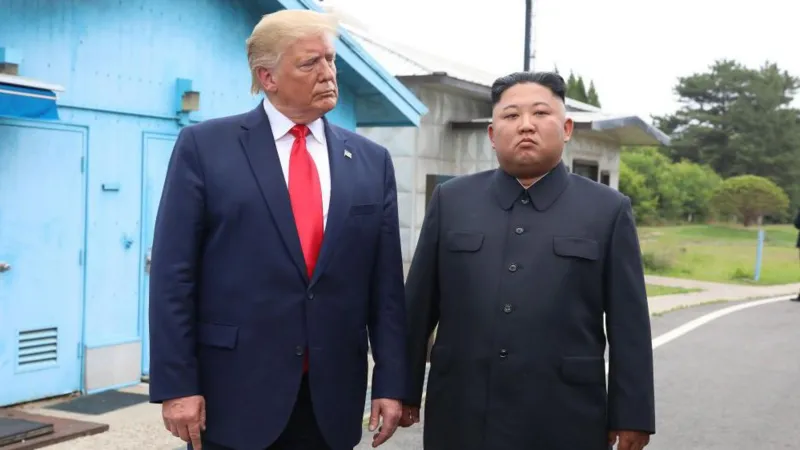
US President Donald Trump has ordered the Pentagon to “substantially reduce” joint military exercises with South Korea, linking the decision to his relationship with North Korean leader Kim Jong Un and Seoul’s refusal to participate in US efforts against Iran.
Trump’s announcement came just as the annual Ulchi Freedom Shield exercises were due to begin, creating fresh uncertainty over the future of one of the most important elements of the US-South Korea security alliance. The 11-day exercise had been expected to involve about 18,000 South Korean troops alongside US forces and other personnel connected to the United Nations Command.
Despite Trump’s last-minute intervention, South Korea said the drills would proceed as scheduled while officials reviewed Washington’s position.
The decision has immediately raised questions about whether the US president is seeking to reopen diplomacy with Pyongyang, reduce the financial burden of maintaining large-scale exercises, or pressure South Korea into taking a more active role in wider US military priorities.
It also comes at a sensitive moment for the Korean peninsula. North Korea has recently conducted ballistic missile tests and continues to expand its nuclear and missile capabilities, while its military cooperation with Russia has given some of its forces additional battlefield experience.

Trump said his decision was based partly on what he described as his “very good relationship” with Kim Jong Un.
He argued that the joint exercises were expensive and sent an inappropriate and hostile signal to North Korea.
The president also referred to Seoul’s decision not to join US efforts aimed at the “denuclearisation” of Iran, saying he had recently asked South Korea whether it wanted to participate and had been told “No thanks”.
The comments suggest that Trump sees the military relationship with Seoul in the context of his broader expectations of US allies.
His administration has repeatedly argued that countries benefiting from American security commitments should contribute more to their own defence and, where appropriate, support US strategic objectives.
South Korea, however, regards the US military presence on the peninsula as a fundamental component of its national security.
The two countries have maintained their alliance since the Korean War, and approximately 28,500 US military personnel are stationed in South Korea.
South Korean officials have sought to avoid an immediate confrontation with Washington.
The presidential Blue House said Seoul was reviewing Trump’s remarks and would continue consultations with the United States on military cooperation.
It also expressed hope that improved relations between Washington and Pyongyang could eventually contribute to meaningful dialogue.
That creates a complicated situation for South Korean President Lee Jae Myung.
Seoul has previously encouraged Trump to re-engage with Kim, particularly because Trump’s personal relationship with the North Korean leader remains one of the few channels through which direct communication between Washington and Pyongyang might become possible.
At the same time, reducing military preparedness carries potential risks for South Korea, particularly while North Korea continues developing its weapons programmes.
The South Korean military therefore confirmed that the scheduled exercises would proceed despite Trump’s announcement.
Ulchi Freedom Shield is not simply a symbolic military exercise.
The drills are intended to improve the ability of US and South Korean forces to operate together during a potential crisis on the peninsula.
Military exercises allow commanders and troops to practise communications, logistics, command structures and responses to different scenarios.
They also provide an opportunity to identify weaknesses before a real conflict occurs.
Leif-Eric Easley, a professor at Ewha University in Seoul, warned that reducing the exercises could have consequences beyond the immediate savings.
He argued that the drills are essential for maintaining military readiness and that scaling them back could weaken alliance coordination and slow South Korea’s efforts to assume greater responsibility for its own defence.
The professor also questioned whether the financial savings would be significant enough to compensate for the possible strategic costs.
Trump’s announcement comes at a time when North Korea’s military capabilities are becoming increasingly difficult for Washington and Seoul to ignore.
Pyongyang has accelerated its nuclear and missile programmes since the collapse of Trump’s high-profile diplomacy with Kim in 2019.
North Korea has also deepened military cooperation with Russia.
US and South Korean military officials have discussed the deployment of North Korean troops in support of Russia’s war in Ukraine, noting that personnel who return from the conflict could bring new battlefield experience with them.
Modern combat experience involving drones, electronic warfare, GPS disruption and other technologies could potentially influence North Korea’s future military capabilities.
That makes training and preparedness particularly important for the US and South Korean militaries.
Officials had previously said that their exercises were being adapted to account for the evolving threat.
Pyongyang has historically regarded US-South Korean military exercises as preparation for an attack.
North Korea’s foreign ministry recently condemned the drills as a rehearsal for an aggressive war.
That position has remained largely consistent even when the scale of exercises has been reduced.
From Pyongyang’s perspective, however, Trump’s decision could be viewed as a significant diplomatic gesture.
The reduction may reinforce Kim Jong Un’s long-standing demand that Washington stop what North Korea considers hostile military activity.
Whether Kim interprets the move as an invitation to restart negotiations remains uncertain.
There has been no immediate substantive response from Pyongyang to Trump’s latest announcement.
The decision is not without precedent.
During Trump’s first presidency, he suspended major US-South Korean exercises in 2018 as he pursued negotiations with Kim.
At the time, Trump described the exercises as provocative and emphasised their cost to the United States.
The drills were also reduced during the Covid-19 pandemic in 2020.
The latest announcement therefore fits a broader pattern in Trump’s approach to the alliance: maintaining the security relationship while questioning the cost, scale and political value of large military exercises.
The significant difference this time is the broader geopolitical environment.
North Korea is now more heavily armed, has strengthened ties with Russia and has continued missile testing.
Trump’s reference to Iran makes the decision particularly significant.
South Korea has traditionally attempted to maintain a careful balance in its foreign policy, particularly when US military priorities extend beyond the Korean peninsula.
Trump’s remarks indicate that Washington increasingly expects allies to contribute to American strategic objectives in different regions.
The issue could therefore become part of a larger discussion about burden-sharing between the United States and its partners.
For Seoul, participating directly in the US conflict with Iran could create diplomatic, military and economic complications.
South Korea’s geographical position also means that its immediate security priorities remain focused heavily on North Korea and the wider East Asian region.
Trump, however, appears to view allied support through a broader global framework.
Critics of the decision argue that military exercises have a deterrent purpose even when no conflict is expected.
A credible ability to respond quickly can discourage an adversary from believing that an attack might succeed.
Reducing exercises could therefore create uncertainty about the readiness of US and South Korean forces.
The concern is particularly relevant given North Korea’s recent missile activity.
At the same time, supporters of reducing the exercises could argue that excessively large drills risk unnecessary escalation and make diplomatic engagement with Pyongyang more difficult.
Trump’s previous suspension of exercises demonstrated that Washington can use military training decisions as part of a diplomatic strategy.
The question now is whether the latest reduction will produce meaningful negotiations or simply weaken military preparedness.
The tensions come after South Korea has attempted to strengthen its relationship with the United States in other areas.
Seoul has made significant economic commitments to the US and has sought to demonstrate that it remains a major strategic and economic partner.
South Korean officials have also tried to accommodate Trump’s concerns about burden-sharing.
But the dispute over military exercises demonstrates that disagreements remain.
For Seoul, the US military presence is closely connected to the country’s survival and deterrence strategy.
For Trump, the alliance is increasingly being evaluated through questions of cost, reciprocity and wider American interests.
Those different perspectives could make negotiations over the future shape of the alliance increasingly difficult.
Trump’s decision leaves both sides attempting to balance competing priorities.
Washington wants to preserve the possibility of diplomacy with North Korea while demanding greater contributions from its allies.
Seoul wants to maintain its close relationship with Washington while ensuring that its defence against North Korea remains credible.
For Kim Jong Un, the reduction in military exercises could represent an opportunity to test whether Trump is prepared to make further concessions in exchange for renewed dialogue.

But North Korea’s continued nuclear and missile development means that any reduction in allied military preparedness will be closely watched in Seoul, Tokyo and Washington.
The immediate exercises will continue, but their future scale and purpose are now under renewed scrutiny.
The central question is whether Trump’s latest move will become the beginning of another diplomatic opening with Pyongyang or another source of uncertainty within the US-South Korea alliance.
For South Korea, the challenge is to preserve the benefits of its partnership with Washington without compromising its own security needs. For the United States, the challenge is to pursue diplomacy with North Korea while maintaining sufficient deterrence against a country whose military capabilities continue to grow.
The coming months could therefore determine whether Trump’s decision becomes a strategic opening for negotiations or a costly gamble with one of America’s most important alliances in Asia.
Related News:
 Two National Guard Soldiers Critically Injured Near White House
 US National Guard Member Killed in DC Shooting
 American Mother Extradited From UK to U.S. on Murder Charges
 Russia losses Ukraine war peace talks intensify amid rising deaths
 US Cities Erupt in Protests Against Trump’s Venezuela Military Action
 Trump Escalates Minnesota Immigration Surge Amid Rising Tensions
 Homeland security agents deployed amid Minneapolis protests
 Trump Weighs Response to Iran Crackdown as Tehran Says Communication Open With US
 Minnesota Sues Trump Administration Over ICE Surge
 Trump targets Iran trade with 25% tariff warning
 US Clears Nvidia AI Chip Sales to China in Policy Shift
 Trump Threatens Strong Action If Iran Executes Protesters
 Portland man pleads not guilty after Border Patrol shooting
 European Leaders Condemn Trump Tariff Threat Over Greenland
 EU Says US Ties Have Suffered ‘Big Blow’ After Greenland Crisis
 Videos reveal earlier clash before Alex Pretti shooting
 ‘We Are Ready to Talk’: US News Anchor Savannah Guthrie Pleads for Return of Her Abducted Mother
 Headline: Measles Alert: Dr Oz Urges Americans to Vaccinate
 Nurses’ families fear breakup under UK immigration crackdown
 ‘Trump Will Be Gone in Three Years,’ Top Democrats Tell Europe
 US Civil Rights Leader Jesse Jackson Dies Aged 84
 Iran Says ‘Guiding Principles’ Agreed With US at Nuclear Talks
 Eight Skiers Found Dead After California Avalanche
 Trans Youth Care Crisis: NY Hospital Ends Gender‑Affirming Treatment
 Trump’s new tariff takes effect at lower than expected rate
 Who is Abigail Spanberger, the Democrat set to give State of the Union response
 Bill Gates ‘Took Responsibility’ Over Epstein Ties in Staff Meeting, Foundation Says
 American Citizen Killed in Cuba Boat Shooting, U.S. Officials Say
 Deadly Texas Bar Shooting ‘Potentially Act of Terrorism,’ FBI Says
 Trump Faces Questions Over Iran Conflict Plan
 The US Now Has the Medicine for Cheap Swarming Drone Attacks
 Talarico Secures Democratic Victory for US Senate in Texas
 Thousands Protest Iran Strikes Outside US Embassy London
 US Bombers Arrive at RAF Base Amid Rising Iran Tensions
 Real Estate Brothers Convicted in Sex Trafficking Trial
 Iran War Puts Trump at Political Risk Amid Rising Prices
 Trump’s Confidence Undimmed — But Every Iran Option Carries Risk
 Chain of Fire: US Bunker Busters Strike Major Iranian Ammo Depot in Isfahan
 Can Congress Stop US Sports Teams From Moving Cities?
 The “Protective Shield”: Who is Todd Blanche, the New Acting U.S. Attorney General?
 US Airman Rescued in Daring Mission After F-15 Shot Down in Iran
 The Bench Strikes Back: Lower Court Judges Emerging as Main Obstacle to Trump’s Executive Pivot
 The Moral Crisis Looming Within the American Chain of Command
 The Changing Face of Georgia: Trump-Backed Clay Fuller Wins Election
 The Gilgo Beach Case: Heuermann Expected to Plead Guilty to Eighth Victim
 Trump Signals Hope for New Iran Talks as Ceasefire Fades
 Identity Revealed: Suspected Washington Gunman Named
 America’s Furry Leaders: A Curious Civic Tale
 Trump’s Approval Hits Record Low Amid Economic Crisis
 Trump Threatens UN Budget Cuts as US Pushes ‘Trade Over Aid’ Agenda
 US Court Restores Abortion Pill Access Temporarily
 Miami Upgrades Shake Up F1 Title Fight
 Florida Surgeon ‘Devastated’ Over Fatal Surgery Error
 US Awaits Iran Reply on New Ceasefire Proposal
 Immigration Judges Fear Pressure in Trump Era
 US green card applicants must apply from abroad, DHS says
 DeSantis’s ‘Alligator Alcatraz’ Faces Final Shutdown
 Trump Approves $700m Coal Industry Investment
 Israel Strikes Iran After Missile Attack
 Scott Pelley Claims Editorial Pressure Over “60 Minutes” Segment Framing of Officer Incident
 US Launches Strikes on Iran After Military Helicopter Downed Near Strait of Hormuz
 Three Indian Sailors Killed in US Strike on Tanker Near Oman as US–Iran Conflict Escalates
 Battle for Washington: Mayoral Race Braces for Trump
 Is JD Vance the Ultimate Fall Guy for Trump’s Shaky Iran Deal?
 US Courts Back Trump on Park Signage Removals
 Former Olympian Indicted Over Alleged Vandalism at Washington’s Reflecting Pool
 Trump Helps Clear Balogun for Belgium World Cup Clash
 Trump Helps Clear Balogun for Belgium World Cup Clash
 Trump’s Major Recruitment Drive Targets Border Patrol Growth
 Trump’s New Vision for 250 Years of US Expansion
 Trump Declares Iran Ceasefire Over at Ankara Summit
 Trump Refuses to Sign Housing Bill, But Law Takes Effect
 Trump Tariffs Could Cut Northern Ireland Exports to the US by 15%, Research Suggests
 US Unveils Fresh Tariffs on Global Trading Partners
 Trump Hosts Zelensky and Netanyahu as Ukraine and Iran Conflicts Shape Global Agenda
 Trump Remembers Lindsey Graham as ‘Giant of the US Senate’ at Funeral Ceremony
 Trump Renews Push to End Birthright Citizenship
 Suspect Planned Spokane Wildfire on Dry, Windy Day
 US, RWE Reach Major Deal as Offshore Wind Projects End
 Tennessee Town Backs Trump as War Fuels Its Economy