Published: 26 May 2026. The English Chronicle Desk. The English Chronicle Online.
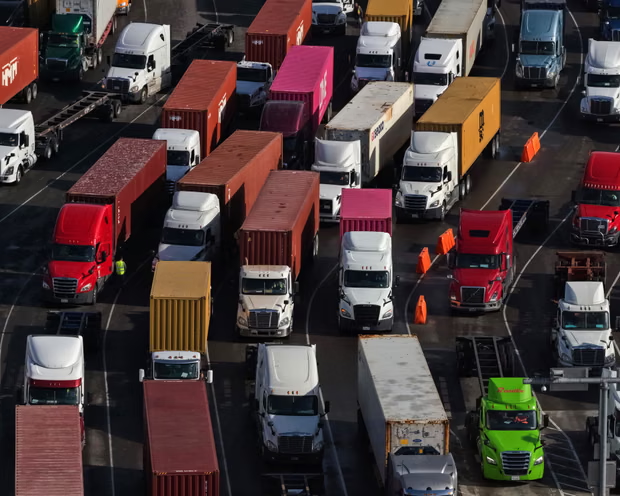
A controversial new maritime and transport policy has sparked outrage across the United States. Nearly two hundred thousand professional truck drivers now face the immediate loss of their livelihoods. This sudden crisis follows a strict directive issued by the US Department of Transportation. The emergency measure effectively disqualifies a vast number of foreign-born motorists from holding commercial licenses. Tens of thousands of legal immigrant workers have been left stranded in professional limbo. The policy took effect this March, igniting a wave of immediate legal challenges. Federal courts are currently reviewing multiple lawsuits aimed at blocking the sweeping federal mandate.
The restrictive rule specifically targets drivers holding non-traditional employment authorizations within America. This includes vulnerable individuals such as registered asylum seekers and legally recognized refugees. It also strips commercial driving privileges from younger immigrants protected under the Daca framework. The sudden regulatory shift has profoundly shaken a dedicated and essential logistics workforce. Many affected individuals have spent decades serving the American supply chain with distinction. Their sudden disqualification threatens to disrupt the transport of vital goods across the continent. Industry experts warn that the policy could trigger severe shortages in major shipping hubs.
Sarabjeet Singh is an experienced operator from India based in central California. He has maintained a flawless professional driving record for over twelve years. Last month, he attempted to renew his expiring credentials at a state bureau. Officials promptly turned him away, citing the newly enacted federal transport guidelines. The abrupt rejection has completely upended his life and his family’s long-term stability. His wife, Kavita Patel, described the devastating impact of this sudden professional ban. She explained that the loss has created an immense emotional and mental burden. The financial strain has placed their entire household under severe, unexpected pressure.
Patel noted that onlookers often falsely assume alternative employment is easily found. However, her husband’s entire specialized skill set centers entirely on operating heavy machinery. Building a successful career in logistics requires years of rigorous on-the-road experience. She described a profound sense of helplessness engulfing their daily family life. Waking up to find a legitimate career erased overnight feels entirely surreal. Representatives from the Federal Motor Carrier Safety Administration have largely avoided direct media questions. They merely referred independent journalists to an official press release regarding the policy.
Government officials have strongly denied allegations that the regulatory change is racially motivated. In an official statement, US Transportation Secretary Sean Duffy defended the strict enforcement. He asserted that commercial licenses were previously granted to dangerous foreign operators illegally. Duffy insisted this practice posed an immediate threat to families sharing public highways. To justify the crackdown, he highlighted five recent fatal accidents involving foreign-born drivers. However, independent analysts note these accidents represent a microscopic fraction of national statistics. The cited crashes comprise just a tiny percentage of overall commercial vehicle fatalities.
Federal data indicates that unlicensed operations remain a much larger systemic safety concern. Approximately one-fifth of drivers in fatal crashes lacked any legal commercial credentials. Despite this, federal policy has focused heavily on restricting legally registered immigrant drivers. The political tension escalated further during a public event held this April. A non-domicile driver with valid Daca status directly confronted Secretary Duffy. The operator demanded to know why law-abiding residents were being stripped of careers. Duffy initially suggested that the rule should not be impacting those specific individuals.
An agency spokesperson later claimed the secretary simply misheard the question. They insisted he misspoke during the brief, highly charged public interaction. Meanwhile, Secretary of State Marco Rubio has echoed these strong national security arguments. He claimed an influx of foreign drivers actively undermines American worker livelihoods. Last August, the State Department abruptly halted work visas for international commercial drivers. Critics argue the administration has provided no empirical data to support its claims. They maintain that foreign commercial license holders do not pose a distinct threat.
In fact, overall highway safety metrics have shown steady improvements over recent years. The National Safety Council reported a notable decrease in fatal large-truck accidents. Major labor organizations have actively condemned the administration’s aggressive regulatory approach. The AFL-CIO sent a formal letter of protest to Congress this spring. The prominent union federation argued that the policy actually undermines road safety. Their internal data suggests that the excluded immigrant drivers boast exemplary safety records. Statistically, foreign-born operators are involved in fewer fatal accidents than domestic peers.
Therefore, removing experienced drivers could inadvertently lower overall driving standards on highways. Despite these arguments, the administration’s rhetoric has successfully influenced a segment of the public. Official comment portals are flooded with messages supporting the restrictive transport rule. Many citizens frequently cite concerns regarding illegal immigration to justify the new restrictions. This public perception persists despite the rule explicitly targeting legally authorized workers. The federal directive has also created severe friction with several state-level authorities.
Democratic leaders in states like New York initially resisted enforcing the federal mandate. They attempted to protect local drivers by refusing to revoke state-issued licenses. In response, Washington threatened to withhold billions in vital federal infrastructure funding. This intense financial pressure eventually forced local authorities to comply with federal demands. Immigrant drivers maintain that the policy unfairly punishes individuals with clean records. They emphasize that they entered the country legally and obtained credentials properly. This regulatory targeting actually predates the current administration’s latest federal transport rule.
Last April, Arkansas Governor Sarah Huckabee Sanders signed a strict English proficiency law. That state legislation specifically targeted foreign-born operators navigating regional transit routes. Ignacio Romero has worked as a professional trucker in California for thirty-seven years. He believes a broader movement is actively targeting minority and foreign motorists. He links this hostile political climate to the recent growth of the industry. The number of foreign-born drivers in America doubled over the last two decades. Romero reports experiencing routine profiling and increased law enforcement stops this year alone.
He questions why an entire workforce is being punished for isolated accidents. He believes the current policy relies on unfair blanket statements rather than accountability. The sweeping regulations are also hurting international trade dynamics along the southern border. Julio Ortiz is a commercial driver who regularly transports goods from Mexico. He describes the new border restrictions as a grave error for commerce. He believes it is unjust to block individuals who wish to work honestly. Other veteran drivers point out a fundamental flaw in the government’s logic.
Narinder Johal has operated commercial vehicles in California for nearly three decades. He argues that truly unscrupulous operators easily evade these specific bureaucratic rules. Meanwhile, tax-paying, law-abiding drivers are the ones being forced off the roads. Longtime industry organizers argue that corporate greed remains the true threat to trucking. Billy Randel, a prominent New York labor activist, blames systemic domestic deregulation. He notes that all drivers have faced lower wages and deteriorating working conditions. Yet, political rhetoric conveniently shifts the blame onto vulnerable immigrant communities instead. He reminds critics that the ancestors of most Americans arrived seeking similar opportunities.
Related News:
 Saudi Officials Report Zubaidi Flee Before Yemen Peace Talks
 UK Targets in New York Bomb Threat Hoax: Man Jailed
 Gambia Supreme Court Hears Case to Overturn FGM Ban
 Trump targets Iran trade with 25% tariff warning
 US Senate rejects resolution limiting Trump military powers
 Gulf states warn Trump Iran strikes risk wider Middle East war
 Machado Trump medal gesture reshapes Venezuela power struggle
 Geopolitical football: Iran, Trump and the World Cup clash
 Canada-China trade gains momentum in new strategic partnership
 Syria President Declares Victory as Ceasefire Reached with SDF
 Shinzo Abe’s killer receives life sentence in Japan
 China General Under Investigation Amid Leadership Purge
 Philippines ferry disaster leaves 15 dead, dozens missing
 Cambridge Faces Scrutiny Over Arms Investment Transparency
 Epstein UAE Emails Shake British Royal Andrew’s Legacy
 Christchurch gunman seeks to vacate guilty plea
 Concerns rise for Canberra boy amid Iran detention fears
 Ukraine Sends Drone Experts to Defend US Bases in Jordan
 Abramovich Chelsea Sale Cash Faces Jersey Probe
 Yvette Cooper: UK Must Follow Principles, Not US Pressure
 Jury Rules Meta and YouTube Liable for Addictive Design
 The Woman Guarding Earth From the Threat of Asteroids
 Exiled Tycoon Warns of New Russian Attacks on UK Soil
 LA 2028: Millions of Affordable Olympic Tickets Announced
 Trump Slams Europe as Transatlantic Tensions Boil Over
 Inside the Deceptive Machine: A Former Producer Speaks Out
 Spain Faces Backlash Over Xenophobic Chants in Egypt Draw
 A Global Voice For Justice: Stephen Lewis Dies At Age 88
 Hope and Fear as Iranians Flee Across the Turkish Border
 Reform UK Pledges To Halt Visas Over Reparations Demands
 US and Iran Agree to Two-Week Provisional Ceasefire
 Starmer visits Gulf as US and Iran agree ceasefire
 Pakistan Brokers Historic Peace Deal Amid Rising Tensions
 UK Holds Firm on Strait of Hormuz Amid Trump Pressure
 Trump Signals Hope for New Iran Talks as Ceasefire Fades
 Reeves Slams Trump Over Iran War Lack Of Exit Plan
 US and Iran Pursue Extension of Ceasefire via Pakistan
 Trump’s Islamabad Gamble: The High Stakes of a New Iran Deal
 Ian Katz to Step Down as Channel 4 Content Chief
 The General’s Gambit: Pakistan’s New Role in Global Peace
 Mexico, Spain and Brazil call for Cuba dialogue amid crisis
 Pakistan’s Ambitious Bid for Middle East Peace
 Israeli Soldiers Jailed Over Vandalism of Lebanese Statue
 Trump Weighs Sending Afghan Allies to the Congo
 Pentagon Shakes Up Navy Leadership Amid Hormuz Blockade
 Trump Threatens UK With Big Tariff Over Tech Tax
 Prominent Voices Challenge Palestine Action Ban
 Security Scrutiny After Washington Shooting Incident
 Merz Criticises US Approach in Iran Conflict
 UK Envoy Sparks Controversy Over Special Relationship Claims
 Ukraine Urges UK to Seize Russian Oil Tankers
 US Calls Australia Media Law “Foreign Extortion”
 The Billionaire’s Secretary and the £1m Fraud
 Ukraine strikes Tuapse as oil disaster worsens
 Brewing Tension: Taiwan Baristas Rebrand for World Stage
 Tensions Emerge in Netanyahu-Trump Alliance
 Mission to the World’s Edge: A Heroic Rescue in Tristan
 US and Mexico Face Heatwave as Floods Batter South Africa
 Mexico’s Missing: State Complicity in a Growing Crisis
 French Patient Told Hantavirus Was Just Anxiety
 The Long Way Home: Australia’s High-Stakes Virus Mission
 Putin Signals War End as Russian Momentum Stalls
 Romania’s Judicial Crisis: A System Under Siege
 Lee Lai Makes History with Landmark Stella Prize Victory
 Philippine Senator Flees After Days Under Senate Siege
 Alberta Separatist Bid Blocked by Canadian Court
 Canadian Court Blocks Alberta Independence Referendum Bid
 Big Tobacco Under Fire Over Controversial New Ad Campaign
 Bolsonaro Son Tape Scandal Sparks Massive Brazil Backlash
 Court Upholds Landmark Win for Transgender Rights
 Tragedy in the Maldives: Inside the Deep Sea Rescue
 Liberal Senator Criticises Immigration Rhetoric
 Senate Moves to Restrict Trump’s War Powers on Iran
 ICC Arrest Warrant Threat Sparks West Bank Retaliation
 Uefa Transforms Men’s Major Tournament Qualification
 Taliban Codifies Strict New Marriage and Divorce Legislation
 Tony Abbott Returns as New Liberal Party President
 Tiger Escape Shatters Peace in Germany
 Tulsi Gabbard exits after turbulent intelligence tenure
 Discontent grows around Putin amid war strain