
Published: 05 August 2026 | The English Chronicle Desk | The English Chronicle Online
For 15 years, Lisa built a career writing online content, turning her language skills into a stable income that supported her family as a single mother.
Like thousands of other Filipinos, she found opportunity in the country’s booming outsourcing industry, a sector that transformed the Philippines into one of the world’s leading destinations for business services.
But after years of writing, meeting deadlines and producing content without relying heavily on artificial intelligence, Lisa suddenly found herself without a job.
She believes the technology she helped train may have contributed to her own redundancy.
“I feel like I dug my own grave,” she said. “We were the ones who trained the artificial intelligence that replaced us.”
Lisa, whose real name has not been disclosed, is among several former outsourcing workers who say they lost their jobs during a period of rapid AI adoption. They spoke anonymously because they signed confidentiality agreements after receiving severance payments and fear damaging their chances of finding future employment.
Their stories highlight a growing global debate over artificial intelligence: whether it will create new opportunities or remove the very jobs that helped millions of people improve their living standards.
For more than two decades, the Philippines has built one of the world’s most successful outsourcing industries.
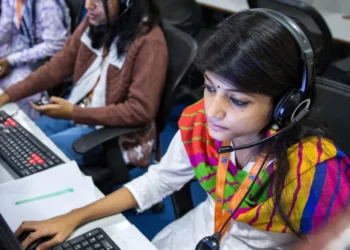
From call centres and accounting services to software development and content creation, Filipino workers have provided support for companies across the globe.

Business districts in Manila and other major cities became symbols of economic progress, with thousands of employees working night shifts to serve international clients in different time zones.
The rise of business process outsourcing, commonly known as BPO, was driven by the country’s large English-speaking workforce, government incentives and investment from multinational companies.
Major global firms established large operations in the Philippines, creating employment opportunities for graduates and helping expand the country’s middle class.
Today, the outsourcing sector employs around 1.9 million people and generates billions of dollars in annual revenue, making it a major contributor to the Philippine economy.
However, experts warn that many of these jobs are among those most exposed to generative AI.
Lisa said she never felt dependent on artificial intelligence in her work.
She believed her experience and writing ability were enough to complete assignments effectively.
However, before she was made redundant, she said her employer began working with an external public relations agency that produced AI-generated material.
Employees were asked to edit and improve the content, ensuring it matched the company’s writing style.
Lisa believes that process helped train AI systems that eventually reduced the need for human writers.
“I was doing my job well,” she said. “But suddenly, the technology we helped develop became part of the reason our roles disappeared.”
Another former content writer, Mary, described a similar experience.
She said employees were encouraged to use AI tools as productivity assistants, but instead of reducing workloads, the technology created additional responsibilities.
Workers had to spend more time checking information, correcting mistakes and verifying AI-generated content.
“We had to edit more, fact-check more because the data AI produced was inaccurate,” she said.
Despite those challenges, she was later made redundant.
The Philippines’ outsourcing industry is increasingly embracing artificial intelligence as international clients demand greater efficiency and lower costs.
Jack Madrid, president of the IT and Business Process Association of the Philippines, said many companies are already experimenting with AI systems.
He acknowledged that some roles are vulnerable to automation, particularly jobs involving repetitive tasks.
“Agentic AI has the potential to automate at a much more accelerated pace,” Madrid said.
However, he argued that many affected employees have been moved into other roles within companies rather than simply losing employment.
Industry leaders say AI will transform jobs rather than eliminate them completely.
Large outsourcing companies including Teleperformance, Accenture and Concentrix have said they are investing in training programmes designed to help employees adapt.
They argue that AI can handle routine tasks while allowing human workers to focus on more complex responsibilities requiring creativity, judgement and communication.
Despite promises of retraining, some experts say outsourcing companies face enormous pressure from multinational clients to adopt AI quickly.
Paul Quintos from the University of the Philippines-Diliman said many domestic companies are concerned about potential job losses but cannot ignore demands from international partners.
“Managers are worried about how much of the workforce might be displaced,” he said.
“But there is tremendous pressure from foreign clients to adopt AI. It is a major cost-cutting measure.”
The Philippines competes with countries such as India for outsourcing contracts.
As businesses look for cheaper and faster services, AI has become a key part of competition between providers.
Companies are increasingly expected not only to provide skilled workers but also to integrate automation into their services.
Experts also warn that not every job loss blamed on AI is necessarily caused by technology.
Quintos said some companies may use AI as an explanation for restructuring decisions that are actually linked to weaker demand or broader economic pressures.
He referred to the concept of “AI washing”, where organisations present changes as technology-driven even when other factors are involved.
The distinction matters because workers need to understand whether they are being replaced by machines or whether companies are simply reducing costs.
Labour groups say current employment laws in the Philippines do not provide enough guidance on how companies should introduce AI into workplaces.
Unlike some countries, the outsourcing sector has limited union representation, meaning many employees have little influence over decisions involving new technology.
The government has acknowledged the challenge and says both public and private sectors must invest in training.
Leandro Aguirre from the Philippines Department of Information and Communications Technology said the country needs to prepare workers for a changing economy.
“To be completely honest, I think we’re slightly behind. We have to catch up,” he said.
The government has announced plans to provide additional training opportunities for hundreds of thousands of outsourcing employees.
Officials hope to shift the country from relying mainly on foreign investment towards developing local technology companies and higher-value jobs.
For decades, the Philippines succeeded by offering skilled workers to global companies.
AI does not necessarily mean the end of outsourcing, but it is changing what employers need from workers.

Routine writing, customer service and administrative tasks may increasingly be handled by machines, while demand grows for employees who can manage technology, analyse information and solve complex problems.
For workers like Lisa, however, the transition feels deeply personal.
After spending years building a career, she now faces uncertainty about how her skills fit into an economy being reshaped by artificial intelligence.
Her experience reflects a wider global concern: that the benefits of AI may not be shared equally unless governments, companies and workers prepare for the changes ahead.
As the technology race accelerates, the challenge for countries like the Philippines will be ensuring that AI becomes a tool for opportunity rather than a force that leaves millions behind.
Related News:
 UK firms accused of ‘AI washing’ boom
 AI Jitters Send Chip Stocks Tumbling in US and Asia
 China’s AI ‘Lobster’ Craze Signals Bigger Ambitions
 Europe EV Demand Surges as Fuel Prices Rise
 AI May Soon Start Conversations on Dating Apps
 Zuckerberg Veteran Speaks on AI and Future Jobs
 Lawmakers Demand AI Kill Switch After Safety Fears
 China Faces New Challenge as AI Fake Videos Spread After Disasters
 Trump Administration Bans New Chinese Humanoid Robots Amid Growing Technology Rivalry
 Urgent AI Threat Research Needed, Says Google Boss
 Jack Dorsey’s Block Cuts Thousands of Jobs as It Embraces AI
 Burger King Rolls Out AI Headsets to Track Employee ‘Friendliness’
 How AI Can Read Our Scrambled Inner Thoughts
 China Sets Lowest Economic Growth Target Since 1991
 Gulf Oil Shock Sends Global Economic Ripples
 India’s $300bn Outsourcing Industry Faces AI Test
 Gas on the Line: Will the Iran War Squeeze India’s Piped Gas Next?
 China’s Tech Giants Race to Hong Kong as Global “Staging Post”
 Apple at 50: Three Products That Changed How We Live
 China and the US: The Divergent Fronts of the Global AI Superpower Race
 The Silicon Emerald: How Irish Engineers are Cashing In on the AI Boom
 Artemis II Returns After Historic Moon Flyby
 Robots Outpace Humans in Beijing Half-Marathon
 Reform UK funding: mystery billionaire revealed
 US Awaits Iran Reply on New Ceasefire Proposal
 China mine blast death toll rises to 90
 British Paralympian to Become First Disabled Astronaut in Orbit
 AI-Designed Vaccine Marks Global Breakthrough
 Can Ordinary Investors Buy SpaceX Shares?
 Diamond Miners Struggle as Lab Gems Reshape Market
 Global Stock Markets Slide Amid Tech Sell-Off and Middle East Tensions
 Majority of New US AI Data Centres Planned for Drought-Prone Regions, Report Warns
 US Places BYD on List of Companies Alleged to Have Chinese Military Links
 SpaceX Market “Blast-Off” Could Mark Elon Musk’s Biggest Financial Gamble Yet
 Unlocking the Genome: The Quest to Sequence Tardigrades
 Microsoft Cuts 4,800 Jobs in Major Xbox Restructure
 China Achieves First Reusable Rocket Landing
 Meta Drops AI Image Tool After Privacy Backlash
 China’s Economic Growth Slows, Missing Official Target
 Google Burning Through Cash as Spiralling AI Costs Put Pressure on Tech Giant
 Tech Billionaire Faces $644m Divorce Settlement
 SpaceX Rocket Part Set to Crash Into Moon
 How to Exit Your Broadband Contract Without Paying Exit Fees
 Big Pharma Investment Freeze Puts UK Life Sciences Sector Under Strain
 Jaguar Land Rover Extends Production Halt Following Cyber-Attack
 Virgin Trains Moves Closer to Challenging Eurostar Monopoly
 MPs warn AI financial risks threaten UK stability
 Amazon mistakenly signals new global layoffs to employees
 UK New Car Discounts Near £6,000 as Prices Are Slashed
 BT Names New Openreach Chief Amid Major Fibre Expansion
 Live Markets Bet on Spring Rate Cut as Inflation Falls
 AI Coding Firm’s ‘Pride’ at Business Award Win
 Uncertainties Loom for Businesses and Consumers After Trump’s Tariff Changes
Instagram Investigating AI Profiles ‘Fetishising’ Disabled People
Uncertainties Loom for Businesses and Consumers After Trump’s Tariff Changes
Instagram Investigating AI Profiles ‘Fetishising’ Disabled People
 Instagram Investigating AI Profiles ‘Fetishising’ Disabled People
 Oil Price Jumps Despite Deal to Release Record Amount of Reserves
 Sri Lanka Sets Weekly Shutdown to Save Fuel
 Councils Pressed to Use Universal Parking App to Cut ‘Unfair’ Fines
 One Ant for $220: The New Frontier of Wildlife Trafficking
 The $11k Ticket: High Stakes and Dynamic Pricing in FIFA’s First Open Sale
 Asian Powers Secure Energy Lifelines as Trump’s Hormuz Deadline Looms
 Electric Shock: Australians Buy Record Number of New EVs as Fuel Crisis Bites
 War, Windfalls, and the Carbon Trap: The Iran Conflict’s Brutal Energy Math
 The Great Saddle-Up: Sydney Commuters Ditch the ‘Crazy’ Bowsers for the Bike Lane
 The Great Chokehold: Why the Strait of Hormuz is the Epicenter of the 2026 Crisis
 ‘Maritime Drones and Steel’: £50m Defence Deals Set to Spark Job Boom in Plymouth and South Yorkshire
 The Next Chapter: Apple’s Future Under the Stewardship of John Ternus
 Human Capital for AI Infrastructure: Meta Cuts 8,000 Staff to Fuel $135bn Bet
 Beyond the Swoosh: Anta Sports Overtakes Rivals to Become Global Top Three
 Southeast Asia Turns to Russia Amid Energy Crisis
 A Massive Legal Triumph Reshapes the Future of AI
 Bear Escapes Factory Through Open Window
 World’s Largest Chipmaker Signals Possible Price Increases Amid Rising Costs
 SpaceX Prepares for Historic Valuation Launch
 Severn Trent CEO Reward Package Doubled Despite Public Anger
 India Orders Meta to Remove Child Abuse Ads
 Bangladesh Balances China Ties as India Relations Improve
 EasyJet Agrees in Principle to £5.2bn Takeover Deal
 US Unveils Fresh Tariffs on Global Trading Partners
 Shell’s Profits More Than Double as Higher Oil and Gas Prices Boost Energy Giant