Published: 15 August 2026.The English Chronicle Desk. The English Chronicle Online.
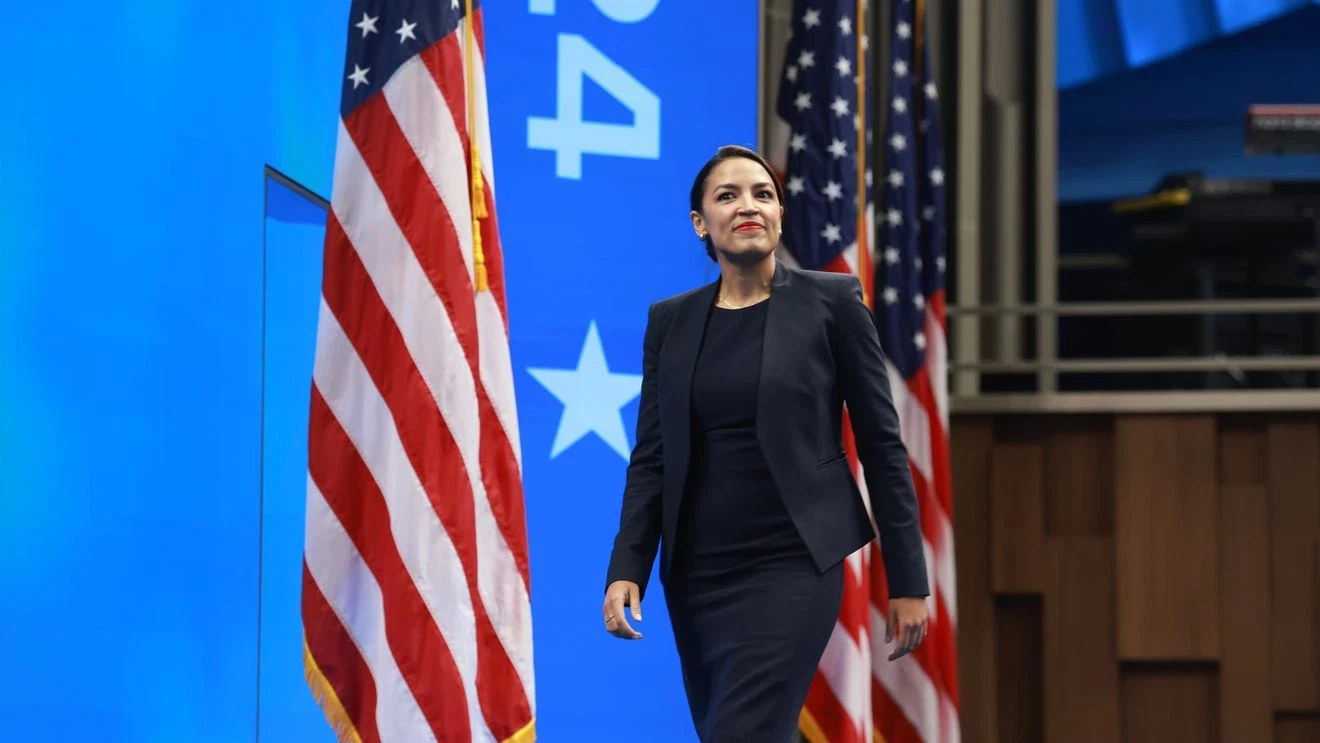
Alexandria Ocasio-Cortez’s growing national profile has intensified speculation that the New York congresswoman could seek the Democratic nomination for president in 2028, as voters increasingly demand political change and a new generation of leaders begins to challenge the party establishment.
At 36, Ocasio-Cortez is already one of the most recognisable progressive politicians in the United States. Her influence extends well beyond her New York district, with millions of followers on social media and a national political movement that has developed around her outspoken advocacy for economic equality, healthcare reform and progressive causes.
The congresswoman has not ruled out a presidential campaign. Although she has repeatedly resisted presenting herself as someone driven by political titles, her recent activities have done little to silence speculation that she could eventually seek the White House.
Speaking at the University of Chicago earlier this year, Ocasio-Cortez said her ambition was not about obtaining a particular political position but about changing the country. The remarks were met with enthusiastic applause and quickly became part of a broader conversation about whether she might eventually seek the presidency.

The political environment could be increasingly favourable to such a campaign. Democratic voters have shown growing frustration with an ageing political establishment, while progressive candidates advocating economic justice, expanded healthcare and stronger government intervention have achieved notable victories in local and congressional contests.
Recent polling has added momentum to the speculation. A Granite State Poll from the University of New Hampshire placed Ocasio-Cortez at the front of a potential Democratic field in the state, an important early testing ground for presidential candidates.
Her enormous social media following also gives her an advantage that previous generations of politicians could not have imagined. With nearly 10 million followers on Instagram alone, she can communicate directly with voters, build political enthusiasm and attract attention without relying entirely on traditional media or established party networks.
Her supporters argue that this combination of name recognition, communication skills and political authenticity could make her a formidable presidential candidate.
Ocasio-Cortez’s political rise began outside the traditional Washington establishment. Before entering Congress, she worked as a bartender and waitress and volunteered for Bernie Sanders’ 2016 presidential campaign. Her political career was transformed in 2018 when she defeated Joe Crowley, a ten-term Democratic congressman and prominent member of the party establishment, in a New York primary.
The victory turned Ocasio-Cortez into a national political phenomenon almost overnight. She entered Congress with limited financial resources but benefited from support from progressive organisations and activists.
Her first communications director, Corbin Trent, has recalled that political insiders began discussing her future almost immediately after her primary victory. Yet he has said she did not approach politics as a conventional career ladder leading inevitably towards the Senate or White House.
Instead, her political identity was built around issues and movements. Her supporters say this gives her a degree of authenticity that is difficult for traditional politicians to reproduce.
Trent argues that Ocasio-Cortez’s appeal comes partly from her genuine curiosity about other people and her willingness to speak openly about herself. Her personal background and working-class experience have also helped her connect with voters who feel disconnected from Washington politics.
Political strategist Chris Scott, who worked on Kamala Harris’s 2024 presidential campaign, said Ocasio-Cortez’s experience as a former bartender resonates with younger voters because it represents a lived experience rather than a carefully constructed political biography.
Yet the congresswoman’s evolution has also created tensions within the progressive movement. After years of criticising the Democratic establishment, she has increasingly worked with party leaders, prompting some activists on the far left to question whether she has become more comfortable inside the political system she once challenged.
Former House Speaker Nancy Pelosi recently praised Ocasio-Cortez for becoming highly effective within Congress, describing her as operational and enjoyable to work with. Such praise from a long-time Democratic establishment figure illustrates how dramatically Ocasio-Cortez’s position in Washington has changed since her insurgent campaign in 2018.
The shift has not gone unnoticed among her former allies. Some progressive activists argue that she has become more cautious and more strategic as her influence has grown.
Her approach to foreign policy has also remained a source of debate. Ocasio-Cortez has described Israel’s actions in Gaza as genocide and has supported efforts to restrict US military assistance. At the same time, critics on the left have questioned her support for Democratic candidates and her participation in the 2024 Democratic National Convention.
Her recent comments about the cultural battles surrounding the Covid-era political debate have further fuelled speculation about an attempt to broaden her appeal beyond the progressive base.
When asked about controversies surrounding the political left, she joked that “Woke One was crazy”, a comment interpreted by some observers as an effort to distance herself from aspects of progressive politics that could alienate moderate voters.
If she decides to run for president, Ocasio-Cortez would face a crowded Democratic field. Potential contenders could include Vice-President Kamala Harris, California Governor Gavin Newsom, former presidential candidate Pete Buttigieg, California Congressman Ro Khanna and Georgia Senator Jon Ossoff.
The question of whether Democratic voters are prepared to nominate a democratic socialist would also be central to the contest. Although progressive ideas have gained popularity among parts of the electorate, the party remains divided over how far left it should move in a general election.
One major challenge could be winning support among African American voters, particularly in early primary states such as South Carolina. Some progressive activists acknowledge that the movement has not done enough to build strong relationships with Black communities.
Nina Turner, a former national co-chair of Sanders’ 2020 campaign, has argued that progressive organisations need to do more to demonstrate their understanding of Black voters and the historical connection between working-class politics and Black liberation.
South Carolina Democratic strategist Antjuan Seawright said Ocasio-Cortez’s national prospects would depend partly on her ability to focus on broadly shared economic concerns. He suggested that healthcare and affordability could provide a stronger foundation for a national campaign than issues likely to divide voters.
A presidential campaign would also expose Ocasio-Cortez to an aggressive Republican campaign. Conservatives have spent years portraying her as an extreme leftwing politician, and her progressive record would provide opponents with extensive material for attack advertisements.
Republican strategist Tara Setmayer said Ocasio-Cortez’s recent comments distancing herself from some elements of progressive political culture could represent an effort to moderate her image. However, she argued that years of associations with figures on the American left would remain part of the political record and would be difficult to erase.
Setmayer believes Ocasio-Cortez could instead pursue a Senate career by challenging Chuck Schumer for his New York seat. She argues that serving in the Senate could provide additional national credibility and experience before a future presidential campaign.
Others believe waiting could be dangerous. American political history contains numerous examples of politicians who delayed a presidential bid in the hope of gaining more experience, only to find that the political moment had passed.
Barack Obama demonstrated the alternative approach when he entered the 2008 presidential race relatively early in his national career and successfully captured a political wave that carried him to the White House.
Ocasio-Cortez could potentially follow a similar path. If elected president in 2028, she would become the youngest president in US history, surpassing the records of Theodore Roosevelt and John F Kennedy.
Her supporters argue that her age could be one of her greatest advantages. After years of political battles dominated by older leaders, voters may be increasingly receptive to a candidate who represents a generational change.

The Democratic Party, however, would have to decide whether Ocasio-Cortez’s ability to energise progressives could translate into a nationwide coalition capable of winning a general election.
Her strongest asset may ultimately be her ability to attract attention. She is one of the few politicians capable of generating intense enthusiasm among supporters while simultaneously provoking strong opposition from critics. That level of political engagement can be an enormous advantage in an era dominated by social media and rapidly changing news cycles.
Whether that attention can be converted into a presidential campaign remains unknown. Ocasio-Cortez has yet to announce that she will seek the White House, and the 2028 Democratic field is still taking shape.
But the question surrounding her ambitions is becoming increasingly difficult for the party to ignore. She has national recognition, an established political movement, a powerful communications platform and a growing record of working within the Democratic establishment.
The central issue may therefore no longer be whether Ocasio-Cortez has the ambition to run for president, but whether the Democratic Party and the American electorate are ready to embrace the political transformation she represents.
For now, the congresswoman continues to leave the door open. Her stated ambition is larger than any single office, but if the political conditions continue moving in her favour, the path to the White House could become increasingly difficult to resist.
Related News:
 US states redraw maps after voting rights ruling
 US ‘Narco Boat’ Strikes Draw Global Outcry
 Immigration Judges Fear Pressure in Trump Era
 Trump’s Revenge Drive Deepens GOP Divide
 Five Years of Taliban Rule Leave Afghanistan in Crisis
 Putin Intensifies Territorial Demands Before US Talks
 Trump to Recheck Green Cards from 19 Nations After DC Attack
 Trump Escalates Minnesota Immigration Surge Amid Rising Tensions
 Greenland Faces Pivotal Summit Over Arctic Power Struggle
 Trump Threatens Strong Action If Iran Executes Protesters
 Trump Receives Machado’s Nobel Medal in White House Meeting
 EU Says US Ties Have Suffered ‘Big Blow’ After Greenland Crisis
 Thousands Protest ICE Operations in Nationwide US Day of Action
 Epstein Files Reveal Trump Officials’ Emails with Financier
 Thousands Protest ICE in New York Against Trump Deportation Campaign
 Trump Praises ‘Terrific’ Petro After White House Talks
 Clinton Testimony Erupts in Fiery Exchange
 Trump Faces Questions Over Iran Conflict Plan
 UK Prepares Aircraft Carrier for Middle East Crisis
 Pete Hegseth Iran War Remarks Spark Alarm
 Trump’s Harsh Rhetoric on Iran Sparks Global Alarm
 Melania Trump Epstein remarks spark survivor backlash
 Iran Crisis Tests Trump’s Global Leadership
 Trump Faces Crisis as Iran Reopens Hormuz Tensions
 Canadian astronaut French words ease language row
 Charles Faces Trump Test in High-Stakes US Visit
 Chornobyl Still at Risk 40 Years After Disaster
 Athens Mayor Moves to Tackle Overtourism Crisis
 UK Stands Firm on Falklands Amid US Rift
 US Labor Department in turmoil after secretary resigns
 RAF Typhoons scrambled amid Russian drone threat near Nato
 Trump DOJ Targets James Comey Again
 Judge Blocks Trump Bid for Arizona Voter Data
 US Court Weighs Fate of TPS for Migrants
 US Court Ruling Reshapes Voting Rights Landscape
 Cartel crackdown raises fears of fresh violence
 Trump orders US troop pullout from Germany
 Judge halts deportation of Yemeni refugees in US
 Trump likens US Navy actions to ‘pirates’
 Trump approval plunges amid Iran war fears
 Giuliani hospitalised in critical condition
 Ohio’s Battle for Trust: Democrats Vying to Flip the Buckeye State
 Trump Threatens UN Budget Cuts as US Pushes ‘Trade Over Aid’ Agenda
 Trump warns Iran as Middle East tensions surge again
 Indiana Republicans Defy Trump in Key Vote Test
 US Court Restores Abortion Pill Access Temporarily
 Ohio Primaries Set Stage for Crucial Midterms
 Afghan Families Left in Limbo Face Risk of Deportation
 Florida Surgeon ‘Devastated’ Over Fatal Surgery Error
 Tensions Emerge in Netanyahu-Trump Alliance
 France Faces Record Presidential Crowded Race Amid Far-Right Surge
 US Awaits Iran Reply on New Ceasefire Proposal
 Hormuz Talks Near Critical Stage
 Former ICC prosecutor condemns US sanctions
 Gunman Killed After White House Security Shootout
 Trump Claims Iran Peace Deal Near Completion
 Farage and Reform UK Reshape British Politics
 Starmer Leadership Under Pressure After Setbacks
 US Midterm Primaries: Democrats Target Key Republican Seats
 House Curbs Trump’s War Powers in Rare Rebellion
 Trump’s Mount Rushmore Speech: A Divisive Anniversary
 Le Pen’s Popularity Holds Despite Conviction
 Dreyfus Statue Finally Gets Permanent Paris Home
 Mystery Grows Over Mitch McConnell’s Health
 Senate Halts Defense Bill Over Iran Clashes
 Trump Jokes, Jabs and Press Tensions at WHCA Dinner
 Houthis Strike Saudi Arabia as Middle East Tensions Rise
 Trump Orders Signs Criticising Smithsonian Museum
 Israeli Strike in Southern Lebanon Kills Seven
 Trump dismisses concerns over 250-day carrier deployment
 Greenland Crisis Forces Europe to Draw a Line With Trump
 UK and US Drop in Global Corruption Index Rankings
 Canberra Poster Seizure Sparks Free Speech Row
 Jacinda Ardern Move Sparks Kiwi Reflection
 Injured Mojtaba Khamenei Elevated as Iran Leader
 Air Canada CEO Faces Outcry Over Recent Language Misstep
 Relationship with Trump may be beyond repair, Starmer warned
 Ben Roberts-Smith Denies War Crime Allegations in First Statement
 England and Norway Fans Turn Miami Into World Cup Carnival
 Olympus Awaits Unesco Heritage Recognition