Published: 05 June 2026. The English Chronicle Desk. The English Chronicle Online.
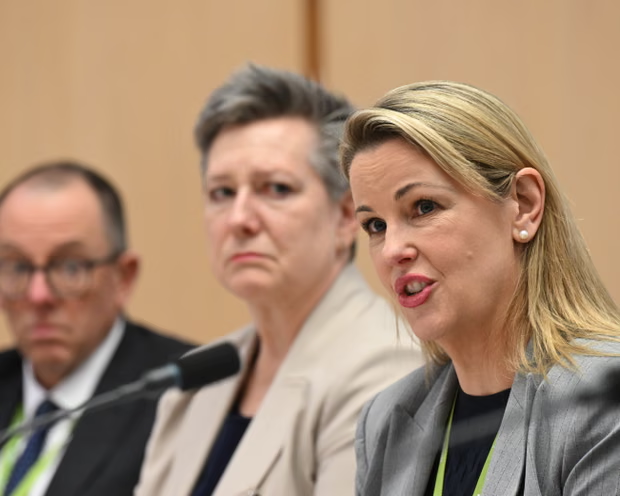
The Australian National University is currently facing an unprecedented and severe reputational crisis. This prestigious global institution has recently suffered a staggering financial blow to its name. The calculated damage to the university brand has now reached about one hundred million dollars. This shocking estimate was delivered directly to an intense parliamentary committee hearing on Friday. Interim Vice-Chancellor Rebekah Brown revealed these distressing figures to the gathered political leaders. She admitted the famous institution has endured an incredibly challenging and turbulent recent period.
The massive financial decline stems from severe damage to the university donor pipeline. Furthermore, international student recruitment has been heavily impacted by these ongoing structural failures. Brown stated that the financial impact is still live and actively evolving today. Officials are continuing to model the full extent of this massive economic shortfall. The university has been plagued by damaging scandals regarding its problematic internal culture. Allegations of poor financial management have also severely tarnished the reputation of the school. Serious accusations of bullying were previously leveled against former chancellor Julie Bishop directly.
Bishop has firmly rejected each and every allegation made against her leadership style. However, the wider governance failures have already triggered massive structural upheaval across campus. A controversial cost-cutting program called Renew ANU sparked intense anger and widespread confusion. This problematic program directly caused the sudden resignation of former Vice-Chancellor Genevieve Bell. Her departure in September followed intense scrutiny from staff and external higher education observers. The aggressive program resulted in at least three hundred and ninety-nine redundancies overall. These deep cuts decimated staff morale and stripped away vital institutional knowledge quite rapidly.
Bishop became chancellor in 2020 but resigned early from her post this May. Her planned term was originally scheduled to expire at the very end of December. The wider university council has also seen five prominent members resign this year. This mass exodus of senior leadership highlights the profound depth of the crisis. The selection of a new chancellor has now been stripped from the council. The national higher education regulator has intervened directly to restore basic institutional integrity. The Tertiary Education Quality and Standards Agency will now oversee the upcoming selection process.
An independent panel will ultimately recommend the next chancellor to the remaining council. Acting Chancellor Andrew Metcalfe openly acknowledged the severe loss of public confidence today. He stated that staff and students have felt deeply hurt and completely undervalued. Metcalfe promised that the current council would confront these systemic failures very directly. The Australian National Audit Office released a incredibly scathing review of the university. This official audit focused heavily on the design of the Renew ANU program. Auditors found the program was approved without any clear evidence of actual necessity.
The university leadership failed to prove the massive cuts were urgent or achievable. Implementing this highly controversial cost-cutting measure eventually cost over thirty-five million dollars total. The program did manage to achieve some ongoing annual savings for the institution. The audit report confirmed annual savings of nearly seventy-five million dollars were realized. However, serious risks regarding future revenue and personnel retention still remain highly critical. Independent Senator David Pocock described the official audit report as a very tough read. He argued the findings fully justified the intense outrage felt by the community.
Pocock claimed the entire situation represented a completely manufactured financial crisis for ANU. The senator highlighted a massive swathe of distinct failings within the university administration. He noted the program was approved without any clear understanding of the problems. Furthermore, leadership failed to properly assess available options or implementation risks beforehand. This ongoing disaster serves as a stark warning for major global universities everywhere. Higher education institutions must maintain transparent governance to protect their valuable international brands. Without rigorous oversight, even the most prestigious universities can suffer catastrophic reputational damage.
The global higher education sector is watching the unfolding situation with deep concern. International student markets are incredibly sensitive to negative news regarding university culture. Parents and students expect safe environments and stable management from top-tier global institutions. The dramatic fall of ANU highlights the fragility of institutional trust today. Rebuilding a shattered reputation often takes decades of consistent and transparent ethical leadership. The interim management team faces an incredibly steep uphill battle moving forward into next year. They must completely rebuild broken trust with fractured staff and disappointed global donors.
The upcoming appointment of the next chancellor will represent a critical turning point. The university requires a leader with impeccable credentials and absolute commitment to reform. Independent oversight will ensure the selection process remains completely fair and transparent throughout. This regulatory intervention is a drastic but necessary step to save the institution. The broader Australian academic community hopes for a swift and comprehensive recovery period. However, the financial scars of this crisis will linger for many years. The hundred-million-dollar loss will inevitably restrict future research and academic development goals.
Faculty members remain deeply concerned about the long-term impacts on educational quality standards. Reduced funding and staffing shortages can severely diminish classroom experiences for enrolled students. The university must prioritize restoring its core educational mission above all else now. Administrative restructuring should focus on empathy, accountability, and clear financial responsibility moving forward. The global reputation of Australian higher education rests heavily on how ANU recovers. International onlookers demand absolute clarity and swift justice regarding past administrative failures. The coming months will reveal if the institution can truly heal its self-inflicted wounds.
An independent panel will ultimately recommend the next chancellor to the remaining council. Acting Chancellor Andrew Metcalfe openly acknowledged the severe loss of public confidence today. He stated that staff and students have felt deeply hurt and completely undervalued. Metcalfe promised that the current council would confront these systemic failures very directly. The Australian National Audit Office released a incredibly scathing review of the university. This official audit focused heavily on the design of the Renew ANU program. Auditors found the program was approved without any clear evidence of actual necessity.
The university leadership failed to prove the massive cuts were urgent or achievable. Implementing this highly controversial cost-cutting measure eventually cost over thirty-five million dollars total. The program did manage to achieve some ongoing annual savings for the institution. The audit report confirmed annual savings of nearly seventy-five million dollars were realized. However, serious risks regarding future revenue and personnel retention still remain highly critical. Independent Senator David Pocock described the official audit report as a very tough read. He argued the findings fully justified the intense outrage felt by the community.
Pocock claimed the entire situation represented a completely manufactured financial crisis for ANU. The senator highlighted a massive swathe of distinct failings within the university administration. He noted the program was approved without any clear understanding of the problems. Furthermore, leadership failed to properly assess available options or implementation risks beforehand. This ongoing disaster serves as a stark warning for major global universities everywhere. Higher education institutions must maintain transparent governance to protect their valuable international brands. Without rigorous oversight, even the most prestigious universities can suffer catastrophic reputational damage.
The global higher education sector is watching the unfolding situation with deep concern. International student markets are incredibly sensitive to negative news regarding university culture. Parents and students expect safe environments and stable management from top-tier global institutions. The dramatic fall of ANU highlights the fragility of institutional trust today. Rebuilding a shattered reputation often takes decades of consistent and transparent ethical leadership. The interim management team faces an incredibly steep uphill battle moving forward into next year. They must completely rebuild broken trust with fractured staff and disappointed global donors.
The upcoming appointment of the next chancellor will represent a critical turning point. The university requires a leader with impeccable credentials and absolute commitment to reform. Independent oversight will ensure the selection process remains completely fair and transparent throughout. This regulatory intervention is a drastic but necessary step to save the institution. The broader Australian academic community hopes for a swift and comprehensive recovery period. However, the financial scars of this crisis will linger for many years. The hundred-million-dollar loss will inevitably restrict future research and academic development goals.
Faculty members remain deeply concerned about the long-term impacts on educational quality standards. Reduced funding and staffing shortages can severely diminish classroom experiences for enrolled students. The university must prioritize restoring its core educational mission above all else now. Administrative restructuring should focus on empathy, accountability, and clear financial responsibility moving forward. The global reputation of Australian higher education rests heavily on how ANU recovers. International onlookers demand absolute clarity and swift justice regarding past administrative failures. The coming months will reveal if the institution can truly heal its self-inflicted wounds.
Related News:
 Saudi Officials Report Zubaidi Flee Before Yemen Peace Talks
 UK Targets in New York Bomb Threat Hoax: Man Jailed
 Gambia Supreme Court Hears Case to Overturn FGM Ban
 Trump targets Iran trade with 25% tariff warning
 US Senate rejects resolution limiting Trump military powers
 Gulf states warn Trump Iran strikes risk wider Middle East war
 Machado Trump medal gesture reshapes Venezuela power struggle
 Geopolitical football: Iran, Trump and the World Cup clash
 Canada-China trade gains momentum in new strategic partnership
 Syria President Declares Victory as Ceasefire Reached with SDF
 Shinzo Abe’s killer receives life sentence in Japan
 China General Under Investigation Amid Leadership Purge
 Philippines ferry disaster leaves 15 dead, dozens missing
 Cambridge Faces Scrutiny Over Arms Investment Transparency
 Concerns rise for Canberra boy amid Iran detention fears
 Ukraine Sends Drone Experts to Defend US Bases in Jordan
 Abramovich Chelsea Sale Cash Faces Jersey Probe
 Yvette Cooper: UK Must Follow Principles, Not US Pressure
 Jury Rules Meta and YouTube Liable for Addictive Design
 The Woman Guarding Earth From the Threat of Asteroids
 Exiled Tycoon Warns of New Russian Attacks on UK Soil
 LA 2028: Millions of Affordable Olympic Tickets Announced
 Trump Slams Europe as Transatlantic Tensions Boil Over
 Inside the Deceptive Machine: A Former Producer Speaks Out
 Spain Faces Backlash Over Xenophobic Chants in Egypt Draw
 A Global Voice For Justice: Stephen Lewis Dies At Age 88
 Hope and Fear as Iranians Flee Across the Turkish Border
 Reform UK Pledges To Halt Visas Over Reparations Demands
 US and Iran Agree to Two-Week Provisional Ceasefire
 Starmer visits Gulf as US and Iran agree ceasefire
 Pakistan Brokers Historic Peace Deal Amid Rising Tensions
 Trump Signals Hope for New Iran Talks as Ceasefire Fades
 US and Iran Pursue Extension of Ceasefire via Pakistan
 Trump’s Islamabad Gamble: The High Stakes of a New Iran Deal
 The General’s Gambit: Pakistan’s New Role in Global Peace
 Mexico, Spain and Brazil call for Cuba dialogue amid crisis
 Pakistan’s Ambitious Bid for Middle East Peace
 Israeli Soldiers Jailed Over Vandalism of Lebanese Statue
 Trump Weighs Sending Afghan Allies to the Congo
 Pentagon Shakes Up Navy Leadership Amid Hormuz Blockade
 Trump Threatens UK With Big Tariff Over Tech Tax
 Prominent Voices Challenge Palestine Action Ban
 Security Scrutiny After Washington Shooting Incident
 Merz Criticises US Approach in Iran Conflict
 UK Envoy Sparks Controversy Over Special Relationship Claims
 Ukraine Urges UK to Seize Russian Oil Tankers
 US Calls Australia Media Law “Foreign Extortion”
 The Billionaire’s Secretary and the £1m Fraud
 Ukraine strikes Tuapse as oil disaster worsens
 Brewing Tension: Taiwan Baristas Rebrand for World Stage
 Tensions Emerge in Netanyahu-Trump Alliance
 Mission to the World’s Edge: A Heroic Rescue in Tristan
 US and Mexico Face Heatwave as Floods Batter South Africa
 Mexico’s Missing: State Complicity in a Growing Crisis
 French Patient Told Hantavirus Was Just Anxiety
 The Long Way Home: Australia’s High-Stakes Virus Mission
 Putin Signals War End as Russian Momentum Stalls
 Romania’s Judicial Crisis: A System Under Siege
 Lee Lai Makes History with Landmark Stella Prize Victory
 Philippine Senator Flees After Days Under Senate Siege
 Alberta Separatist Bid Blocked by Canadian Court
 Canadian Court Blocks Alberta Independence Referendum Bid
 Big Tobacco Under Fire Over Controversial New Ad Campaign
 Bolsonaro Son Tape Scandal Sparks Massive Brazil Backlash
 Court Upholds Landmark Win for Transgender Rights
 Tragedy in the Maldives: Inside the Deep Sea Rescue
 Liberal Senator Criticises Immigration Rhetoric
 Senate Moves to Restrict Trump’s War Powers on Iran
 ICC Arrest Warrant Threat Sparks West Bank Retaliation
 Uefa Transforms Men’s Major Tournament Qualification
 Taliban Codifies Strict New Marriage and Divorce Legislation
 Tony Abbott Returns as New Liberal Party President
 Tiger Escape Shatters Peace in Germany
 Tulsi Gabbard exits after turbulent intelligence tenure
 Discontent grows around Putin amid war strain
 Trump Diplomacy Faces Hurdles from Tehran to Tbilisi
 Teaching Machines Right From Wrong in the Digital Age
 Trump Faces Legal Blow Over Global Tariffs
 Washington Brokerage Sparking Hope Amid Regional Firestorms
 New York Consumer Watchdog Tackles Corporate Lawbreaking