Published: 13 August 2026 | The English Chronicle Desk | The English Chronicle Online
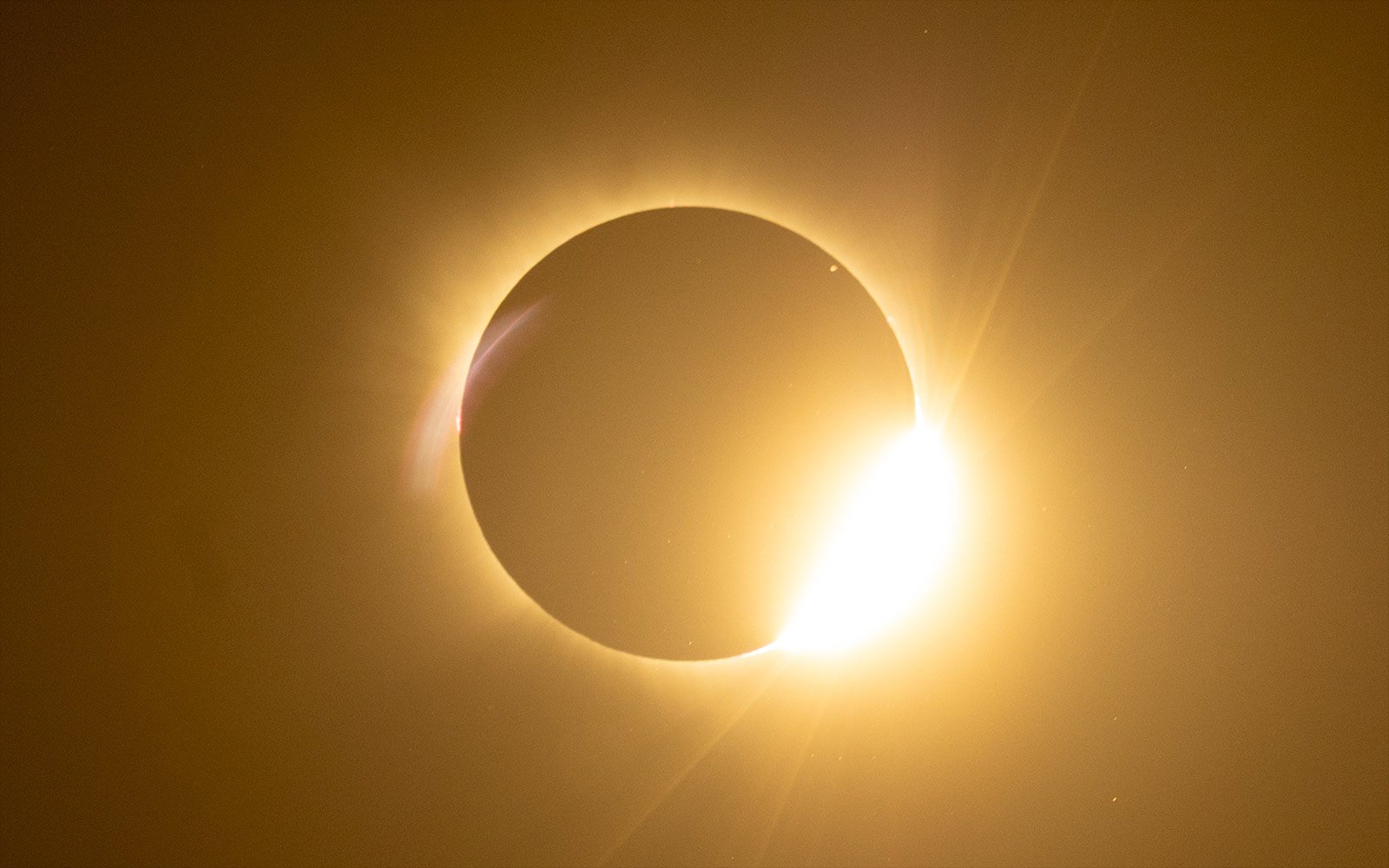
Millions of people across Europe experienced an extraordinary celestial spectacle as the Moon moved directly between Earth and the Sun, transforming daylight into darkness and creating one of the most striking eclipses seen across the continent in decades.
The eclipse drew crowds to streets, parks, beaches, viewing sites and open countryside, with people gathering to witness the rare alignment of the Sun, Moon and Earth. For many observers, the event lasted only a few minutes, but the sudden change in the sky created a memorable experience that brought together professional astronomers, amateur sky-watchers and members of the public.
In much of the United Kingdom, the Moon covered more than 90% of the Sun. It was the greatest extent of solar coverage seen across much of the country since 1999, making the event particularly significant for a generation of observers who had never experienced such a dramatic eclipse.

Parts of Greenland, Iceland and Spain were even more fortunate. They lay within the path of totality, where the Moon completely obscured the visible surface of the Sun for a short period.
As the eclipse progressed, daylight gradually weakened. Shadows became unusual, temperatures changed in some locations and the atmosphere took on an eerie appearance. In areas close to totality, the transition from daylight to darkness happened remarkably quickly, giving spectators the impression that evening had suddenly arrived in the middle of the day.
For those fortunate enough to experience totality, darkness lasted for less than two minutes. Yet the brief period was enough to create scenes of excitement and wonder.
Some crowds cheered when the final visible portion of the Sun disappeared behind the Moon. Others watched quietly, captivated by the unusual sight above them.
A solar eclipse occurs when the Moon passes between Earth and the Sun and temporarily blocks some or all of the Sun’s light. Although eclipses are natural astronomical events, total solar eclipses are relatively rare from any particular location because the Moon’s shadow covers only a narrow section of Earth’s surface.
That rarity helps explain why large crowds often travel considerable distances to reach the path of totality.
For astronomers, eclipses are not simply spectacular public events. They also provide valuable opportunities to study the Sun and its surrounding atmosphere.
During a total solar eclipse, the bright surface of the Sun is blocked, allowing observers to see the solar corona, the outer atmosphere that is normally difficult to observe because of the overwhelming brightness of the Sun.
The corona can reveal information about solar activity, magnetic fields and the movement of extremely hot plasma around the Sun. Scientists can combine observations made during eclipses with data collected by satellites and space-based observatories to improve their understanding of solar behaviour.
The event also demonstrated the continuing public fascination with astronomy. Long before the eclipse began, viewing locations across Europe attracted people hoping to secure a clear view of the sky.
For many families, schools and community groups, the eclipse became an opportunity to introduce children to astronomy and explain the movements of planets and moons.
Teachers and science communicators used the event to demonstrate how the Earth, Moon and Sun interact. The eclipse provided a real-world example of concepts that are often difficult to visualise in a classroom.
The spectacle also created an important reminder about eye safety. Looking directly at the Sun without suitable protection can cause permanent damage to the eyes, even when most of the solar disc is covered.
Specialised eclipse glasses and approved solar viewing equipment are required for safe observation during the partial phases of an eclipse. Ordinary sunglasses are not sufficient protection.
The need for safe viewing was particularly important in Britain, where most observers experienced a partial rather than total eclipse. With more than 90% of the Sun covered in some areas, the remaining visible portion was still intensely bright.
The difference between partial and total eclipses is significant. During a partial eclipse, part of the Sun remains visible throughout the event, while during totality the Moon completely covers the solar disc. Only during the brief period of totality can observers safely view the fully eclipsed Sun without solar viewing filters, and only when totality has actually begun.
The eclipse also offered a striking demonstration of how dramatically the appearance of the environment can change when sunlight is temporarily reduced.
Across Europe, people reported an unusual atmosphere as the Moon moved across the Sun. The changing light affected landscapes, buildings and crowds, creating photographs that captured a moment very different from an ordinary daytime scene.
The event was particularly meaningful for people who had waited years to witness a major eclipse. Solar eclipses can be predictable with extraordinary precision, but their visibility depends heavily on location and weather conditions.
Cloud cover can turn an eagerly anticipated astronomical event into a disappointing experience. Clear skies, by contrast, can transform the same event into an unforgettable spectacle.
For communities located within the path of totality, the eclipse represented more than a scientific curiosity. It became a major public occasion, bringing together visitors and residents in anticipation of a few seconds or minutes of complete darkness.
The phenomenon also highlighted the remarkable precision of celestial mechanics. The apparent size of the Moon and Sun in Earth’s sky allows the Moon to cover the Sun almost perfectly during total solar eclipses. This alignment is possible because the Sun is vastly larger than the Moon but also much farther away from Earth.
The result is one of nature’s most dramatic visual coincidences.
Modern technology has changed how people experience such events. Thousands of spectators used smartphones and cameras to record the changing light, while broadcasters and scientific organisations shared images with audiences far beyond the areas where the eclipse could be seen.
Social media allowed photographs and videos from different countries to appear almost immediately, creating a shared European experience.
Yet photographs and videos cannot completely reproduce what observers experience in person. The sudden darkness, changing temperature, altered shadows and reaction of surrounding crowds combine to create an atmosphere that is difficult to capture digitally.
For some observers, the eclipse may also have encouraged a renewed interest in astronomy. Events of this kind often inspire people to learn more about the Moon, planets, stars and the wider universe.
Scientists say eclipses remain valuable not only because they generate public interest but also because they provide opportunities to communicate science to audiences who may not normally engage with astronomy.
The European eclipse therefore combined scientific significance with a powerful cultural and emotional impact.
For people in the United Kingdom, the sight of more than 90% of the Sun disappearing was particularly remarkable given the rarity of such extensive coverage. For those in Greenland, Iceland and Spain who experienced totality, the event offered an even more extraordinary view as daylight briefly gave way to darkness.

Then, almost as quickly as it arrived, the darkness began to disappear.
The Moon continued along its path, gradually uncovering the Sun and restoring daylight. Crowds began to disperse, cameras were put away and ordinary daytime activity slowly resumed.
But for the millions who witnessed it, the eclipse offered a rare interruption to everyday life: a moment when an entire continent looked upwards and watched the movements of the solar system unfold above them.
The spectacle served as a reminder that, despite the routine of modern life, the night sky and the wider universe remain capable of producing events that unite people through simple curiosity and wonder.
For a few fleeting moments, the Sun disappeared, daylight faded and Europe stood beneath an extraordinary celestial shadow. The darkness was brief, but the memory is likely to last considerably longer.
Related News:
 Magnitude 7.1 Earthquake Strikes Japan, Several Injured
 People Trapped in Japan Shopping Centre After Earthquake
 Many Trapped Inside Japanese Shopping Centre After Earthquake
 Japan Quake Survivors Recall Terror as Homes Crumble
 British AI Startup Outshines Human Forecasters in Global Prediction Contest
 UK Fighter Jet Purchase Could Breach Nuclear Treaty, Warns CND
 Google at 27: The Untold Story of Ruth Kedar, the Woman Behind the Iconic Logo
 Cooper Unveils £4m Cyber Plan Against Russian Hackers
 Experts Warn Russia’s Burevestnik Missile Could Destabilise Arms Control
 Britain deploys RAF specialists to assist Belgium with drone threats
 Hitler’s DNA Confirms He Truly Had Only One Testicle
 Pokémon to open world’s first theme park in Japan next year
 US Clears Nvidia AI Chip Sales to China in Policy Shift
 UK New Car Discounts Near £6,000 as Prices Are Slashed
 Snow and Rain Warnings as Cold Snap Continues in the UK
 Shutting North Sea ‘Will Drive Up Carbon Emissions’
 Indian University Kicked Out of AI Summit for Claiming Chinese Robot Dog as Its Own Invention
 China Shows Off Nunchuck‑Wielding Humanoid Robots for Lunar New Year
 Eight Skiers Found Dead After California Avalanche
 The Chinese AI App Sending Hollywood Into a Panic
 How Do You Modernise Mango Farming? India’s Growers Urged to Innovate as Climate Change Hits
 Bill Gates Pulls Out of India’s AI Summit Over Epstein Files Controversy
 Musk Cuts Starlink Access for Russian Forces – Giving Ukraine an Edge at the Front
 Storm Hernando: Edinburgh Airport Flights Cancelled in US Travel Chaos
 Social Media Trial: Woman Says Addiction Began at Six
Instagram Investigating AI Profiles ‘Fetishising’ Disabled People
Social Media Trial: Woman Says Addiction Began at Six
Instagram Investigating AI Profiles ‘Fetishising’ Disabled People
 Anthropic Boss Rejects Pentagon Demand to Drop AI Safeguards
 Why Russia Controls Its People With a Flick of a Switch
 The US Now Has the Medicine for Cheap Swarming Drone Attacks
 Boy George Says He’s Using ChatGPT to Help Write New Songs
 Protesters Rally in San Francisco Against OpenAI Deal With Pentagon
 We Have More Privacy Controls Yet Less Privacy Than Ever — The Paradox of Digital Life
 Study Says Only Two Nations May Survive Nuclear War
 Spring Awakening: Temperatures to Hit 17°C as Britain Bathes in Sunshine
 One Ant for $220: The New Frontier of Wildlife Trafficking
 Trump Considers Military Operation to Seize Iran’s Uranium
 Jim Ratcliffe’s £3.5bn Chemical Plant Delayed with Parts Stranded in the Gulf
 ‘At the Doorstep of the Future’: Florida’s Space Coast Braces for Historic Artemis II Launch
 ‘We Go for All Humanity’ — Artemis II Returns Humans to the Lunar Vicinity
 The Orion Capsule: A High-Stakes Vigil in Earth’s Orbit
 A Name for the Nameless: DNA Finally Links 1974 Utah Murder to Ted Bundy
 7.4-Magnitude Earthquake Jolts Eastern Indonesia; Tsunami Warning Lifted
 Breaking the Horizon: Blind Runner to Tackle Brighton Marathon with Smart Glasses
 Red Skies and Raging Floods: One Dead as Storm Erminio and Saharan Dust Grip Greece
 Lunar Bound: Artemis II Leaves Earth’s Orbit for Historic Deep-Space Journey
 “Homo Sapiens are All of Us”: Artemis II Crew Sends Emotional Message of Unity from Deep Space
 Apple at 50: Three Products That Changed How We Live
 Voices of the Vanguard: ‘Audio Time Capsule’ of Disability Rights Pioneers Discovered
 Electric Shock: Australians Buy Record Number of New EVs as Fuel Crisis Bites
 War, Windfalls, and the Carbon Trap: The Iran Conflict’s Brutal Energy Math
 The Great Chokehold: Why the Strait of Hormuz is the Epicenter of the 2026 Crisis
 Moldova River Crisis Exposes War’s Hidden Cost
 The Outback Squeeze: ‘Out of Control’ Diesel Prices Threaten Australia’s Freight Arteries
 The Frozen Frontier: Why Frostbite is the Least of Concerns for Canada’s Arctic Forces
 Canadian astronaut French words ease language row
 ‘The End of the Quiet Era’: Japan Relaxes Arms Export Rules in Historic Pivot From Pacifism
 Rations and Rides: Global Responses to the 2026 Fuel Crisis
 Beyond the Swoosh: Anta Sports Overtakes Rivals to Become Global Top Three
 “Grounded”: Beijing Implements Total Ban on Drone Sales Citing Capital Security
 “The Floating Fever”: WHO Confirms Second Hantavirus Case as Cruise Outbreak Death Toll Reaches Three
 “A Deliberate Act”: NTSB Data Reveals Fuel Cut-Off Preceded Fatal 2022 China Eastern Crash
 “The Digital Frontier”: Scotland’s Papers Grapple with AI Harassment and ‘Mortgage Bottlenecks’
 “The Trial’s Strange Turn”: Musk v. Altman Case Veers into Personal Testimony and ‘Sperm Offers’
 “The Mush-Brain Mandate”: How to ‘Think Outside the Bots’ and Bypass the AI Resilience Deficit
 “The Turbo-Fly Blueprint”: Tiny Insect Brains Spark a ‘Clinical’ Revolution in Neuromorphic AI
 “The Swap Shop”: Dr Chris van Tulleken Backs Southampton Teens’ Fight Against ‘The Matrix’ of Ultra-Processed Food
 “The Bio-Marker Breakthrough”: At-Home Blood Test Could Spot Alzheimer’s Risk Years Before ‘Clinical’ Symptoms
 “The Gavel of Governance”: Meet the ‘No-Nonsense’ Judge Bypassing the ‘Accountability Rot’ in Musk v Altman
 The Pathogen Protocol”: Third British National Monitored for ‘Nasty’ Suspected Hantavirus
 “Eyes in the Sky, Spikes on the Ground”: Advanced Satellite Imagery and AI Algorithms Deployed Across Britain to Save the Vanishing Hedgehog
 “The Critical Intervention”: Essential Steps for Identifying and Treating Heat-Related Emergencies
 UN Issues Urgent Warning: Imminent Return of El Niño
 Dangerous Heatwave Grips United States as Millions Brace for Fourth of July Holiday
 UK Heatwaves May Have Claimed Thousands of Lives
 France Approves Law Banning Children Under 15 from Social Media Platforms
 French Firefighters Battle ‘David vs Goliath’ Wildfire
 AI Jitters Send Chip Stocks Tumbling in US and Asia
 Wildfires Intensify in South-West France as Region Braces for 40C Heatwave
 Two Killed as Firefighting Helicopters Collide During Greece Wildfire Mission
 Drone Warnings Issued as South Korea Battles Historic Heatwave