Published: 03 August 2026 | The English Chronicle Desk | The English Chronicle Online
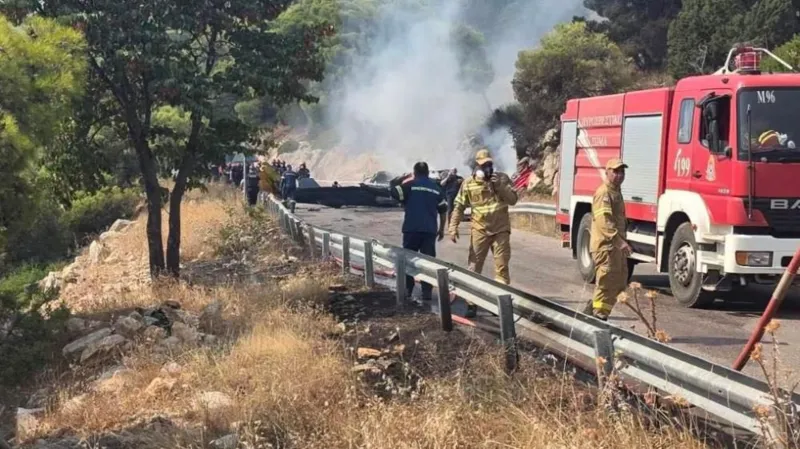
Two crew members have died after two firefighting helicopters collided while battling a wildfire in Greece, with a British pilot surviving the crash, according to authorities.
The accident happened during a firefighting operation as crews were working to control a blaze that had spread in challenging conditions. The incident has shocked Greece’s emergency services and raised renewed concerns about the risks faced by pilots and rescue workers who operate in dangerous environments during wildfire seasons.
Officials have launched investigations into the cause of the collision as emergency teams continue their efforts to contain wildfires affecting parts of the country.
The two helicopters were involved in efforts to support ground crews fighting a wildfire when they collided, causing a fatal accident.
Emergency services confirmed that two members of the helicopter crews lost their lives in the crash.
A British pilot involved in the operation survived the incident and was reported to be safe following the collision.
Authorities have not yet released full details about the circumstances surrounding the accident, including the exact sequence of events leading to the collision.

Investigators are expected to examine flight data, communication records, weather conditions and operational procedures as part of their inquiry.
Helicopters play a vital role in wildfire response, particularly in areas where difficult terrain makes it challenging for firefighters on the ground to reach affected locations.
They are used to drop large quantities of water, support evacuation operations and help slow the spread of flames.
However, wildfire firefighting is considered one of the most demanding forms of aviation work.
Pilots often operate at low altitudes, close to smoke, flames, mountains and unpredictable wind conditions.
Reduced visibility caused by smoke and rapidly changing weather can create significant risks even for highly experienced crews.
The accident comes as Greece continues to face increasing wildfire threats during periods of extreme heat and dry weather.
The Mediterranean country has experienced severe fires in recent years, with rising temperatures, prolonged drought conditions and strong winds contributing to dangerous fire conditions.
Climate experts have warned that warmer and drier summers are increasing the likelihood of intense wildfires across southern Europe.
Greece has invested heavily in emergency response systems, including aircraft, firefighting equipment and international cooperation programmes, but officials say the scale of modern wildfires presents unprecedented challenges.
Following the crash, tributes were paid to the two crew members who died while carrying out their firefighting duties.
Government officials and emergency service leaders described them as professionals who lost their lives protecting communities and fighting natural disasters.
Firefighting crews often operate in dangerous situations, placing themselves at risk to protect homes, forests and vulnerable populations.
The deaths have prompted messages of sympathy from colleagues and members of the public.
Officials said support would be provided to the families of those who lost their lives.
The survival of the British pilot involved in the crash has drawn attention, with officials confirming that the pilot escaped the incident.
The pilot’s role in the operation and the condition following the accident have not been fully detailed.
Aviation experts said surviving a helicopter collision during a firefighting mission depends on multiple factors, including the nature of the impact, altitude, aircraft condition and emergency response time.
The incident has highlighted the international nature of wildfire response, with pilots and crews from different countries often supporting nations facing severe fire emergencies.
Greek authorities have begun investigating the circumstances surrounding the collision.
Aviation accident investigators are expected to examine several possible factors, including:
- Weather and visibility conditions.
- Communication between aircraft.
- Flight coordination procedures.
- Mechanical issues.
- Pilot decision-making during the operation.
Officials have stressed that conclusions will not be reached until a full investigation has been completed.
Aviation investigations can take months or longer, particularly when analysing technical information and operational procedures.
Firefighting aircraft crews around the world face significant dangers while responding to natural disasters.
Wildfire pilots must make rapid decisions in environments where conditions can change within minutes.
Unlike routine aviation operations, wildfire missions often require repeated low-level flying, precise water drops and close coordination with ground teams.
The pressure increases during major emergencies when firefighters are racing against time to stop flames from reaching populated areas.
Safety officials say improving coordination, training and technology remains essential to reducing risks.
Scientists have increasingly linked the rise in severe wildfires to climate change.
Higher temperatures, reduced rainfall and longer dry seasons create conditions where vegetation becomes more vulnerable to ignition.
Southern European countries, including Greece, Spain, Italy and Portugal, have experienced increasingly intense wildfire seasons.
Researchers warn that traditional firefighting methods are being tested by fires that spread faster and cover larger areas than in previous decades.
Governments across Europe have been increasing investment in prevention, early warning systems and emergency response capabilities.
The loss of two experienced crew members could affect firefighting operations as Greece continues to battle seasonal fires.
However, officials have emphasised that emergency services remain fully operational and continue working to protect communities.
Firefighting aircraft remain a critical part of Greece’s wildfire strategy, particularly during periods of extreme weather.
International assistance is also frequently provided through European emergency response mechanisms when countries face overwhelming fire threats.
The helicopter collision is expected to prompt further discussions about aviation safety during wildfire operations.
Experts say improved communication systems, advanced monitoring technology and better coordination between aircraft can help reduce risks.
Modern firefighting aircraft are equipped with sophisticated technology, but human judgement remains essential in challenging environments.

The incident serves as a reminder of the dangers faced by those who work in emergency response roles.
The deaths of two crew members after firefighting helicopters collided in Greece have highlighted the dangers faced by aviation teams battling increasingly severe wildfires.
While a British pilot survived the crash, the tragedy has brought grief to emergency services and raised questions about the challenges of operating aircraft in extreme firefighting conditions.
As investigators work to determine the cause of the collision, Greece continues its battle against wildfires intensified by heat, drought and changing climate conditions.
The accident is a reminder of the courage and risks involved in protecting communities during some of the world’s most dangerous natural disasters.
Related News:
 Thousands Evacuated in France as Wildfires Spread Across Regions
 Wildfires Intensify in South-West France as Region Braces for 40C Heatwave
 At Least 19 Killed After Powerful Earthquake Hits Southern Philippines
 Deadly Spain Wildfire Leaves 11 Dead, 19 Missing
 Wildfires Force Mass Evacuations in France And Spain
 Wildfires Threaten Bordeaux as Mass Evacuations Grow
 Wildfires Advance Toward Farmland Near Bordeaux
 French Wildfire Sparks Rare Lightning Storm Near Bordeaux
 French Firefighters Battle ‘David vs Goliath’ Wildfire
 Dozens of Flood Warnings in England After Days of Non-Stop Rain
 Fast-moving Wildfires Rage Across Southwestern US
 Shutting North Sea ‘Will Drive Up Carbon Emissions’
 As Trump Retreats from Climate Goals, China Is Becoming a Green Superpower
 Storm Hernando: Edinburgh Airport Flights Cancelled in US Travel Chaos
 Storm Hernando: Edinburgh Airport Flights Cancelled in US Travel Chaos
 UK Winter Nowhere Near a Record Breaker Despite Floods and Storms
 UK Records Warmest Day of the Year as Temperatures Exceed 18 °C
 Millions Left Without Power as Grid Fails
 Red Skies and Raging Floods: One Dead as Storm Erminio and Saharan Dust Grip Greece
 Evacuations Ordered as California Wildfires Spread Fast
 Queensland Braces for Potential Second Severe Cyclone Hit
 The Spiky Standoff: German Mayors Call for Night-Time ‘Robot Ban’ to Save Hedgehogs
 Capitalism ‘Suicidal’, Warns Petro at Climate Summit
 Ukraine strikes Tuapse as oil disaster worsens
 Norway Doubles Down on Oil and Gas for Europe Energy Security
 The Great May Meltdown: Europe Braces for a Historic Swing from Arctic Chill to Extreme Late-Spring Heat
 Pope Meets Families in Italy Toxic Waste Zone
 Deadly Earthquake Hits Philippines
 Temperatures Set to Fall This Week, But Forecasters Warn Heat Could Return Soon
 Why Extreme Heat Can Cause Trees to Collapse and What Experts Say Can Be Done
 African Fishermen Blame Chinese Trawlers for Declining Catches
 Venezuela Quake Death Toll Surpasses 4,000
 Rain Forecast to Return This Weekend as Parts of UK Edge Closer to Drought Conditions
 No Helicopters Available to Fight Wildfires as ‘Crisis Management’ Plans Activated
 Venezuelans Still Seek Answers One Month After Quakes
 France Evacuates Tourist Area as Wildfires Spread
 Amber Heat Health Alerts Issued as UK Heatwave Set to Reach 35C Peak
 ‘Extinct’ Antelope Returns to Sahara, Bringing Hope
 EU weighs response amid Greenland tariff crisis with Trump
 EU Says US Ties Have Suffered ‘Big Blow’ After Greenland Crisis
 Thousands Left Without Heating in Ukraine Amid Russia Strikes
 What is Groundwater Flooding and Why Dorset is Seeing ‘Historical Highs’
 Portugal Election Delivers Socialist Win as Far Right Surges
 Macron Rebuked in Franco-German Defence Row
 Temperatures Dip Below Freezing as Arctic Air Sweeps Across the UK
 Snow and Rain Warnings as Cold Snap Continues in the UK
 Flooding May Worsen Before It Improves as More Rain Forecast for the UK
 Eight Skiers Found Dead After California Avalanche
 How Do You Modernise Mango Farming? India’s Growers Urged to Innovate as Climate Change Hits
 Louvre Museum Director Resigns Months After High‑Profile Heist
 Orbán Accuses Ukraine of Disrupting Oil Supplies to Hungary
 Greenpeace $345m Ruling Sparks Appeal Battle
 Spain Declassifies Files on 1981 Attempted Coup in Effort to Dispel Conspiracy Theories
 Macron Finds ‘Freedom Fries’ Redemption in Iran Crisis
 Study Says Only Two Nations May Survive Nuclear War
 Finland Plans to Lift Decades‑Old Ban on Hosting Nuclear Weapons
 Ukraine War Becomes Flashpoint in Hungarian Election
 The Banbridge Rescue: 300 Sheep Saved from Massive Hay Shed Inferno
 ‘The Soul of Spain’: Politicians Clash Over Renewed Push to Move Picasso’s Guernica
 Moldova River Crisis Exposes War’s Hidden Cost
 “Speechless and Determined”: Two Dead, 22 Injured in Leipzig “Vehicular Rampage”
 Man killed in shark attack on Great Barrier Reef
 UN Issues Urgent Warning: Imminent Return of El Niño
 Zelensky Invites Putin to Direct Peace Talks
 European Allies Set Peace Terms for Ukraine
 Spain Tourism Surges as Travellers Avoid Middle East
 Spain Sees Tourism Boom as Travellers Shift Away From Middle East

 Net Zero School Remains Cool and Open as Heatwave Tests Britain’s Buildings
 Girl Survives 32 Hours Under Rubble After Venezuela Quake
 China Storms Claim Fifteen Lives in Tragic Surge
 Le Pen to Run for President Despite Embezzlement Conviction
 Europe Scorched as Record Heatwaves Grip the Continent
 UK Heatwaves May Have Claimed Thousands of Lives
 Britain Set for ‘Bumper Year’ for Butterflies as Conservationists Predict Strong Season
 Three-Quarters of England’s Riverbanks Still Off Limits
 Berlin Pride Attack Suspect Killed in Police Raid
 Trump Hosts Zelensky and Netanyahu as Ukraine and Iran Conflicts Shape Global Agenda
 Major Incident Declared in Suffolk as 90 Firefighters Battle Heathland Wildfire