Published: July 10, 2026 | The English Chronicle Desk | The English Chronicle Online
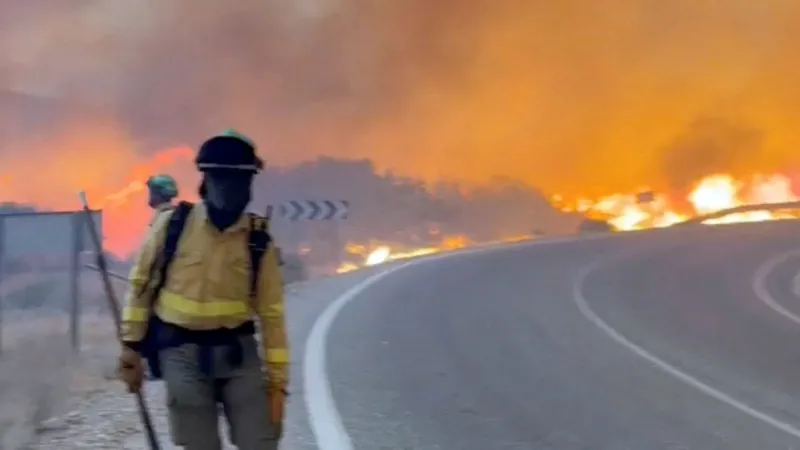
A devastating wildfire sweeping through southern Spain has claimed at least 11 lives, left 19 people missing and forced the evacuation of around 1,000 residents, as emergency crews battle one of the deadliest forest fires the country has witnessed in recent years. Authorities in the Andalusia region say the blaze spread with extraordinary speed through dry woodland near Los Gallardos in Almería province, overwhelming residents and emergency responders alike.
Regional officials have warned that the death toll could rise as firefighters continue searching burned-out vehicles, homes and forested areas while attempting to contain the advancing flames.
The tragedy unfolded during an intense heatwave that has pushed temperatures close to 40 degrees Celsius across large parts of southern Spain, creating ideal conditions for rapidly spreading wildfires. Strong winds, dry vegetation and prolonged drought have further complicated firefighting operations, with authorities describing the incident as one of the most destructive natural disasters to strike the region in decades.

Andalusian regional president Juanma Moreno expressed deep sorrow over the loss of life, describing the disaster as a heartbreaking moment for the entire region.
“Our hearts are filled with grief,” Moreno said while visiting the affected area. He warned that rescue teams continued searching locations that remain inaccessible because of dangerous fire conditions, meaning additional victims could still be found.
Emergency officials confirmed that the bodies of 11 victims were recovered in and around the village of Bédar, situated near Los Gallardos.
Several victims were discovered attempting to flee advancing flames, while four others were found inside a vehicle that became trapped as fire engulfed nearby roads.
Antonio Sanz, Andalusia’s Minister for Health and Emergency Services, said preliminary investigations indicate that four of the deceased may have been British nationals.
Investigators reached that initial conclusion after discovering that the vehicle involved featured a right-hand-drive steering wheel, although formal identification procedures remain underway.
British consular officials are working alongside Spanish authorities to establish the identities of the victims and provide assistance to affected families.
The UK’s Foreign Office said it was in contact with local authorities and stood ready to support British nationals impacted by the disaster.
Spanish emergency services also confirmed that at least four people remain in hospital with severe burn injuries.
Another four patients are receiving treatment for less serious burns, smoke inhalation and respiratory complications resulting from prolonged exposure to heavy smoke.
Doctors say several of those injured remain in critical condition, while specialist burn units continue providing intensive care.
Hundreds of firefighters supported by military emergency units, helicopters and water-dropping aircraft have been deployed to contain the wildfire.
The Spanish Military Emergency Unit, frequently mobilised during major natural disasters, joined regional firefighting teams as authorities sought to prevent flames from spreading towards additional communities.
Fire crews have faced exceptionally difficult conditions.
Steep terrain, dense woodland, powerful winds and extreme temperatures have repeatedly hampered containment efforts, forcing emergency teams to work around the clock under hazardous circumstances.
Authorities have closed multiple roads across the affected region while ordering the evacuation of approximately 1,000 residents from nearby villages.
Temporary shelters have been established for displaced families, with local municipalities coordinating accommodation, food, medical assistance and psychological support.
Investigators believe the fire may have originated after the collapse of a power line.
Juanma Moreno said early evidence suggested that a damaged electricity pole triggered the blaze before flames rapidly spread across surrounding vegetation.
However, officials stressed that a comprehensive technical investigation will be required before the precise cause can be officially confirmed.
“If maintenance failures are found to have contributed, those responsible will be held accountable,” Moreno said.
Electricity infrastructure experts have already begun inspecting damaged transmission equipment while prosecutors monitor the investigation.
The wildfire comes during another exceptionally severe fire season across southern Europe.
Spain, Portugal and France have all experienced repeated outbreaks as prolonged periods of extreme heat combine with unusually dry vegetation to increase wildfire risks.
Thousands of people have been forced from their homes across several Mediterranean countries during recent weeks as emergency services respond to multiple simultaneous fires.
Meteorologists attribute the worsening conditions to a prolonged heatwave affecting much of southern Europe.
Several Spanish regions have recorded daytime temperatures approaching or exceeding 40 degrees Celsius, while forecasts indicate further periods of intense heat remain likely.
Scientists say such conditions dramatically increase the likelihood that even small ignition sources can develop into rapidly spreading wildfires.
Climate researchers continue warning that rising global temperatures are extending Europe’s wildfire season.
According to the European Union’s Copernicus Climate Change Service, Europe is warming approximately twice as fast as the global average, contributing to longer heatwaves, drier landscapes and increasingly severe fire conditions.
Spain has experienced several record-breaking temperature events in recent years.
Last year alone, nearly 393,000 hectares of land burned across the country, according to the European Forest Fire Information System. That figure represented more than six times Spain’s long-term annual average and highlighted the growing severity of wildfire risks facing Mediterranean nations.
Across the European Union, more than one million hectares of land burned during last year’s wildfire season, making it the worst since systematic records began.
Researchers from the World Weather Attribution initiative have linked increasingly destructive Mediterranean wildfire seasons directly to climate change, concluding that higher temperatures and prolonged drought substantially increase both the likelihood and intensity of extreme fires.
Environmental scientists say continued warming is expected to make such disasters more frequent unless global greenhouse gas emissions are significantly reduced.
Meanwhile, local residents returning briefly to assess damaged properties described scenes of devastation.
Entire hillsides have been reduced to blackened earth, while homes, vehicles and agricultural land have suffered extensive damage.
Many families remain uncertain whether their houses survived as emergency authorities continue restricting access to dangerous areas.

Search operations for the 19 missing people remain underway.
Emergency teams equipped with drones, thermal imaging technology and specially trained rescue personnel are combing affected forests and isolated rural properties whenever fire conditions allow safe access.
Authorities have urged residents not to enter evacuation zones independently, warning that rapidly changing wind conditions continue creating life-threatening hazards.
As Spain mourns another deadly wildfire, officials say their immediate priority remains saving lives, supporting displaced communities and bringing the blaze under control before weather conditions worsen further.
The disaster has once again underscored the growing challenge posed by extreme weather events across southern Europe and renewed calls for stronger wildfire prevention, infrastructure resilience and climate adaptation measures in the years ahead.
Related News:
 Norway Doubles Down on Oil and Gas for Europe Energy Security
 The Great May Meltdown: Europe Braces for a Historic Swing from Arctic Chill to Extreme Late-Spring Heat
 Pope Meets Families in Italy Toxic Waste Zone
 Deadly Earthquake Hits Philippines
 EU weighs response amid Greenland tariff crisis with Trump
 EU Says US Ties Have Suffered ‘Big Blow’ After Greenland Crisis
 Thousands Left Without Heating in Ukraine Amid Russia Strikes
 Canada Dispatches Senior Officials to Open Greenland Consulate
 Dozens of Flood Warnings in England After Days of Non-Stop Rain
 Portugal Election Delivers Socialist Win as Far Right Surges
 BRRRITAIN: Met Office Issues Yellow Weather Warning for More Snow
 Macron Rebuked in Franco-German Defence Row
 Facing a Demographic Catastrophe, Ukraine Is Paying for Troops to Freeze Their Sperm
 Five Young People Die in Spain Apartment Block Fire
 Snow and Rain Warnings as Cold Snap Continues in the UK
 Shutting North Sea ‘Will Drive Up Carbon Emissions’
 Eight Skiers Found Dead After California Avalanche
 Break from Wintry Weather as UK Temperatures to Climb to 14 °C
 How Do You Modernise Mango Farming? India’s Growers Urged to Innovate as Climate Change Hits
 New Russia Sanctions on Hold as Hungary Blocks EU Package Ahead of Fourth Ukraine War Anniversary
 Storm Hernando: Edinburgh Airport Flights Cancelled in US Travel Chaos
 More Than 5,000 Flights Cancelled as US East Coast Digs Out of Record Snow
 Rob Jetten becomes Netherlands’ youngest ever prime minister
 Ukraine remembers its dead as war enters a fifth year
 Louvre Museum Director Resigns Months After High‑Profile Heist
 Orbán Accuses Ukraine of Disrupting Oil Supplies to Hungary
 UK Winter Nowhere Near a Record Breaker Despite Floods and Storms
 UK Records Warmest Day of the Year as Temperatures Exceed 18 °C
 Spain Declassifies Files on 1981 Attempted Coup in Effort to Dispel Conspiracy Theories
 Hungary Faces Political Tension Over the Ukraine Crisis
 Russia Blames Ukrainian Naval Drones as Tanker Sinks
 Macron Finds ‘Freedom Fries’ Redemption in Iran Crisis
 Study Says Only Two Nations May Survive Nuclear War
 Finland Plans to Lift Decades‑Old Ban on Hosting Nuclear Weapons
 Istanbul Mayor Faces Corruption Trial Amid Political Storm
 Ukraine War Becomes Flashpoint in Hungarian Election
 Bodies of Two Chinese Backpackers Found in Floodwaters
 Red Skies and Raging Floods: One Dead as Storm Erminio and Saharan Dust Grip Greece
 Evacuations Ordered as California Wildfires Spread Fast
 The Spiky Standoff: German Mayors Call for Night-Time ‘Robot Ban’ to Save Hedgehogs
 ‘The Soul of Spain’: Politicians Clash Over Renewed Push to Move Picasso’s Guernica
 The ‘Svuota Londra’ Effect: Why the Super-Rich are Swapping Dubai for Milan
 Moldova River Crisis Exposes War’s Hidden Cost
 Cyclone Vaianu Forces Mass Evacuations in New Zealand
 Capitalism ‘Suicidal’, Warns Petro at Climate Summit
 Coalition pushes fossil fuel phaseout plan
 Ukraine strikes Tuapse as oil disaster worsens
 Global order shifts amid Trump-era turmoil
 “Speechless and Determined”: Two Dead, 22 Injured in Leipzig “Vehicular Rampage”
 The Quarantine Crossing”: Hantavirus-Hit MV Hondius Bound for Canary Islands After Deadly Outbreak
 France Faces Record Presidential Crowded Race Amid Far-Right Surge
 Bad Weather Threatens Hantavirus Cruise Ship Evacuation
 Ex-Chief of Staff Named in Major Ukraine Corruption Probe
 “A Classroom in Crisis”: Special School Extends Closure Following Devastating Flash Flooding
 “The Climate Multiplier”: Assessing the Dual Threat of Disease-Bearing Mosquitoes and Heat-Related Mortality
 Former ICC prosecutor condemns US sanctions
 Deadly Russian Air Raids Strike Across Ukraine
 UN Issues Urgent Warning: Imminent Return of El Niño
 Zelensky Invites Putin to Direct Peace Talks
 Republicans Defy Trump on Ukraine Aid Bill
 Albania Protests Erupt Over Luxury Resort Plan
 Papal Visit Offers Political Lifeline to Spanish Premier
 Global Chicken Consumption Soars, UN Reports
 European Allies Set Peace Terms for Ukraine
 Spain Tourism Surges as Travellers Avoid Middle East
 Drone Attacks Overshadow Russia Economic Forum
 Armenia Votes Under Pressure From Russia
 At Least 19 Killed After Powerful Earthquake Hits Southern Philippines
 Spain Sees Tourism Boom as Travellers Shift Away From Middle East

 Pope Leo Visits Canary Islands to Draw Attention to Migrant Crisis
 Russian Artist and Kremlin Critic Shot Dead in Poland
 Temperatures Set to Fall This Week, But Forecasters Warn Heat Could Return Soon
 Why Extreme Heat Can Cause Trees to Collapse and What Experts Say Can Be Done
 Dangerous Heatwave Grips United States as Millions Brace for Fourth of July Holiday
 Sydney Records Hottest June Since 1859 as Expert Warns New High a ‘Signature’ of Global Warming
 Le Pen Appeal Verdict Could Reshape France’s Political Future
 UK Fighter Jets Intercept Russian Aircraft Over Norwegian Sea
 Le Pen to Run for President Despite Embezzlement Conviction