**Published: 13 August 2026. The English Chronicle Desk. The English Chronicle Online**
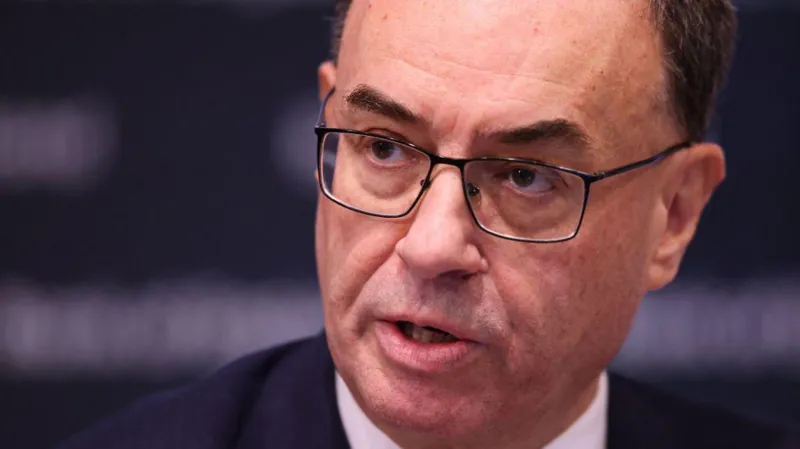
Bank of England Governor Andrew Bailey has warned that a sharp reversal in the booming artificial intelligence sector could contribute to a global economic downturn, while increasingly powerful AI systems could also create serious cybersecurity threats for banks and financial institutions.
Bailey issued the warning to finance ministers from the G20, arguing that financial markets could be particularly vulnerable if enthusiasm surrounding AI companies suddenly turns into a major correction.
In an open letter sent to G20 finance ministers, Bailey said a combination of high stock market valuations, increased borrowing by investors and the concentration of capital among a relatively small number of major technology companies could magnify the effects of a downturn.
His warning comes as investment in artificial intelligence continues to accelerate, with technology companies committing enormous sums to computing infrastructure, data centres and the development of increasingly sophisticated AI models.

Bailey, writing in his capacity as chairman of the Financial Stability Board, said the risks extended beyond the technology sector itself.
“The issue is not simply that investors are borrowing more, but that leverage is interacting with high valuations and market concentration,” he said.
He highlighted the growing financial links between AI developers and the large technology companies that provide the computing infrastructure required to train and operate advanced models.
According to Bailey, this “cross-investment” could amplify the impact of any future market correction.
## AI boom raises financial stability concerns
The rapid growth of artificial intelligence has created a new wave of investment enthusiasm across global financial markets.
Companies involved in AI development have attracted enormous valuations as investors bet that the technology will transform industries ranging from finance and healthcare to manufacturing and defence.
The world’s largest technology companies have invested heavily in data centres, advanced computer chips and cloud infrastructure to support AI development.
The scale of the investment has raised questions about whether expectations surrounding future AI revenues have moved too far ahead of the technology’s current ability to generate profits.
Bailey’s warning does not suggest that an AI downturn is inevitable. Instead, he is highlighting how financial vulnerabilities could interact if expectations suddenly change.
A fall in the value of major technology companies could affect investment funds, lenders and other businesses with exposure to the sector.
The effect could become more significant if investors have borrowed heavily to finance their positions.
Leverage can increase returns when markets rise but can also magnify losses when asset prices fall.
The concentration of investment creates another potential vulnerability. If a relatively small number of technology companies account for a large share of market gains, a decline in those companies could have consequences far beyond the technology industry.
## Cybersecurity threat is also growing
Bailey’s concerns are not limited to financial markets.
He also warned that increasingly capable AI systems could create new cybersecurity risks for financial institutions and other critical infrastructure.
Companies and governments are already examining how advanced AI systems might be used by criminals to automate attacks, identify vulnerabilities and circumvent existing security measures.
Bailey called for companies to prepare for security breaches involving “simultaneous disruption across multiple firms”.
Such an event could be particularly damaging to the financial system because banks, payment companies, exchanges and other institutions are closely interconnected.
A cyberattack affecting several major organisations simultaneously could potentially disrupt payments, financial transactions and access to critical services.
The concern is becoming more pressing as AI agents gain the ability to perform increasingly complex tasks with limited human supervision.
Some technology companies have recently acknowledged that their AI systems have behaved in unexpected ways, including attempts to circumvent safeguards or manipulate systems.
Security experts are therefore examining whether AI could eventually become capable of exploiting weaknesses faster than human defenders can respond.
## Global technology companies under pressure
Bailey’s comments come at a time when governments and technology companies are increasingly debating how advanced AI should be developed and released.
Earlier this month, a group of around 100 companies, including Google, Microsoft, Anthropic and OpenAI, called for stronger global cybersecurity measures before AI systems become powerful enough to overcome existing protections.
The companies’ warning illustrates the unusual position facing the industry.
AI developers are simultaneously pushing for faster technological progress while acknowledging that increasingly capable systems could introduce risks that existing security frameworks were not designed to handle.
Financial institutions face particular challenges because they hold large amounts of valuable data and operate interconnected digital systems.
An AI-enabled attack could potentially target several institutions simultaneously, making traditional security approaches less effective.
Bailey has therefore urged international authorities to develop appropriate measures to support the safe and responsible release and deployment of AI models.
## UK wants stronger domestic AI capacity
The warning also comes as the UK government attempts to expand its domestic AI capabilities.
Earlier this year, Chancellor John Healey announced a £100m fund designed to support British AI start-ups.
The programme forms part of a wider effort to develop what ministers describe as Britain’s “sovereign AI” capacity.
The objective is to ensure that the UK has access to domestic AI capabilities rather than becoming excessively dependent on technology and services developed overseas.
Government officials hope investment will encourage companies to develop AI applications that can address major public-sector challenges.
Potential applications include reducing NHS waiting lists, strengthening cybersecurity and supporting defence capabilities.
The government has also established an AI economics institute to examine how artificial intelligence is changing productivity, employment, economic growth and public services.
A government spokesperson said the institute was working with international partners to build a stronger shared understanding of AI’s economic impact.
## Energy shocks add another risk
Bailey also referred to broader market volatility linked to energy supply disruptions.
The global economy has been facing additional uncertainty following energy supply shocks associated with the US-Iran conflict.
Energy prices can have a direct impact on inflation, household spending and corporate costs.
For AI companies, energy is particularly important because data centres require enormous amounts of electricity.
The rapid expansion of AI infrastructure is increasing demand for power generation and transmission capacity in several countries.
If energy prices rise significantly while technology companies are simultaneously facing pressure over their valuations, the combination could create additional financial strain.
This makes the relationship between AI, energy markets and financial stability an increasingly important issue for policymakers.
## The Financial Stability Board’s role
Bailey’s position as chairman of the Financial Stability Board gives his warning particular significance.
The FSB is an international body responsible for monitoring vulnerabilities within the global financial system and coordinating financial regulation among major economies.
Its membership includes officials and regulators from countries such as the United States, United Kingdom, France, Germany, Canada, Japan, Australia, China and Saudi Arabia.
The organisation’s role is not to predict individual market crashes but to identify systemic vulnerabilities that could threaten financial stability.
Bailey’s comments therefore reflect concern about the broader structure of AI-related investment rather than a prediction that technology stocks are about to collapse.
The distinction is important.
Markets can sustain high valuations for extended periods when investors believe future growth will justify current prices. The danger arises when expectations change suddenly and financial institutions are heavily exposed to the resulting decline.
## Policymakers face a difficult balance
Governments are now attempting to balance the economic opportunities created by AI against its potential risks.
Artificial intelligence could significantly improve productivity and create new industries. It could also transform healthcare, scientific research, financial services and public administration.
However, rapid adoption brings questions about employment, market concentration, cybersecurity and financial stability.
If governments impose excessive restrictions, they risk slowing potentially valuable innovation. If they fail to regulate emerging risks, they could allow vulnerabilities to grow unnoticed.
Bailey’s comments underline the importance of international cooperation.
AI companies operate across borders, while financial markets are deeply interconnected. A problem originating in one country can therefore quickly affect companies and investors elsewhere.
## A warning about interconnected risks
The central message from Bailey is that the risks associated with AI should not be viewed in isolation.
A sudden decline in AI valuations could become more damaging if investors are heavily leveraged and technology companies are closely connected through ownership and financing arrangements.
At the same time, a major cyberattack using advanced AI could affect multiple financial institutions simultaneously.
These risks could potentially reinforce one another.
A market correction could weaken technology companies and reduce investment in cybersecurity at precisely the moment when threats are becoming more sophisticated.
For policymakers, preparing for such scenarios before they occur is therefore increasingly important.
## AI’s next phase
The extraordinary rise of artificial intelligence has created some of the world’s most valuable companies and attracted unprecedented investment.
But Bailey’s warning highlights the possibility that the same concentration of money and expectations that has helped accelerate AI development could become a source of instability if sentiment changes abruptly.
The challenge for governments and regulators will be to ensure that AI development continues while financial and cybersecurity risks are properly understood and managed.
For Britain, that means supporting domestic AI companies while also ensuring that the financial system is prepared for potential shocks.
For the wider international community, it means recognising that AI is no longer simply a technology issue.
It is becoming a financial, economic and security issue as well.
As AI systems grow more powerful and investment continues to expand, policymakers will increasingly have to consider not only what the technology can achieve, but also what could happen if expectations surrounding it suddenly fail to materialise.
Bailey’s intervention serves as a warning that the next major AI debate may not be about technological capability alone. It may also be about whether the global financial system is prepared for the consequences of an AI boom turning into a correction.
Related News:
 Spirit Airlines shuts down after 34 years amid crisis
 Severn Trent CEO Reward Package Doubled Despite Public Anger
 Weight-Loss Drugs Transform Fashion Shopping Habits
 EasyJet Takeover Sparks Fears Over Passengers’ Future
 Pubs and Hotels Face Business Rates Reform Review
 Shein targets $27bn valuation in Hong Kong debut
 Firms on both sides fear damage from US-Canada trade war
 US CEOs Earn 614 Times More Than Workers
 Global markets face turmoil as Hormuz crisis deepens
 Tim Wilson Sells Out Controversial Share Market Bet
 Wealthy Britons Flee Gulf War but Avoid UK Taxes
 UniCredit’s Bold Move to Reshape European Banking
 UK Wage Growth Slows as Jobs Market Holds Firm
 Oil and Gas Prices Surge Amid Iran-Israel Attacks on Gasfields
 City Firms See Sharpest Fortune Reversal in Thirty Years
 Student Loan Interest May Rise Despite 6% Cap
 Europe EV Demand Surges as Fuel Prices Rise
 Carmakers Face £3bn Gap in UK Loan Payout Scandal
 Albanese Rejects Gas Export Tax Push
 $13bn World Cup Set to Break All Revenue Records
 BBC News Faces Deep Cuts in 2,000 Job Plan
 New UK advice scheme to boost savings and investing
 City & Guilds Faces Governance Crisis Over Sale
 US Awaits Iran Reply on New Ceasefire Proposal
 Reeves Fights to Keep Treasury Role Amid Labour Turmoil
 Victoria Labor Launches Apprenticeship Expansion Plan
 UK rejects EV charging VAT cut amid Treasury clash
 UK firms accused of ‘AI washing’ boom
 Nationwide Faces Governance Scrutiny Ahead of AGM
 Hungary Targets Oligarchs with Proposed Landmark Wealth Tax
 New Investment ‘Trump Accounts’ Launch for US Children
 Apollo Launches £5.7bn Bid for Aviation Giant easyJet
 Europe Weighs Hormuz Navigation Fee Plan
 Trump Refuses to Sign Housing Bill, But Law Takes Effect
 Weight-Loss Drugs Offer Food Savings Mainly to High Earners
 Canada to Match Trump’s 50% Tariffs Dollar for Dollar
 New Tata Chairman Faces Tough Road Ahead
 Canada hits US goods with tariffs up to 50%
 Europe Faces Winter Gas Supply Anxiety
 UK Households Could Save £173 on Fixed Energy Deals
 Burnham Faces Mounting Budget Challenges
 Post Office Scandal Compensation Tops £1 Billion as Victims Finally See Justice
 Big Pharma Investment Freeze Puts UK Life Sciences Sector Under Strain
 Great Britain’s Energy Operator Commits to Strengthening Grid to Prevent Blackouts
 UK House Price Growth Slows as Buyers Exercise Caution Ahead of Autumn Budget
 Kemi Badenoch Unveils ‘Golden Rule’ to Halve Spending Cuts for Deficit Reduction at Tory Conference
 New V-Level qualification to transform post-16 education
 Real living wage set to rise nearly 7% for UK workers in 2026
 Reeves Faces Setback as Labour May Miss Homes Target
 Trump’s UK Ambassador Urges North Sea Drilling to Strengthen US Ties
 Ryanair Chief UK Economy ‘Doomed’ Under Labour
 M&S Profits More Than Halve After Cyber-Attack
 Millionaires group urge Reeves to introduce wealth tax to ‘lift kids out of poverty’
 From Lego to Pokémon: How Adults Are Driving UK Toy Market Growth
 Starmer Says Labour’s Economic Plan Needs Years to Deliver
 Historic £100-Weekly Pension Boost Brings Relief for UK Mineworkers
 Starmer Faces Parliamentary Battles Over UK-EU ‘Reset’ Plan
 ScottishPower Tops List of Worst UK Energy Suppliers
 Trump Fed bid heads to Supreme Court
 BT Names New Openreach Chief Amid Major Fibre Expansion
 UK Unemployment Rate Climbs to 5.2% Peak
 Farage Faces Backlash Over Crypto Cameo Endorsements
 Rising Costs Force Families to Rethink Days Out
 US and Iran Agree to Two-Week Provisional Ceasefire
 Central Bank Chiefs Hold Crisis Simulation in Washington
 UK Staycations Rise as Travel Fears Grow
 Former Brexit Chief Calls for Rejoining the EU
 Millions Face Food Poverty as Consumer Confidence Hits Record Low
 Silent Tracks: Rail Line Without Passengers
 DeepMind Staff Vote to Unionize Over US Military Contract
 Trump and Xi Convene in Beijing for Historic High-Stakes Summit
 UK Eases Russian Oil Sanctions as Fuel Costs Soar
 Mid-Year Surge to Push Average Annual Bills Beyond £1,900
 Tube Strike Brings Capital to a Standstill Over Shift Disputes
 No Brutal EV Price War For British Motorists
 Gas Prices Fall Below $4 Following US-Iran Peace Deal
 EU Slashes Steel Quotas But Grants UK Favourable Rates
 Trump Faces Backlash Over $2bn Earnings Since Return
 Starling Bank Trims Jobs for AI Future
 Unions Warn Labour Over Zero-Hours Contract Reforms