Published: 17 September 2026. The English Chronicle Desk. The English Chronicle Online
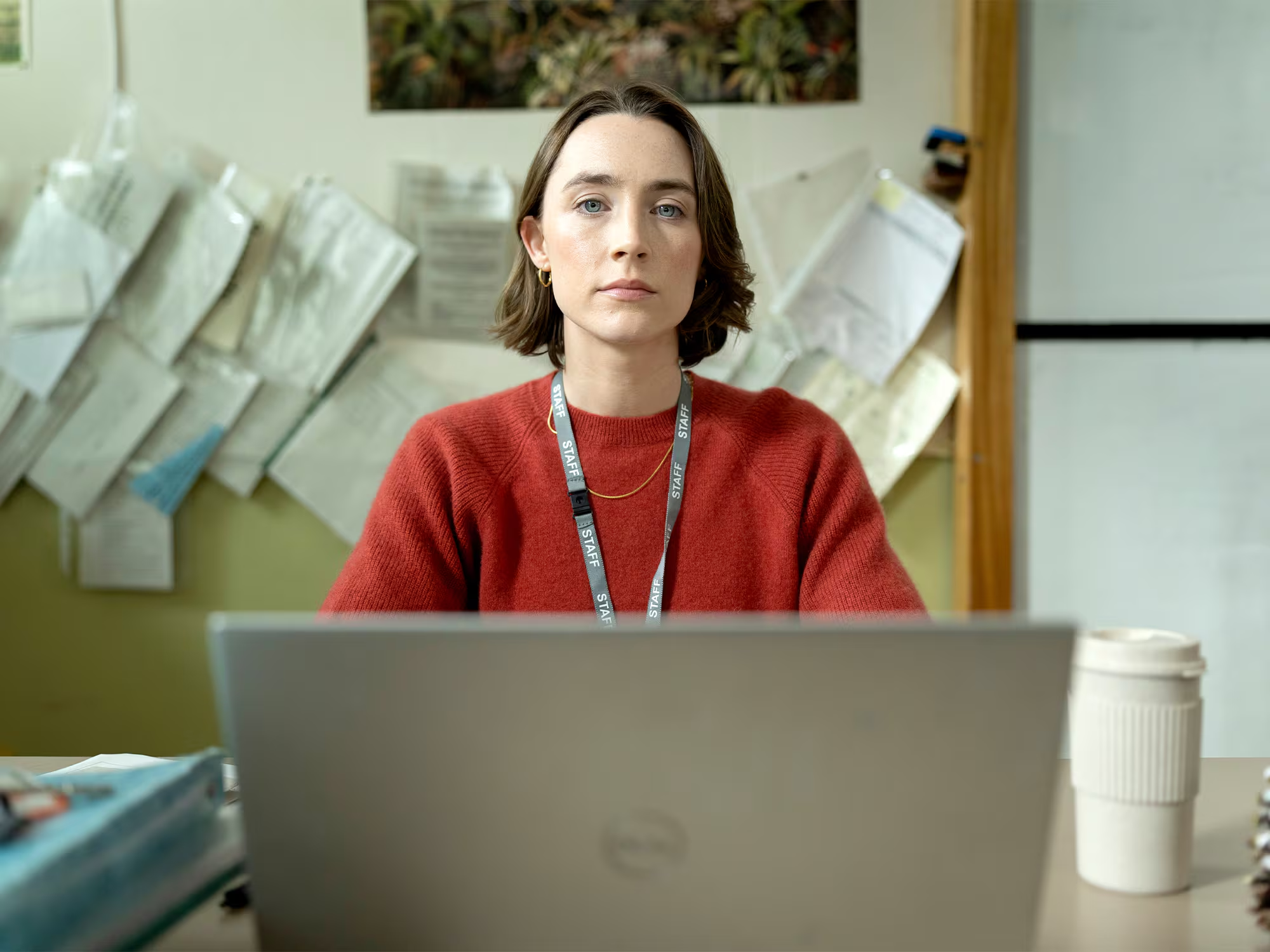
Saoirse Ronan takes centre stage in Bad Apples, a dark school-based satire that combines elements of psychological horror, social commentary and black comedy. Directed by Jonatan Etzler and adapted with co-writer Jess O’Kane from Swedish author Rasmus Lindgren’s novel De Oönskade, the film places an apparently ordinary primary-school teacher in an increasingly disturbing situation.
Ronan plays Maria, an idealistic and hardworking teacher at a primary school in the English West Country. She is committed to her pupils and appears determined to create a positive classroom environment. That stability is disrupted by Danny, a seriously disruptive pupil whose behaviour creates repeated difficulties for Maria and the rest of the class.
The film’s central premise develops from the conflict between Maria’s professional responsibilities and her growing frustration with Danny. After an incident at the boy’s home leaves him unconscious, Maria panics and makes the extraordinary decision to take him to her own house and confine him in the basement.
From that point, Bad Apples transforms from a school drama into an unsettling black comedy about what happens when an apparently respectable person decides that conventional systems are no longer working. Maria’s actions are deliberately presented as morally disturbing, while the film simultaneously explores the temptation to remove a difficult problem rather than confront its underlying causes.

The result is intended to create an uncomfortable mixture of humour and horror. However, the film’s effectiveness depends heavily on whether audiences accept its deliberately exaggerated premise and the increasingly implausible circumstances surrounding Maria.
The classroom itself becomes the film’s most important contrast. With Danny no longer disrupting proceedings, the other children begin to flourish. Maria’s teaching appears more successful, and she receives a highly favourable inspection report from Ofsted.
That development creates one of the film’s central satirical ideas. Maria is suddenly rewarded professionally after eliminating the source of the classroom disruption, even though the method she has used is profoundly unacceptable. The contrast allows the filmmakers to question whether institutions sometimes measure success through outcomes without fully confronting the circumstances that produced them.
The film therefore draws attention to difficult questions surrounding schools, classroom management and the pressures placed on teachers. Teachers can be expected to support children with challenging behaviour while also maintaining a productive environment for an entire class. Bad Apples pushes that conflict into an extreme fictional scenario.
The satire is deliberately uncomfortable because Maria is not initially presented as a conventional villain. She is portrayed as a teacher who wants her pupils to succeed and who appears frustrated by the limitations of the system around her. Her ordinary character is what makes the increasingly extraordinary decisions more unsettling.
Ronan’s performance is central to that effect. The actor has built a reputation for taking on varied dramatic roles, and here she plays a character whose outward normality gradually becomes harder to reconcile with her actions. Rather than turning Maria into an exaggerated caricature, the performance keeps much of her behaviour grounded in the rhythms of an ordinary teacher’s life.
That approach creates both the film’s strength and one of its limitations. Because Maria remains relatively recognisable, the story avoids becoming a straightforward horror exercise. But the decision to keep her sympathetic also reduces some of the impact that the premise might otherwise have.
The film belongs to a small group of unsettling stories built around captivity and the hidden abuse of power. Earlier films in this broad area have often relied on sustained psychological intensity or deliberately extreme horror. Bad Apples, by contrast, tries to combine disturbing material with satire.
Its central question is not simply whether Maria’s actions are wrong. That is obvious within the film’s moral framework. The more complicated question is what the situation says about the desire to solve social problems by removing people who are considered disruptive or inconvenient.
The title itself points towards that idea. “Bad apples” is a familiar expression for individuals perceived to cause problems within an otherwise functioning group. By applying that concept to a classroom, the film plays with the notion that removing one supposedly problematic individual can make everything else appear better.
But the metaphor becomes increasingly difficult to sustain as the story progresses. The practical details of Maria’s secret confinement raise questions about how the situation could continue without detection. The film asks viewers to accept circumstances that would ordinarily create immediate logistical and social consequences.
That suspension of disbelief may be acceptable in a heightened satire, but the film has to provide enough humour or dramatic intensity to make the exaggeration convincing. Critics have argued that Bad Apples does not always achieve that balance.
The problem becomes particularly pronounced in the later stages of the story. As the consequences of Maria’s decision become more significant, the film needs its satire to become sharper or its horror to become more intense. Instead, its deliberately restrained approach can make some developments feel laborious rather than shocking.
This is where Ronan’s performance becomes especially important. Even when the screenplay struggles to make its premise completely convincing, she gives Maria an emotional presence that keeps the audience engaged. Her character remains watchable because the performance creates a tension between Maria’s ordinary professional identity and the extraordinary secret she is attempting to maintain.
Eddie Walker plays Danny, the pupil whose behaviour drives the story, while Nia Brown appears as Pauline, another child in Maria’s class. Pauline is portrayed as an academically successful pupil whom Maria privately finds irritating, adding another layer to the teacher’s complicated relationship with the children she is responsible for.
The supporting performances help establish the classroom dynamic that the film later turns upside down. Danny’s disruptive behaviour is not treated simply as a source of individual conflict; it becomes the catalyst for the wider question of how institutions respond to children whose behaviour is difficult to manage.
That makes the film potentially relevant beyond its horror premise. Beneath its exaggerated plot is an argument about educational systems, expectations of teachers and the pressure to demonstrate measurable improvement. The glowing inspection result following Danny’s disappearance is particularly pointed because it creates a deliberately uncomfortable connection between institutional success and the removal of a problem.
The film’s black humour depends on that contradiction. Yet its tone remains uncertain. At times it seems to want to be a social satire about education and institutional failure; at others it moves towards psychological horror. Neither mode is allowed to dominate completely.
That ambiguity may appeal to audiences who enjoy films that resist conventional genre boundaries. For viewers expecting a straightforward horror movie, however, the restrained approach could make the story feel less intense than its premise suggests.
The film’s Swedish literary origins also give the story a broader European context. The adaptation relocates the action to an English primary school, giving the story a recognisable British institutional setting through references to schools and Ofsted inspections.
That setting allows the filmmakers to examine familiar social structures while maintaining the heightened absurdity required by the story. The result is neither a conventional school drama nor a traditional horror film, but a deliberately uncomfortable hybrid.
There is also a wider question about responsibility running through the film. Maria initially sees herself as someone trying to protect her pupils and improve their education. Her decisions, however, gradually reveal how easily a desire for order can become an abuse of authority when normal safeguards are abandoned.
The film does not present that transformation as a straightforward justification for her behaviour. Instead, it places the audience inside an increasingly uncomfortable contradiction: the classroom appears to improve while the means by which that improvement has been achieved become progressively harder to defend.
That contradiction is where Bad Apples has its strongest satirical potential. It asks whether an institution can genuinely be considered successful if its apparent improvement depends on something being hidden from view.
Whether the film fully develops that idea is more debatable. Its premise is striking, but the narrative sometimes struggles to support the scale of the situation it creates. The balance between humour, horror and social criticism is similarly uneven.

Nevertheless, Ronan gives the film a strong central presence. Her performance ensures that Maria never becomes simply a collection of plot devices, and the character’s outward normality makes the story’s increasingly disturbing direction more effective.
Bad Apples ultimately presents an unusual take on the pressures of teaching, institutional expectations and the temptation to identify individuals as the source of wider problems. Its dark premise gives it plenty of room for satire, even if its execution does not always deliver the level of comedy or shock that such an extreme concept might promise.
The film is scheduled to arrive in UK and Irish cinemas on 18 September 2026, giving audiences an opportunity to judge for themselves how effectively Etzler’s adaptation balances its school drama, horror and black-comedy elements.
For all its narrative weaknesses, Bad Apples remains notable for putting Ronan at the centre of such an unconventional story. Her performance provides the film with much of its emotional and dramatic interest, while the unusual premise invites questions about education, authority and the consequences of treating difficult people as problems to be removed rather than individuals to be understood.
Related News:
 Whistler’s Mother and why its fame frustrated artist
 Yayoi Kusama, Iconic Polka Dot Artist, Dies at 97
 Susan Sarandon Says Palestine Stand Costs Roles
 Exhibition Revisits Life of 18th-Century Black Court Figure
 Harry and Meghan’s Australia Visit Sparks Debate
 Disneyland Adds Facial Recognition at Entrances
 Sycamore Gap Artwork Chosen After Public Vote
 Cannes filmmakers split over AI’s role in cinema
 The Obamalisk: Inside the Controversial $850m Presidential Center
 Dreyfus Statue Finally Gets Permanent Paris Home
 Can Anyone Replace Graham Norton? Chat Show Challenge
 Is This the End of Harry and Meghan’s US Dream?
 Indian Jewellery Ad Pulled After Backlash Over Outfit
 British Museum Faces Questions Over Peter Thiel’s Private Bayeux Viewing
 Practical Magic 2: Why Fans Want Simpler Times
 English Heritage Revives Traditional Scything Skills
 Ozzy Osbourne: The Prince of Darkness Bows Out, Leaving Behind a Legacy of Metal and Myth
 Unseen Killers of the Deep Inside the UK Lab Uncovering the Silent Deaths of Sea Creatures
 Gen Z Embraces the Big, Bold ‘Fake’ Indian Wedding Party Trend
 My Husband Won’t Stop Playing with Lego and It’s Driving Me Nuts
 Sean Hayes Reimagined: From Sitcom Stardom to Serious Stage Acclaim
 Russell T Davies Warns of Declining UK Gay Rights Amid Rise of Reform UK and Trump Influence
 Terence Stamp, ’60s British Film Legend and Star of Superman, Dies at 87
 September’s Must-See Films: From Spinal Tap II to Leonardo DiCaprio’s Latest Thriller
 Watchdog, Cornflakes and Courage: Remembering John Stapleton, a Broadcaster Who Did It All
 Beloved Actress Dame Patricia Routledge Dies Aged 96
 Karen Carney Shines on Strictly Come Dancing Week Two Despite Tango Wobbles
 Jilly Cooper: The Bonkbuster Queen Who Redefined Romantic Fiction
 Paedophile Singer Ian Watkins Dies After Prison Attack
 Strictly Celebs Starstruck as Cynthia Erivo Shines
 Man Charged Over 2020 Death of Tattoo Artist Georgina Ward
 Kate Winslet to Narrate Film Highlighting King’s Environmental Mission
 I’m a Celebrity 2025 line-up revealed: Osbourne joins
 From Lego to Pokémon: How Adults Are Driving UK Toy Market Growth
 Pokémon to open world’s first theme park in Japan next year
 SS Rajamouli Announces ‘Varanasi,’ a Mythic Time-Travel Epic
 Eminem Takes Legal Aim at Australian ‘Swim Shady’ Brand
 Director Michael Caton-Jones Reflects on Career and Beginnings
 Rusty Bond-Era Aston Martin Restored to £1m Glory
 Pavarotti statue frozen in Italian ice rink sparks backlash
 John Lithgow criticises Rowling stance in trans debate
 Draco Malfoy Emerges as Lunar New Year Icon in China
 Top 10 Must-See Films Arriving This February
 Rising Costs Force Families to Rethink Days Out
 Ticketmaster Fees Rise Despite Recent US Junk Fee Crackdown
 Scott Mills Sacked by BBC Over Personal Conduct Claims
 Army Probes Apache Flyover at Kid Rock’s Nashville Estate
 M&S Demands Urgent Action on Rising Violent Retail Crime
 Unveiling Hidden Masters: Female Artists Take Centre Stage
 Stephen Fry Sues Tech Organisers For £100k Following Stage Fall
 Greens Face Internal Row Over Antisemitism Claims
 The Burning Lens: An Iranian Artist’s Visual Resistance
 Barrister Criticises Trial After Suicide Case Verdict
 Pope Meets Families in Italy Toxic Waste Zone
 Farage and Reform UK Reshape British Politics
 Starmer Leadership Under Pressure After Setbacks
 Saving the Scalloped Hammerhead: The Pacific Battle
 BBC Faces Backlash Over Ashley Cain Vetting Failures
 Trump’s Mount Rushmore Speech: A Divisive Anniversary
 British Teens in EU Face Soaring UK University Fees
 Rotterdam Museum Honours Artist With Peanut Butter Floor
 England and Norway Fans Turn Miami Into World Cup Carnival
 UK Schools Struggle as Classrooms Top 40C
 Sydney Arts Venue Faces Eviction After Religious Protests
 Olympus Awaits Unesco Heritage Recognition
 Westminster Council Threatens Charing Cross Soup Kitchen
 Burnham unveils £65m drought aid for farmers
 Gen Z turns to BirdTok for a gentler digital escape
 Queue row erupts on Wales’ highest mountain
 Ghent Professors Questioned Cofnas Appointment
 RAF Barnham Protests Fuel Tensions in Norfolk Town
 # How to Beat the Back-to-Work Blues After Summer
 Bayeux Tapestry Revives Franco-British Ties
 Man Arrested in Mississippi Woman’s Death
 UK Retailers Accused of Breaking Refund Laws
 UK Pay Growth Slows to 3.9% as Rate Decision Nears
 UK Heatwaves Set to Worsen Pothole Damage, RAC Warns
 Mayors Could Gain Greater Powers Over Water Firms
 Entain Plans 400 Job Cuts After Profit Update
 Turkey LGBTQ Crackdown Expands With New Arrests