Published: 21 September 2026. The English Chronicle Desk. The English Chronicle Online.
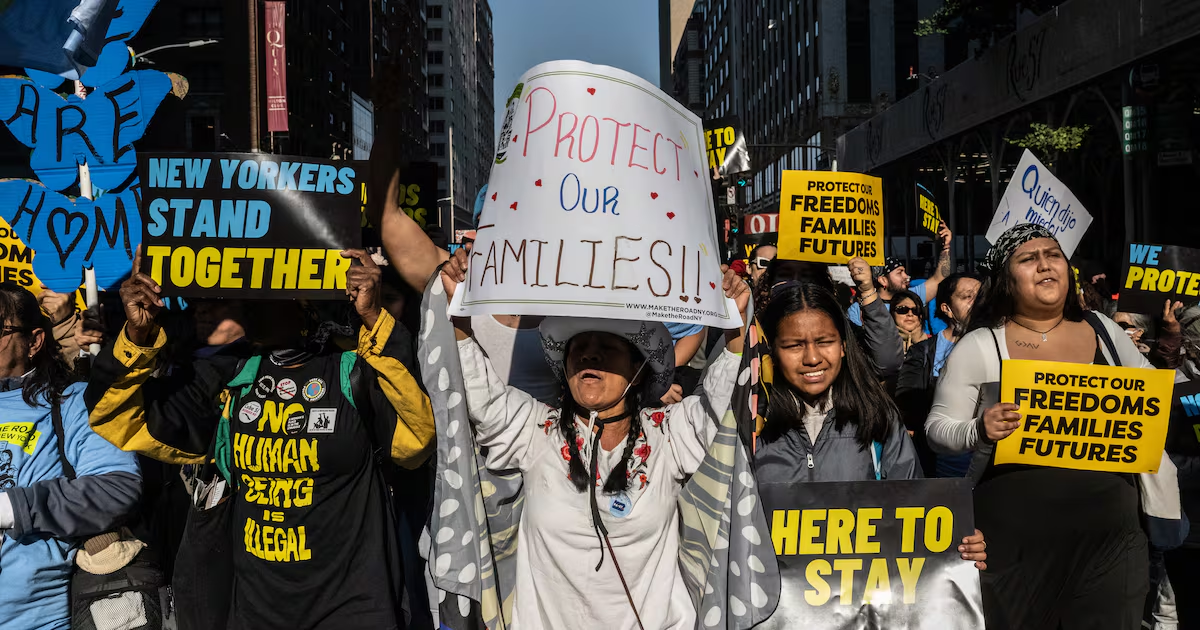
The United States has expanded a system under which migrants are deported to countries other than their countries of origin, with thousands of people sent to nations with which they have little or no previous connection. The policy has generated legal challenges, concerns from immigration lawyers and questions about the agreements and financial arrangements used to facilitate the removals.
An international investigation involving multiple media organisations has tracked more than 100 deportation flights involving 28 countries. The investigation found that more than 25,000 people have been sent to third countries under arrangements developed during Donald Trump’s second administration. The broader network involves agreements with dozens of governments and has particularly affected countries in Africa, Latin America and the Caribbean.
The policy is designed to address cases in which the United States cannot or does not immediately return a person to their country of origin. Some migrants have final removal orders but are protected from being returned to countries where they could face persecution or other serious harm. Others cannot be repatriated because their home governments do not accept them.
Under the third-country arrangements, those individuals can instead be transported to another country that has agreed to receive them.

The practice has become one of the most consequential elements of the Trump administration’s immigration enforcement strategy. The administration has defended the policy as part of its effort to remove people who do not have a legal right to remain in the United States and strengthen border enforcement.
A recent ruling by the US Court of Appeals for the First Circuit has nevertheless placed significant legal limits on the way such removals can be carried out. The court found that migrants must receive a meaningful opportunity to challenge a decision to send them to a third country when they have concerns about persecution or torture.
The ruling largely upheld an earlier decision by a federal judge in Boston, who found the administration’s rapid third-country removal policy unlawful. The appeals court questioned whether people could meaningfully contest a deportation if they were not given sufficient information about where they were being sent.
The administration is expected to continue its legal challenge, meaning the future of the policy remains subject to further court proceedings.
The legal dispute is particularly significant because many of the people involved have already spent months or years navigating the US immigration system. Some have established families and communities in the United States, while others have received specific legal protections preventing their return to their home countries.
One case highlighted by the investigation involves Nika, an Iranian woman whose name was changed to protect her relatives. She had fled Iran after participating in protests and spent more than a year in US immigration detention.
An immigration judge granted her withholding of removal, a form of protection available to people who may face serious harm if returned to their country of origin. She was subsequently released and became eligible to work in the United States.
According to the investigation, Nika was later rearrested during what her lawyer described as a routine immigration check-in. She was subsequently placed on a deportation flight and transported to the Central African Republic.
Her lawyer, Sahar Jalili, said she had attempted to prevent the deportation and argued that more time was needed to challenge the decision. By the time lawyers became aware of Nika’s specific situation, the flight had already departed.
Nika said passengers were not initially told where they were going. During the journey, they learned that their destination was the Central African Republic, a country with which most of them had no connection.
After arriving in Bangui, Nika was taken to accommodation arranged for deported migrants. She later became ill and was diagnosed with malaria. She also said she had difficulties moving around because she lacked a passport and other identification documents.
Her case illustrates one of the central issues surrounding the third-country system: whether a person who is legally protected from removal to their country of origin can nonetheless be transferred to a distant country without having adequate time to challenge that destination.
The administration has argued that third-country removals are necessary in cases involving people who cannot be returned directly to their home countries. Officials have also described immigration enforcement and border security as major priorities.
However, the investigation found that the people sent under these arrangements do not form a single category. Some have criminal records, while others do not. Some have spent most of their lives in the United States, and some had previously received protection from removal to their home countries.
The agreements themselves also vary considerably.
According to documents reviewed by journalists involved in the investigation, the United States has committed or pledged hundreds of millions of dollars connected to third-country arrangements. The Washington Post reported that at least $410m had been authorised or pledged for agreements involving dozens of countries, primarily in Africa and Latin America.
The arrangements can include financial support for governments or international organisations operating in receiving countries. In some cases, funding is connected to broader programmes rather than being presented solely as payment for accepting deportees.
Cameroon, for example, was reportedly offered support for United Nations operations in exchange for accepting migrants. The Democratic Republic of the Congo was also promised financial assistance under an arrangement involving deportees.
The number of people actually transferred under individual agreements has sometimes been substantially lower than the maximum numbers contemplated in the arrangements.
The countries involved have also established different conditions regarding who they will accept. Some agreements are limited by nationality, while others contain restrictions concerning criminal records or particular categories of offences.
Ghana, for example, has reportedly agreed to accept people from West African countries. Other countries have accepted migrants from a wider range of nationalities.
This variation has created uncertainty for immigration lawyers, particularly when their clients are told that they may be transferred to countries where they have no family, employment history or cultural connection.
Another case highlighted by the investigation concerns Rabbiatu Kuyateh, a Sierra Leonean-born woman who spent most of her life in the United States. She worked as a nurse and cared for vulnerable people, including patients during the coronavirus pandemic.
Kuyateh was transferred from the United States to Ghana before being sent onward to Sierra Leone. Her family said the removal separated her from relatives in the United States, including elderly parents who depended on her support.
Her case has also drawn attention to what can happen after migrants arrive in an intermediate country. Some people transferred under third-country arrangements have subsequently been sent to their countries of origin, despite having previously argued that returning there would expose them to danger.
Human rights lawyers have raised concerns that third-country transfers could therefore function as an indirect route around protections that prevent direct removal.
The US government’s position is that people without a legal right to remain can be removed using lawful procedures. A State Department spokesperson said implementing the administration’s immigration policies was a priority and that the government would use legal means to remove people who have no right to remain.
The recent appeals court ruling, however, emphasises that the process used to determine the destination also matters. Migrants must have an opportunity to raise safety concerns before being transferred to a third country.
The ruling could have significant consequences for future deportation flights. It does not necessarily prevent all third-country removals, but it requires the government to follow appropriate procedures and provide sufficient opportunity for affected individuals to challenge the destination.
The policy has also placed international organisations in a complicated position. The International Organization for Migration has provided accommodation, transportation, food and other assistance to some migrants after their arrival in receiving countries.
US funding for migration programmes has increasingly been directed towards countries participating in third-country arrangements. The organisation has said its involvement is guided by its mandate and by an assessment of whether its engagement can improve conditions for migrants.
The role of international agencies has nevertheless attracted criticism from immigration lawyers and human rights advocates who argue that providing assistance after deportation can make international organisations part of a system they believe places vulnerable people at risk.
For migrants themselves, the consequences can be profound. People who spent years building lives in the United States may suddenly find themselves in countries where they have no established support network, do not speak the local language and may face difficulties obtaining employment or healthcare.
The investigation also found that some people transferred through the system subsequently lived in fear after being returned to their countries of origin. Others described prolonged uncertainty about where they would ultimately be allowed to remain.
For immigration lawyers, the increasing number of cases has created a growing workload. Attorneys say they often have very little time to identify a planned deportation, obtain information from immigration authorities and seek judicial intervention.

The recent court ruling has therefore become an important development in the wider dispute. It places procedural protections at the centre of the debate over third-country removals and could require the administration to provide more meaningful opportunities for migrants to contest proposed destinations.
The Trump administration’s broader immigration programme remains focused on increasing removals and reducing unauthorised migration. Third-country agreements have become one mechanism for pursuing that objective when direct repatriation is difficult or legally restricted.
The future of the policy will now depend partly on further court proceedings and the administration’s response to the appeals court decision. It will also depend on whether countries continue agreeing to receive migrants from the United States and under what conditions.
The cases of people such as Nika and Kuyateh demonstrate the human consequences of decisions made through diplomatic agreements and immigration procedures. Their experiences also show why questions about notice, legal protection and conditions in receiving countries have become central to the continuing debate.
As the United States expands its network of third-country arrangements, the policy is likely to remain under scrutiny from courts, lawyers, governments and international organisations. The central issue is increasingly not only how many people the government can remove, but also the legal process through which their destination is determined and the protections available to them before they are placed on a plane.
Related News:
 US states redraw maps after voting rights ruling
 Immigration Judges Fear Pressure in Trump Era
 Judge Allows Pentagon Firings at Stars and Stripes
 New Mexico Takes Facebook to Trial Over Data Scandal
 Trump Media Ban Triggers First Amendment Clash
 US National Guard Member Killed in DC Shooting
 Trump to pause migration from ‘third-world countries’
 Franklin Turtle, Sabrina Carpenter Slam US Social Media Use
 Trump officials continue false claims after Alex Pretti shooting
 Partial US Government Shutdown Hits Homeland Security Funding
 Thousands Protest ICE Operations in Nationwide US Day of Action
 Swalwell Faces Pressure to Quit Governor Race
 Harmeet Dhillon Faces Scrutiny in DOJ Role Debate
 Trump at Press Dinner Sparks Tension
 Judge Blocks Trump Bid for Arizona Voter Data
 US Court Weighs Fate of TPS for Migrants
 Florida Redistricting Map Sparks Major US Political Battle
 US Voting Rights Ruling Sparks Celebration and Outcry
 FBI Links Brown University Shooting to Long-Term Grievances
 US Charges Sinaloa Governor in Major Cartel Case
 US Court Ruling Reshapes Voting Rights Landscape
 Cartel crackdown raises fears of fresh violence
 Judge halts deportation of Yemeni refugees in US
 White House Security Case Sparks Political Firestorm
 Trump warns Iran as Middle East tensions surge again
 US Supreme Court fast-tracks Voting Rights ruling
 US ‘Narco Boat’ Strikes Draw Global Outcry
 US Court Restores Abortion Pill Access Temporarily
 Florida Surgeon ‘Devastated’ Over Fatal Surgery Error
 FDA Chaos Deepens as Trump Eyes Makary Exit
 US judge dismisses Kilmar Abrego Garcia indictment
 US green card applicants must apply from abroad, DHS says
 Tulsi Gabbard exits after turbulent intelligence tenure
 Trump’s Revenge Drive Deepens GOP Divide
 Former ICC prosecutor condemns US sanctions
 Gunman Killed After White House Security Shootout
 Prosecutor Proposes Law to Combat Election Deceit
 Trump Weighs Retreat from Controversial $1.8bn Slush Fund
 Murder Probe Continues After Arrest Release
 Mystery Grows Over Mitch McConnell’s Health
 Trump Refuses to Sign Housing Bill, But Law Takes Effect
 Trump Orders Signs Criticising Smithsonian Museum
 Is America Ready for an AOC Presidential Run?
 Trump Calls Iran War ‘Small Potatoes’ Despite US Deaths
 Armed Suspect Attacks Ohio Governor Candidate
 Trump gives $45,000 holiday gifts to White House aides
 Experts Warn of Growing US Terrorism Risks 25 Years After 9/11
 Patriot Platform Raises Concern Across Britain
 Reform UK Receives Record £36m Donation From Crypto Billionaire
 Israel Accused of Undermining Palestinian Life
 Trump’s Washington Projects Face Architectural Criticism
 Election Candidate Abuse Raises Alarm in England
 UK Urged to Probe US Diplomat Case
 Texas Charges Seven Noncitizens in Voting Crackdown
 Omar Proposes Bill to Redirect ICE Funding
 Texas Transfers Raise Fears for Migrant Children
 Memphis Questions National Guard Crime Surge
 ICE Shooting in Austin Sparks Calls for Transparency
 French Taxi Driver Cleared in David Lammy Theft Case After Fare Dispute
 Major Rent Reform Ends No-Fault Evictions in England
 ICC to Rule on Duterte’s Provisional Release
 Australia grants Asio powers to designate hate groups under new laws
 Trump press secretary attacks reporter over ICE question
 Trump Fed bid heads to Supreme Court
 Sinema payment row deepens after $9,000 transfer claim
 Nurses’ families fear breakup under UK immigration crackdown
 Adelaide University Faces Backlash Over Event Cancellation
 Proposed Law Leaves Gap for Children of Convicted Paedophiles
 Trump Signals Hope for New Iran Talks as Ceasefire Fades
 Ben Roberts-Smith Denies War Crime Allegations in First Statement
 UK Stands Firm on Falklands Amid US Rift
 Investigation Into Anti-Trump Motives After Gala Shooting
 Trump orders US troop pullout from Germany
 Barrister Criticises Trial After Suicide Case Verdict
 Kevin Warsh sworn in as Fed chair amid economic backlash
 AOC Backs El-Sayed in Tight Michigan Senate Primary
 New Footage Revives Peter Falconio Mystery
 Unions Warn Labour Over Zero-Hours Contract Reforms
 Man Arrested in Mississippi Woman’s Death
 US Sanctions Open New Battle for Cuba Assets